TL;DR: Student driver accidents during a lesson can create liability beyond the person behind the wheel. If a student driver crashes into you, the instructor, driving school, vehicle owner, or a parent of a minor may also share fault, which can affect insurance coverage and compensation, and California generally gives you 2 years to file a personal injury lawsuit.
Highlights:
- Identify whether the lesson used a school car or a private car.
- Get the instructor’s name, school name, and vehicle owner details.
- Photograph the vehicles, road conditions, and any training equipment.
- Ask whether the vehicle had an instructor brake and an extra mirror.
- Save lesson schedules, instructor logs, and school records if available.
- File an SR-1 within 10 days if California law requires it.
- Track medical bills, missed work, and other crash-related losses.
Tip: Gather names, photos, and insurance details early, and stick to facts when speaking with insurers or reporting the crash.
Table of Contents
If a student driver crashes into you during a lesson, you may have a claim against more than just the person behind the wheel. Depending on how the crash occurred, the case may involve the student driver, the driving instructor, the driving school, the vehicle owner, or a parent or guardian if the student is a minor. These cases often become more complicated than a typical two-car accident because liability and insurance may extend beyond the student driver alone.
These claims usually turn on negligence, meaning whether the student driver, instructor, driving school, vehicle owner, or another party failed to use reasonable care and caused injury to a driver, passenger, pedestrian, bicyclist, motorcyclist, or another affected person.
Your case will usually start as an insurance claim. From there, the main questions become who caused the crash, who had a duty to supervise the lesson, what insurance policy applies, and how much your injuries and other losses are worth. If you were a driver, confirm whether you need to file an SR-1 within 10 days.
Things To Expect After Being Hit By A Student Driver
If a student driver crashes into you during a lesson, the case is usually handled as an insurance claim first. However, unlike a typical car accident, this type of crash may involve multiple liable parties and multiple insurance policies.
The student driver may have caused the collision, but the driving instructor, driving school, vehicle owner, or a parent or guardian may also become part of the case, depending on the facts.
If you are involved in a car collision with a student driver, here are some things to consider:
 The Case Often Expands Beyond the Student Driver: Many people assume the case begins and ends with the student driver. That is not always true. A lesson crash may raise questions about whether the instructor provided proper supervision, whether the school used safe training practices, and whether another party had legal responsibility for the vehicle or the driver. That broader review can affect both liability and available insurance coverage.
- The Value of the Claim Depends on the Injuries and Losses: Once the parties identify who may be responsible, the process moves to calculating damages. That usually includes medical bills, future treatment, lost income, reduced earning ability, pain and suffering, and other losses tied to the crash.
If the injuries are serious, the case may require a closer review of long-term care needs, work limitations, and how the injuries affect daily life.
- The Insurance Company May Try to Limit Payout: Even when fault seems clear, the insurance company may still challenge the claim. It may be argued that the injuries were minor, that some treatment was not necessary, or that another party caused part of the crash. In California, comparative fault can reduce the amount recovered if the injured person shares part of the blame. That is one reason these cases often become more contested when the injuries are significant.
- Settlement Talks Usually Come Before a Lawsuit: Most cases begin with insurance negotiations. The claim may settle once the evidence shows who was at fault and the extent of the injuries.
If the insurance company refuses to offer fair compensation, the injured person may file a lawsuit. At that point, the case may move into formal litigation, where both sides exchange evidence and continue negotiating or prepare for trial.
- A Lawyer Can Help Identify Every Liable Party and Source of Coverage: A lawyer can help determine whether the case involves only the student driver or whether the instructor, school, vehicle owner, or another party also shares liability.
That matters because a broader investigation may uncover additional insurance coverage and strengthen the claim. In a lesson-crash case, that extra layer of review often makes a major difference.
 The Case Often Expands Beyond the Student Driver: Many people assume the case begins and ends with the student driver. That is not always true. A lesson crash may raise questions about whether the instructor provided proper supervision, whether the school used safe training practices, and whether another party had legal responsibility for the vehicle or the driver. That broader review can affect both liability and available insurance coverage.
If the accident leads to an injury, death, or property damage of over $1,000, you must file an SR-1 report within 10 days with the California Department of Motor Vehicles (DMV).
Why A Student Driver Lesson Crash Can Be More Complicated
A crash during a lesson can involve more people and more legal issues than a normal collision. In a regular accident, the focus often stays on the two drivers. Crash analysis may also include whether the instructor supervised the student properly, whether the school used a compliant training vehicle, and whether the student was practicing under the supervision California law requires.
The California DMV says training vehicles must be equipped with an instructor foot brake, an additional rearview mirror, and annual inspections, and must carry the required bodily injury and property damage liability insurance.
That is why one of the first questions after this kind of crash is simple: Was this a driving school vehicle or a private car?
California DMV says driving school training vehicles must be insured and equipped with an instructor’s foot brake and an additional rearview mirror. The supervision rules can also matter. California DMV says a permit holder must practice with a California-licensed driver seated close enough to take control of the vehicle if needed. That supervising driver must be at least 18 for adult permit holders and at least 25 for minors. If the student was not driving under proper supervision, that fact may affect liability and coverage.
Who Is Liable When A Student Driver Causes An Accident?
Insurers and courts look at who caused the crash when determining liability in California car accidents. As a result, a student driver, their instructor, or even their school can be responsible for the collision. However, a car accident with a student driver can involve several liable parties, including:
- The Student Driver: Student drivers still have a duty to use reasonable care. Being new to driving does not excuse careless conduct. If the student driver ran a light, turned unsafely, followed too closely, or made another driving mistake, they may be at fault.
- The Driving Instructor: A driving instructor may also be responsible if they failed to supervise the lesson properly. In some situations, the instructor may have had time to warn the student, correct the mistake, or use the instructor-side brake, but failed to do so. Whether that happened depends on the facts.
- The Driving School: A driving school may be responsible if the instructor was working within the scope of their job at the time of the crash. The school may also face liability for unsafe training practices, vehicle problems, or poor supervision.
- A Parent or Guardian: If the student driver is under 18, a parent or guardian who signed for the minor’s driving privilege may also be financially responsible. The California DMV states that parents or guardians assume financial responsibility for drivers younger than 18 and pay for damages if the minor is involved in a collision.
- The Vehicle Owner: If the lesson occurred in a private car, the owner’s insurance may also be relevant. In many cases, the first insurance question is tied to the vehicle that was actually being driven.
Who Pays If The Crash Happened In A Driving School Car Vs. A Private Car?
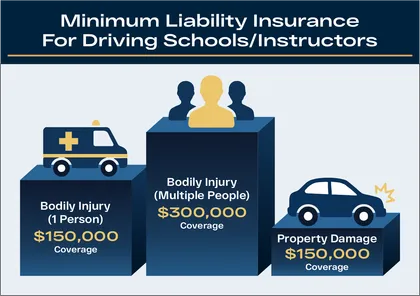
If the crash happened in a driving school car, the school’s commercial auto insurance may apply first. The Vehicle Code requires driving school owners and certain instructors to carry liability insurance on vehicles used in driving instruction.
That required coverage includes at least:
- $150,000 for bodily injury to or death of one person in any one accident.
- $300,000 for bodily injury to or death of two or more persons in any one accident.
- $50,000 for property damage in any one accident.
If the crash happened in a private car, the insurance on that vehicle may apply first, depending on the policy language and the facts of the collision. In some cases, additional policies may also come into play if the injuries are serious, the damages exceed one policy’s limits, or more than one party shares fault.
This distinction matters because it can affect the amount of coverage available and which insurer controls the claim. One of the first things your attorney will usually want to confirm is whether the student was learning in a school-owned vehicle or a privately owned one.
What Evidence Helps Prove Liability In A Student Driver Lesson Crash?
These cases often depend on details that do not arise in a typical accident claim. Strong evidence may include the police report, photos of the vehicles, photos or video of the road and surrounding conditions, witness statements, medical records, and repair estimates.
Student driver accident lawyers often review these records when assessing liability and available insurance coverage.
In a student driver lesson crash, it also helps to identify:
- The driving school.
- The instructor.
- The type of vehicle used for the lesson.
- Whether the vehicle had the required training equipment.
Other useful evidence may include:
- Lesson schedules
- Instructor logs
- School records
- Insurance information for the training vehicle
- Maintenance records
- Dashcam or surveillance footage.
These details can help show whether the instructor properly supervised the student, whether the school used a compliant training vehicle, and which insurance policy should cover the loss.
What Compensation Can You Seek After The Crash?
If the student driver or another responsible party caused the crash, you may be able to seek compensation for both financial and personal losses.
- Economic Damages: These are the losses you can usually measure with bills, receipts, or wage records, such as:
- Medical bills.
- Future medical care.
- Lost wages.
- Lost earning capacity.
- Vehicle repair or replacement costs.
- Out-of-pocket expenses tied to the crash.
- Non-Economic Damages: These cover losses that do not come with a fixed bill, such as:
- Pain and suffering
- Emotional distress
- Loss of enjoyment of life
- Scarring or disfigurement
What If The Insurance Company Says You Were Also At Fault?
California follows comparative fault rules. That means you can still recover damages even if you were partly at fault, but your share of responsibility may reduce your recovery.
California’s civil jury instructions direct juries to assign percentages of responsibility when an injured person’s own negligence contributed to the harm. Arash Law can evaluate the facts of the crash, challenge unfair blame-shifting, and argue that the other party bears full or greater responsibility.
For example, if your damages are $100,000 and you were found 20% at fault, you can only recover up to $80,000.
How Long Do You Have To File A Claim In California?
In California, you generally have two years to file a lawsuit for personal injuries caused by someone else’s wrongful act or neglect. Property-damage-only claims generally have a three-year deadline.
These deadlines can be shorter or more complicated in some situations, so do not assume you have plenty of time.
Questions People Ask After A Student Driver Crashes During A Lesson
If you were involved in a car accident with a student driver, you may have questions as to what comes next. You may have questions regarding insurance, liability, and the legal process. Here is a list of common concerns after these types of accidents.
Can I Sue A Driving Instructor Or Driving School After A Lesson Crash?
Yes, if the facts show their negligence contributed to the crash. That may happen if the instructor failed to supervise the student properly or if the school’s conduct played a role in what happened.
Are Driving Schools Required To Carry Insurance In California?
Yes. California DMV says training vehicles must be insured with the required bodily injury and property damage liability coverage.
What If The Student Driver Were A Minor?
That can affect both financial responsibility and the insurance investigation. The California DMV states that parents or guardians assume financial responsibility for drivers under 18.
How Can A Personal Injury Lawyer Help After Being Hit By A Student Driver?
Attorneys can investigate the collision and follow the legal process. Lawyers can determine potentially liable parties and review state laws governing parental liability. They can also help calculate your losses, negotiate with insurers, and file a civil case if necessary.
Get Legal Help If A Student Driver Crashes Into You
If a student driver is at fault in a California vehicle accident, multiple parties may share liability. Traffic law violations by student drivers may also result in the suspension of their permits. It’s normal to seek free advice from student driver accident lawyers after an accident.
AK Law’s dedicated team of attorneys is here to help you. We offer skilled legal representation to help you pursue financial compensation for your injuries and losses. Our accident attorneys work on a contingency fee basis. If you are asking, “Do lawyers only get paid if they win?” the answer at our firm is yes. Under contingency fees, our lawyers only charge legal fees if they win a case or secure a settlement.
If you or a loved one sustained an injury in an accident with a student driver, you may think, “I need a personal injury lawyer.” Our team is committed to helping clients pursue fair compensation for their losses. Call us at (888) 488-1391 or fill out our “Do I Have A Case?” form.