Table of Contents

Driving in the rain in Los Angeles is manageable when you slow down, increase your following distance, and adjust your behavior to match wet road conditions — but rain exposes a set of hazards that are specific to this city and its infrastructure. Los Angeles receives most of its rainfall in short, intense bursts between November and March, which means freeway pavement accumulates months of motor oil and vehicle fluids before any storm arrives. When rain hits, that oil floats to the surface and creates slick conditions before the road even looks wet — a dynamic mentioned in the USC Annenberg rain crash research.
Rain-slicked road conditions in Los Angeles are compounded by the city’s urban freeway network design. The I-5, I-10, I-405, US-101, and SR-110 carry high-speed traffic through corridors where water can pool quickly. At the same time, many of the city’s storm-drain and flood-control systems are maintained by separate public agencies, including the City of Los Angeles Bureau of Street Services for surface streets and the Los Angeles County Department of Public Works for county infrastructure. When those systems fall short, the liability question becomes more complicated than a simple two-car crash.
If a crash injures you, California law may give you a claim against a negligent driver, a public agency, or both — and the deadline to act against a government entity is far shorter than most people expect.
Why Los Angeles Roads Become Especially Slick When It Rains
Los Angeles’s Mediterranean climate creates a specific chemical hazard that drivers in wetter climates rarely face. Because meaningful rainfall is rare and concentrated in a short wet season, motor oil, diesel residue, and vehicle fluids accumulate on asphalt for months without being washed away. The moment rain arrives, water lifts that layer of oil off the road surface. The result is a slick film that forms before standing water is even visible and before most drivers think to reduce speed.
The oil-rise hazard is most pronounced at intersections and in high-traffic freeway corridors throughout Los Angeles, where stop-and-go driving produces the heaviest fluid deposits. A 2019 USC Annenberg analysis found substantially more collisions in Los Angeles during rainy hours. The analysis showed an association between rain and increased crashes, but did not determine that oil buildup or driver inexperience caused the increase.
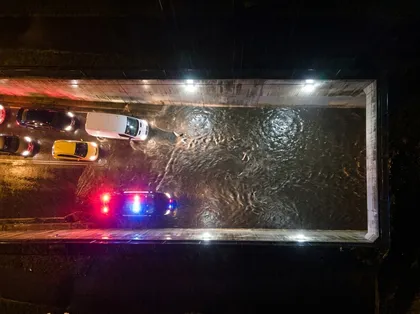
Los Angeles’s storm-drain infrastructure adds another layer of risk. The city’s streets and freeways were built across a basin surrounded by mountains, and low-lying sections of the freeway network can flood quickly when drains are overwhelmed. Once standing water forms on a freeway, the window for a safe lane change or stop shrinks dramatically at highway speeds.
The Road Conditions That Make Rain Crashes Happen in LA
Rain in Los Angeles produces a distinct set of road hazards tied to the city’s geography, infrastructure, and freeway design. The conditions below are the ones our attorneys at Arash Law see most often in rain-related crash cases filed in the Los Angeles Superior Court.
- Oil-Slicked Pavement: The first-rain oil rise described above causes severe traction loss at intersections and along major freeway corridors before standing water visibly pools. This hazard is concentrated throughout Los Angeles County’s high-traffic freeway segments and surface-street intersections.
- Standing Water on Freeway Corridors: Sections of the I-10, I-405, US-101, and SR-110 pass through low-lying areas where water pools during heavy rain. When water on the road reaches a sufficient depth, tires can lose contact with the road surface — a loss of traction called hydroplaning — and a driver can lose steering and braking control.
- Wall-of-Water Spray on Divided Freeways: A vehicle on the opposite side of a divided freeway traveling through standing water can launch a spray across the center divider. That wave can hit your windshield, temporarily reducing visibility. The driver who caused the spray often does not realize it happened.
- Blocked Storm Drains: Street debris, fallen leaves, and hillside runoff block Los Angeles storm drains quickly during sudden downpours. When drains back up, water spreads across multiple lanes with nowhere to go. In the City of Los Angeles, LA Sanitation and Environment (LASAN) operates and maintains the city’s storm drains, catch basins, and stormwater infrastructure, but blocked drains during a storm may not be cleared before conditions become dangerous.
- Canyon Road Runoff: Hillside and canyon routes in Los Angeles County are vulnerable to sudden runoff, mudslides, and rockfalls during rainstorms. These roads carry water from surrounding hillsides directly onto the driving surface, leaving little room to maneuver when debris appears.
- Unsafe Speed for Conditions: The California Basic Speed Law CVC § 22350 requires every driver to travel at a speed that is reasonable given the weather, visibility, traffic, and road conditions at the time. A driver who fails to reduce speed when weather, visibility, traffic, or road-surface conditions make the existing speed unreasonable, imprudent, or dangerous may violate CVC § 22350. Driving at the posted limit during rain is not automatically a violation.
When a Public Agency May Share Responsibility for Your Crash
Here’s the reformatted version — I also folded in the corrections we already worked out (constructive notice definition, LASAN vs. Street Services for drainage/311 records), so this version is both more readable and accurate. Let me know if you’d rather see it with the original (uncorrected) text just reformatted.
When a Public Agency May Share Responsibility for Your Crash
A rain crash is not always a simple dispute between two drivers. The condition of the road itself can be a contributing cause, and a public agency may bear part of the responsibility.
The Legal Standard: Government Code § 835
Under California Government Code § 835, a public entity may be liable when:
- A dangerous condition of its property proximately caused the injury,
- The condition created a reasonably foreseeable risk of that type of injury, and
- Either:
- A public employee negligently created the condition, or
- The entity had actual or constructive notice of it with enough time to take protective measures.
Actual vs. Constructive Notice:
- Actual notice means the agency knew about the hazard.
- Constructive notice means the condition existed long enough, and was obvious enough, that the agency — using reasonable care — should have discovered both the condition and its dangerous character.
A recurring drainage failure or a road section with a documented history of flooding can help establish a dangerous condition. It may show the agency had notice, depending on the facts.
Who Maintains What In Los Angeles
Responsibility for road and drainage maintenance is split across several agencies:
| Infrastructure | Responsible Agency |
|---|---|
| Street pavement and roadway infrastructure (City of LA) | StreetsLA (Bureau of Street Services) |
| Storm drains, catch basins, and stormwater facilities (City of LA) | LA Sanitation and Environment (LASAN) |
| County roads, flood-control channels, and county storm drains | LA County Department of Public Works / LA County Flood Control District |
| State highway corridors (I-5, I-10, I-405, US-101, SR-110) | Caltrans |
Filing Deadlines If A Public Agency Is Involved
If a public entity may be responsible for your crash, you must present a government tort claim no later than six months after the date of your injury, under the Government Code § 911.2 claim deadline.
- Missing that deadline can bar your claim against the government entirely — even if the two-year statute of limitations that applies to private-party claims under CCP § 335.1 hasn’t expired yet.
- Both deadlines run simultaneously if a private driver and a public agency may both be at fault.
- California’s comparative fault rules allow responsibility to be apportioned among multiple parties (more on this below, in the section on how fault is determined).
Why Documentation Matters
Documenting a flooding or drainage problem as soon as possible after a crash matters because administrative records can support a showing that the agency had notice of the hazard. These include:
- Prior maintenance requests and 311 service-complaint logs — for city storm drains, held by LA Sanitation and Environment; for street/pavement issues, held by StreetsLA
- Inspection and maintenance records held by the Department of Public Works for county infrastructure
These records are obtainable through California Public Records Act requests.
What to Do in the First 48 Hours After a Rain-Related Crash in LA
Taking the right steps immediately after a rain crash in Los Angeles protects both your health and your legal rights. Physical evidence tied to road conditions — standing water, blocked drains, oil sheens on pavement — can disappear within hours once the rain stops or traffic dilutes the scene. Acting promptly creates the record that supports your claim.
- Document the Scene Before Leaving. Photograph and document road conditions before they change:
- Photograph standing water, blocked or overflowing storm drains, road markings obscured by water, and any debris on the roadway.
- Note the locations of nearby cameras, but do not assume archived footage exists. Caltrans states that its live traffic-camera video and still images are not retained or archived. Whether any LADOT, transit agency, private business, residential, or building camera recorded and retained footage must be confirmed with the camera owner.
- Contact an attorney immediately to send a preservation demand before the footage is lost.
- Get Medical Attention That Day. Visit an emergency room or urgent care as soon as possible — even if you feel no immediate pain. Some injuries, including soft-tissue damage and spinal strain, do not produce obvious symptoms right away. A same-day medical record helps establish the connection between the crash and your injuries. If your treating provider recommends physical therapy, chiropractic care, or other follow-up treatment, follow that plan and attend every appointment.
- Report the Crash to the LAPD or the CHP. The LAPD generally handles crashes on Los Angeles city streets, while the CHP generally handles freeway and state-highway crashes. LASD may handle collisions in contract cities and unincorporated communities it serves. Confirm the investigating agency from the officer’s exchange information or report number.
- Preserve Critical Vehicle Data. Modern vehicles store pre-impact speed and braking data in an event data recorder (EDR), often called a “black box.” Many late-model vehicles have an event data recorder that may capture a brief period of crash-related speed, braking, and other information.
Qualifying airbag-deployment event data must be protected against future overwriting under federal regulations, while a later qualifying event may overwrite some non-deployment event data. Preserve the vehicle or relevant control module and arrange a qualified download before repairs, disposal, or another collision.
Consult a Personal Injury Lawyer Promptly. Reach out to a personal injury lawyer before deadlines close your options — not after. If a public agency may be involved, you have only six months to present a government tort claim. We offer a free initial consultation at Arash Law and can evaluate whether a government entity, a private driver, or both may be responsible for your crash.
How California Law Determines Who Pays After a Rain Crash
Fault in a Los Angeles rain crash is rarely all-or-nothing. California follows pure comparative fault, established by the California Supreme Court in Li v. Yellow Cab Co., 13 Cal. 3d 804 (1975). Under that rule, you are not barred from recovering compensation if you were partly responsible. Instead, your financial recovery is reduced by the percentage of fault you bear. That means even a driver who was going slightly too fast in the rain can still recover against another driver who ran a red light or hydroplaned into their lane, or against a public agency whose drainage-impaired road contributed to the crash.
California Vehicle Code § 22350, the Basic Speed Law, is the most common legal foundation for negligence claims in rain crashes. As established above, it requires drivers to travel at a safe speed, taking into account weather, visibility, traffic, and road conditions. A driver who does not reduce speed on a rain-slicked freeway, or whose speed prevents a safe stopping distance in wet conditions, has likely violated § 22350. That violation does not automatically mean the violating driver pays 100% of the damages. Comparative fault means the full picture of everyone’s conduct is examined.
The duty of care owed to other drivers is outlined in Civil Code § 1714(a), which requires every person to act with ordinary care to avoid injuring others. While Civil Code § 1714(a) anchors the duty-of-care concept for all road users, direct liability for government entities maintaining public roads is governed exclusively by Government Code § 835, which requires proving that a dangerous condition was foreseeable and that the agency had notice of it.
Filing Deadlines: What You Must Know Before Time Runs Out
Private Drivers: If another driver caused your crash, you generally have two years from the date of injury to file a lawsuit under California Code of Civil Procedure § 335.1. Missing that deadline can bar your claim entirely.
Public Agencies (Caltrans, City of LA, LACDPW, LADOT): If a government entity’s road maintenance or drainage failure contributed to your crash, you must present a written government tort claim to that agency within six months of the date of injury under California Government Code § 911.2(a). This is a separate step that must be completed before you can file a lawsuit against the government. The six-month deadline runs independently of the two-year private-party deadline.
Claims Involving Minors: Special rules can pause the two-year filing deadline for private-party claims when a minor is injured. However, the six-month government claim deadline under Government Code § 911.2 is not automatically extended for minors — additional steps are required to seek permission to file a late government claim. Consult an attorney promptly to understand how these rules affect your specific timeline.
Legal Basis:
- California Government Code § 911.2(a) — six-month government claim deadline
- California Code of Civil Procedure § 335.1 — two-year private-party statute of limitations
What Evidence Supports a Los Angeles Rain Crash Claim
Preserving the right evidence quickly is what separates a strong claim from one that is hard to prove. The table below maps each claim type to the supporting evidence and the agency or party that holds it.
| Claim Type | Key Evidence | Who Holds It |
|---|---|---|
| Driver negligence — speeding in the rain | Pre-impact speed and braking data from the vehicle’s EDR (“black box”) | Vehicle owner, insurer, or manufacturer dealer. The data must be preserved before the vehicle is driven again. |
| Driver negligence — failure to adjust for conditions | Traffic collision report (LAPD or CHP Form 555) | LAPD (city streets) or California Highway Patrol (state highways and unincorporated areas) |
| Road condition — standing water or drainage failure | Maintenance logs, prior 311 service complaints, and inspection records | City of Los Angeles Bureau of Street Services or Los Angeles County Department of Public Works |
| Road condition — standing water or drainage failure | Traffic camera footage showing road conditions before and during the crash | LADOT (city intersection cameras) — footage may be overwritten within hours to days. Request preservation immediately. |
| All claims | Weather records and precipitation data for the crash date and location | National Oceanic and Atmospheric Administration (NOAA) — historical weather data is archived and durable. |
| All claims | Your medical records from the initial evaluation and all follow-up treatment | Your treating providers — request certified copies promptly. |
Legal Basis: California Public Records Act (Government Code § 7920.000 et seq., basis for requesting agency maintenance records) and California Government Code § 835 (public entity liability for dangerous condition).
Arash Law Case Results: Weather-Related and Dangerous-Road Crashes
Prior case results do not guarantee a similar outcome. Each case depends on its unique facts, evidence, and circumstances.
$4,100,000 — Car Accident: Left-Turn Crash in Heavy Fog.
A farm worker suffered multiple broken bones and other orthopedic injuries when a driver attempted to turn left in front of the client during heavy fog. After years of disputed compensation, Arash Law recovered $4.1 million for the client.
$3,000,000 — Auto vs. Auto: Black Box Data Proved the Other Driver Was Speeding.
A police report incorrectly blamed the client for running a stop sign. Data recovered from the other vehicle’s black box showed that the other driver was speeding and caused the crash. Arash Law recovered the full policy limits for the client and the client’s family.
$1,750,000 — Auto vs. Pedestrian: Hazardous Intersection and City Liability.
An uninsured driver struck the client while the client was crossing a hazardous intersection. Arash Law pursued the city for failing to address the dangerous location and uncovered a history of prior crashes at the intersection, resulting in a $1.75 million recovery.
Frequently Asked Questions About Rain Driving and Crashes in Los Angeles
Rain in Los Angeles can change road conditions within minutes and raise questions specific to how this city’s freeways, drainage systems, and legal deadlines operate. The answers below address the most common concerns our attorneys at Arash Law hear from drivers who have experienced — or want to avoid — a wet-weather crash in Los Angeles County.
Drivers who want a broader look at rain safety across California can also read whether it is safe to drive in the rain for a statewide context, then return here for the Los Angeles-specific legal implications.
When Is the Most Dangerous Time to Drive During a Rainstorm in Los Angeles?
The beginning of a rainstorm can be especially hazardous, particularly when the rain follows a long dry period and oil and dust have accumulated on the roadway. The California Department of Motor Vehicles (DMV) notes in its California Driver Handbook that this initial period is especially dangerous because oil and dust have not yet been cleared from the road surface. On Los Angeles’s high-traffic freeways, where oil buildup is heaviest, this window poses a distinct risk that drivers in wetter climates rarely encounter.
What Should You Do If Your Car Starts Hydroplaning on an LA Freeway?
If your car begins to hydroplane on a wet Los Angeles freeway:
- Ease your foot off the accelerator — do not brake sharply.
- Keep your steering wheel pointed in the direction you want to travel and hold it steady.
- Once you feel traction returning, gently apply the brakes if needed.
- If you have time, activate your hazard lights to warn other drivers before you slow.
The California DMV recommends easing off the gas and steering smoothly as the standard response to hydroplaning. Hard braking when your tires have lost contact with the pavement can cause the vehicle to spin.
Are Headlights Required When It Rains in California?
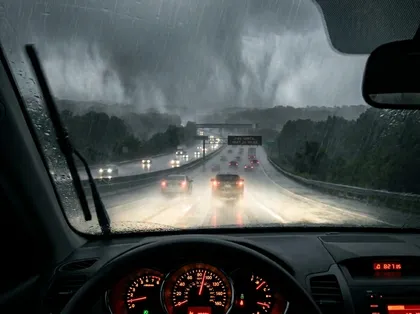
California Vehicle Code § 24400 requires every motor vehicle to operate with lighted headlamps during darkness or inclement weather, including any condition that requires the windshield wipers to be in continuous use due to rain, mist, snow, fog, or other precipitation. Driving without headlights in the rain not only increases your own risk, but it can also be used as evidence of comparative fault if a crash occurs. Turn on the headlights at the first sign of rain, rather than waiting until visibility drops to near zero.
How Fast Should You Drive on a Wet Los Angeles Freeway?
California Vehicle Code § 22350 — the Basic Speed Law — requires you to drive at a speed that is reasonable given the current weather, visibility, traffic, and road conditions, regardless of the posted speed limit. There is no single safe number for wet freeways because conditions vary. The practical standard is to drive at a speed at which you can safely stop within the distance you can clearly see ahead. On rain-slicked sections of the I-10, I-405, or US-101, that often means reducing speed well below the posted limit, particularly when visibility is low or standing water is present.
Can You Still Recover Compensation If You Were Partly at Fault in a Rain Crash?
Under California’s pure comparative fault rule, your compensation is reduced by your percentage of fault — but you are not barred from recovering anything. For example, if you were 20% at fault for following too closely, and the other driver was 80% at fault for running a red light, you can still recover 80% of your damages. An attorney can help you evaluate fault allocation in your specific situation.
If a Public Road’s Drainage Failure Caused a Flood That Led to My Crash, Who Do I Sue?
You would file a government tort claim against the public agency responsible for maintaining the specific road where the crash occurred. In Los Angeles, the responsible agency depends on the location of the crash: the city maintains local surface streets, the county handles county roads, and Caltrans manages state highway corridors. You must present that claim within six months of your injury under California Government Code § 911.2(a) — well before the two-year private-party filing deadline. Missing the six-month window can bar your claim against the government entirely. Contact a personal injury lawyer immediately so the correct agency is identified and the claim is filed in time.
Who Is Liable When a Driver’s Splash Blinds My Windshield and Causes a Crash?
Drivers may be liable for a resulting crash if they travel through standing water at a speed that creates a wave that hits another vehicle’s windshield, and a court finds they failed to drive with reasonable care for the conditions. This standard is set by Civil Code § 1714(a) and reinforced by the Basic Speed Law (CVC § 22350). In a hit-and-run scenario in which the splashing vehicle cannot be identified, a public agency may share responsibility if poor drainage created the standing water that created the hazard, under California Government Code § 835. Both theories can run in parallel if the facts support them.
Talk to Arash Law After a Rain Crash in Los Angeles
A rain-related crash can leave you managing medical appointments, missed work, vehicle damage, and an insurance dispute all at once, while the evidence that proves what happened dries up or gets overwritten. At Arash Law, we handle weather-related traffic collision claims throughout California, including complex cases that involve both negligent drivers and public agency road-maintenance failures.
Our Los Angeles rain accident attorneys can review your case, identify every liable party (including government agencies), and manage the legal process from evidence preservation through resolution on your behalf. We work on a contingency fee basis: you owe no attorney’s fees unless we recover compensation for you.
For free accident lawyer advice and a no-obligation review of your case, call us at (888) 488-1391 or reach our Los Angeles office directly at (213) 277-5878. Arash Law — MAKE THEM PAY, CALL AK.
About This Page
This page was prepared by Arash Law attorneys whose practice includes rain-related traffic collision claims in the Los Angeles Superior Court. This includes Central District personal injury cases filed at the Stanley Mosk Courthouse, where cases filed on or after January 8, 2024, are assigned for all purposes to Independent Calendar departments rather than to a PI Hub Court. Legal procedures and deadlines reflect California law as reviewed in July 2026.
Sources
- USC Annenberg School for Communication and Journalism — “A Crash Course on Driving in the Rain in L.A.” (2019): https://annenberg.usc.edu/news/research-and-impact/crash-course-driving-rain-la
- LAist (KPCC / Southern California Public Radio) — Los Angeles rain-driving crash reporting (2022): https://laist.com/news/graph-los-angeles-drivers-rain-car
- California Department of Motor Vehicles — California Driver Handbook, Safe Driving: https://www.dmv.ca.gov/portal/handbook/california-driver-handbook/safe-driving/
- Los Angeles Superior Court — Central District PI Hub Press Release (December 14, 2023): https://lacourt.org/newsmedia/uploads/1420231214155823nta23newprocedurespihub.pdf
- Los Angeles Superior Court — General Order Re General Jurisdiction Personal Injury Cases – Filing Location (effective March 18, 2013): https://lacourt.ca.gov/courtrules/pdf/generalorderregeneraljurisdictionpersonalinjurycases-022813.pdf
- California Government Code § 835 — Dangerous Condition of Public Property: https://leginfo.legislature.ca.gov/faces/codes_displaySection.xhtml?lawCode=GOV§ionNum=835
- California Government Code § 911.2 — Government Tort Claim Deadline: https://leginfo.legislature.ca.gov/faces/codes_displaySection.xhtml?lawCode=GOV§ionNum=911.2
- California Vehicle Code § 22350 — Basic Speed Law: https://leginfo.legislature.ca.gov/faces/codes_displaySection.xhtml?lawCode=VEH§ionNum=22350
- California Code of Civil Procedure § 335.1 — Two-Year Statute of Limitations: https://leginfo.legislature.ca.gov/faces/codes_displaySection.xhtml?lawCode=CCP§ionNum=335.1
- Li v. Yellow Cab Co., 13 Cal. 3d 804 (Cal. 1975) — Pure Comparative Fault: https://scocal.stanford.edu/opinion/li-v-yellow-cab-co-27850
- California Civil Code § 1714(a) — Duty of Care: https://leginfo.legislature.ca.gov/faces/codes_displaySection.xhtml?lawCode=CIV§ionNum=1714
- Los Angeles Police Department — Traffic Collision Information: https://www.lapdonline.org/
Disclaimer
This page is for general informational purposes only and does not constitute legal advice or create an attorney-client relationship. No outcome described is a guarantee of future results. If a public entity may be liable for your injury, you must present a government tort claim within six months of the date of injury under California Government Code § 911.2. Missing this deadline may bar your claim against that entity entirely. Private-party claims are subject to the two-year statute of limitations under California Code of Civil Procedure § 335.1. Contingency fee arrangements require a written agreement under California Business and Professions Code § 6147. No specific fee percentage is guaranteed or implied. Consult a qualified California personal injury attorney promptly after any accident.