Highlights:
- Call 911 and tell responders it happened on a job site.
- If suspended in a harness, call for rescue immediately to prevent suspension trauma.
- Photograph the scaffold setup, guardrails, planks, inspection tags, and any nearby power lines.
- Get witness names, phone numbers, and job roles before crews disperse from the site.
- Request the DWC-1 form from your employer, complete your section, return it, and keep a copy.
- Ask whether Cal/OSHA was notified and obtain any investigation report or citation details.
- Calendar your deadlines: 30 days to notify your employer, 1 year to file workers’ comp, 2 years to file a lawsuit, and 6 months if a public entity is involved.
Tip: Back up all photos, videos, and written notes to a personal cloud account immediately, and record only the facts you observed.
Table of Contents

After a scaffold fall on a Sacramento construction site, your priority is medical care, followed by a written notice to your employer and documentation of the scene. Sacramento’s job sites present conditions specific to this region:
- Hot Central Valley summers that exhaust workers.
- Gusts off the Sacramento–San Joaquin Delta that can shift elevated platforms.
- Energized overhead lines operated by the Sacramento Municipal Utility District (SMUD). As of July 2026, SMUD serves most of Sacramento County, including the City of Sacramento — a footprint that covers the city’s active construction corridors.
Each of these factors can turn a scaffold fall into a more serious injury, and each can affect who is legally responsible.
California law gives you two separate tracks for recovering compensation. Workers’ compensation is a no-fault system covering medical bills and partial lost wages. A third-party personal injury lawsuit can recover pain and suffering damages from a general contractor, scaffold manufacturer, or property owner. Missing the deadlines or losing early evidence can permanently close one or both tracks.
The attorneys at Arash Law represent injured construction workers throughout Sacramento County. This page explains what to do first, what evidence to protect, and how the two claim tracks work, so you can move quickly and protect your rights.
First Actions After A Scaffold Fall In Sacramento
The steps you take immediately after a scaffold fall in Sacramento help protect your health and preserve vital evidence for your legal claims. Call 911 right away and tell dispatchers the injury happened on a construction job site. This step ensures the right emergency response and creates a dispatch record tied to the location.
Once you are safe, visit an emergency room or, if your injuries are less severe, another treating physician. Both can document your injuries on the same day, creating a medical record that directly links your condition to the fall. Gaps between the accident and your first medical visit give insurance adjusters room to argue that the injury happened elsewhere.
Before the scene is disturbed, or while someone assists you, take the following steps:
- Take Photos and Videos: Capture the scaffold structure, the fall area, guardrails (or their absence), planks, inspection tags, and any overhead power lines. Wide shots and close-ups both matter. Construction conditions and scaffold configurations can change quickly, so document the scene as soon as it is safe to do so.
- Collect Witness Details: Ask co-workers and bystanders for their names, phone numbers, and job roles. Sacramento construction crews often rotate between projects within days, so gather this information before anyone leaves the site.
- Notify Your Supervisor in Writing: Inform your site manager or foreman of the accident as soon as it is safe to do so. This is not the formal DWC-1 filing. It is the first step in creating an employer record of the incident.
- Preserve Scene Evidence: Photograph safety certifications, maintenance logs, and any posted Cal/OSHA permits. Request copies of daily work logs and toolbox-talk records. These documents can show whether safety briefings occurred.
- Secure Surveillance Footage: Note the locations of any job-site security cameras or drones so an attorney can quickly send a preservation demand to the general contractor and property owner before the footage is overwritten.
The Sacramento City Fire Department and the Sacramento Metropolitan Fire District respond to scaffold fall and suspension trauma emergencies.
Falls that leave you suspended in a harness carry an added danger most people don’t expect: suspension trauma. Hanging motionless in a harness can cause blood to pool in the legs within minutes, leading to a dangerous drop in blood pressure and, in severe cases, loss of consciousness.
If such an event happened to you before rescue, it’s worth understanding even after the fact: suspension trauma symptoms can surface after rescue, not just during it, so get evaluated the same day, even if you feel stable once you’re down. That evaluation matters for your claim as much as your health. It ties a harder-to-see injury directly to the fall, rather than leaving a gap that an insurance adjuster can use to question whether your symptoms are related to the accident at all.
Injured on a Sacramento scaffold? Call Arash Law at (888) 488-1391 for a free consultation — available 24 hours a day. No attorney’s fees unless we recover for you.
Reporting The Injury And Filing Your Workers’ Compensation Claim
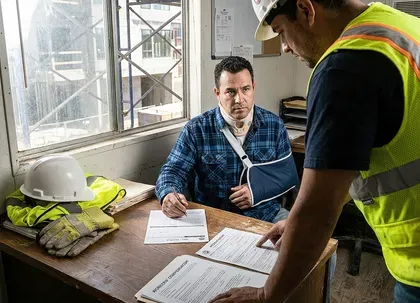
California Labor Code § 5400 requires you to notify your employer of a workplace injury in writing within 30 days of the accident. Missing this window can bar your right to wage benefits and medical coverage under workers’ compensation. Written notice, such as a text, email, or signed incident report, protects you better than a verbal conversation.
After you give notice, your employer is required to provide you with a DWC-1 claim form. Complete the employee section with the date, time, location, and description of the accident, then return it to your employer and keep a copy for your records. Your employer files the form with their insurer, which officially opens your workers’ compensation claim. Under Labor Code § 5405, workers generally must begin proceedings for workers’ compensation benefits within one year. The date from which that period runs can depend on when the injury occurred and whether qualifying benefits or medical treatment were provided.
Workers’ compensation is a no-fault system. You do not need to prove your employer was negligent. You only need to show that the injury arose out of and occurred in the course of your employment. Covered benefits include medical treatment, a portion of lost wages, and permanent disability payments if your injuries are lasting. If you have questions about the claim process, the Sacramento Division of Workers’ Compensation (DWC) District Office handles claims for injured workers in Sacramento County. It can connect you with an Information and Assistance Unit representative.
Sacramento DWC District Office is located at 160 Promenade Circle, Suite 300, Sacramento, CA 95834.
Phone #: 916-928-3101
How A Third-Party Lawsuit Complements Workers’ Compensation
Workers’ compensation does not compensate you for pain and suffering, full lost earning capacity, or losses caused by another party’s negligence — a third-party personal injury claim does. The two tracks may run simultaneously. Filing workers’ comp does not prevent you from suing a third party after a Sacramento scaffold accident if that non-employer contributed to the accident.
Common third parties and liability theories in Sacramento scaffold-fall cases include:
- Property Owners: A property owner may be liable under limited circumstances, such as when the owner failed to warn the contractor about a concealed, preexisting hazard that the owner knew or reasonably should have known about and that the contractor could not reasonably discover.
- General Contractors: A general contractor may be liable if it retained control over the work and affirmatively exercised that control in a way that contributed to the injury. Merely retaining general authority over job-site safety is not enough.
- Subcontractors: A crew from another trade that removed guardrails, left floor openings uncovered, or altered the scaffold without authorization.
- Scaffold Manufacturers and Rental Companies: A manufacturer whose scaffold components failed due to a design or manufacturing defect, or a rental company that provided defective equipment. Claims against manufacturers may be based on strict liability for design or manufacturing defects, separate from a negligence theory.
- Utility Coordination Failures: If inadequate coordination with SMUD or another utility provider contributed to an electrocution involving scaffold work near energized overhead lines, that may create additional liability against the property owner or general contractor, beyond workers’ compensation.
To succeed on a negligence claim, you must show that a duty existed, it was breached, the breach caused your injury, and you suffered damages. California’s pure comparative fault rules mean your own share of fault, such as not using provided fall-protection equipment, may reduce, but does not eliminate, your recovery in a third-party lawsuit.
Ordinary worker negligence generally does not reduce workers’ compensation benefits. However, Labor Code § 4551 permits a 50% reduction in the award when the injury was caused by the employee’s serious and willful misconduct, subject to statutory exceptions. Not wearing a harness, by itself, does not establish serious and willful misconduct.
Cal/OSHA Investigations: How They Protect Your Claim
Cal/OSHA — the Division of Occupational Safety and Health (DOSH) — investigates serious occupational injuries on California construction sites. Under California Code of Regulations (CCR) Title 8 § 342, your employer must report a serious injury or fatality to Cal/OSHA within 8 hours of knowing about the injury. This is the employer’s legal obligation. It is separate from, and independent of, your own 30-day notice deadline under Labor Code § 5400.
After receiving a report of a serious scaffold fall, Cal/OSHA may open an investigation. Depending on the circumstances, investigators may inspect the site, photograph conditions, interview witnesses, and review safety, training, and inspection records. Cal/OSHA may issue citations if its investigation establishes a violation. Fall-protection and scaffold violations are commonly cited on individual construction-site inspections.
A final Cal/OSHA citation may be relevant evidence of a safety violation, but it does not by itself establish third-party liability or entitlement to the 50% increase under Labor Code § 4553. The worker must separately prove that the employer or a qualifying managing representative committed serious and willful misconduct that caused the injury.
This information is relevant to a third-party claim, and it can serve as strong evidence if you file a separate petition against your employer under Labor Code § 4553 for serious and willful misconduct, which may increase workers’ compensation benefits by 50%. A Cal/OSHA citation is not, in itself, the mechanism for this boost. Securing the additional compensation requires a separate WCAB petition.
Arash Law’s attorneys can request Cal/OSHA investigation records and send preservation letters on your behalf. Call (888) 488-1391 for a free case review.
Sacramento-Specific Hazards That Affect Scaffold Fall Risk
Sacramento’s geography and climate create specific construction-site conditions that increase the risk of scaffolding accidents. Documentation of these local factors, including weather records, site safety plans, and SMUD coordination documents, often becomes vital evidence in your claim.
- Delta Winds: Sacramento’s proximity to the Sacramento-San Joaquin Delta can produce gusty afternoon winds that may destabilize improperly anchored scaffold frames. A properly prepared site requires wind monitoring and tie-back verification when elevated work is planned.
- Summer Heat: The Central Valley’s summer heat poses a recognized risk of worker fatigue on construction sites in Sacramento. High ambient temperatures increase the likelihood of dehydration and reduced reaction time on elevated platforms.
California’s heat-illness prevention standard, CCR Title 8 § 3395, requires drinking water, access to shade, and preventative cool-down rests when needed. Construction employers must also follow additional high-heat procedures when temperatures reach 95°F. Violations of that standard can be cited alongside scaffold violations and are relevant to a third-party negligence claim.
- SMUD Overhead Lines: SMUD’s own published safety protocols instruct construction workers to treat every overhead line in the Sacramento area as energized, to identify power lines and pad-mounted equipment upon arriving at each job site, and to review an emergency plan with the crew before work begins near utility infrastructure. When scaffold work brings workers close to overhead lines, failure to follow those protocols can create a serious electrocution risk and potential liability for the property owner or general contractor.
- Urban Scaffold Complexity: Sacramento’s ongoing urban development frequently requires tall scaffold systems with complex tie-back and rigging arrangements. Greater height and rigging complexity increase the potential severity of a scaffold failure.
Legal Deadlines For Sacramento Scaffold Injury Claims
Several deadlines may apply, but they do not all necessarily run from the accident date. Missing any one of them can permanently bar a category of recovery.
| Action To Take | Deadline | Legal Basis |
|---|---|---|
| Notify your employer of the injury. | 30 days from the date of injury | California Labor Code § 5400 |
| File a workers’ comp claim. | Generally, within 1 year, although the triggering date and exceptions vary | California Labor Code § 5405 |
| Sue a private party (third-party case) for personal injury. | 2 years from the date of injury | California Code of Civil Procedure § 335.1 |
| File a government tort claim. | Generally, you must file within six months of the date your legal claim begins | Government Code § 911.2 |
The government tort claim deadline applies only when a public entity, such as the City of Sacramento, Caltrans, a Sacramento County agency, or another California government agency, owned or controlled the job site or contributed to the hazard. It is not a universal requirement for every scaffold-fall case. However, if a public entity is involved, you must present the government tort claim before you can file a lawsuit, no matter how strong your evidence is.
The 6-month government claim deadline has two downstream consequences.
- If the agency formally rejects your claim, you generally have six months from the rejection date to file suit in Sacramento County Superior Court, which handles Sacramento County civil filings at the Tani G. Cantil-Sakauye Courthouse at 500 G Street.
- If the agency does not respond within 45 days, different rules govern the time available to file. An attorney can identify exactly which window applies to your situation.
The two-year personal injury deadline may feel distant on the day of the accident, but Sacramento construction sites are regularly altered, dismantled, or rebuilt within weeks. Scaffolding is routinely removed, SMUD coordination records are archived, and witnesses disperse. That means vital evidence can disappear before you have a chance to use it. An attorney can immediately send a preservation letter to the general contractor and property owner after the accident to legally preserve these materials before they are lost. These notices help establish that the recipients knew the evidence could be relevant. However, they do not guarantee that every requested record will still exist or be recoverable.
Evidence That Supports Your Sacramento Scaffold Claim
Scaffold-fall claims require evidence from multiple sources, and some of it disappears quickly. The table below maps each evidence category to its custodian and to the steps you can take to preserve it.
| Evidence | Custodian | How to Preserve |
|---|---|---|
| DWC-1 claim form (your completed copy) | You and your employer’s insurer | Retain your copy upon submission. Do not rely on the employer to keep it. |
| Photographs of the scaffold, guardrails, planks, and tags | You (personal device/cloud backup) | Back up to a personal cloud account immediately after taking photos. |
| Witness names, phone numbers, and job roles | You, then your attorney | Collect at the scene before the crew disperses. |
| Cal/OSHA investigation report and any citations | Cal/OSHA – DOSH | Submit a Public Records Act request. Issued citations may be publicly accessible, but investigative materials may be delayed, withheld, or redacted under applicable law. |
| SMUD line records and site electrical documentation | SMUD and the general contractor | Send a preservation letter to SMUD and the contractor. Submit a California Public Records Act request for utility records. Still, some records may be exempt (e.g., security-sensitive information). |
| Government tort claim filing confirmation | The relevant public entity and you | File by certified mail. Retain all correspondence and delivery confirmation. |
| Emergency dispatch and 911 records (suspension trauma cases) | Sacramento City Fire or Sacramento Metropolitan Fire District | Submit a Public Records Act request to the responding agency. |
Note: The California Public Records Act governs public records requests for Cal/OSHA and fire dispatch records.
What To Bring To Your First Consultation With Arash Law
Coming prepared to your first meeting with an Arash Law attorney helps the legal team move faster on evidence preservation and deadline tracking. Bring everything you have — the attorneys can work with partial documentation.
- Any photos or videos you took at the scene, including screenshots of any timestamps
- Your written notice to the employer (text, email, or incident report copy)
- Your completed DWC-1 form copy, if you have already filed
- Medical records and bills from your emergency room visit, chiropractor, or treating physician
- Witness names and contact information
- Any correspondence from your employer’s workers’ comp insurer
- Any Cal/OSHA citation notices or inspection records, if you have received them
- Pay stubs from the 30 days before the accident to document your wage rate
You are generally not required to give a recorded statement to a third party’s insurer, but if you have already given one to an insurance adjuster, bring that as well. If they have contacted you, a Sacramento scaffold injury lawyer can take over that communication once you are represented.
Arash Law Case Results: Construction Falls & Scaffold Injuries
Past results do not guarantee future outcomes. However, they can help illustrate how Arash Law has handled similar cases before:
$3,750,000 — Traumatic Brain Injury: Fall From a Roof at a Construction Site. A client was injured after falling from a roof while working at a construction site, sustaining a traumatic brain injury that required extensive rehabilitation. The case was referred to Arash Law by workers’ compensation colleagues who recognized the complexity of securing appropriate rehabilitative care for a catastrophically injured worker. A Riverside workers’ compensation judge approved a $3.75 million settlement.
$2,356,000 — Construction Accident: Fall into an Open Elevator Shaft. A client fell after stepping into an open elevator shaft at a construction site and lost consciousness upon impact. While the defense accepted that the injury occurred, it disputed the nature and extent of the harm. Prior counsel had referred the matter to Arash Law after an earlier settlement offer of only $125,000. Following additional discovery establishing that the client could no longer compete in the open labor market, the case settled for $2.35 million.
Contingency Fees: How Arash Law Gets Paid
Arash Law represents Sacramento scaffold injury clients on a contingency fee basis. This means you don’t pay the attorney’s fees unless we recover compensation for you. If there is no recovery, you owe no fee.
Business and Professions Code § 6147 requires third-party personal injury contingency fee agreements to be in writing and to specify how fees and costs are calculated.
Workers’ compensation fees work differently. They’re set as a percentage of certain benefits and must be approved by a Workers’ Compensation Appeals Board judge. Arash Law provides a written fee agreement at the start of every case that spells out exactly how the applicable fee structure works. You will know what to expect before you sign anything.
Frequently Asked Questions About Sacramento Scaffold Fall Claims
Construction workers injured on Sacramento job sites often have questions that go beyond the general workers’ comp or personal injury framework — questions about what happens if they lack safety gear, whether their immigration status affects their rights, or what government entity deadlines mean in practice.
What If I Was Not Wearing My Safety Harness When I Fell?
Workers’ compensation does not deny benefits because you were not wearing a harness. The system is no-fault: your employer’s negligence and your own are both irrelevant to basic eligibility. If you also pursue a third-party lawsuit against a general contractor, a scaffold manufacturer, or a property owner, California’s comparative fault rules may apply.
A jury or arbitrator could assign a percentage of fault to you, which would reduce, but not eliminate, your damages. An attorney can assess how significant that reduction might be based on the specific facts of your fall and the safety equipment that was available to you.
Can Undocumented Construction Workers File Claims In California?
California workers’ compensation law protects workers regardless of immigration status. You are entitled to medical treatment and wage benefits if you were injured on the job. You also retain the right to pursue a third-party personal injury claim when someone other than your employer contributed to the accident. Neither your employer nor an insurance company can legally condition your workers’ comp benefits on your immigration status.
What Are The Most Common Scaffold Violations That Lead To Falls?
Fall-protection and scaffold violations are commonly cited on individual construction-site inspections, even though they aren’t the single most frequently cited standards statewide. The violations that commonly contribute to scaffold falls include:
- Missing or inadequate fall-protection systems (no guardrails, no personal fall arrest system)
- Improper scaffold assembly or inadequate load ratings
- Defective or overloaded planking
- Unsafe ladder and access systems
- Failure to inspect scaffolding before each work shift
When Cal/OSHA issues a citation for one of these violations after your accident, that citation becomes documented evidence that a safety standard was breached. This citation can be relevant to both a workers’ comp claim and a third-party negligence lawsuit.
At What Height Must Workers On Scaffolds Receive Fall Protection?
Under California’s scaffold regulations, employees on scaffolds generally must receive fall protection when working 7.5 feet or more above a lower level. Required protection may include a properly installed guardrail system, a personal fall arrest system, or other Cal/OSHA-approved measures. The obligation to provide that protection falls on the employer and, in many cases, the general contractor who controls site safety.
Does The 6-Month Government Claim Deadline Apply To Every Sacramento Scaffold Case?
No. The 6-month government tort claim deadline under Government Code § 911.2 applies only when a public entity owned, controlled, or contributed to the hazard on the job site. If your accident happened on a purely private construction project with no government ownership or oversight involvement, the standard 2-year personal injury statute of limitations under CCP § 335.1 applies. Discuss your specific job site with an attorney early: the consequences of missing the 6-month deadline are often irreversible.
Can You Sue For Pain And Suffering After A Sacramento Scaffold Fall?
Workers’ compensation does not provide pain-and-suffering damages. A third-party personal injury lawsuit — filed against a general contractor, scaffold manufacturer, property owner, or subcontractor who contributed to the accident — can include compensation for physical pain, emotional distress, and loss of enjoyment of life, in addition to the medical costs and wage losses workers’ comp covers. To preserve that option, you must file within two years of the injury date under CCP § 335.1. Arash Law evaluates third-party liability at no charge during the initial consultation.
Ready to Talk to a Sacramento Injury Attorney About Your Scaffolding Accident?
Arash Law’s attorneys handle scaffold fall cases throughout Sacramento County on a contingency basis. No fees unless we recover compensation for you. We can send preservation letters to the general contractor and property owner, request Cal/OSHA investigation records, identify every party who may share liability, and meet the government claim deadline if a public entity was involved.
Call (888) 488-1391 — available 24 hours — to schedule your free initial consultation. There is no obligation, and the call is confidential. MAKE THEM PAY, CALL AK.
About This Page
This page was prepared by the attorneys and legal writers at Arash Law and last reviewed by Arash Khorsandi, Esq., California State Bar #249405, in July 2026. It draws on procedural information from the California Division of Workers’ Compensation Sacramento District Office, Cal/OSHA’s publicly available citation data, and the Sacramento Superior Court – Tani G. Cantil-Sakauye Courthouse. Government tort claim procedures are sourced from the Sacramento County Law Library guide on Government Code § 911.2. SMUD electrical safety requirements are sourced from SMUD’s published construction worker safety protocols. This page provides general legal information only. It does not constitute legal advice and does not create an attorney-client relationship. Consult a licensed California attorney promptly to protect your rights.
Sources
- California Department of Industrial Relations – Division of Workers’ Compensation. Sacramento District Office. 160 Promenade Circle, Suite 300, Sacramento, CA 95834. Phone: 916-928-3101. https://dir.ca.gov/dwc/dwc_address/sacramento.html (accessed July 14, 2026).
- California Division of Workers’ Compensation. Workers’ Compensation FAQs — DWC-1 Claim Form, 30-Day Notice, 1-Year Filing Deadline. https://dir.ca.gov/dwc/faqs.html (accessed July 14, 2026).
- California Division of Workers’ Compensation. DWC-1 Claim Form. https://www.dir.ca.gov/dwc/dwcform1.pdf (accessed July 14, 2026).
- Cal/OSHA – Division of Occupational Safety and Health. Top 10 Most Frequently Cited Title 8 Standards. https://dir.ca.gov/dosh/statistics/frequently-cited-standards.html (accessed July 14, 2026).
- Cal/OSHA – Division of Occupational Safety and Health. Fatal Occupational Injuries in California, 2015–2024. CFOI Program, April 2026. https://dir.ca.gov/dosh/cfoi/california-occupational-fatalities.pdf (accessed July 14, 2026).
- Sacramento County Law Library (SacLaw). Claims Against the Government — California Tort Claims Act. https://saclaw.org/resource_library/claims-against-the-government/ (accessed July 14, 2026).
- Sacramento Superior Court. Court Locations — Tani G. Cantil-Sakauye Courthouse. https://www.saccourt.ca.gov/general-information/court-locations (accessed July 14, 2026).
- Sacramento Municipal Utility District (SMUD). Work Safely Around Utility Lines — Construction Worker Safety Guide. https://smudsafety.com/worker/wp-content/uploads/2024/01/1335553010SMUDCSScmben041922v4.pdf (accessed July 14, 2026).
Disclaimer: The information on this page is for general informational purposes only and does not constitute legal advice. Reading this page does not create an attorney-client relationship with Arash Law. The deadlines, procedures, and legal standards described here are based on California law as of the last review date and may not reflect recent changes. Every case is different. Contact a licensed California personal injury attorney promptly to understand how these rules apply to your specific situation.