TL;DR: You can file a claim if another driver hits your parked car, even in a hit-and-run. Report it to your insurer promptly. If you were driving, file an SR-1 within 10 days when injuries, death, or over $1,000 in property damage occurred.
Highlights:
- Document damage immediately with photos and video from multiple angles before the evidence disappears.
- Contact nearby businesses to request that they preserve security camera footage.
- File a police report to create official documentation for your insurance claim.
- Report the incident to your insurer within 24-72 hours or risk coverage denial.
- File the DMV SR-1 form within 10 days if damage exceeds $1,000 to avoid license suspension.
- If the driver left a note, verify it contains their name, phone number, and insurance details.
Tip: Collect all evidence at the scene first—surveillance footage, debris, and paint transfer—because security systems often overwrite recordings within 24 to 72 hours.
Table of Contents
Yes, you can file an insurance claim if someone hits your parked car. You do not need the other driver’s full information to start the claim. California law and your insurance policy both provide ways to recover repair costs, including in hit-and-run cases.
Uninsured Motorist Property Damage (UMPD) applies only if the at-fault vehicle is identified as uninsured and the policy includes UMPD coverage. In most hit-and-run cases where the vehicle cannot be identified, collision coverage is typically the main source for repair costs.
Who Is At Fault When A Legally Parked Car Is Hit?
When a moving vehicle hits a legally parked car, the driver of the moving vehicle is usually found at fault. Drivers have a duty to stay in control of their vehicle and avoid hitting stopped or parked cars.
If your car is parked legally, shared fault arguments are less common, but insurance companies may still try to raise them. Most of the time, the moving driver carries most or all of the responsibility.
If a car is parked illegally, liability can change. If the vehicle blocks traffic or parks in a restricted area, the insurance company may argue that the driver who parked it is partially responsible. Under California’s comparative negligence rule, any recovery can be reduced by that share of fault.
A parking ticket does not automatically prevent you from filing a claim. It may affect the amount you recover depending on the facts and evidence in the case. Fault usually depends on the evidence from the scene, including photos, witness statements, and police reports.
You may look for free advice from a parked car injury accident lawyer to help you understand how negligence rules apply to your case. How fault is divided often comes down to evidence gathered at the scene.
What To Do If Someone Hits Your Parked Car And Leaves
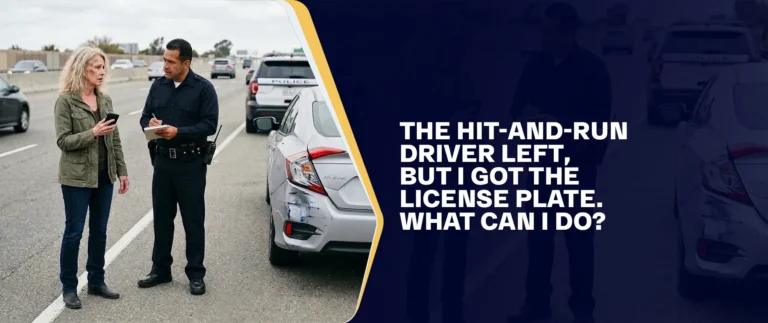
Security footage and physical debris at the scene can disappear within hours. Your ability to support a claim may be affected by what you document now. In California, a driver who hits your parked car and leaves no note has committed a hit-and-run under California Vehicle Code (VC) §20002. You can still pursue civil compensation even if the driver is never found or convicted.
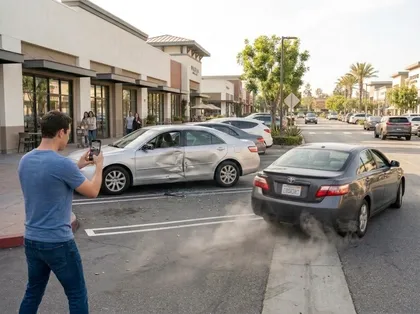
If the driver fled the scene, take these steps before evidence disappears:
- Leave your car where it is unless it’s unsafe or creates an immediate traffic hazard. Where your car sits helps police and adjusters understand how the crash happened.
- Seek medical care as soon as possible, even if your injuries seem minor. Some injuries take time to appear, and medical records help support your claim.
- Document the damage right away. Take photos and video of all dents, scratches, skid marks, debris, and paint transfer from multiple angles.
- Check for a note. Under VC §20002, drivers are required to stop and leave their own and the vehicle owner’s name, address, and a statement of the circumstances of the accident. If you find a note, keep it safe.
- Go into nearby businesses right away and ask them to save any security camera footage. Security footage retention periods vary widely by system and business. Ask the owner to preserve any relevant footage as soon as possible.
- Call the police to file an official report. This report is your primary documentation when filing an insurance claim.
- Consult a lawyer. They can help identify applicable coverage, deal with insurers, and work to file your claim before deadlines or evidence issues arise.
Our attorneys at Arash Law can review your options and help you through the claims process. You can also learn more about how often people sitting in parked cars get hit by other vehicles and the risks involved.
Below are cases we’ve handled involving parked cars and low-speed impact accidents:
$1,000,000 — Sleeping Driver Drifts Into Parked Truck
Our client sat inside his parked truck when another driver fell asleep and drifted into the vehicle. The crash caused neck and lower-back injuries that required spinal surgery. The defense paid the $1,000,000 policy limits a few weeks before trial.
$1,000,000 — Tow Truck Collision on Freeway Shoulder
Our client parked on the I-10 freeway shoulder with hazard lights on when a tow truck swerved and struck his vehicle. The impact caused the tow truck to overturn and led to serious injuries. We recovered $1,000,000 for the claim.
$1,000,000 — Parking Lot Pedestrian Accident
A pedestrian was struck at low speed in a parking lot, worsening a pre-existing eye condition. The defense denied responsibility and claimed the pedestrian walked into a stopped vehicle, with no witnesses at the scene. The case was referred to Arash Law after earlier efforts to resolve it stalled. Liability was built through circumstantial evidence and employer-linked insurance coverage, resulting in a $1,000,000 settlement.
Previous outcomes do not ensure or forecast comparable results. Each case is distinct, with outcomes contingent upon its particular facts, evidence, insurance coverage, and legal conditions.
How Insurance Covers Parked Car Damage
California auto policies cover hit-and-run incidents under specific coverage types, such as collision or uninsured motorist property damage. Insurers typically require evidence of the damage and circumstances of the crash to process a claim.
If the driver who hit your car is identified and insured, you can pursue compensation through their policy. If the driver is never identified, you must rely on your own coverage. Which coverage applies also depends on the type of loss, property damage, or physical injury.
California has several coverage types that may apply:
- Liability Insurance (at-Fault Driver’s Policy): If the other driver is identified and insured, you may be able to file a claim for your repairs and a rental car. You may also be able to claim diminished value in some third-party claims, depending on the facts and insurance coverage. Diminished value is the drop in your car’s resale price after an accident. It is not a standard line item automatically paid by the policy.
- Collision Coverage: This pays for damage to your car, no matter who caused it or whether the other driver is ever found. You pay a deductible first, a set amount you cover out of pocket before your insurance pays the rest. Collision coverage is not required by California law, although a lender or lessor may require it under a financing or lease agreement.
- Uninsured Motorist Property Damage (UMPD): California Insurance Code §11580.2 governs UMPD. It applies only when the at-fault driver is identified and found to be uninsured. If the driver was never identified, UMPD generally does not apply, and Collision coverage is typically the available path for property damage.
- Injury Damages: If you were in the car when it was hit, you may be able to claim medical bills, visits to a chiropractor, and lost wages. If the thought “I need a personal injury lawyer” has crossed your mind, speaking with an attorney can help you understand which claims you may be able to pursue and under which policy.
The applicable coverage depends on whether the at-fault driver was identified. All of these options are subject to strict California deadlines. Missing deadlines can significantly limit or bar your right to recover, depending on the facts and any applicable exceptions.
Deadlines And Reporting Requirements In California
California sets strict deadlines for reporting accidents and filing claims. Miss them, and you may lose your right to seek compensation, or your license may be suspended.
Here is how the deadlines fall, from earliest to latest:
- Insurance Notification: Report the accident to your insurer promptly and follow the deadlines in your policy. For an uninsured-motorist bodily injury claim involving an unidentified hit-and-run driver, California Insurance Code §11580.2 generally requires a police report within 24 hours and a sworn statement to the insurer within 30 days. Qualifying uninsured motorist property damage claims are subject to separate requirements under §11580.26.
- Department of Motor Vehicles (DMV) SR-1 Report (10 Days): Under Vehicle Code §16000, you must file an SR-1 form with the DMV within 10 days if the crash caused injury or property damage over $1,000. This is separate from any police report. Failing to file may result in a suspended license after DMV review and enforcement action.
- Government Vehicle Claims (6 Months): If a government vehicle caused the damage (a city bus, a sanitation truck, or a car driven by a public employee), you must file a claim within six months of the crash. Missing this can bar your case entirely.
- Personal Injury Lawsuits (2 Years): Under California Code of Civil Procedure (CCP) §335.1, you have two years from the crash date to file a personal injury lawsuit.
- Property Damage Lawsuits (3 Years): Under CCP §338, you have three years to sue for property damage alone.
Your policy may also set its own internal deadlines. Missing one can cost you coverage even when the legal filing period has not expired. Review your policy and talk to an attorney if you are unsure.
Frequently Asked Questions About Parked Car Accidents
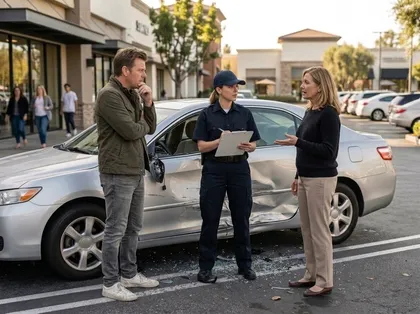
Accidents involving parked cars raise questions that a normal at-fault crash does not. The rules on fault, rate increases, and deductibles differ in these cases. You may be wondering if your rates will rise, what a hit-and-run means for your costs, or what to do if the driver left a note. Below are answers to these commonly asked questions.
Will My Insurance Go Up If Someone Hits My Parked Car In California?
No. In California, insurers generally cannot raise your rate for an accident that was not your fault, under Proposition 103 rating rules. If you were not at least 51% responsible for the crash, your insurer cannot raise your rate. In most cases, you may file a claim without a rate increase, as long as your insurer treats the accident as not your fault.
Do I Have To Pay A Deductible If My Parked Car Was Hit In A Hit-and-Run?
Generally, yes. If the other driver is never found, you will likely file under your own Collision coverage, which means paying your deductible. Some policies include a deductible waiver for crashes with an identified uninsured driver. Coverage terms vary by insurer, and hit-and-run cases may not qualify because the other driver’s status cannot be confirmed.
The insurer needs to verify that the other driver was uninsured, and that is not possible when the driver is unknown. If the driver is found later, you may be able to seek a refund of your deductible from their liability insurer. Liability insurance is a part of a driver’s policy that pays for damage they cause to others. Whether that happens depends on the insurer’s review and the policy terms.
What Not To Tell Your Insurance Agent?
Do not admit fault or apologize after an accident. Do not guess about speed, distance, or how the crash happened if you are not sure. Do not say “I’m fine” or downplay injuries, since pain can appear later. Do not lie or hide information about the accident, your vehicle, or your injuries.
When you file a claim or speak with an insurance adjuster, stick to clear and verified facts only.
What Do I Do If The Driver Leaves A Note?
Documenting the note with a photo and checking that it has the driver’s name, phone number, and insurance details are good first steps. If any information is missing, reaching out to the driver to get it before filing a claim can help avoid delays. Saving the note as proof is a good idea in case a dispute comes up later.
The next step is to file a claim against the at-fault driver’s liability coverage. Depending on the facts and the driver’s policy terms, that coverage may pay for your repairs, and you may not need to pay a deductible.
Consult With Arash Law About Your Parked Car Accident
When someone hits your parked car and disappears, the insurance fight that follows can feel overwhelming. If you reach out and we take your case, our attorneys at Arash Law can step in to handle those negotiations and track down evidence before it is gone. Critical evidence, like surveillance footage, may disappear quickly.
Before a lawsuit is filed, AK Law can send a preservation notice requesting that evidence be saved. If a lawsuit is filed, a subpoena may later be used to compel production of evidence.
Your attorney can also negotiate your medical bills and repair costs to help reduce your out-of-pocket expenses while your claim is open. If your insurer denies your claim or lowballs your repair costs, an attorney can push back on that decision.
Clients often ask, “Do lawyers only get paid if they win?” Most personal injury lawyers work on a contingency fee, meaning attorney fees are paid only if the case is resolved in the client’s favor, as stated in the fee agreement. You pay no attorney fees unless the case resolves in your favor, with no upfront costs required.
Call (888) 488-1391 to schedule a free initial consultation.