TL;DR: The most dangerous highways for truck accidents in San Joaquin County are I-5, Highway 99, and SR-4, driven by heavy freight, Tule fog, and aging infrastructure. Multiple parties, including drivers, carriers, cargo loaders, or Caltrans, may share liability. After a crash, preserve time-sensitive evidence such as black box data, ELD logs, or video footage.
Highlights:
- Call 911, get medical care, and ask police to document the scene.
- Photograph vehicles, skid marks, lane markings, and any missing signs or barriers.
- Collect the truck driver’s, carrier’s, and witnesses’ names, numbers, and DOT info.
- Promptly request preservation of black box data, driver logs, and maintenance records.
- Track losses with records like bills, pay stubs, and chiropractic treatment notes.
- File within 2 years for claims against private parties. If a public agency like Caltrans may be responsible, a government claim must be filed within 6 months.
- Get a contingency-fee consultation to identify every potentially liable party.
Tip: When speaking with insurers, stick to facts you know and avoid guessing about speed, distance, or fault.
Table of Contents

I-5, Highway 99, and SR-4 are the most dangerous highways for truck accidents in San Joaquin County. Each route carries heavy freight traffic and high-speed vehicles. Tule fog, aging infrastructure, and active construction zones also increase the risk. These conditions leave little room for error when an 80,000-pound truck is involved.
Countywide crash data illustrates the broader traffic-safety risks. In 2023, the California Office of Traffic Safety recorded 6,095 people killed or injured in San Joaquin County crashes. The county also recorded 1,280 speed-related fatal and injury collisions and 637 nighttime fatal and injury collisions. These figures cover all types of vehicles, not just truck crashes alone. However, they provide context for the conditions motorists face on the county’s major highways.
San Joaquin County sits at the junction of multiple major California freight corridors: I-5 running north to south, Highway 99 threading through the heart of the Central Valley, and SR-4 linking Stockton to rural agricultural communities toward Telegraph City. The Port of Stockton, regional warehouse clusters, and rail connections feed heavy commercial vehicles onto all three routes, so freight traffic does not confine itself to off-peak hours. Passenger vehicles share these lanes with loaded tractor-trailers around the clock.
Truck accident claims may involve an additional regulatory layer, as federal motor carrier regulations, including hours-of-service and Electronic Logging Device (ELD) requirements, apply to many covered commercial drivers and carriers. California rules or regulatory exemptions may apply in other cases.
Those regulations create a separate evidentiary layer; violations may constitute negligence per se, but causation must still be established independently. The evidence needed to prove a federal-rule violation, such as black box data, driver logs, and maintenance records, can disappear within days if not preserved immediately.
Arash Law represents truck accident victims across San Joaquin County. Call us at (888) 488-1391 for a free consultation with our attorneys.
What The Crash Data Tells Us About San Joaquin County Highways
San Joaquin County recorded 6,095 victims killed and injured in all crashes in 2023, ranking it 15th out of 58 California counties for total fatal and injury victims, according to the San Joaquin County 2023 OTS crash rankings. Rather than showing where truck crashes occurred, this countywide figure provides context for the overall volume of serious collisions on roads used by commercial and passenger vehicles.
Within the City of Stockton alone, which is served by both I-5 and Highway 99, the Stockton 2023 OTS crash data shows 1,913 individuals were killed or injured in 2023, placing Stockton 3rd out of 15 of the largest California cities by daily vehicle miles traveled (DVMT) in that victim category. That figure places Stockton among California’s most crash-affected urban centers.
San Joaquin County’s 628 hit-and-run fatal and injury collisions in 2023 earned the county a 1st-place ranking among all 58 California counties, a factor that is particularly significant for truck accident cases. The ranking does not establish that trucks were involved in those collisions. However, it highlights the importance of identifying every vehicle and preserving evidence when a crash occurs on a high-volume route.
When a truck or another vehicle leaves the scene on roads like I-5, SR-99, or SR-4, physical evidence (camera footage, skid marks, and debris fields) begins to degrade immediately, and surveillance camera footage is typically overwritten within days, weeks, or even months. Because of this high rate of hit-and-run crashes, taking immediate action is necessary to document these scene indicators before they are lost entirely.
Note on Data: The statistics cited on this page come from the most complete publicly available datasets at the time of writing. Traffic, crash, and roadway data are updated on different schedules by state and local agencies. Arash Law monitors these sources and updates this content when newer official data becomes available.
Why San Joaquin County’s Freight Network Concentrates Crash Risk
San Joaquin County functions as a distribution hub for California’s broader freight system. I-5, Highway 99, and SR-4 do not operate in isolation. They connect to other regional highways that route trucks into and out of the county. The Port of Stockton, rail terminals, and nearby airport access increase the number of commercial vehicles on all three corridors, so freight activity does not vary only with consumer shopping patterns. Agricultural harvests, warehouse fulfillment cycles, and intermodal transfers push heavy trucks onto these roads at all hours.
San Joaquin County’s constant freight pressure creates a specific hazard pattern: trucks do not share the road only with long-haul through traffic. Agricultural vehicles, local delivery trucks, commuters, and school traffic enter and exit at grade-level intersections and older ramps designed for lighter traffic volumes. Because loaded tractor-trailers can weigh up to 80,000 pounds while most passenger vehicles weigh under 5,000 pounds, occupants of smaller vehicles face the greatest physical risk in truck accidents, a fundamental disparity that shapes the harm pattern on all three corridors.
Tule fog compounds every other risk factor during the late fall and winter months across the Central Valley. This ground-level fog forms overnight and can reduce visibility to near zero on open freeway stretches of I-5 and Highway 99, where vehicles travel at speed with little time to respond to sudden slowdowns or stopped traffic. The combination of high-speed travel, heavy truck traffic, and severely reduced visibility creates the specific environmental conditions that lead to multi-vehicle pileups on these corridors.
Highway 99: Freight Volume, Urban Access Points, And Fog
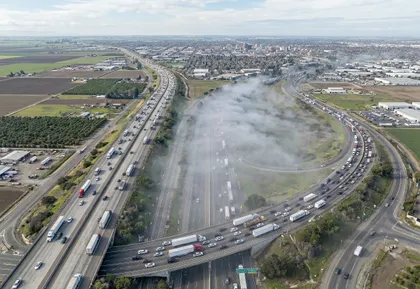 Highway 99 carries a denser mix of traffic types than I-5 because it passes through more urbanized areas near Stockton and surrounding Central Valley communities before continuing north and south through the state. That urban density means the highway serves not only long-haul freight but also agricultural trucks moving farm products to processing facilities, local delivery vehicles making frequent stops, and commuters driving between these communities and the greater Sacramento region.
When commuter, agricultural, and commercial freight traffic mix on a high-speed corridor, the gap between truck speed and car speed — and between truck mass and car mass — creates constant merge and lane-change hazards.
Data from Caltrans traffic volumes on state highways documents significant commercial truck volumes on Highway 99 through San Joaquin County, with segment-level counts available in annual Caltrans traffic census files. Growing freight demand on an aging corridor is a concern because portions of Highway 99 through San Joaquin County include older interchanges and heavily used merge areas. Whether a particular lane, shoulder, or ramp contributed to a crash requires review of the roadway plans, measurements, maintenance records, and conditions at the specific location.
Common physical risk factors on this corridor include:
- High Truck Traffic Volume: Among the highest truck volumes in the San Joaquin Valley, with growing freight demand that will further stress existing roadway design.
- Narrow Lanes and Limited Shoulders: Older lane widths leave less lateral space beside fast-moving trucks, and minimal shoulders give disabled vehicles fewer options to clear traffic.
- Median Barrier Gaps: Sections without continuous median barriers create a risk of crossover crashes when a driver loses control.
- Short Merge Areas: Older entrance ramps give trucks and passenger cars less distance to match highway speed before entering the travel lane.
- Heavy Local Access: Frequent on-and-off ramps near Stockton mean trucks regularly accelerate and decelerate in traffic, creating rear-end and sideswipe hazards.
When Tule fog settles over Highway 99 through San Joaquin County in the early morning hours, visibility can drop significantly while trucks continue traveling at freeway speeds. California law requires drivers to operate at a speed that is reasonable and prudent for actual road and visibility conditions — a standard that applies in all fog-related truck crash claims. To establish whether a driver was traveling faster than conditions safely permitted, San Joaquin truck accident lawyers examine weather service records, CHP Traffic Collision Reports, and on-board vehicle data.
Interstate 5: Long-Haul Speeds And High-Risk Interchanges Near Stockton
The I-5 functions as California’s primary north-south long-haul freight spine, connecting Southern California ports and the Central Valley to Sacramento, Oregon, and Washington through San Joaquin County. Unlike Highway 99, which serves a mix of regional and local traffic, I-5 carries substantial long-distance commercial truck traffic through San Joaquin County. Because of this long-haul profile, drivers arriving at Stockton-area I-5 interchanges may have been behind the wheel for hours, accumulating fatigue that federal hours-of-service regulations under 49 CFR Part 395 are designed to limit.
A loaded tractor-trailer traveling at 55 mph requires approximately 196 feet to stop under ideal conditions, according to Federal Motor Carrier Safety Administration (FMCSA) guidance. On the open stretches of I-5 north and south of Stockton, that gap becomes critical when traffic suddenly slows at interchange merge points, where congestion can build quickly. Even when a truck driver believes the following distance is adequate, delayed braking may leave insufficient room to stop when traffic slows suddenly.
Liability for truck crashes on I-5 often requires examining multiple evidence sources simultaneously:
- Electronic Control Module (ECM) / Black Box Data: Records speed, braking inputs, throttle position, and engine fault codes at the time of the crash. This data can be overwritten within days if the truck returns to service; preservation must be requested immediately.
- ELD and Driver Logbooks: Federal rules require carriers to retain ELD data for 6 months. These records can show whether the driver exceeded hours-of-service limits before the crash.
- Vehicle Maintenance and Inspection Records: Pre-trip inspection reports and repair orders can show whether the carrier knew of a mechanical defect (brake wear, tire condition) that contributed to the crash.
- CHP Traffic Collision Report: The California Highway Patrol’s Stockton Area office investigates crashes on I-5 within San Joaquin County and produces a Traffic Collision Report (TCR) that is a primary evidence document for any claim.
If you are thinking “I need a personal injury lawyer” after a crash on I-5, Arash Law’s experience with the complexity of federal trucking regulations and multi-party liability makes early legal consultation especially important. Determining whether a driver’s fatigue, a carrier’s dispatch pressure, or a vehicle maintenance failure contributed to the crash requires access to records that carriers are not required to volunteer.
State Route 4: Active Construction Zone And Merge Hazards Near Stockton
SR-4 connects Stockton to rural San Joaquin County communities along the Farmington Highway corridor and carries a mix of commuters, farm vehicles, and freight trucks, unlike I-5’s long-haul profile. The route passes through agricultural land east of Stockton toward Farmington and Telegraph City, and its older road geometry was built for traffic volumes that have grown substantially since the route’s original design.
Caltrans District 10 has announced the SR-4 Farmington Highway improvement project, which covers approximately 25 miles of SR-4 from Stockton to Telegraph City. The project includes pavement repairs, bridge railing upgrades, rumble strip installation, new signs and striping, and guardrail improvements. The project includes extensive repairs and safety-related upgrades along the corridor. While construction is ongoing, overnight and extended one-way traffic control is required, creating work-zone conditions that elevate crash risk for both truck drivers and passenger vehicle occupants traveling the route.
SR-4 crash hazards combine the corridor’s existing design limitations with the added risk of an active work zone:
- Active Construction Zone: Lane shifts, reduced shoulders, and work-zone speed differentials create sudden changes in road geometry, affecting truck braking and steering.
- Short Merge Areas: Limited merging space on an aging roadway gives drivers less time to react when trucks enter traffic, slow down, or change lanes near agricultural access roads.
- Blind Spots at Merge Points: Smaller vehicles entering or exiting near trucks during merge maneuvers may fall into the driver’s blind spots, areas that modern trucks do not fully cover with mirrors alone.
- Bridge and Guardrail Gaps: The Farmington Highway project’s inclusion of bridge railing and guardrail upgrades confirms that safety hardware on portions of this corridor does not meet current standards.
- Mixed Traffic Demands: Agricultural equipment, commuter vehicles, and commercial freight trucks operate at different speeds and with different braking distances, creating unpredictable gaps in traffic flow.
A crash in an SR-4 construction zone raises the question of who bears responsibility, and that question may extend to Caltrans itself. If inadequate warning signs, improper lane markings, or missing temporary barriers contributed to the crash, a claim against Caltrans under the California Government Claims Act (Government Code § 911.2) may be available. That claim must be filed within six months of the crash date, a deadline that applies specifically when a public entity like Caltrans is a potential defendant, not as a universal rule for all truck accident claims. Arash Law’s experience with Caltrans District 10 claims means an attorney can evaluate whether the specific road conditions at your crash location support a government-entity claim.
Arash Law represents truck accident victims injured on SR-4, I-5, and Highway 99. Call us at (888) 488-1391 for a free consultation.
Who Is Legally Responsible When A Truck Crash Happens On These Corridors
 Responsibility for a truck crash on I-5, Highway 99, or SR-4 may extend beyond the truck driver. Depending on how the collision occurred, a claim may involve the trucking company, other motorists, cargo handlers, maintenance contractors, or a government agency responsible for the roadway.
Truck accident cases filed in San Joaquin County Superior Court can name multiple defendants, and California’s pure comparative fault rule allows fault to be allocated among all responsible parties, including the driver, the trucking company, other motorists, cargo handlers, maintenance contractors, and government agencies.
Each potential defendant’s liability rests on a different legal theory, and proving any one of them requires evidence specific to that theory:
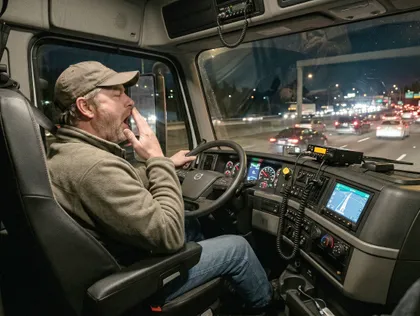
- Truck Driver: Liability may arise from fatigue, distracted driving, following too closely, unsafe lane changes, or driving too fast for conditions. Negligence (the failure to use reasonable care) must be proved, not assumed from the crash itself.
- Trucking Company (Motor Carrier): Under the legal principle of respondeat superior, a carrier may be liable for its drivers’ on-duty negligence. Separate negligence claims may also arise from the carrier’s own conduct, inadequate driver screening, unsafe dispatch policies, or failures to maintain the vehicle.
- Cargo Loaders: Improperly secured or overloaded cargo can shift in transit, destabilize a truck, or spill onto the roadway. Liability here requires showing that the loading was defective and that this defect caused or contributed to the crash.
- Maintenance Contractors: Third-party shops that performed brake, tire, or steering repairs may share responsibility if they left a known defect unaddressed. Federal FMCSA regulations require documented inspection and repair records that authorities can subpoena.
- Other Motorists: Drivers who cut off a truck, brake suddenly in a truck’s limited field of vision, or make unsafe lane changes may bear partial fault under California’s comparative fault system.
- Caltrans (Government Agency): Dangerous road conditions, missing barriers, inadequate signage, or defective roadway design on I-5, SR-99, or SR-4 may support a government claim, but only if Caltrans knew or should have known about the condition in time to act.
A violation of federal FMCSA safety regulations, such as exceeding hours-of-service limits or failing to maintain required inspection records, does not automatically establish liability. It may constitute negligence per se under California law, meaning the violation is treated as evidence of negligence. However, causation must still be established: the violation must have actually contributed to the crash and your injuries.
Cases involving multiple parties across federal and state regulatory frameworks require early legal consultation, including seeking free advice from a truck accident attorney, to understand who may be responsible and what evidence needs to be preserved before it disappears.
Deadlines For Filing A Truck Accident Claim In San Joaquin County
California Code of Civil Procedure § 335.1 gives you two years from the date of your injury to file a personal injury lawsuit against a private party, a truck driver, a trucking company, a cargo loader, or a maintenance contractor.
The filing timeline is shorter when Caltrans or another public agency may be responsible. The California Government Claims Act (Government Code § 911.2) requires you to present a written claim to the state within six months of the incident before you can file a lawsuit. For crashes on I-5, SR-99, or SR-4 where a road defect, missing barrier, or inadequate construction-zone warning may have contributed, Caltrans (administered in San Joaquin County by District 10) must be notified through the California Government Claims Program. Missing this six-month deadline likely bars the lawsuit against the government entity, regardless of the strength of the underlying facts.
Most civil truck accident cases in San Joaquin County are filed at the San Joaquin County Superior Court. The court has temporarily adjusted the clerk’s counter and phone hours while it rolls out a new case management system. The schedule is as follows:
- June 15–August 14, 2026: 8:00 a.m. to 2:00 p.m.
- August 17–September 4, 2026: 9:00 a.m. to 1:00 p.m.
- September 7–October 30, 2026: 8:00 a.m. to 2:00 p.m.
These hours apply Monday through Friday, excluding court holidays. Check the court’s current schedule before visiting, as temporary hours may change.
Deadlines apply regardless of whether you are still treating for injuries, negotiating with an insurer, or waiting for the CHP Traffic Collision Report to be released.
What Evidence To Gather And Preserve After A Highway Truck Crash
A truck’s ECM or EDR may record data such as speed, braking, driver inputs, and vehicle dynamics, depending on the vehicle and system. Other important evidence, including medical records, hospital bills, pay stubs, and treatment notes from a chiropractor or physical therapist, is essential to establishing the full scope of your damages. Chiropractic care is often part of the recovery from soft-tissue injuries common in rear-end and sideswipe truck crashes, and those records should be preserved from the first treatment visit.
Much of the evidence in a truck accident case is controlled by other parties. A formal preservation demand can place those parties on express notice and help prevent relevant records or physical evidence from being routinely overwritten, altered, or destroyed. For clients who retain Arash Law, preservation demands go out immediately after the case is opened, so the critical evidence window is not lost while they focus on recovery.
The following table identifies the primary evidence types, who holds them, and how quickly each can disappear:
| Evidence Type | Custodian | Disappears In |
|---|---|---|
| ECM / Black Box Data | Motor carrier/truck owner | Days, if the truck returns to service |
| ELD Records and Driver Logbooks | Motor carrier | After the 6-month federal retention minimum |
| Vehicle Maintenance and Inspection Records | Motor carrier / third-party shop | After the regulatory retention period |
| CHP Traffic Collision Report | CHP Stockton Area office | Durable, archived after ~2–3 years |
| Caltrans Traffic Camera Footage | Caltrans Traffic Management Center | ~30 days before overwrite |
| Private Surveillance Video | Businesses along SR-99 / I-5 corridors | 7–30 days |
| Caltrans Road Maintenance Records | Caltrans District 10 (Public Records Act) | Durable, but harder to access without a formal request |
Legal basis: ECM/ELD retention: 49 CFR § 395.8. Government records requests: California Government Code § 7920 et seq. CHP report access: California Vehicle Code § 20012.
Preserving truck crash evidence requires immediate, formal written demands sent to the motor carrier and any other custodian. An emergency court order (temporary restraining order) may be available if there is reason to believe the truck will be repaired or returned to service before a preservation letter can be honored. Surveillance footage from businesses along I-5 and SR-99 near Stockton can document the approach, the crash itself, and the post-crash scene, but only if someone contacts those businesses within days of the event.
Arash Law Case Results: Highway & Freeway Truck Accidents
Past results do not guarantee future outcomes. Every case is different, and results depend on the specific facts and evidence involved.
$5,000,000 — Pedestrian Struck By Large Truck: Disputed Liability and Mild TBI. A pedestrian was struck by a large truck while lawfully walking within a crosswalk. The trucking company attempted to shift blame by claiming the pedestrian was distracted by his phone. Arash Law prevailed for the client, who suffered a mild traumatic brain injury.
$1,150,000 — Freeway Rear-End Truck Collision: Neck and Back Injuries. A delivery truck company rear-ended a client on the freeway, causing neck and back injuries. The defense attempted to attribute the injuries to the client’s weight and pre-existing conditions. The case resolved at mediation before trial.
Frequently Asked Questions
After a truck crash on I-5, Highway 99, or SR-4 in San Joaquin County, the questions that matter most are often practical ones: who pays, what evidence is needed, and how long you have.
How Much Does A Truck Accident Attorney Cost In San Joaquin County?
Arash Law handles truck accident cases on a contingency fee basis, meaning you pay no attorney’s fees unless your case results in a recovery. California Business and Professions Code § 6147 requires contingency fee agreements to be in writing and specifies how fees are calculated. You will receive a written agreement before any representation begins, so you can review the terms before making any commitment.
Are Trucking Companies Automatically At Fault When A Crash Happens?
A trucking company is not at fault simply because one of its trucks was involved in a crash. California law requires proof of negligence or a showing that the driver’s on-duty conduct triggers the carrier’s liability under respondeat superior. An investigation must examine driver logs, vehicle maintenance records, dispatch records, and the driver’s history before fault can be properly allocated. A violation of federal FMCSA regulations may serve as evidence of negligence per se, but causation still must be established independently.
What Truck Evidence Disappears Fastest After A Crash On San Joaquin County Highways?
The most time-sensitive evidence is the truck’s Electronic Control Module (ECM) or Event Data Recorder (EDR), also known as the black box, which records speed, braking, and driver inputs at the time of impact. Depending on the truck’s system and subsequent operation, ECM or event data may be overwritten, altered, or lost. A formal preservation request must be submitted immediately after the crash.
Can I Bring A Claim Against Caltrans For A Dangerous Road Condition On SR-4?
You may have a claim against Caltrans if a dangerous condition on SR-4, such as inadequate construction-zone warning signs, a missing guardrail, or defective pavement, contributed to your crash. The California Government Claims Act (Government Code § 911.2) requires you to present a written claim to the state within six months of the incident. The SR-4 Farmington Highway improvement project, which covers approximately 25 miles from Stockton to Telegraph City under Caltrans District 10 supervision, means that work-zone conditions on this corridor are an active area of potential government-entity liability. An attorney can evaluate whether the specific conditions at your crash location support this type of claim.
What Evidence Do Chiropractic And Medical Treatment Records Provide?
Treatment records, including chiropractic care records, document the type, frequency, and duration of care you needed as a result of the crash. They help establish both that you were injured and the extent of those injuries over time. In soft-tissue injury cases from rear-end or sideswipe crashes, which are common on SR-4 and Highway 99, chiropractic records can demonstrate that an injury was serious enough to require ongoing professional care. These records should be kept from the first treatment visit and sent to your attorney as part of your damages documentation.
What Counts As A Commercial Truck For Federal Safety-Rule Purposes?
Under federal motor-carrier safety regulations, a commercial motor vehicle includes certain vehicles used in interstate commerce that have a GVWR, GCWR, gross vehicle weight, or gross combination weight of 10,001 pounds or more. The definition also covers specified passenger-carrying vehicles and vehicles transporting placardable quantities of hazardous materials, even when the weight threshold is not met.
This covers most tractor-trailers, large box trucks, and flatbeds operating on I-5, SR-99, and SR-4 in San Joaquin County. California has its own classifications that may differ depending on the regulatory context. An attorney experienced in both state and federal trucking law can clarify which rules apply to the specific vehicle involved in your crash.
Call Arash Law After A Truck Accident In San Joaquin County
Truck accident claims on I-5, Highway 99, and SR-4 move on a tight timeline. Insurance carriers for trucking companies open their investigation files immediately after a crash, and the evidence that matters most (black box data, ELD records, and surveillance footage) can be gone before you have had a chance to focus on your recovery. Arash Law’s San Joaquin County truck accident attorneys know these corridors, the Caltrans District 10 regulatory framework, and the evidence-preservation steps that protect your claim from the first day.
Call Arash Law at (888) 488-1391 to schedule your free initial consultation. Our attorneys represent truck accident victims throughout San Joaquin County on a contingency fee basis; no fees unless we recover for you. MAKE THEM PAY, CALL AK.
About This Page
This page was prepared by Arash Law to help those injured in San Joaquin County truck accidents understand their rights, evidence preservation, and claim deadlines. Crash-ranking data is sourced from the California Office of Traffic Safety (OTS) 2023 Crash Rankings for San Joaquin County and Stockton. Rankings reflect victims killed and injured. SR-4 construction project information is drawn from a Caltrans District 10 news release. Legal deadlines are based on California Code of Civil Procedure § 335.1 and Government Code § 911.2 and are provided for general informational purposes only; they do not constitute legal advice for any specific situation. Consult a licensed California attorney for guidance on your case.
Reviewed by: Arash Khorsandi, Esq., California State Bar #249405, admitted 2007, last reviewed July 2026
Sources
- California Office of Traffic Safety — San Joaquin County 2023 Crash Rankings: https://ots.ca.gov/rankings/san-joaquin-county-2023
- California Office of Traffic Safety — Stockton 2023 Crash Rankings: https://ots.ca.gov/rankings/stockton-2023
- Caltrans District 10 — SR-4 Farmington Highway Improvement Project news release: https://dot.ca.gov/caltrans-near-me/district-10/district-10-news/caltrans-to-begin-sr4-farmington-hgway-stockton-to-telegraph
- Caltrans Traffic Census Program — Traffic Volumes on California State Highways: https://dot.ca.gov/programs/traffic-operations/census/traffic-volumes
- San Joaquin County Superior Court: https://sjcourts.org/
- California Code of Civil Procedure § 335.1 (two-year personal injury statute of limitations): https://leginfo.legislature.ca.gov/faces/codes_displaySection.xhtml?sectionNum=335.1.&lawCode=CCP
- California Government Code § 911.2 (Government Claims Act — 6-month claim deadline): https://leginfo.legislature.ca.gov/faces/codes_displaySection.xhtml?sectionNum=911.2.&lawCode=GOV
- Federal Motor Carrier Safety Administration — 49 CFR Part 395 (Hours of Service of Drivers): https://www.ecfr.gov/current/title-49/subtitle-B/chapter-III/subchapter-B/part-395
- California Highway Patrol — Crash Report Request: https://www.chp.ca.gov/traffic/request-a-crash-report/
Disclaimer: The information on this page is for general informational purposes only and does not constitute legal advice or create an attorney-client relationship. Laws and procedures change. Confirm all information with a licensed California attorney before taking legal action. Results in prior cases do not guarantee or predict outcomes in any future matter.