TL;DR: There is no single established main reason for scooter accidents. However, these crashes often result from unsafe road conditions, careless drivers, and mechanical failures. Identifying the underlying cause can determine who may be responsible and what your legal options are after a crash.
There is no one main reason for scooter accidents. These crashes can result from road conditions, loss of control, interactions with other road users, rider behavior, or equipment problems. Research examining real-world e-scooter trips has found that infrastructure-related loss of control can be a particularly significant factor.
Under its Vehicle Code (§ 407.5), California law defines motorized scooters as being distinct from motorcycles, motor-driven cycles, and motorized bicycles or mopeds. Instead, it is a two-wheeled device that has handlebars, is powered by a motor and sometimes human propulsion, and has either:
- A floorboard that the rider can stand on while traveling.
- A seat and footrests instead of a floorboard.
Because victims of scooter accidents, such as the riders of these vehicles and other road users like pedestrians, lack a steel frame, airbags, and seat belts, even a relatively minor crash can cause serious injuries. That is why, under state law, the cause of the crash can affect who may be legally responsible for the harm a scooter accident victim sustains. Depending on the circumstances, a claim may involve a negligent driver, a public entity responsible for a dangerous road condition, or a company connected to a defective scooter.
Data Transparency Note: Research on the causes of scooter accidents is more widely available for electric scooters than for scooters generally. As a result, some of the studies cited on this page focus specifically on e-scooter crashes and injuries. We will update this page as new, reliable research becomes available.
Key Facts About Scooter Accidents in California
- There is no single established main cause of scooter accidents. Crashes can result from loss of control, unsafe road conditions, careless drivers, mechanical failures, or a combination of factors.
- Drivers can contribute to scooter crashes by failing to see or yield to riders. Blind-spot conflicts, dooring, distracted driving, and unsafe turns can all lead to collisions.
- Road hazards can destabilize scooters quickly. Potholes, uneven pavement, debris, loose gravel, and abrupt surface changes are especially hazardous for scooters because they have small wheels and short wheelbases.
- Mechanical failures can cause riders to lose control. Problems involving brakes, stems, batteries, electronic components, or sudden power loss may contribute to a crash.
- U.S. Consumer Product Safety Commission (CPSC) data shows an estimated 149,100 micromobility-related emergency department visits in 2024, the highest annual total in the 2017–2024 dataset. Of those, an estimated 79,300 involved e-scooters.
Table of Contents

Common Causes of Scooter Accidents
There is no single established cause of scooter accidents. However, a more specific Virginia Tech e-scooter study found that the following factors can contribute to safety-critical events (SCEs), which include both crashes and near-crashes:
- Infrastructure-related factors (67%).
- The presence of other road users (19%).
- Rider behavior (14%).
The study considers infrastructure-related factors to be the most prevalent cause of SCEs because they result in a loss of rider control. However, these factors are not the main reason for all scooter accidents, as the study is specific to e-scooters and analyzed only SCEs that occurred on the Virginia Tech campus. The study also doesn’t account for other possible causes of scooter accidents, such as mechanical failures.
Despite that, these findings help explain why determining what happened immediately before a scooter crash is important. In California, the underlying cause of an accident can affect who may be legally responsible for the resulting injuries and losses, what legal options a victim has, and what evidence they need to support their case.
Road Hazards and Poor Infrastructure Create Dangerous Conditions
Infrastructure-related issues were the most frequent precipitating factor in the aforementioned Virginia Tech study because they can lead to a loss of control. Scooters are especially sensitive to surface defects because their wheels are much smaller than car tires.
A pothole or pavement gap that a car may pass over with little difficulty can abruptly stop or redirect a scooter wheel, causing the rider to fall. A scooter’s short wheelbase also leaves less room to recover from sudden changes in the road surface. In fact, the Virginia Tech study found that transitions between pavement, gravel, dirt, or grass could increase the risk of an SCE.
Cracked pavement, construction plates, broken asphalt, poorly maintained bike lanes, and unexpected elevation changes can thus quickly destabilize the scooter. Visibility can make these hazards even more dangerous. Poor lighting, faded markings, obstructed signs, or debris that blends into the roadway may give riders little time to react. When several of these conditions are present at once, the risk of losing control can increase.
Scooter Rider Behavior Can Contribute to Accidents
Rider behavior can increase the risk of a scooter crash that injures other road users, particularly when it affects balance, attention, or the rider’s ability to react to hazards. Behaviors such as using a phone, riding with one hand, and riding in groups can increase the risk of SCEs.
Alcohol or drug impairment, abrupt movements, excessive speed for conditions, and failing to stay alert can also make a crash more likely. That is why the CPSC’s 2026 study, Micromobility Products-Related Deaths, Injuries, and Hazard Patterns: 2017–2024, identifies several rider behaviors as potentially causing injuries. Of the e-scooter victims involved in the injury case follow-ups conducted by CPSC staff:
- 11% mentioned distractions such as loud music as a potential contributing factor to their accidents.
- 32% said they were injured while riding an e-scooter and carrying something in one hand.
- 37% did not report helmet use.
Other Road Users Can Cause Scooter Crashes
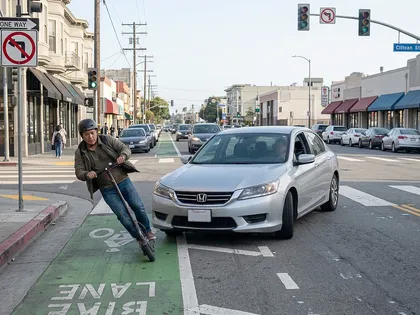
Individuals sharing the road with scooter riders, particularly drivers, can cause crashes when they act carelessly or recklessly. Every driver in California has a legal duty to share the road with scooter riders and to use reasonable care (Civil Code § 1714). Many fail that duty simply because they do not see the rider in time. Scooters are compact and low to the ground, making them easy to miss in a blind spot, at an intersection, or alongside a parked car.
Several driver behaviors appear in scooter crash cases:
- Failure to Check Blind Spots: A scooter can disappear behind a parked vehicle or fit entirely inside a driver’s blind spot. A driver who merges or changes lanes without checking may strike a rider they never saw.
- Dooring: When a driver or another vehicle occupant swings a car door open into traffic without checking for oncoming road users, they may injure a scooter rider.
- Distracted Driving: According to the NHTSA, when a driver traveling at 55 mph gets distracted for even five seconds, it’s like covering a distance that’s roughly the length of a football field with their eyes closed. A driver who texts, adjusts in-vehicle controls, or looks away for even a moment may not see a scooter in time to avoid hitting it.
- Right-Hook Turns: A driver who swings right across a bike lane, cutting off a rider going straight, forces the rider to absorb the full force of the collision with almost no warning.
Mechanical Failures and Defective Scooters Can Put Riders at Risk
Mechanical problems can cause a scooter to fail suddenly while a rider is using it. Brake malfunctions, broken stems, battery fires, and unexpected power loss can interfere with a rider’s ability to slow down, steer, or remain balanced. Some defects may develop due to wear, poor maintenance, manufacturing defects, or failures in electronic components or software.
How Establishing the Accident’s Cause Affects Your Claim
In California, if someone else causes an accident, they may be legally responsible for the resulting harm. To pursue a personal injury claim, however, you have to prove that their actions or inaction directly led to your injuries and losses. That’s why it’s so important to establish the cause of your scooter crash.
To begin with, the cause of your accident will determine the type of claim you need to file:
- Negligence Claims: An injured victim can file one if they can show that the at-fault party failed to exercise reasonable care and that the failure substantially caused the accident and resulting losses. An example may include a car driver or scooter rider driving while distracted and hitting a pedestrian, leading to a broken arm that required surgery and time off work.
- Dangerous Public Property Claims: If a road, intersection, pavement defect, or other condition of public property contributed to the crash, a victim may have a claim against a public entity. However, they must establish the following under Government Code (GOV) § 835:
- The public entity owned or controlled the property.
- The property was in a dangerous condition.
- The condition created a reasonably foreseeable risk of the type of injury that occurred.
- The condition was a substantial factor in causing the harm.
- Either a public employee created the dangerous condition through a negligent or wrongful act or omission, or the public entity had actual or constructive notice of the condition in time to take protective measures.
- Product Liability Claims: If the victim was injured by a defective product, such as a malfunctioning scooter component, they may be able to pursue a product liability claim against an appropriate manufacturer, distributor, retailer, or other commercial supplier. These parties may be held strictly liable under California law. That means the victim must show that the defect existed and substantially caused their injury, rather than proving ordinary negligence.
Identifying the correct cause of the accident also matters, as different filing deadlines may begin on the day of the crash. These can vary depending on the type of claim or lawsuit being filed. Missing the one that applies to your case could bar you from pursuing compensation altogether:
- Personal Injury: California generally gives you two years from the date of injury to file a personal injury lawsuit against a private party under Code of Civil Procedure (CCP) § 335.1.
- Property Damage: A lawsuit seeking compensation for damaged personal property is generally subject to a three-year statute of limitations (CCP § 338(c)(1)). For a scooter crash, this could include damage to the scooter, a phone, clothing, or other personal property.
- Claims Against Government Entities: A claim involving personal injury or property damage must be presented to the responsible government entity within 6 months (GOV) § 911.2. This administrative claim is generally required before filing a lawsuit against the public entity. If you miss this initial deadline, you may be permitted to file a late claim, generally within one year of accrual (GOV § 911.4). If that request is denied, court relief may be available (GOV § 946.6).
Because the applicable legal theory and deadlines depend on what caused the crash and who may be responsible, identifying what caused your accident early can help you preserve the correct claim. The scooter accident lawyers at Arash Law work to identify every liable party, challenge inflated fault assignments, and build the evidence your case needs. Call Arash Law at (888) 488-1391 for a free case review.
Frequently Asked Questions About Scooter Accidents in California
California’s scooter laws are technical, and scooter injury claims can be more complex than standard car accident claims. These are the questions that victims of scooter accidents in California ask most often.
Are Helmets Required When Riding Electric Scooters in California?
California requires motorized scooter riders under 18 to wear a properly fitted and fastened bicycle helmet. Riders age 18 and older are not required by state law to wear one. Even when a helmet is not legally required, wearing one can reduce the risk of serious head injury in a crash.
Where Am I Supposed to Ride an Electric Scooter on the Road?
In California, motorized scooter riders must use a Class II bike lane when one is established on the roadway, subject to limited statutory exceptions. On roads with speed limits above 25 mph, riders generally must remain within a Class II or Class IV bikeway unless local law specifically permits otherwise on roads with speed limits up to 35 mph. Motorized scooters generally cannot be ridden on sidewalks, except when necessary to enter or leave adjacent property.
Does My Car Insurance Cover Me When I Rent a Scooter?
Not necessarily. A personal auto liability policy generally does not cover you simply because you are riding a rental scooter. However, your uninsured or underinsured motorist coverage may apply if a motor vehicle hits you and the at-fault driver has no insurance or insufficient coverage, depending on your policy and whether you qualify as an insured. Medical Payments coverage may also depend on the specific policy terms.
CVC § 21224 exempts motorized scooters from financial-responsibility requirements, but that exemption does not determine what your personal insurance policy covers. Review your policy and endorsements to identify any available coverage.
How Do I Report an Electric Scooter Accident in California?
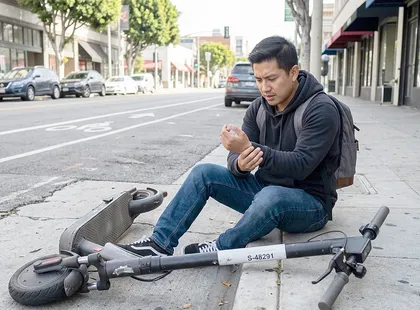
You can report an e-scooter crash by contacting the law enforcement agency responsible for the area where it occurred. For crashes on city streets, the agency will usually be the city police department.
If you were a driver involved in an electric scooter accident, and the crash resulted in an injury or death, you must report the accident to law enforcement within 24 hours (CVC § 20008). If the collision caused an injury, death, or more than $1,000 in property damage, you will also have to make a separate report to the California DMV by submitting an SR-1 form within 10 days of the incident.
Even when you are not legally required to report an accident, doing so promptly can help law enforcement create an official record of the crash.
Do Lawyers Only Get Paid If They Win a Scooter Accident Case?
Yes. In many scooter accident cases, personal injury lawyers work on a contingency fee basis, meaning they are paid only if they recover compensation for the client. This arrangement allows injured riders to hire a lawyer without paying up front.
What Does a Scooter Crash Do to Your Body?
A scooter crash can mainly affect your body by causing head and facial trauma, broken bones, wrist and arm injuries, leg injuries, sprains, cuts, and other serious harm.
A 2023 review of studies published in the databases of PubMed, Web of Science, EMBASE, and Cochrane concluded that fractures caused by e-scooter accidents primarily affect the forearm in the upper limbs and the shin in the lower extremities. Another common injury, found in 8 of the 11 studies reviewed, was the craniofacial fracture. The review’s authors noted that only 5.3% of patients in those studies were wearing helmets at the time of injury.
Can More Than One Party Be Liable for My Scooter Crash?
Yes. California’s pure comparative negligence rule allows fault to be allocated among multiple responsible parties.
Depending on the circumstances, potentially liable parties may include a negligent driver, a scooter manufacturer, or a commercial lessor if a defect contributed to the crash. A government entity may also share liability if a dangerous condition of public property caused the injury, and California’s statutory requirements are met.
Scooter Accident? Get Help from Arash Law Today.
A scooter crash can result in serious injuries and involve several potentially liable parties. Important evidence, such as rental records, maintenance histories, and software data, may not remain available indefinitely. Given these factors, it can be challenging to pursue a claim on your own, especially if you’re still healing from your injuries.
Arash Law has recovered over $1 billion for injured clients across California. Our attorneys can investigate the cause of your scooter crash, identify potential sources of compensation, and preserve the evidence needed to support your claim. Contact Arash Law today for a free case evaluation and find out what legal options may be available to you.
Call us at (888) 488-1391 for a free case evaluation. We work on a contingency fee basis, so there are no legal fees unless we recover for you.
Arash Law. Make Them Pay, Call AK.
Sources
- California Legislature. California Vehicle Code § 407.5: Definition of Motorized Scooter. https://leginfo.legislature.ca.gov/faces/codes_displaySection.xhtml?sectionNum=407.5.&lawCode=VEH
- California Legislature. California Vehicle Code §21224: Motorized Scooter Financial Responsibility Exemption. https://leginfo.legislature.ca.gov/faces/codes_displaySection.xhtml?sectionNum=21224.&lawCode=VEH
- California Legislature. California Vehicle Code §21229: Bicycle Lane Use Requirements for Motorized Scooters. https://leginfo.legislature.ca.gov/faces/codes_displaySection.xhtml?sectionNum=21229.&lawCode=VEH
- California Legislature. California Vehicle Code §21235: Equipment and Speed-Limit Operating Rules for Motorized Scooters. https://leginfo.legislature.ca.gov/faces/codes_displaySection.xhtml?sectionNum=21235.&lawCode=VEH
- California Legislature. California Government Code §911.2: Six-Month Government Claim Deadline. https://leginfo.legislature.ca.gov/faces/codes_displaySection.xhtml?sectionNum=911.2.&lawCode=GOV
- U.S. Consumer Product Safety Commission (CPSC). Micromobility Products-Related Deaths, Injuries, and Hazard Patterns: 2017–2024. https://www.cpsc.gov/s3fs-public/Micromobility_Products-Related_Deaths_Injuries_and_Hazard_Patterns_2017-2024.pdf
- National Highway Traffic Safety Administration (NHTSA). Distracted Driving. https://www.nhtsa.gov/risky-driving/distracted-driving
- White, E., et al. What Factors Contribute to E-Scooter Crashes: A First Look Using a Naturalistic Riding Approach. Journal of Safety Research, Vol. 85, 2023, pp. 182–191. ScienceDirect. https://www.sciencedirect.com/science/article/abs/pii/S0022437523000178
- California Legislature. California Civil Code § 1714: Responsibility for Injuries Caused by Lack of Ordinary Care. https://leginfo.legislature.ca.gov/faces/codes_displaySection.xhtml?sectionNum=1714.&lawCode=CIV
- California Legislature. California Government Code § 835: Liability for Dangerous Conditions of Public Property. https://leginfo.legislature.ca.gov/faces/codes_displaySection.xhtml?sectionNum=835.&lawCode=GOV
- Judicial Council of California. CACI No. 1200: Products Liability. California Civil Jury Instructions, 2026 Edition. https://courts.ca.gov/system/files/file/judicial_council_of_california_civil_jury_instructions_2026.pdf
- California Legislature. California Code of Civil Procedure § 335.1: Two-Year Statute of Limitations for Personal Injury. https://leginfo.legislature.ca.gov/faces/codes_displaySection.xhtml?sectionNum=335.1.&lawCode=CCP
- California Legislature. California Code of Civil Procedure § 338(c)(1): Three-Year Statute of Limitations for Injury to Personal Property. https://leginfo.legislature.ca.gov/faces/codes_displaySection.xhtml?sectionNum=338.&lawCode=CCP
- California Legislature. California Government Code § 911.4: Application to Present a Late Government Claim. https://leginfo.legislature.ca.gov/faces/codes_displaySection.xhtml?sectionNum=911.4.&lawCode=GOV
- California Legislature. California Government Code § 946.6: Petition for Relief from Government Claim Requirements. https://leginfo.legislature.ca.gov/faces/codes_displaySection.xhtml?sectionNum=946.6.&lawCode=GOV
- California Legislature. California Insurance Code § 11580.2: Uninsured and Underinsured Motorist Coverage. https://leginfo.legislature.ca.gov/faces/codes_displaySection.xhtml?sectionNum=11580.2.&lawCode=INS
- California Legislature. California Vehicle Code § 20008: Written Report Following an Injury or Fatal Traffic Accident. https://leginfo.legislature.ca.gov/faces/codes_displaySection.xhtml?sectionNum=20008.&lawCode=VEH
- California Legislature. California Vehicle Code § 16000: DMV Accident Reporting Requirement. https://leginfo.legislature.ca.gov/faces/codes_displaySection.xhtml?sectionNum=16000.&lawCode=VEH
- PubMed. Epidemiology of Fractures Following Electric Scooter Injury. National Library of Medicine. https://pubmed.ncbi.nlm.nih.gov/37214358/
- California Supreme Court. Li v. Yellow Cab Co., 13 Cal. 3d 804 (1975): California Pure Comparative Negligence Rule. https://scholarlycommons.pacific.edu/cgi/viewcontent.cgi?article=2458&context=mlr
Disclaimer
The information on this page is for general educational purposes and does not constitute legal advice. Reading or relying on this content does not create an attorney-client relationship. If you were injured, consult a licensed California personal injury attorney about your specific situation. Arash Law — (888) 488-1391.