TL;DR: Most car accident settlements in California take several months, though the timeline can vary based on injury severity, disputed fault, insurance cooperation, and whether a lawsuit is needed. Claims involving serious injuries or litigation often take longer due to medical treatment, evidence review, and legal deadlines.
Highlights:
- Get medical evaluation promptly and follow the treatment plan to document injuries.
- Photograph the scene, vehicles, and injuries; save repair estimates and receipts.
- Request the police report and collect witness names and contact information.
- Track medical bills, lost wages, and out-of-pocket expenses in one folder.
- Review both drivers’ coverage, including UM/UIM, MedPay, and umbrella policies.
- Follow up if the insurer misses 15-day acknowledgment or 40-day decision windows.
- Calendar 2 years for injury lawsuits, 6 months for government claims, 3 years for property damage.
Tip: Keep a dated symptom and activity log, and in all insurance communications stick to observable facts and avoid guessing.
Table of Contents
Most car accident claims in California resolve within several months. Some cases take longer, especially when injuries are severe, fault is disputed, or insurance companies delay negotiations. If a lawsuit becomes necessary, the timeline can extend to a year or more.
Delays often occur while insurers investigate the crash, review medical records, or assess liability. Understanding what affects settlement timing can help you plan and avoid unnecessary setbacks.
Typical Stages Of A Car Accident Claim In California
Every car accident case follows a similar process, though the time spent at each stage varies. Knowing what usually happens can help set realistic expectations.
- Medical Treatment and Documentation — After an accident, the priority is medical care. Injured individuals seek treatment and follow medical advice. During this stage, important records are gathered, including medical records, photos of the accident scene, documentation of vehicle damage, repair estimates, and the police report. These materials form the foundation of the claim.
- Insurance Investigation and Liability Review — The insurance company reviews the claim to determine responsibility for the accident. This may involve examining reports, reviewing vehicle damage, speaking with witnesses, and evaluating available evidence. This step focuses on how the accident happened and who may be legally responsible.
- Demand Letter and Settlement Discussions — Once medical treatment is complete or future care needs can be reasonably evaluated, a demand letter may be submitted to the insurer. The letter outlines the injuries, damages, and the basis for seeking compensation. Settlement discussions may follow, including offers and counteroffers.
- Resolution Through Settlement or Litigation — If the parties reach an agreement, the claim resolves through settlement. If negotiations do not result in an agreement, the case may proceed through the court system. Litigation involves formal legal procedures and court oversight.
Although many claims move through these stages, no two cases follow the same path. The process depends on factors such as the nature of the injuries, the evidence available, and how the parties respond at each stage.
Factors That Can Speed Up Or Delay A Car Accident Settlement

Several issues influence how long it takes to resolve a claim. Understanding these factors can help explain delays and avoid unrealistic expectations.
Here are common factors that can affect the timeline of your settlement:
- Case Complexity — Claims involving minor injuries and clear fault often resolve faster. Cases with serious injuries, multiple vehicles, or unclear liability usually take longer.
- Disputed Facts — When parties disagree about who caused the crash or the extent of injuries, insurers often take more time to investigate and negotiate.
- Parties’ Willingness to Compromise — Settlements move faster when insurers respond promptly and negotiate in good faith. Low offers or delayed responses can slow the process.
- Medical Recovery — Most claims are not resolved until medical treatment is complete or future care needs are clear. This helps ensure all medical costs are accounted for.
- Legal Action — If negotiations fail, the case may go to court. Lawsuits and court steps can stretch the process for months or even years.
These common factors can significantly affect the speed of your car accident settlement. When delays arise, many accident victims realize, “I need a personal injury lawyer to help manage the process.” Yes, a lawyer can provide guidance and help you comply with critical legal deadlines.
Key Deadlines That Affect A Car Accident Settlement Timeline
Certain legal and insurance deadlines play a big role in how quickly your case can move. Knowing these timelines can help you avoid delays and make sure your claim stays on track.
Insurance Company Timelines
Under California’s Code of Regulations, insurers must follow state-mandated timelines when processing claims. Here’s what you need to know:
- The insurer has 15 days to acknowledge receipt of your claim. During this period, they must also provide the necessary claim forms and instructions and begin investigating if necessary.
- After receiving all necessary documentation from you, they have 40 days to accept or deny your claim.
- If they approve your claim, the insurer should issue payment within 30 calendar days.
You can review your insurance policy to understand your coverage and timelines. If you have questions or feel your claim is delayed, consulting a lawyer can provide guidance and help protect your rights.
Statute Of Limitations For Car Accident Cases
California law typically gives you two years from the date of the accident to file a personal injury lawsuit. Missing this deadline can prevent you from recovering compensation.
Exceptions to keep in mind:
- If the accident involves a government agency, you typically have six months from the date of the incident to file a claim.
- If the injured party is under 18, the statute of limitations pauses. The victim generally has 2 years from the date of turning 18 to file a claim.
- If your vehicle or other property was damaged, the statute of limitations is generally three years from the date of the accident.
Acting promptly can give you enough time to gather evidence and build a strong case. Consulting a lawyer can also help keep track of crucial deadlines. However, the potential cost often leads people to wonder, “Do lawyers only get paid if they win?” If a lawyer works on a contingency basis, then they only get paid if they obtain compensation on your behalf.
Car Accident Settlement Negotiation Readiness Checklist
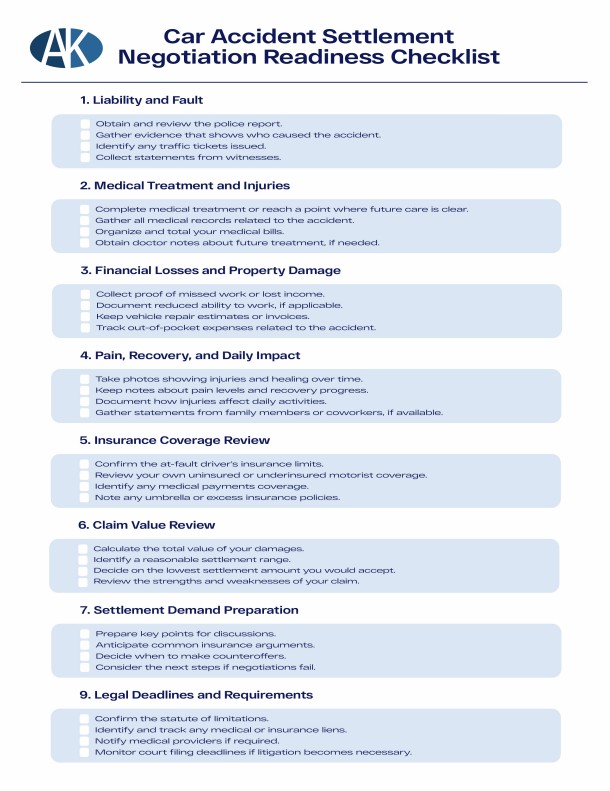
How prepared you are can affect how quickly a car accident settlement moves forward. Missing records, incomplete medical information, or unclear evidence can delay negotiations. This checklist helps you stay organized, respond to insurance requests faster, and approach settlement talks with confidence.
Here is a general checklist to guide you through the process:
- Liability and Fault
- Obtain and review the police report.
- Gather evidence that shows who caused the accident.
- Identify any traffic tickets issued.
- Collect statements from witnesses.
- Medical Treatment and Injuries
- Complete medical treatment or reach a point where future care is clear.
- Gather all medical records related to the accident.
- Organize and total your medical bills.
- Obtain doctor notes about future treatment, if needed.
- Financial Losses and Property Damage
- Collect proof of missed work or lost income.
- Document reduced ability to work, if applicable.
- Keep vehicle repair estimates or invoices.
- Track out-of-pocket expenses related to the accident.
- Pain, Recovery, and Daily Impact
- Take photos showing injuries and healing over time.
- Keep notes about pain levels and recovery progress.
- Document how injuries affect daily activities.
- Gather statements from family members or coworkers, if available.
- Insurance Coverage Review
- Confirm the at-fault driver’s insurance limits.
- Review your own uninsured or underinsured motorist coverage.
- Identify any medical payments coverage.
- Note any umbrella or excess insurance policies.
- Claim Value Review
- Calculate the total value of your damages.
- Identify a reasonable settlement range.
- Decide on the lowest settlement amount you would accept.
- Review the strengths and weaknesses of your claim.
- Settlement Demand Preparation
- Draft a clear demand letter.
- Attach all supporting documents.
- Explain why the other party is responsible.
- Set a reasonable response deadline.
- Negotiation Strategy
- Prepare key points for discussions.
- Anticipate common insurance arguments.
- Decide when to make counteroffers.
- Consider the next steps if negotiations fail.
- Legal Deadlines and Requirements
- Confirm the statute of limitations.
- Identify and track any medical or insurance liens.
- Notify medical providers if required.
- Monitor court filing deadlines if litigation becomes necessary.
A qualified California car accident lawyer can help organize this information, communicate with insurance companies, and advise on next steps if negotiations stall or legal action becomes necessary.
Tips To Avoid Unnecessary Delays In A Car Accident Settlement

After a car accident, the last thing you want is a long, stressful wait for your settlement. Here are some steps that can help you stay organized and avoid unnecessary delays:
- Document Everything — Take photos of the accident scene, vehicle damage, and injuries. Keep detailed records of medical treatments, expenses, and lost wages.
- Seek Prompt Medical Care — Get examined by a doctor. Even minor injuries should be checked. This step can link your injuries to the accident and create official medical records.
- Set Realistic Expectations — Understand typical timelines for personal injury claims. Avoid rushing into a settlement that may undervalue your case.
- Work with an Attorney — A car accident lawyer can guide you through the process. They can negotiate with insurance companies for a fair settlement. With legal help, you can avoid common mistakes that could delay your settlement.
- Be Honest and Consistent — Give accurate, consistent information to your attorney and insurance adjusters. Contradictions can weaken your claim.
- Avoid Admitting Fault — Never admit blame or speculate about the accident. Let your attorney handle communications and avoid giving recorded statements without them present.
- Consider Mediation or Arbitration — These options can resolve your claim faster if negotiations stall. They can help prevent lengthy court proceedings.
How Long Does It Take To Receive My Car Accident Settlement Payment?
After a settlement is reached and the required release forms are signed, payment is issued once the insurance company completes its processing and any necessary legal steps are finished. The timing varies based on the insurer’s procedures, whether an attorney is involved, and whether liens or other deductions must be resolved.
Several factors can affect when payment is released, including:
- The insurance company’s internal review and payment process.
- The method used to issue the settlement payment.
- Whether additional approvals or verification are required.
When an attorney is involved, the process typically includes:
- The settlement payment being sent to the attorney first.
- Deposit of the funds into a client trust account.
- Clearance of the funds before distribution.
- Resolution of medical liens, legal fees, and required deductions.
Once these steps are complete:
- The remaining settlement funds are released to you.
- Payment may be issued by check or electronic transfer.
Certain situations can extend the process, such as:
- Complex medical or insurance liens.
- Government-related liens that require additional review.
- Requests for additional documentation.
What Types Of Compensation Can I Pursue After A Car Accident?

If you got injured in a car accident in California, here are the types of compensation you may pursue in a claim:
- Economic Damages — These cover measurable financial losses caused by the accident, including:
- Medical expenses.
- Future treatment costs, including chiropractic care.
- Lost wages during recovery.
- Future lost earnings if injuries limit your ability to work.
- Property damage, including vehicle repair or replacement.
- Non-Economic Damages — These address the personal and emotional impact of the accident, such as:
- Pain and suffering related to physical pain and limitations.
- Emotional distress such as anxiety, fear, or mental anguish.
- Loss of companionship in cases of severe injury or wrongful death.
A lawyer can help evaluate the full value of your claim and pursue fair compensation for your losses. As a victim, you can support your case by keeping all medical records and bills. In addition, keep any documentation related to lost income or property damage.
Frequently Asked Questions On Car Accident Settlement Timelines
Navigating a car accident claim can be confusing without legal knowledge and experience. You can seek free accident lawyer advice to understand your options and your next steps at no cost. Read below for answers to common questions about car accident settlement timelines.
Does Accepting A Fast Settlement Reduce Compensation?
Most likely yes. Accepting a quick settlement often results in lower compensation than your claim may be worth. Initial offers from insurers may not fully account for all your damages and losses. Before accepting any settlement, consider consulting a lawyer. They can help you estimate the potential value of your claim.
Can I Settle My Car Accident Claim Before Finishing Medical Treatment?
Yes, it is legally possible to settle before treatment is complete. However, it is usually not recommended. Settling too early can leave future medical costs or long-term issues unaccounted for. Most attorneys advise waiting until you reach maximum medical improvement (MMI). This approach can help ensure the settlement reflects the full extent of your injuries.
How Long Does It Take To Get A Second Settlement Offer?
The timing of a second settlement offer varies from case to case. It often depends on how negotiations progress, how quickly the insurance company responds, and whether additional evidence or documentation is requested or reviewed.
When Should I File A Lawsuit Instead Of Negotiating?
Negotiation is usually preferred for its speed and lower cost. However, you can file a lawsuit instead of negotiating when:
- The other party denies accountability.
- The other party is uncooperative.
- You’ve suffered significant harm.
- You need court power to force the other side to share withheld information.
Who Determines Fault In An Auto Accident In California?
Insurance companies usually make the initial determination of fault. They examine evidence to determine who caused the accident. Then, they assign a percentage of responsibility. If the case goes to court, a judge or jury makes the final determination. Any compensation awarded is based on each party’s assigned percentage of fault.
Talk To An Experienced Car Accident Lawyer About Your Claim
The length of a car accident settlement process in California depends on the details of the case and applicable legal deadlines. A lawyer can help set realistic expectations based on your situation.
If you want to settle a car accident claim, Arash Law is here to help. Our car accident lawyers can handle the tough negotiations and organize all necessary documentation. We help address insurance delays and seek a fair settlement for your losses. Call AK Law today at (888) 488-1391 for a free initial consultation.