TL;DR: After a bicycle-car accident in California, immediately report the crash to authorities, gather evidence, and seek medical attention, even if you feel fine. Notify your insurance company and avoid admitting fault. Victims may be eligible for compensation for injuries, lost income, and property damage, depending on fault and evidence. Be mindful of reporting deadlines, including DMV notifications and legal filing timeframes. Cyclists should also be aware of comparative fault rules in California.
Highlights:
- Call the police and get an official crash report.
- Exchange contact and insurance details with all involved.
- Photograph injuries, vehicles, bike damage, and surroundings.
- Ask nearby businesses to save camera footage immediately.
- See a doctor promptly and follow treatment advice.
- Notify your insurer and keep records of your communications.
- File a DMV SR-1 within 10 days if required.
Tip: Stick to facts when speaking with insurers and avoid guessing about what caused the crash.
Table of Contents
After a bicycle-car accident in California, prioritize your health and safety by getting medical attention. Depending on the circumstances of your crash, you may also have to follow specific procedures when exchanging information with the other party and reporting the collision to the authorities.
If someone else’s negligence caused the accident, you can take further steps to support an insurance or legal claim. For example, you can capture photos of the scene and gather statements or contact information from any available witnesses. Promptly notifying your insurance company and seeking legal help can also help you understand how you may pursue compensation for your losses.
A bicycle-car accident can cause injuries that manifest later and affect insurance and legal rights. This guide explains what to do immediately and how California reporting rules (including those for submitting the DMV’s SR‑1 form) work. You’ll also learn about what mistakes to avoid, key deadlines to consider, and types of compensation to pursue.
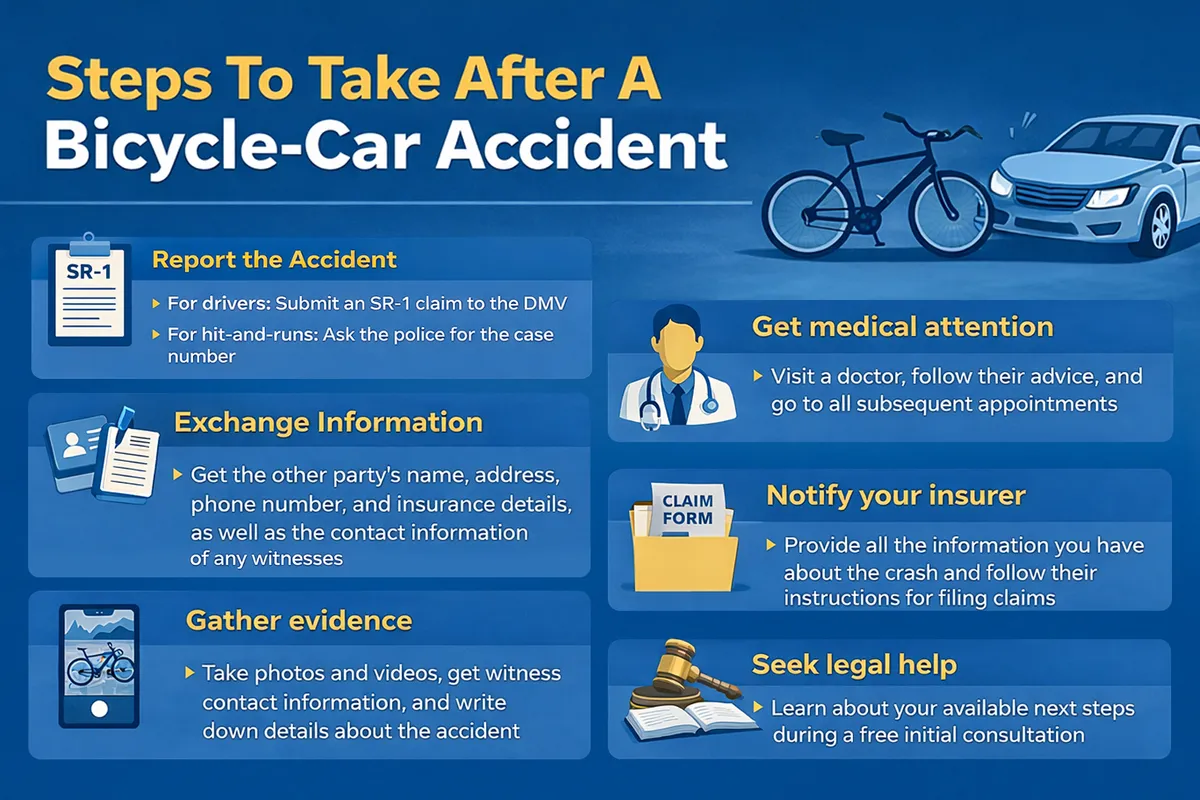
Steps To Take After A Bicycle-Car Accident
Being in a bicycle-car accident can leave you feeling shaken and unsure of what to do next. Taking specific steps afterward can help protect your health, your rights, and your financial well-being.
Below are the key actions you can take, whether as a cyclist or a driver:
Step 1: Report The Accident
If you have not yet reported the accident, contact the police immediately. Responding officers can create an accident report that can serve as an important record for insurance or legal purposes.
In severe accidents that require prolonged hospitalization, ask the police to come to your hospital so they can take your statement. Be sure to provide an accurate account of what happened.
If the police cannot come to the hospital, submit a written report to the police or California Highway Patrol (CHP) within 24 hours of the accident, or as soon as your condition allows.
To get a copy of the official accident report, find out which law enforcement agency handled the scene, such as:
- The local police department (city streets and local roads).
- CHP (freeways, state highways, and unincorporated county roads).
You can ask for the report directly from that agency. Nowadays, many agencies offer online services to make the request process easier.
Additional Steps For Car Drivers
- Notify the California Department of Motor Vehicles (DMV) by submitting an SR-1 report within 10 days of the crash. Otherwise, the DMV may suspend your driver’s license. This is a separate step from filing a police report, and you need to do it even if you’re not at fault. You’re generally required to file an SR-1 form after crashes that:
- Lead to injuries, no matter how minor.
- Result in fatalities.
- Cause property damage exceeding $1,000.
- If you were driving for a rideshare service like Uber or Lyft at the time of the crash, report the incident to your company as soon as possible. This step can usually be done through its app. Doing so ensures your company is aware of the incident and can guide you through its claims process.
Additional Steps For Cyclists If The Driver Flees The Scene
- Confirm that the police officially classify the incident as a hit-and-run.
- Ask the responding officer to check for any local Automated License Plate Reader (ALPR) cameras that may have captured the fleeing vehicle.
- Request a copy of the case number right away. You’ll need this information for your insurance claim.
Step 2: Exchange Information
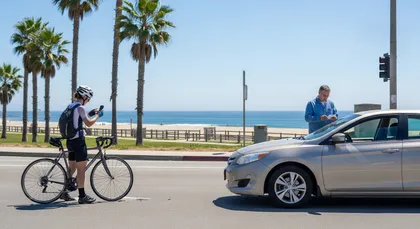
Exchange names, addresses, phone numbers, and insurance details with the other party involved in the accident. Be sure to note the make, model, and license plate of any vehicles.
If there are witnesses, politely ask for their names and contact information. Ask them to provide a summary of what they saw, if they’re willing, and record their testimony. Witness statements can help clarify what happened and support your version of events.
Step 3: Document The Scene And Gather Evidence
Take clear photos of:
- Your visible injuries.
- All vehicles involved.
- The bicycle and any visible damage.
- Property damage (such as to personal items).
Ask nearby businesses, homes, or bystanders if they have footage of the accident. Obtaining videos taken by security cameras, dashcams, or traffic cameras as soon as possible can be crucial, as many systems erase recordings in as little as 24 hours. If car or property owners can’t provide you with the necessary footage and require a police request, ask them to save the video in the meantime.
Additionally, write down details about the road conditions, weather, traffic signs, and anything else that might be important.
Step 4: Seek Medical Attention
Even if you feel fine, see a doctor promptly. Some injuries, such as concussions, internal bleeding, or soft tissue damage, may have delayed symptoms. They might only appear hours or even days after the accident.
Follow all medical advice from your doctor and attend any recommended follow-up appointments. Detailed medical records can serve as crucial evidence of your injuries when processing insurance or legal claims.
Step 5: Notify Your Insurance Company
Inform your insurance provider of the crash as soon as possible. Give them the details of what happened, including the police report number and any photos or documentation you collected. Follow their instructions for filing a claim and keep records of all your communications.
After you file your claim, the other party’s insurance company will evaluate the details. Be aware that you may face common issues such as:
- Delays or denial of the claim.
- Requests for additional information.
- Low settlement offers that do not fully cover your losses.
By notifying your insurer, you may be able to leverage benefits from your own policy. That could be helpful if you experience delays while pursuing compensation from the other party’s provider.
Step 6: Seek Legal Help
If you’re unsure about what to do or feel overwhelmed by the insurance process, consider getting legal help. You can seek free accident lawyer advice from an injury attorney with experience handling car or bicycle accident claims. They can guide you through the legal and insurance steps you need to take so you don’t miss anything important.
More specifically, bicycle and car accident lawyers can help:
- Review your case and explain your options.
- Collect and organize key evidence.
- Calculate your damages.
- File an insurance claim on your behalf.
- Handle case-related communications and negotiations with insurers.
- Represent you in court if your case goes to trial.
Many victims may hesitate to consult an attorney due to the cost of legal representation. In this case, they might ask, “Do lawyers only get paid if they win?” If they work on a contingency fee basis, as is the case with the attorneys at Arash Law, the answer is yes. Under this no-win, no-fee arrangement, you only pay them legal fees if they recover compensation for you.
What Not To Do After A Bicycle-Car Accident
Avoiding common mistakes after a crash can help protect your health, rights, and any potential claims. Here are things you should not do:
- Do Not Admit Fault at the Scene — Avoid making statements like “I’m sorry” or “It was my fault.” Insurers may use these statements to reduce your potential payout, as they imply that you’re taking blame for the crash.
- Do Not Post About the Accident on Social Media — Updates, photos, or comments, even if well-intentioned, may contradict the contents of your claim and could weaken your case.
- Do Not Delay Seeking Medical Treatment — Waiting too long to see a doctor or skipping follow-up appointments can harm both your health and your case. Insurance companies may argue that your injuries aren’t serious or weren’t caused by the crash.
- Do Not Repair or Dispose of Your Bicycle or Vehicle Too Early — Keep damaged property as evidence until your claim is resolved.
Understanding Fault, Deadlines, And Claims After A Bicycle-Car Accident
After a crash, questions about liability, filing deadlines, and financial recovery often move to the forefront. Insurance companies will investigate the facts and may dispute who caused the collision. Understanding how California law handles shared responsibility, time limits, and available damages can help you protect your right to compensation.
How Shared Fault Works In Bicycle-Car Collisions
Drivers are usually at fault in crashes, but cyclists can also share responsibility. For example, a driver may be primarily at fault for drifting into the bike lane. However, if the cyclist wasn’t wearing a helmet, they could be partially to blame for their injuries. In these situations, compensation is adjusted based on each person’s percentage of fault.
California follows the rule of pure comparative negligence. This rule states that multiple parties may share responsibility for an accident. That includes injured victims, who can still pursue compensation even if they’re up to 99% at fault. However, their share of responsibility reduces the amount they can recover. For instance, if they’re 20% at fault for the crash, they may only receive up to 80% of their total damages.
Who Is At Fault When A Cyclist Hits An Open Car Door?
When a cyclist crashes into an open car door, the person who opened it is often responsible. Drivers and passengers must check for approaching traffic, including bicycles, before opening a door into a roadway or bike lane. Failing to look for oncoming cyclists can make the vehicle occupant legally at fault for the collision.
However, fault can still be shared. If a cyclist was riding outside the bike lane without reason or traveling at an unsafe speed for the conditions, an insurer may argue that they contributed to the crash. In that case, California’s pure comparative negligence rules may reduce the amount of compensation the cyclist can recover.
Deadlines For Filing Personal Injury Lawsuits
If negotiations with insurance companies fail, you may need to take further legal action. In California, you usually have two years from the date of the accident to start a personal injury case. However, there are some exceptions to this legal deadline:
- The Victim Is a Minor — The countdown doesn’t begin until the person turns 18, giving them until their 20th birthday to file.
- A Public Entity Is Involved — If poor road conditions or a government vehicle contributed to the crash, you have six months to submit an administrative claim against the responsible agency. If the public entity rejects your claim, you have another six months from the date of the denial to file a lawsuit.
It’s crucial to act quickly. Missing the deadline for your case can cause you to lose your right to seek compensation. Due to the critical time limits and legal paperwork involved, you may think, “I need a personal injury lawyer.” Attorneys can determine how the statute of limitations applies to your situation and help you submit the necessary legal requirements on time.
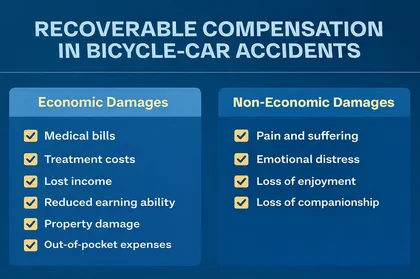
Recoverable Compensation In Bicycle-Car Accidents
Depending on the circumstances of the crash and evidence, you may be eligible for two main types of compensation:
- Economic Damages — These are the financial losses you can clearly document, such as:
- Medical bills for emergency care, surgery, and medication.
- Treatment costs for physical therapy or chiropractic care.
- Lost income from missed work.
- Reduced earning ability.
- Property damage.
- Out-of-pocket expenses.
- Non-Economic Damages — These cover the intangible impact the accident has on your life, such as:
- Pain and suffering from physical injuries.
- Emotional distress, such as due to anxiety, depression, or trauma.
- Loss of enjoyment of life if you can no longer participate in certain activities.
- Loss of companionship.
Keep in mind that the amount of compensation you may recover depends on several factors, including:
- The severity and long-term impact of your injuries.
- Whether ongoing care or rehabilitation is needed.
- The percentage of fault assigned to each party.
- The quality of your evidence.
Frequently Asked Questions About What To Do After A Bicycle-Car Accident
Below are answers to the most commonly asked questions about bicycle-car accidents.
How Much Does A Personal Injury Lawyer Charge In A Bicycle-Car Accident Case?
The legal fees for a bicycle-car accident case can vary based on its complexity, such as whether it requires more preparation or needs to go to trial. The amount you pay a personal injury lawyer can also depend on the payment agreement they use. Some attorneys charge by the hour, require a retainer, or use a sliding fee scale.
Many personal injury lawyers in California work on a contingency fee basis. This fee structure means you don’t pay anything up front. Your lawyer only gets paid a pre-agreed-upon percentage if you win your case or secure a settlement.
What If The Bicycle-Car Accident Occurred During A Group Ride Or Event?
If you get injured in a bicycle accident during a group ride or event, your legal rights are the same as in any other bike crash. However, liability can get complicated. Organizers or sponsors might be responsible if their actions or lack of safety measures contributed to the bicycle-car accident. For example, they might not have posted clear signage to help drivers detour around an event’s route. Other cyclists could also share some of the blame.
Group rides often involve many people and different insurance policies. As a result, figuring out who is liable can be more challenging. Statements from other participants can help clarify how the accident happened.
Can I Still File A Claim If The Bicycle-Car Accident Happened On Private Property?
Yes. The location of a crash does not prevent you from seeking compensation if someone else’s negligence caused your injuries.
Accidents on private property can involve additional parties. For instance, suppose the bicycle-car accident occurred in a mall parking lot. The mall owner or parking lot manager might be responsible if unsafe property conditions contributed to the crash. These cases may fall under premises liability. As a result, different laws and insurance policies could apply. An attorney can explain how that could impact the claims process in your situation.
If I Weren’t Wearing A Helmet, Could I Still Recover Damages?
Yes, you can still seek compensation even if you weren’t wearing a helmet at the time of the accident. Not wearing a helmet does not automatically remove the driver’s responsibility if their negligence caused your injuries.
However, under California’s comparative fault law, your compensation could be reduced. For example, insurers could argue that wearing a helmet would have reduced the severity of your injuries.
What Insurance Options Do I Have If The Driver Flees The Scene?
If the driver fled the scene and can’t be located, you may still have options for covering your expenses, including:
- Uninsured Motorist (UM) Coverage — Your auto policy’s UM coverage may compensate you for your losses if the at-fault driver can’t be found, even if you weren’t in a car when the crash happened. However, California law doesn’t require drivers to carry it. If this is the case and you don’t have UM coverage, check if you’re covered under a household member’s policy.
- Medical Payments (MedPay) — If it’s part of your auto insurance, MedPay can help cover urgent medical bills after an accident, regardless of who was at fault.
- Health Insurance — Health insurance can also help pay for your medical expenses after a bicycle-car accident. This coverage typically includes doctor visits, hospital care, surgery, prescriptions, and rehabilitation.
Check your insurance policies and contact your insurer to confirm whether any of the above may apply.
Talk To A Legal Professional After A Bicycle-Car Accident
The aftermath of a bicycle-car accident can be overwhelming. You might be facing medical bills, lost wages, or uncertainty about how to move forward. It can also be challenging to navigate insurance claims and understand your legal rights. Speaking with an attorney can help you understand your options and make informed decisions for your future.
Our car and bicycle accident lawyers can guide you through the process, so you don’t have to handle everything on your own. If you have questions and want to know your next steps, reach out to AK Law. Our legal team can help you seek compensation for your injuries and related losses. Call (888) 488-1391 for a free initial consultation.