TL;DR: After a slip and fall at Yoshinoya, you may have grounds for a personal injury claim if negligence is proven. California businesses must keep their premises safe, and failure to do so may result in compensation for the injured.
Highlights:
- Get medical care immediately, even for minor injuries.
- Report the incident to the manager and request a written report.
- Document the accident scene with clear photos and witness details.
- Seek medical follow-ups to support your injury claim.
- Save all medical records, receipts, and related communications.
- Consult a personal injury lawyer for legal guidance and a potential claim.
Tip: Stick to the facts when discussing the incident and avoid admitting fault.
Table of Contents
If you slip and fall at a Yoshinoya, you may sustain injuries to your back, hips, wrists, arms, or head. Any resulting bruises, sprains, fractures, or internal damage can lead to financial and personal losses. If Yoshinoya’s failure to keep the restaurant safe caused the accident, you may be eligible to file a premises liability case against it.
Under California law, businesses, including restaurants, have a duty to exercise reasonable care in maintaining a safe environment for visitors, such as diners. This responsibility includes regularly inspecting the property, addressing hazardous conditions, and warning patrons of dangers that are not immediately obvious.
If there is evidence that negligence caused your slip and fall at Yoshinoya, you may have the right to file an injury claim with the business.
How Premises Liability Applies After A Slip-And-Fall At Yoshinoya
California’s premises liability law states that entities controlling a property have a legal duty to keep visitors safe from harm. This statute also extends to businesses like Yoshinoya. The restaurant must keep its premises safe by:
- Regularly inspecting its locations and addressing any dangerous conditions that violate industry safety regulations.
- Cleaning up immediate hazards, such as spilled food or drinks.
- Posting clear signs to warn customers and employees about dangers it cannot address right away.
When it comes to premises liability cases, the concept of notice is generally considered:
- Actual Notice: The restaurant or an employee knew about the hazard before the accident. For example, an employee saw the spill themselves, or a customer reported it to a manager.
- Constructive Notice: Staff did not know, but should have known, about a hazard if they had used reasonable care. Evidence such as maintenance logs can help prove that the safety issue existed long enough for a proper inspection to have discovered it.
Slip-and-fall lawyers who handle Yoshinoya restaurant accidents evaluate surveillance footage and maintenance logs to determine whether these legal requirements are met. This evidence can help demonstrate notice by:
- Establishing how long a hazard was present before the slip-and-fall occurred.
- Showing how close Yoshinoya employees were to the dangerous condition prior to the accident.
- Confirming the frequency at which restaurant staff conducted safety inspections and maintenance on the property before the incident.

What To Do After Slipping And Falling At Yoshinoya
After a slip and fall at a Yoshinoya restaurant, stay calm and look around. Look for the hazard that caused you to slip. Afterward, prioritize your health and well-being above all else. Once you’ve ensured your safety, consider the legal implications of your accident.
Here’s a brief overview of what to do when you slip and fall in a restaurant like Yoshinoya:
- Get Medical Care: Your health comes first. Ask for help to get to the nearest infirmary or hospital. If you are seriously hurt, call 911 for emergency assistance. You can ask someone to do it for you if you’re unable to. If your injury seems less severe, see a doctor as soon as possible, preferably on the same day.
- Report the Incident: After addressing urgent medical needs, report the incident to the owner or manager. Ask them to complete a written incident report, and request a copy for your records. Notifying the restaurant may help, especially if there are no witnesses to your slip-and-fall accident. Here are a couple of details you can provide about the incident:
- How the fall happened.
- Specific hazards, such as a wet floor, a loose mat, or damaged tiles.
- Document the Accident Scene: Gather evidence that can help your slip-and-fall case. For example, you can:
- Take clear photos of where you fell, including any spills or floor damage. If possible, capture these images from different angles and distances.
- Get the names and contact information of any witnesses. Write down every detail you remember about the accident, and note any locations where CCTV cameras might have captured what happened.
It is best not to admit fault or apologize for the incident, even if you feel unsure about what happened. You should also refrain from minimizing or dismissing your injuries right after the accident. You may not discover their extent until you get a proper medical evaluation. Knowing what to do after a slip and fall accident at a restaurant can help your potential claim.
What To Focus On Days After A Yoshinoya Slip And Fall Accident
In the days following a slip-and-fall, take extra medical precautions to support your recovery. Additionally, gather relevant documents and consult a lawyer if you decide to pursue a claim. Here’s a brief overview of what to focus on after getting injured at Yoshinoya:
- Get Medical Follow-Ups: Review the results of any diagnostic tests with your doctor and follow their treatment plan for your injuries. You may need physical therapy, chiropractic care, medication, or surgery. Finally, continue attending appointments throughout your recovery. These actions can help you show Yoshinoya’s insurer that your injuries were caused by the accident, that they needed urgent care, and that you’re actively addressing them using recommended treatments.
- Keep All Records: Continue documenting everything after the fall. Save all medical records, bills, receipts, and notes about your injuries and recovery. Additionally, keep copies of all communications with the restaurant. These include incident reports, emails, and written statements. Yoshinoya restaurant accident lawyers can use these documents to estimate the value of your claim and help you pursue compensation, if you have a case.
- Consult an Attorney: If you are still confused about what your possible options are after getting injured, consider seeking free accident lawyer advice. Professional legal guidance can help you understand your rights after a slip-and-fall at a Yoshinoya.
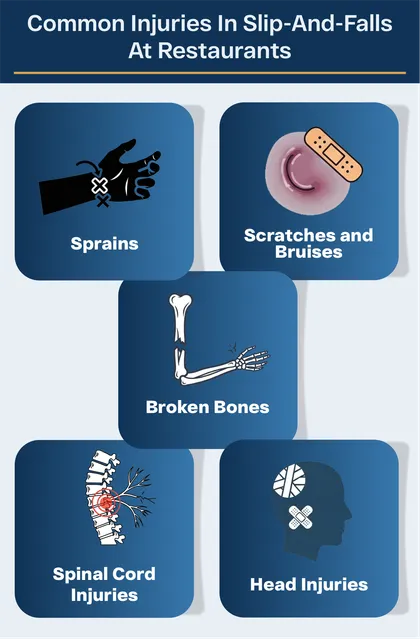
Common Injuries Sustained In Fast-Food Premises Liability Cases
Premises liability cases involving fast-food chains like Yoshinoya commonly involve injuries ranging from minor bruises to severe head trauma. Their nature and extent will depend on the specific circumstances of the incident. These can include the direction in which you fell and the surface you landed on. However, you’re more likely to sustain some injuries than others.
Here are some of the most common ones:
- Sprains: Can develop when a person twists an ankle or wrist on a wet or uneven surface. These injuries often happen when someone tries to catch themselves during a fall, placing sudden stress on their joints.
- Scratches and Bruises: May result from hitting tables, chairs, counters, or hard flooring. A person may also injure their arms or shoulders as they fall or attempt to steady themselves.
- Broken Bones: Can occur in the arms, legs, wrists, or ribs after a hard impact with the floor or other objects. Hip fractures are especially common when someone lands heavily on their side. Older adults are generally more vulnerable to these types of injuries.
- Spinal Injuries: Can damage the back or spine, particularly if the person lands awkwardly. In severe cases, spinal cord injuries can cause long-term complications.
- Head Injuries: May occur if a person strikes their head on a table, chair, or the floor. These injuries can range from mild concussions to more serious traumatic brain injuries, depending on the force of the impact.
Losses Victims Experience After A Yoshinoya Slip And Fall Accident
Beyond physical pain, many slip-and-fall accident victims sustain financial and emotional losses. If you can prove Yoshinoya’s negligence, you may seek damages from them. You may thus be wondering about what kinds of compensation you can pursue or how much you can get from suing the restaurant. The answers to these questions depend on the actual losses you incurred.
Generally, you can seek compensation for:
- Economic Damages: These are costs that can be clearly measured, such as:
- Medical bills for emergency room visits, diagnostic tests, surgery, therapy, and future treatment.
- Lost wages if you missed work, and future lost income if you cannot return to your job.
- Property damage, such as broken glasses, clothing, or personal items caused by the fall.
- Non-Economic Damages: These cover losses that do not have a set dollar amount, including:
- Physical pain and suffering.
- Emotional distress, such as anxiety or depression caused by the accident.
- Loss of enjoyment of life if you can no longer take part in activities you used to enjoy.
If you have a valid claim, you may be able to seek these damages through:
- An Insurance Claim: You can file it against the at-fault party’s insurer. In restaurant slip-and-falls, the responsible party can be the business owner, the building owner, or a third-party contractor. Some businesses carry commercial general liability (CGL) insurance, which may cover incidents like this. Whether it applies depends on the specific circumstances of the accident and the terms of the restaurant’s policy.
- A Personal Injury Lawsuit: Filing a civil case may be necessary if the business does not have sufficient or applicable insurance, or if your losses go beyond the policy limits. It may also be appropriate when there are disputes about who is responsible for the accident.
Can I Sue Yoshinoya If I Slip And Fall In Their Restaurant?
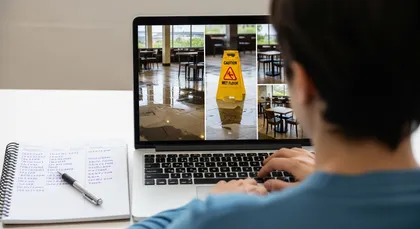
You may be able to sue Yoshinoya directly if there is clear evidence that its negligence caused your slip and fall. Under California’s premises liability law, restaurant owners must keep their premises reasonably safe for visitors. When incidents occur at fast-food chains like Yoshinoya, the franchisee or corporate entity is responsible for addressing hazards and complying with safety protocols.
To have a valid case, you must show the following elements of negligence:
- Duty: Yoshinoya had a duty to keep the property reasonably safe for legal visitors, such as diners and employees.
- Breach: The restaurant failed to meet that duty, such as by not posting a wet floor warning sign or cleaning up a spill. Legal considerations include actual and constructive notice when determining if there is a breach of duty.
- Causation: This breach directly caused your slip-and-fall injury. For example, you slipped on an unmarked wet floor and hurt your back. Medical records and witness statements can help prove this.
- Damages: You suffered actual harm, such as medical bills, lost wages, or pain and suffering.
If these legal elements are present, along with strong pieces of evidence that negligence caused the slip and fall accident at Yoshinoya, you may be able to pursue a personal injury claim.
Liability In Yoshinoya Restaurant Slip And Fall Accidents
Liability in restaurant slip and fall accidents often falls on the party with control over the property. Given this, Yoshinoya itself is usually responsible. However, since it’s also a fast-food chain, the restaurant’s franchisees could also face liability. In some cases, third parties, such as maintenance companies, may share fault.
Lawyers, insurers, and courts may also consider California’s pure comparative negligence rule. Under it, multiple parties can share fault for an accident. While the restaurant and any franchisees are typically liable, other parties can also be involved:
- Building Owner: If they allowed hazards to remain on the property.
- Maintenance Companies: If they created unsafe conditions through their work.
- Contractors or Installers: If they introduced hazards through flooring, lighting, or other installations.
Note that injured victims can also contribute to a Yoshinoya slip-and-fall. Under pure comparative negligence, they can still seek compensation, even if they’re up to 99% at fault. However, a court can reduce your compensation by your percentage of liability. For example, if you’re 10% responsible because you ignored a wet floor sign and your total damages are $10,000, you may only receive $9,000.
Finally, for a premises liability claim to be valid, notice is essential. That means the restaurant must have known, or reasonably should have known, about the hazardous condition, but failed to correct it within a reasonable time. Safety issues Yoshinoya may have ignored include:
- Wet Floors Without Warning Signs: Freshly mopped floors or spilled drinks can be very slippery. Leaking air conditioners and puddles of rainwater by entryways can also create slick surfaces. If staff fail to put up warning signs or block off the area until it is dry, customers may not realize the floors are still wet.
- Loose Rugs or Mats: Loose rugs or mats left in walking paths can cause people to trip. It is the restaurant’s duty to remove or secure these hazards.
- Grease or Food on the Floor: Grease from the kitchen or dropped food can make floors slick. Food spills are common in dining areas, especially when customers come and go. Both customers and staff can be at risk when these slip hazards are left unattended.
- Unsafe Stairs or Ramps: Stairs without handrails, proper lighting, or non-slip surfaces are dangerous. Restaurants must maintain stairs and clearly mark any changes in floor level.
- Poor Lighting: Dim lighting can make it hard to see hazards, such as uneven flooring or objects in the walkway. Proper lighting helps prevent restaurant accidents.
Employees, management, contractors, and building owners can be responsible for these hazards. When identifying who may be at fault, premises liability lawyers often consider who was in charge of fixing the dangerous condition that injured you.
Frequently Asked Questions About Yoshinoya Slip-And-Falls
When a slip-and-fall occurs unexpectedly in a public place, such as Yoshinoya, the situation can quickly become complicated. Below are some of the most commonly asked questions about these incidents.
What If The Injured Person Is A Worker?
Employees at Yoshinoya, such as kitchen staff or servers, may be eligible for workers’ compensation benefits if they are injured on the job. This coverage can help cover medical expenses and a portion of lost wages, regardless of who was at fault.
Injured employees may also have the right to file third-party claims in limited scenarios. For instance, they could seek compensation from an individual or entity not affiliated with Yoshinoya, such as a contractor, that caused the accident. These claims would allow them to pursue non-economic damages such as pain and suffering in addition to medical expenses and lost income.
Do I Need A Personal Injury Lawyer After A Slip-And-Fall At A Yoshinoya?
In many cases, especially complex ones, having legal representation can help. Some evidence can be challenging to obtain on your own. A slip-and-fall lawyer can subpoena relevant supporting records, such as surveillance footage that may be overwritten after just a few days. They can also secure official eyewitness statements on your behalf.
How Long Do I Have To File A Claim After A Yoshinoya Restaurant Accident?
In California, an injured victim has two years from the date of the accident to file a personal injury claim. However, there are some exceptions to this rule:
- Victims Who Are Minors: The time limit will not start until their 18th birthday.
- Delayed Discovery of Injuries: The statute of limitations may instead begin on the date that the injury was discovered or should have been reasonably discovered.
If you’re a Yoshinoya employee who slipped and fell on the job, the rules are different. First, you must report the accident to your supervisor or employer within 30 days. Reporting on the same day is recommended whenever possible. After reporting, you have one year from the date of the accident to formally file a workers’ compensation claim with the employer’s insurance provider.
How Much Is My Yoshinoya Slip-and-Fall Claim Worth?
It depends on the specifics of your case. When estimating the value of your claim, Yoshinoya slip and fall accident lawyers will likely consider the following factors:
- Injury severity
- The duration of your physical recovery
- The costs of future medical care
- Lost wages and reduced earning capacity
- Whether comparative fault applies
- The limits of the at-fault party’s liability coverage
Consider Legal Help After A Slip-And-Fall At Yoshinoya
Slip-and-fall accidents at Yoshinoya can happen for many reasons. Wet or uneven floors, spills, poor lighting, crowded walkways, and poorly maintained areas are common hazards. The restaurant may face liability because it has a legal responsibility to keep its premises safe for customers.
If you have reason to believe that negligence caused your slip-and-fall accident at a Yoshinoya, Arash Law can provide legal support. We can gather evidence and help you determine your legal options. If your concern is, “Do lawyers only get paid if they win?”, our Yoshinoya restaurant accident lawyers at AK Law can explain our contingency fee arrangements in detail. Under this no-win, no-fee policy, we only get paid if we obtain compensation for you. Call us at (888) 488-1391 for a free initial consultation.