TL;DR: Rainy weather reduces visibility and traction, making it harder to spot hazards. Drivers who don’t adjust their speed or braking increase accident risks. Liability often depends on negligence, such as speeding or poor vehicle maintenance. Key evidence includes photos, police reports, and weather data.
Highlights:
- Rain reduces visibility and increases road slipperiness, raising accident risks.
- Hydroplaning occurs when water builds up between tires and the road surface.
- Accidents in the rain often result from speeding, tailgating, or poor vehicle maintenance.
- Key evidence includes weather data, photos, and maintenance records to prove negligence.
- California’s negligence laws apply to rain-related accidents, with damages based on fault.
Tip: Preserve weather data, witness statements, and vehicle maintenance records to support your claim.
Table of Contents
People drive badly in the rain due to poor visibility and reduced traction on wet pavement. Many motorists fail to adjust to these conditions. Instead, they use the same techniques for driving in normal weather, even if wet roads introduce new accident hazards. If they cause a crash, the fact that it was raining won’t excuse them from facing liability.
This article explains why driving in the rain can lead to more crashes. Afterward, it dives into how these collisions can create legal issues and insurance disputes in California. Finally, it outlines what evidence rain-related car accident victims can gather after a crash. With the right proof, you may be eligible to pursue compensation from someone who drove badly in a downpour and injured you, even if you share fault for the crash.
Why Rain Makes It Difficult To Drive
Rainy weather can make driving more challenging by reducing visibility and creating slick surfaces. These factors can make it harder to spot and respond to hazards in time to avoid a crash. Accident risks increase when drivers don’t adapt their behavior, such as by speeding, tailgating, or neglecting maintenance.
To understand why rainy conditions are so dangerous, it’s essential to examine both environmental risks and how driver behavior contributes to crashes.
Major Risks Drivers Face During Rainy Weather
Driving in rainy weather increases the risk of accidents due to reduced visibility, slippery roads, hydroplaning, and hidden hazards. These conditions make it harder to see, control your vehicle, and react to dangers, leading to more crashes and injuries.
Here’s more on why these factors make driving in the rain riskier:
Decreased Visibility
Rain and mist can build up on windshields and windows, making it hard to see the road or other vehicles. Passing cars may also spray dirty water onto windshields, further blocking a driver’s view of the road.
In these cases, where drivers must constantly use windshield wipers to keep the road in view, the California Vehicle Code requires them to use their headlights. However, headlight glare on wet pavement can make visibility even worse, especially at night.
Slippery Roads
Rain can mix with oil and dirt on the road, creating slippery surfaces that reduce tire grip. With less traction, vehicles need a longer distance to stop safely. Drivers who suddenly brake or make sharp turns on slick roads can also lose control. Skidding may occur at high speeds.
As a result, drivers may fail to adjust their stopping distance, resulting in rear-end crashes. These can be particularly common during the First Rain Phenomenon, the first rainfall at the end of a long dry season. In California, a state that frequently experiences this weather event, oil and dirt can mix with water, creating slick pavements during the first 15 to 20 minutes of these downpours.
Hydroplaning
Hydroplaning happens when a layer of water builds up between the tires and the road. As a result, your vehicle may lose direct contact with the pavement, making it more likely for you to skid or slide uncontrollably. Drivers who panic or apply emergency braking techniques may lose control of their vehicle more quickly.
The risk of hydroplaning increases if:
- You’re traveling above 35 mph.
- You have to drive through deeper water.
- Your tires are worn or underinflated.
Hidden Road Hazards
Rainwater may cover deep potholes, debris, or uneven pavement. Hitting or driving through these hidden hazards can damage a vehicle or cause a driver to lose control. Heavy rain can also blur lane markings and make traffic signs harder to see, increasing the risk of crashes.
Flooded areas may also conceal washed-out sections of road. Your vehicle could get stuck or damaged if you drive into these hazards. In some cases, moving water can even sweep it away. After such incidents, victims may be able to file a claim against a government agency. Public entities such as Caltrans are typically responsible for road maintenance and may face liability if dangerous road conditions cause a rain-related accident.
How Driver Behavior Contributes To Bad Driving In The Rain
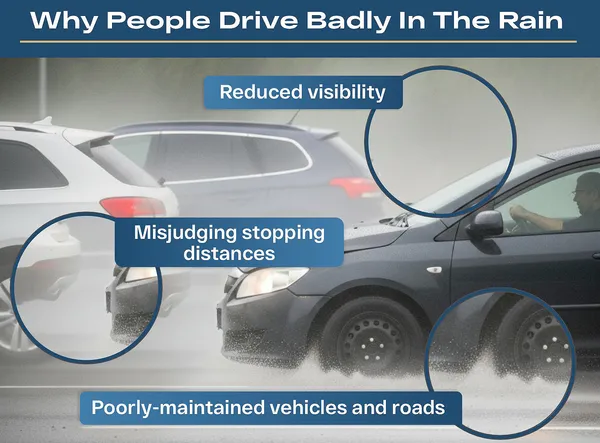
Due to the above factors, the Federal Highway Administration reports that more than 77% of weather-related crashes occur when it’s misty or raining. The risk of these accidents increases when drivers don’t adjust to these conditions. For example, they may speed, tailgate, or neglect basic vehicle maintenance.
Here are some behaviors that lead to poor driving in the rain:
- Overconfidence: Overconfident drivers may continue driving as if conditions are dry. They might not slow down or maintain a safe following distance. Failing to account for the increased braking distance in rain raises the risk of rear-end crashes.
- Operating a Poorly Maintained Vehicle: Neglecting to repair or replace tires, windshield wipers, or brakes makes vehicles less safe to use in rainy weather. For example, poorly-maintained car parts could make it more difficult for drivers to maintain control on slick pavement, keep windshields clear, or stop in time to avoid a crash.
- Misjudging Stopping Distances: Many drivers underestimate how much longer it takes to stop on wet roads. They often follow the vehicle in front of them too closely or brake too late. This mistake can cause more rain-related rear-end collisions.
- Reckless Driving: Some drivers continue to drive carelessly in the rain. They may weave through traffic. They might also speed up or abruptly slow down. These actions further raise the risk of them losing control and causing an accident.
The Legal And Insurance Implications Of Rain-Related Car Accidents
If a driver’s actions cause a rain-related car accident, injured victims may seek compensation from them under California law. The outcomes of their personal injury claims will depend on how drivers responded to the weather and on the available evidence of the crash.
Rain-related car accidents can put multiple road users at risk. These include:
- Drivers of other vehicles, such as cars and trucks
- Road users with less external protection, such as cyclists and motorcyclists
- Passengers of private and commercial vehicles, such as family members and rideshare customers
- Pedestrians
Insurers and courts typically examine negligence, driver conduct, and reliable proof when assessing fault. They may apply the state’s comparative negligence rule if multiple parties contributed to the accident. This law allows them to assign a percentage of liability to each responsible individual or entity.
Who Can Be Liable In Rain-Related Vehicular Accidents?
Potentially liable parties in rain-related vehicular accidents include drivers, car parts manufacturers, and government agencies. The state’s negligence laws determine whether they’re legally responsible for an injured party’s losses. In other words, lawyers and claims adjusters assess whether someone took reasonable steps to prevent harm in rainy conditions.
Here’s how each party may be responsible in a rain-related crash:
- Drivers: Most often liable if they fail to adapt speed, distance, or driving habits to poor weather. Common negligent behaviors include:
- Not slowing down
- Following too closely
- Driving with worn tires or faulty wipers
- Driving under the influence
- Commercial Vehicle Operators or Employers: May be responsible if a commercial driver caused the crash. Examples include delivery drivers, truckers, and independent contractors working for rideshare companies such as Uber or Lyft.
- Car Parts Manufacturers: Could be at fault if the accident was caused by defective car parts, such as:
- Faulty brakes
- Airbags that deploy unexpectedly
- Steering wheels that lock up
- Government Entities: Cities or states may be liable for:
- Poor road design
- Inadequate maintenance
- Lack of proper signage or drainage
However, the law requires victims to prove that these negligent actions caused a crash. To pursue compensation for medical expenses, lost wages, and other related losses, they must demonstrate these four elements:
- Duty: The at-fault party owed them a duty of care. To illustrate, all motorists must drive safely to avoid harming other road users.
- Breach: The at-fault party breached that duty. One example is drivers failing to adjust to road conditions in rainy weather.
- Causation: The breach directly caused the accident. For instance, a driver who accelerated without warning hydroplaned and hit a car in another lane.
- Damages: The victim sustained actual losses, including medical bills incurred and the pain and suffering they experienced due to their injuries.
Navigating Insurance Claims For Rain-Related Accidents
In California, insurance claims for rain-related car crashes typically follow the same process. Injured victims report the incident, gather evidence of their losses, and submit a demand letter for compensation. The type of insurance policy and the circumstances of the crash generally determine the available coverage. If another driver is at fault, their auto policy usually covers the losses.
Insurers examine weather-related accidents carefully. They may deny or reduce a claim by arguing that the rain was the primary cause of the accident, not the at-fault party’s conduct.
Other common arguments from insurers include:
- Claiming the accident occurred solely because of the rain.
- Arguing that the injured driver failed to exercise reasonable caution.
- Asserting that greater caution could have prevented the crash.
The California Department of Insurance requires insurers to handle claims fairly. Insurers typically cannot deny a claim without a reasonable basis. For example, they can cite and explain the law or policy on which they are basing their denial of the claim.
How Insurers And Courts Decide Fault And Compensation

In California, both insurers and courts apply the pure comparative negligence system to car accident claims. They assign fault percentages to each party based on the details of the collision. This method ensures a fair distribution of liability and damages, even when multiple parties are involved.
However, there are cases in which insurers and courts find the injured party partially responsible. In these scenarios, the victim’s compensation can be reduced by their percentage of fault. For example, suppose a driver crashes into you while tailgating. However, you’re found 20% liable because you braked without warning. You may only receive 80% of your total damages.
When determining fault, courts and insurers may consider whether each driver met their responsibilities on the road. Typical expectations include:
- Complying with California’s Basic Speed Law (established by Section 22350 of the state’s Vehicle Code) by adjusting speed below posted limits when conditions require.
- Maintaining vehicles, especially safety equipment.
- Monitoring changing weather conditions and postponing trips when needed.
Courts and insurers may assign more fault to motorists who ignore severe weather warnings. Driving carelessly in dangerous conditions can also increase a driver’s share of liability.
What Evidence Matters In Rain-Related Accident Claims
Key evidence in rain-related accident claims includes photos of the scene, police reports, and witness statements. Insurers and courts look for proof that weather played a role in the crash. They also check if drivers acted responsibly and whether anyone’s negligent actions contributed to an accident.
Other useful evidence to gather includes:
- Footage from dashboard, traffic, or security cameras
- Black box (EDR) data showing speed and braking.
- Weather reports from the time of the crash.
- Vehicle inspection documentation, such as tire and wiper maintenance records.
- Expert opinions on accident reconstruction and weather conditions.
- Phone records that could support distracted driving claims.
- Detailed medical documentation.
To prove that weather conditions were poor at the time of the crash, you can source data from reliable sources, such as:
- Transportation Injury Mapping System (TIMS): A free tool from UC Berkeley that tracks traffic injury data from across California.
- California Highway Patrol (CHP) Records: Can provide official accounts of the rain-related crash.
- National Oceanic and Atmospheric Administration (NOAA) Storm Events Database: Details severe weather patterns, which may be used to confirm the intensity of a downpour at the time of the accident.
Frequently Asked Questions (FAQs)
Rainy conditions raise safety, speed, and traffic-related issues, prompting many drivers to seek free advice from a rain accident lawyer. This section addresses common questions about how rain affects vehicle performance and road safety.
Why Does My Car Drive So Badly In The Rain?
Cars perform poorly in the rain because water mixes with oil, grease, and road debris, creating a slippery surface. This combination increases the risk of drivers losing control, especially if their tires are worn and cannot grip the pavement effectively. Cars can also drive badly if they’re poorly maintained, making them harder to maneuver on wet roads.
Why Is Traffic So Much Worse When It’s Raining?
Traffic gets worse in the rain because drivers have less visibility and reduced traction, so they must drive more slowly. Wet roads, oil buildup, and a higher risk of accidents also add to congestion.
More vehicles on the road and longer following distances can further slow traffic. Since the rain can affect multiple drivers at once, pileups can also occur and cause gridlock.
Why Do People Drive So Slowly In The Rain?
People drive more slowly in the rain because wet roads reduce tire grip and make stopping harder. Visibility also drops, making it difficult to see other vehicles, road markings, and hazards. Because multiple parts of California experience dry weather, many drivers are unaccustomed to wet conditions and may become extra cautious. Slowing down gives drivers more time to react safely, especially during foggy weather conditions.
How To Drive In The Rain Without Hydroplaning?
Here are a few tips you can try to avoid hydroplaning while driving in the rain:
- Reduce your speed and watch for standing water.
- Avoid driving through large puddles or shiny patches on the road.
- Maintain a safe distance from other vehicles and keep your tires in good condition.
- Slow down before entering wet areas and avoid sudden movements with the steering wheel or brakes.
- Refrain from using cruise control in heavy rain.
How Fast Is Too Fast To Drive In The Rain?
Many drivers consider 35 mph to be too fast to drive in the rain. At this speed, you’re more likely to hydroplane. California’s Basic Speed Law requires you to adjust how fast you drive to match road conditions. In rainy weather, this can involve going slower than the posted limits in a specific area.
By driving below 35mph, you may be able to maintain better control of your car. You’ll also give yourself more time to respond to other hazards, such as poor visibility, traffic, and the presence of pedestrians or cyclists.
What Speed Should I Drive In Heavy Rain?
In heavy rain, the Federal Motor Carrier Safety Administration recommends reducing your speed by ⅓ of your normal speed in dry conditions. For example, if you typically drive at 60 mph on a highway, slow to 40 mph when it’s raining. Lower speeds can help your tires maintain their grip on the road. They can also compensate for the longer stopping distances needed on wet pavement.
How Long Do I Have To File A Personal Injury Lawsuit After A Rain Crash In California?
In California, you generally have two years from the date of the car crash to file a personal injury lawsuit. Missing this deadline can result in losing your right to compensation. However, certain exemptions apply depending on the circumstances.
For example, if your claim is against a government agency (such as for dangerous road conditions), you must first file a government claim within six months of the crash. You can only file a lawsuit after receiving a written notice of denial or if you receive no response after 45 days have passed. For minors, the two-year period usually starts when they turn 18.
Can I Still Recover Damages If I Hydroplaned?

Yes, it’s possible to continue pursuing compensation in this scenario. California’s pure comparative negligence rule allows for recovery even if an injured party is up to 99% at fault for an accident. However, keep in mind that courts can reduce your damages by your percentage of liability.
For example, suppose you hydroplaned because you forgot to replace your tires, even though their tread was worn. However, an investigation reveals that a local government agency failed to fix a pothole. When it rained, water pooled here, and this is what your tires skidded on. A court finds that you and that agency share 30% and 70% of fault, respectively. If your total damages are $100,000, you may recover up to $70,000.
Injured In A Rain-Related Accident? Get A Free Case Review Today!
If someone crashed into you while you were driving in a downpour, it’s easy to believe that bad weather was the sole cause of the accident. However, it’s possible that negligence was involved. If so, you may have the right to seek compensation for your losses under California law.
You could potentially recover the costs you incurred due to the collision, such as medical bills, lost wages, chiropractic care, and vehicle repair expenses. Despite that, pursuing a claim is not always easy. If you encounter legal and insurance issues, you may find yourself thinking, “I need a personal injury lawyer to clear things up.” That’s where Arash Law can come in and explain your options. Our rain accident lawyers can review your case and guide you through each step of the claims process.
It’s normal to worry about the cost of legal help and wonder, “Do lawyers only get paid if they win?” The good news is that our attorneys work on a contingency fee basis. You pay nothing in legal fees up front. Instead, our attorneys only get paid if your case is successful.
To get started, call AK Law at (888) 488-1391 for a free initial consultation.