TL;DR: Pain and suffering in California is calculated using the multiplier or per diem method, based on injury severity and recovery time. The value depends on medical records, proof of emotional harm, and daily life impact, and it can drop if you share fault or were uninsured under Proposition 213, reducing what you can recover before the 2-year filing deadline.
Highlights:
- Calculate the total of your medical bills, lost wages, and future care costs as a starting point.
- Follow through with treatment and save notes from every doctor and chiropractor visit.
- Write a same-day pain journal covering limits, sleep problems, and emotional strain.
- Capture timestamped photos or videos and export wearable data showing changes in sleep or activity.
- Ask family, friends, or co-workers for written observations about your day-to-day changes.
- Identify early issues that may reduce value, like shared fault or Proposition 213 limits.
- Take note of deadlines: 2 years to file suit; 6 months for government claims.
Tip: Keep clean copies of all records and communications, and when describing symptoms or the incident, stick to facts and avoid guessing.
Table of Contents
To calculate pain and suffering after an injury, lawyers consider the severity of the injury, its duration, and its impact on daily life. An injury impacts life in many ways beyond just medical bills. It can also bring pain, sleepless nights, and emotional stress. In California, the law allows you to pursue compensation for these personal losses, known as non-economic damages.
Non-economic damages in California include pain and suffering. You can seek compensation for your physical pain, emotional distress, and disruption to your daily life. Unlike medical bills, you can’t provide receipts for them, but they are still a key part of your injury claim.
However, state law does not provide a fixed formula for valuing pain and suffering. Lawyers, insurers, and courts may consider different methods and evidence when assigning a monetary value to these losses.
The Two Main Ways Pain And Suffering Are Calculated In California
There are two commonly used approaches to calculate pain and suffering: the multiplier method and the per diem method. Both methods are tools that help lawyers and insurers assign monetary values to these intangible losses.
California juries, however, are not bound by any formula. Under the California Civil Jury Instructions, jurors use their judgment and consider all evidence. This evidence may include the severity of the injury, its emotional impact, and its effect on daily life to reach a fair verdict.
Approach 1: The Multiplier Method
The multiplier method begins with your total economic losses, including:
- Medical bills
- Lost wages
- Future treatment costs
Lawyers then multiply the total by a factor that reflects the severity of your injury, usually between 1.5 and 5, though no law sets a fixed range. Minor injuries that heal quickly may use a lower factor. Meanwhile, severe injuries requiring long-term care, such as spinal or brain injuries, may warrant a higher factor. Your documented medical treatment, recovery, and the impact on your daily life will affect the final number.
Approach 2: The Per Diem Method
This method assigns a daily dollar amount for each day you experience pain and suffering. The daily count begins on the injury date. The counting continues until your recovery reaches a steady point or your pain no longer changes significantly. Some attorneys tie the daily rate to the injured person’s earnings. Multiplying the daily rate by the number of affected days produces an estimated value for your non-economic damages.
Software Tools Insurers Use
Insurance companies often use software to calculate personal injury compensation, including the value of pain and suffering. These programs often assign injury scores based on diagnosis codes and treatment records. They then generate a preliminary dollar range that serves as a starting point for settlement talks.
What Counts As Pain And Suffering Under California Law?
Non-economic damages are subjective losses with no fixed dollar value. These losses fall into several categories under California law:
- Physical Pain: The bodily hurt your injuries cause, both immediately after the accident and during recovery. Examples include:
- Chronic back pain.
- Nerve damage.
- Headaches that make it hard to sleep or move.
- Emotional Distress: The psychological impact of an injury. Includes conditions such as:
- Post-traumatic stress disorder (PTSD).
- Anxiety.
- Depression.
- Insomnia.
- Panic attacks.
- Loss of Enjoyment of Life: The loss of activities you once loved. If you used to coach your child’s soccer team and now cannot stand for more than a few minutes, that loss has real value.
- Loss of Consortium: A claim your spouse can bring for the loss of your companionship and intimacy. This claim belongs to your spouse, not to you.
To support your claim, you must document these subjective losses. Their value hinges significantly on the specific facts of your case.
Factors That Influence The Value Of Pain And Suffering In Your Claim
In California, there is no fixed dollar amount for pain and suffering. The value depends on the injury’s severity, the length of recovery, the quality of evidence, the effect on daily life, credibility issues, fault, and available insurance coverage.
- Injury Severity & Duration of Recovery: A person who needs months of treatment, physical therapy, injections, surgery, or long-term medical care for a severe injury may have a more established pain and suffering claim than someone who recovers quickly from a minor injury. Ongoing symptoms indicate that the injury continues to interfere with work, sleep, family responsibilities, hobbies, and everyday activities.
- Availability of Evidence: Medical records, imaging results, treatment notes, prescriptions, therapy records, photos, witness statements, and personal journals can help show the injury’s real impact. Gaps in treatment may give insurers room to argue that the injury was not serious or that something else caused the pain.
- Pre-Existing Conditions: These can also affect the claim, but they do not automatically prevent recovery. Under California’s “eggshell skull” rule, an at-fault party may still be responsible when an accident worsens an existing condition. For example, if a crash aggravates a prior back injury, the claim may include the additional pain and suffering caused by the accident.
- Credibility: Insurers may compare your statements with medical records, work records, photos, social media posts, or surveillance footage. If insurers find contradictions between these pieces of evidence and your claimed symptoms, they can reduce their settlement offers or challenge your claim.
- Insurance Coverage: Insurance policy limits may also affect the amount available, even when the pain and suffering is significant.
Injury attorneys can evaluate the facts, evidence, insurance issues, and legal factors that may affect the value of a pain-and-suffering claim.
California Rules That Affect Your Ability To Seek Pain And Suffering Damages
California has laws that can reduce a pain-and-suffering award, including pure comparative negligence and Proposition 213. Your options for seeking pain and suffering damages will also be limited if you were injured while performing job duties.
Here’s how each rule can impact your potential recovery:
- California uses a pure comparative negligence system. This rule means the court reduces your award by your share of fault. For example, if your total damages are $200,000 but the court finds you 30% at fault, your recovery drops to $140,000.
- In motor vehicle accidents, Proposition 213 bars recovery of pain and suffering damages if you were uninsured or driving under the influence, even if the other party was at fault.
- Workers’ compensation only covers financial losses. That means that, if you were injured while working, you cannot seek pain and suffering through a workers’ comp claim. You can only pursue those damages if a third party unaffiliated with your employer caused your injury. In this case, you may be eligible to file a personal injury claim against them and seek compensation for your pain and suffering as part of your non-economic damages.
How To Justify Pain And Suffering Calculations To An Insurance Adjuster
To support calculations for non-economic damages, your evidence should explain why the requested amount matches the injury’s real effect on your life. Adjusters often look for records that connect your symptoms, treatment, and daily limitations to the pain and suffering your injuries caused.
Your medical records are the most important part of your evidence. Keep track of every doctor’s visit, therapy session, and chiropractor appointment. These healthcare professionals can provide notes on your pain and suffering to support calculations of its potential value.
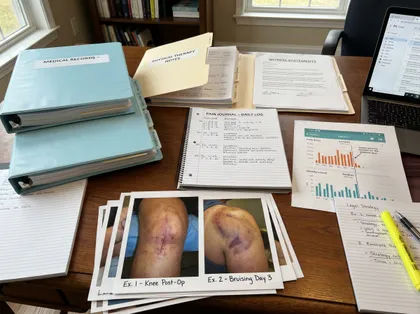
Keeping a daily pain journal is also helpful. Write down how you feel every day, what hurts, what activities you couldn’t do, and how the injury affected your sleep. It’s best to write this down the same day because fresh notes are more believable than memories from months later.
Adjusters also pay close attention to hard-to-dispute evidence. This evidence may include:
- Photos and Video: Images and short video clips of your recovery show timestamped, visible proof of your limitations.
- Wearable Device Data: A smartwatch that logs disrupted sleep or reduced daily steps gives adjusters real numbers, not just your account of how you feel.
- Witness Testimony: People close to you can confirm what your records show. A spouse, coworker, or friend who noticed real changes in your daily life adds human context to your claim.
- Expert Testimony: For issues like PTSD or anxiety, a psychologist can help show how serious the condition is and how it affects you in the long run.
If you find yourself thinking I need a personal injury lawyer, consider consulting one. An attorney knows which records are most important and can help complete your file before the adjuster reviews it. Building this proof takes time, and California’s filing deadlines do not pause while you gather it.

Frequently Asked Questions About Pain And Suffering Claims
Recovering from a serious accident is hard enough without having to fight an insurance adjuster over the monetary value of your physical and emotional pain. Since California law doesn’t use a single fixed formula, it is completely normal to have concerns about how these damages are actually calculated. Here are answers to the most common questions injury victims ask when navigating this part of their claim.
How Long Do I Have To File A Claim For Pain And Suffering In California?
State law generally gives you two years from your injury date to file a personal injury lawsuit. If a government agency caused your injury, you must also file an administrative claim with that entity first. An administrative claim is a formal written notice to the agency requesting compensation, and you have 6 months from the injury date to file it.
Are Pain And Suffering Settlements Taxable In California?
Pain and suffering tied to a physical injury is generally not taxable. Awards for emotional distress without a physical injury may be taxable.
Can I Claim Pain And Suffering Without Medical Records In California?
Without medical records, proving a claim for pain and suffering is extremely difficult. Adjusters use treatment notes and diagnoses to evaluate what you went through, and without them, they will likely deny your claim.
Does Pain And Suffering Include Future Emotional Distress?
Yes, if your injury is expected to affect you long-term. Those future impacts may be included in your damages, allowing you to seek compensation for ongoing suffering. California law allows you to seek compensation for both current and future suffering tied to the injury.
Is There A Cap On Pain And Suffering Damages In California?
Most California personal injury cases have no cap on the value of pain and suffering. Limited exceptions exist under specific statutes. The value of your claim depends on the evidence, your documented losses, and the facts of your case.
These are general guidelines, and how they apply to your case depends on the specific facts involved.
Talk To A Lawyer Who Understands Injury Claims
Insurance companies make their first offer early after an injury, when the scope of your future losses may still be unclear. If you accept it, you may close your case for less than it is worth. Knowing the full value of your pain-and-suffering claim requires more than a formula. It takes someone who understands how to build the evidence and present it effectively.
At Arash Law, we evaluate what you actually went through: the physical pain, the disrupted routines, and the lasting impact of the injury on your life. We also know how insurers assess these claims and how to challenge low offers. Getting free advice from a personal injury lawyer can help you understand what your claim is actually worth before you accept anything.
People also ask, “Do lawyers only get paid if they win?” The answer is yes at our firm. Our injury lawyers work on a contingency basis. You pay nothing up front. You only pay the attorney’s fees if you receive a settlement or court award.
Call (888) 488-1391 to schedule a free initial consultation with an attorney at AK Law. Tell us what happened, and we’ll help you understand what compensation may be available based on the facts of your case.