TL;DR: In California, the driver, motorcycle rider, or both may be at fault in a lane-splitting crash. Lane splitting is legal, so the rider is not automatically responsible. Fault depends on whether either party acted negligently, and compensation is reduced by the injured person’s percentage of fault.
Highlights:
- Confirm that your helmet is FMVSS No. 218-compliant and has a permanent DOT label.
- Choose a helmet with a thick liner and a riveted chin strap that stays secure.
- Document the helmet’s brand, model, size, and purchase details with photos.
- Preserve the helmet and gear as-is – don’t clean, repair, or repaint.
- Photograph vehicles, roadway conditions, and visible injuries as soon as possible.
- Get prompt medical evaluation and keep imaging and treatment records organized.
- Track deadlines – generally two years, and six months for government claims.
Tip: If an insurer asks for your helmet, request written storage and return terms and keep it preserved for inspection.
Table of Contents
A motorcyclist is not automatically at fault just because the rider was lane splitting. Lane splitting is legal in California. Fault depends on how the accident occurred and whether the rider, the other driver, or both failed to use reasonable care.
The law applies the same standard of reasonable care, meaning acting as a cautious person would under the same conditions, to everyone involved. California law also allows fault to be shared between the rider and the driver based on each party’s negligence.
Understanding how fault is determined in a lane-splitting accident is important in protecting a potential claim.
How Is Fault Decided After A Lane-Splitting Crash?
Fault in California is based on negligence. Negligence means a person failed to use reasonable care, and that failure was a substantial factor in the resulting crash or injuries.
California Civil Code section 1714 states that a person is responsible for injuries resulting from their lack of ordinary care. In a lane-splitting case, the main question is not simply, “Was the rider between lanes?” The better questions are:
- Did the driver check mirrors and blind spots?
- Did the driver signal before moving?
- Was the lane change safe?
- Was the rider’s speed reasonable for the traffic?
- Was there enough space for the motorcycle to pass?
- Could either person have avoided the crash?
- Did either person break a traffic law?
- Did the conduct help cause the collision?
The answers come from evidence, not from a general dislike of lane splitting.
California allows lane splitting. California Vehicle Code (CVC) § 21658.1, which took effect on January 1, 2017, defines lane splitting as riding a qualifying motorcycle between rows of stopped or moving vehicles in the same lane.
Having said that, being allowed does not mean being unrestricted. Lane splitting should still be done safely. A rider who recklessly splits lanes may still bear some fault if a crash occurs.
When Is The Driver At Fault?
The driver may be at fault for changing lanes carelessly and ignoring traffic rules. California recognizes lane splitting as legal. Drivers must make lane movements with reasonable safety and use an appropriate signal when doing so may affect another vehicle.
The Driver Made An Unsafe Lane Change
A driver may be at fault when they move into the motorcycle’s path without checking their mirrors or blind spot, resulting in a crash or injury. According to CVC § 22107, a driver may not move right or left until the movement can be made safely.
This is a common lane-splitting crash pattern. A last-second lane change in slow traffic can leave the rider with no safe escape path.
The Driver Failed To Signal
A turn signal indicates a driver’s intent to change lanes or turn, but it does not grant the legal right of way or permission to cut off another vehicle. Likewise, failing to use a turn signal can make a driver’s actions less predictable and may be considered a lack of use of reasonable care if it leads to an accident.
The Driver Intentionally Blocked The Rider
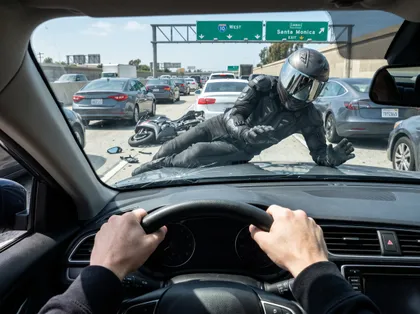
CHP advises that intentionally blocking or impeding a lane-splitting motorcyclist in a way that could cause harm is illegal. A driver may also be liable for an unsafe lane movement, deliberate obstruction, or other conduct that causes a collision. If that sudden stop involves an abrupt lane shift or turning movement without safety or signaling, it can also violate CVC § 22107 for an unsafe movement.
A driver who turns toward a rider, deliberately closes a safe gap, or uses the vehicle to scare the rider may bear most or all of the fault. It is illegal to deliberately block or impede a motorcyclist in a way that could hurt them.
Depending on the circumstances, deliberately causing these issues could also lead to civil liability, including a claim for intentional harm.
A Door Was Opened Into The Rider’s Path
CVC §22517 generally prohibits opening a vehicle door on the side available to moving traffic unless it is reasonably safe and can be done without interfering with traffic. If a driver or passenger deliberately opens a door into the rider’s path, that act may be clear evidence of fault. Intentional conduct may raise other legal issues as well.
The Driver Was Distracted Or Impaired
A driver who is distracted by their phone, eating, under the influence, or too tired may not notice a motorcycle on the road. While these factors alone don’t prove that the driver is at fault, they can be significant evidence when linked to the crash.
In California, evidence that a driver was impaired or distracted can help establish liability in a motorcycle accident.
When Is The Motorcyclist At Fault?
A rider may share fault if their conduct contributed to the crash. Insurers look at speed, visibility, and road conditions when assigning fault.
The Rider Was Going Too Fast For The Conditions
The California Highway Patrol (CHP) has published safety guidelines for lane splitting. The CHP warns that risk increases as overall speed rises and when a rider moves much faster than nearby cars.
A rider may be negligent even when traveling below the posted limit if that speed was unsafe for packed traffic, narrow lanes, poor visibility, or wet pavement.
For example, passing nearly stopped cars at a speed that leaves little time to react may support a claim against the rider.
The Rider Entered A Gap That Was Too Narrow
A rider who tries to pass between wide trucks, buses, mirrors, or vehicles that are close together may create an unsafe risk.
Contact with a mirror or the side of a vehicle may indicate that the available space is unsafe. However, the location of the damage and all other facts must be reviewed before assigning fault.
The Rider Used The Shoulder
Shoulder riding is not protected as lane splitting. If a rider passes traffic on the shoulder and then collides with a car turning or merging, the rider may be assigned a large share of the fault.
The Rider Was Weaving Or Making Sudden Moves
Rapid movement between several gaps can make the motorcycle hard to see and hard to predict. A rider who cuts across lanes, changes position without warning, or passes in an unsafe place may be partly or fully responsible.
The Rider Ignored An Obvious Warning
A rider may share fault if a car had been signaling, slowly moving toward the lane line, or clearly preparing to change lanes, but the rider continued into the closing gap at an unsafe speed.
When a crash happens, what each rider and driver did beforehand determines how responsibility is assigned in motorcycle accident cases.
What Happens When Both Rider And Driver Are At Fault?
In California, fault in a crash is divided by percentage, not decided all at once. This system is called pure comparative negligence. Each involved party is assigned a share of the blame based on their actions. Even if someone shares responsibility for the crash, they can still seek compensation from an at-fault driver. However, their total recovery is reduced by their percentage of fault.
In a scenario where both a rider and a driver share fault, let’s consider a situation where a motorcyclist is lane splitting in heavy traffic. Meanwhile, a driver is distracted by their phone and suddenly changes lanes without checking for other vehicles.
Assume the court assigns the rider 30% fault because the rider was traveling at an unsafe speed for the traffic conditions while lane splitting. The driver is assigned 70% fault for changing lanes while distracted and failing to check for approaching vehicles.
If the court determines the total damages for the rider’s injuries to be $100,000, the compensation would be calculated as follows:
- Total Damages: $100,000
- Rider’s Fault: 30%
- Driver’s Fault: 70%
To find the rider’s potential recovery:
- The rider’s recovery would be $100,000 minus 30% of that amount.
- $100,000 x 30% = $30,000.
- $100,000 – $30,000 = $70,000.
Thus, the rider would be able to recover $70,000 from the at-fault driver. This illustrates how California’s pure comparative negligence rule works when both parties share fault in an accident.
What Evidence Helps Prove Fault In A Lane-Splitting Crash?
In lane-splitting crashes, there is often a tendency to assume the rider is at fault, even when the other driver may be responsible for the collision. Having clear, solid evidence can be crucial for addressing bias and ensuring a fair assessment of the situation.
Evidence that commonly supports a lane-splitting crash claim includes:
- Dashcam or Helmet Camera Footage: Video from your bike or a nearby car can show what happened.
- Eyewitness Statements: People who saw the crash can support your account.
- Skid Marks: Road marks can help show where each vehicle was and whether anyone tried to brake.
- Police Report: This creates an official record. If it contains errors, an attorney can introduce other evidence to correct them.
Insurance adjusters may consider lane splitting when determining fault in an accident, which can affect the outcome of a claim. In such situations, consulting a motorcycle accident lawyer can be beneficial. They can assist you in navigating the legal process and gathering important evidence that can support your case. They can also help address any disputes or concerns regarding fault assignment.
At Arash Law, we advocate for our clients’ rights and pursue fair compensation for their injuries and losses according to California law.
Below are some cases involving motorcycles that our lawyers at Arash Law have won for our clients:
- $5,000,000 — A $5,000,000 settlement was achieved despite initial police reports blaming our client. We demonstrated that the truck driver’s unsafe maneuver caused the accident.
- $1,450,000 — Our client received $1,450,000 after hitting uneven pavement while riding. The responsible parties initially denied liability until the trial began.
- $1,000,000 — We secured a $1,000,000 settlement for a motorcycle accident, initially deemed the client’s fault. Our efforts proved the truck driver was actually at fault.
Disclaimer: Past case results are not indicative of future outcomes and depend on the specific facts of each case.
Types Of Compensation In Lane-Splitting Accidents
A motorcyclist injured in a lane-splitting accident may seek compensation for losses caused by another party’s negligence. Lane splitting does not create a separate category of damages, nor does it automatically prevent recovery.
The available compensation generally follows the same rules as in other California motor vehicle injury cases and depends on proof of liability, causation, and the value of resulting losses. California law permits a person harmed by another’s wrongful act or omission to recover monetary damages for that harm.
Economic Damages
Economic damages cover your out-of-pocket and future financial losses tied to the crash, including:
- Emergency treatment, surgery, hospitalization, and ongoing medical care.
- Physical therapy and rehabilitation.
- Lost wages and reduced future earning capacity if injuries affect your ability to work.
- Property damage to your motorcycle and gear.
- Costs of home modifications or assistive devices for permanent injuries.
Non-Economic Damages
Non-economic damages compensate for losses that don’t come with a receipt:
- Pain and suffering
- Emotional distress
- Loss of enjoyment of life
- Disfigurement or permanent physical impairment
- Loss of consortium for a spouse or registered domestic partner
A note for uninsured riders: Under Civil Code § 3333.4, enacted through Proposition 213, an injured motorcyclist who owned an involved motorcycle that was not insured as required by California’s financial responsibility laws generally cannot recover non-economic damages, such as pain and suffering, even when another party was entirely responsible for the accident. Economic damages may still be recoverable.
The restriction may not apply when:
- Under California Civil Code § 3333.4(c), the DUI exception applies when the injured person owned the uninsured motorcycle and the other driver was convicted of DUI. It does not apply to someone who operated, but did not own, the uninsured motorcycle.
- The injured person was merely a passenger and neither owned nor operated the uninsured motorcycle involved in the accident.
- The injured person was an employee operating an employer-owned vehicle under circumstances in which California’s financial responsibility laws placed the responsibility on the employer rather than the employee, as recognized in Montes v. Gibbens. Employer ownership by itself may not resolve the issue in every case.
Punitive Damages
In rare cases involving especially reckless or intentional conduct, for example, a driver who deliberately swerves to block or intimidate a lane-splitting rider, a court may also award punitive damages under Civil Code § 3294. These require clear and convincing evidence that the defendant acted with malice, oppression, or fraud, and exist to punish and deter the conduct rather than to compensate the victim directly.
Wrongful Death Claims
If a lane-splitting crash is fatal, eligible surviving family members may bring a wrongful death claim. California Code of Civil Procedure §377.60 identifies the persons who may have standing, including a surviving spouse, registered domestic partner, children, and certain other qualifying heirs or dependents.
Wrongful death damages compensate eligible survivors for their losses and may include:
- Funeral and burial costs.
- Loss of expected income and financial support.
- Loss of companionship and guidance, among other losses.
The amount must be just under the circumstances and is separate from damages belonging to the decedent.
A survival action addresses losses the decedent personally sustained or incurred before death, such as medical expenses, pre-death lost earnings, property damage, and, where legally available, penalties or punitive damages. Under Code of Civil Procedure § 377.34(a), survival damages generally do not include the decedent’s pain, suffering, or disfigurement.
Section 377.34(b) provides a limited exception for actions that were granted preference under Code of Civil Procedure § 36 before January 1, 2022, or were filed on or after January 1, 2022, and before January 1, 2026.
As of January 1, 2026, the filing window for that exception has closed. Actions filed on or after that date cannot recover the decedent’s pain, suffering, or disfigurement under § 377.34(b). However, qualifying actions filed before January 1, 2026, may continue to pursue those damages even if the case is resolved afterward. As of the date of writing, no extension of the filing window has been enacted.
California Statute Of Limitations For Lane-Splitting Accidents
In California, you typically have 2 years from the date of the crash to file a personal injury lawsuit. However, if your claim is against a public entity, like a city or state government, you must first notify them within six months of when the injury occurred.
If the public entity provides a legally compliant written rejection, the lawsuit generally must be filed no later than six months after the rejection notice is personally delivered or deposited in the mail. Different deadlines may apply when no compliant notice is provided. Limited exceptions and late-claim procedures may also apply.
Missing these deadlines can bar you from seeking compensation, so it’s crucial to act quickly.
Before making any statements, riders can seek free advice from a motorcycle accident lawyer to first understand their rights. An injury attorney can investigate your case and determine the applicable filing deadline.
Frequently Asked Questions About Fault In California Lane-Splitting Accidents
Motorcycle accident cases raise many questions, especially when lane splitting is involved. The rules around helmet laws, insurance blame, and attorney costs are not always clear. These answers address the questions riders and drivers most often ask after a California motorcycle crash. Knowing the answers can help you protect your rights and avoid common mistakes.
Do I Have To Wear A Helmet While Riding A Motorcycle In California?
Yes. California generally requires motorcycle operators and passengers on highways to wear a properly fastened helmet meeting statutory safety requirements, subject to a narrow exception for certain fully enclosed three-wheeled vehicles. Failure to wear a helmet does not, by itself, make the rider responsible for causing the crash, but it may affect damages if evidence shows that non-use of a helmet contributed to the type or severity of the injuries.
What Should A Driver Do If A Motorcycle Is Splitting Lanes Next To Them?
Drivers should stay in their lane, check mirrors often, and not block or crowd the rider. Deliberately crowding a lane-splitting motorcyclist may violate California traffic laws.
Does Lane Splitting Apply To Bicycles Or E-Bikes?
No. CVC § 21658.1 covers lane splitting only for motorized two-wheeled motorcycles. Bicycles and e-bikes are not included under this law.
Know How Arash Law Can Help With Your Motorcycle Accident
If you were hurt in a motorcycle accident in California, our attorneys can help you understand your rights and pursue compensation. We know how insurers evaluate these claims, and we are prepared to advocate for you at every step.
Call us at (888) 488-1391 to speak with our team. Your first consultation is free. AK Law handles personal injury cases on a contingency fee basis. This means that attorneys only collect a fee if they secure a financial recovery. If there is no recovery, you owe no attorneys’ fees.
When you reach out, our attorneys will review what happened, explain your legal options, and help you understand what your claim may be worth.