TL;DR: Usually, car drivers are at fault when they crash into motorcycles, but it still depends on the facts. These accidents may occur at left turns, lane changes, and intersections. California law allows injured riders to seek compensation, even when they’re partially at fault. Missing the 2-year deadline for a personal injury lawsuit can bar recovery entirely.
Highlights:
- Gather evidence of the accident, such as police reports and eyewitness statements, to support your claim.
- File the SR-1 form with the DMV within 10 days of the crash to avoid a suspended license, regardless of who caused the accident.
- Get medical care right away, and follow your treatment plan to link your injuries to the crash and strengthen your evidence.
- Avoid giving recorded statements to insurance adjusters or posting about the accident on social media — both can be used against your claim.
- Left-turn collisions, lane-change crashes, and rear-end collisions often exhibit clear patterns of fault. These patterns may benefit riders under California law.
- If a road defect caused the crash, the responsible government agency can be held liable, but you must first file a claim within six months.
Tip: Gather clear proof like photos, videos, dashcam footage, and physical evidence or property damage.
Table of Contents
Drivers of cars are usually at fault in motorcycle-versus-car accidents. They may fail to see motorcycles and not check before turning left, merging, or crossing intersections. Motorcycles are smaller and harder to spot, and they don’t provide the external protection that cars have. That’s why riders often suffer more serious injuries.
Whether you’re the motorcyclist or a car occupant, a crash can shake your sense of safety and leave you facing serious injuries, medical bills, and a long recovery. Proving fault is not always simple. A rider’s speed or lane position can influence how courts and insurers divide blame. Understanding California’s negligence rules is key. Negligence means failing to act with reasonable care to avoid harming others.
California laws, traffic rules, and the facts of your case determine how much your claim might be worth.
Common Causes Of Motorcycle Crashes And Who Is Usually At Fault
Motorcycle accidents usually occur when other drivers fail to see the rider or misjudge the rider’s speed. In most motorcycle crashes, the driver of the other vehicle is at fault. Local data backs this up: a Federal Highway Administration (FHWA) study of motorcycle crashes in Orange County, California, found that 63% of motorcycle collisions with other vehicles were caused by unsafe actions by the other driver.
Each crash type has its own fault pattern under California law. These patterns often point to driver negligence, not rider error. However, California law applies different fault rules depending on how the crash happened. Here are common scenarios:
- Left-Turn Collisions: A driver turning left must yield to oncoming motorcycles. When a driver fails to yield and hits a rider, the driver is usually at fault.
- A rider may share liability if they were speeding or ran a red light, making it harder for the turning driver to judge or avoid the rider.
- Lane-Splitting Accidents: Lane splitting is legal in California under Vehicle Code §21658.1. If a driver switches lanes without signaling and hits a rider, the driver is generally at fault.
- A rider going faster than the flow of traffic or squeezing through tight gaps may share some of the blame.
- Rear-End Collisions: A driver who tailgates and fails to stop in time is generally at fault for a rear-end crash.
- A rider may share some fault if they braked abruptly, stopped suddenly without cause, or were following another vehicle too closely.
- Dooring Collisions: A driver who opens their car door into traffic is generally at fault for a dooring accident.
- A rider may share liability if they were riding outside a marked lane, weaving between parked cars, or riding at an unsafe speed.
- Dangerous Road Conditions: Not every crash is caused by another driver. If a pothole, bad road design, or missing signs caused your accident, the agency in charge of that road may be liable.
- Impaired Riding: Alcohol impairment is a common cause of motorcycle crashes. In 2024, 1,606 alcohol-impaired motorcyclists were involved in fatal traffic crashes in the U.S., according to the NHTSA’s National Center for Statistics and Analysis. On the other hand, 4,239 alcohol-impaired car drivers were involved in fatal crashes. The impaired driver or rider is usually at fault in these cases.
Data Transparency Note: This article cites two federal sources. The Federal Highway Administration’s “Motorcycle Crash Causation Study: Final Report” examined motorcycle crashes investigated in Orange County, California. Its findings should not be treated as statewide or national fault statistics. The 2024 alcohol-impairment figures come from the National Highway Traffic Safety Administration’s “Overview of Motor Vehicle Traffic Crashes in 2024,” published in April 2026. We update this content when newer, more reliable data becomes available.
Shared Fault In Motorcycle Crashes
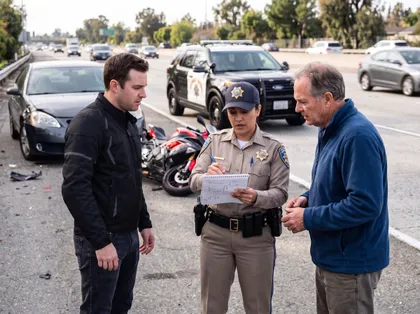
California uses a pure comparative negligence rule, adopted by the California Supreme Court in Li v. Yellow Cab Co. (1975). Under this rule, an injured victim can still pursue compensation even when they share some blame for an accident. Your share of fault may reduce your compensation, but it doesn’t disqualify you from filing a claim.
If the court finds you 30% at fault, any compensation awarded is reduced by 30%, and you keep the remaining 70%. A driver found 90% at fault can still recover 10% of their losses.
For example, if a rider was riding 10 mph over the speed limit when a car made an unsafe left turn in front of them, a court might find the rider 20% at fault for speeding and the driver 80% at fault for failing to yield. On a $100,000 claim, the rider would still recover $80,000.
Fault isn’t always split between just two parties, either. If a road defect contributed to a crash alongside a negligent driver, a court can allocate fault among multiple parties. For example, 60% to the driver, 30% to the government agency responsible for the road, and 10% to the rider.
Insurance companies are well aware of this rule and often use it to their advantage. Adjusters may push to assign riders a higher percentage of fault than the evidence supports. This is one of the main reasons riders benefit from strong documentation and skilled legal representation.
Evidence Used To Prove Fault In A Motorcycle Accident
Clear proof, such as official police reports, photos of the scene, video footage, and eyewitness statements, can help establish fault in a motorcycle accident. If you were injured, the evidence must show what the other driver did, not what they claim.
After a crash, preserve these types of evidence to build a strong case:
- Police or California Highway Patrol (CHP) Report: Officer’s notes and any tickets given to the other driver.
- Eyewitness Accounts: Statements from people at the scene who saw what took place.
- Camera Footage: Video from traffic cameras, dashcams, or nearby cameras that shows the other driver’s actions.
- Vehicle Damage Patterns: Damage on both vehicles that shows how and where the crash took place.
This evidence isn’t just proof for its own sake — it’s what supports the legal elements a court requires before awarding compensation. To recover damages through a negligence claim, an injured rider must prove four elements:
- The other party had a duty of care.
- They breached that duty.
- Their actions caused the crash.
- You suffered measurable physical or financial losses.
For crashes with unclear details, experts can go further. A crash expert can study skid marks and road debris to show true speeds and impact points. They may also retrieve the “black box” data from the vehicles. This device records the vehicle speed and braking seconds before the crash.
An attorney can help you understand how motorcycle accidents are investigated in California. They can also manage the documentation of your losses.
What Damages Can Victims Recover?
Victims of motorcycle accidents can recover economic damages, non-economic damages, and in some cases, punitive damages. The specific types and amounts depend on the severity of the crash, the injuries involved, and the facts of your case.
- Economic Damages: These cover measurable financial losses with a clear dollar value, such as:
- Medical bills, including emergency care, surgery, physical therapy, and future treatment
- Lost wages from time missed at work
- Loss of future earning capacity if injuries affect your ability to work long-term
- Property damage to your motorcycle, gear, and other personal property
- Out-of-pocket expenses, such as transportation to medical appointments or home modifications
- Non-Economic Damages: These cover losses that are harder to assign a dollar figure to, such as:
- Pain and suffering
- Emotional distress
- Loss of enjoyment of life
- Physical impairment or disfigurement
- Loss of consortium, in cases affecting a spouse or registered domestic partner
- Punitive Damages: In rare cases involving extremely reckless misconduct, a court may award punitive damages to punish the at-fault party and deter similar conduct.
A motorcycle accident attorney can review the facts of your case to determine which categories of damages apply and help calculate what your claim may be worth.
Steps To Protect Your Claim After A Crash
Each of the following actions directly affects your ability to prove fault and recover compensation after a crash. Here is what you can do right now to protect it:
- Seek Medical Care: See a doctor or chiropractor right away and follow every treatment plan. Your records connect the crash to your injuries and build the evidence your case depends on.
- File the SR-1 Form: California law requires you to file a Report of Traffic Accident Occurring in California (SR-1) with the DMV within 10 days. This applies if the crash caused injury, death, or property damage over $1,000. Missing this deadline can result in a suspended license, even if the crash was not your fault.
- Refuse Recorded Statements: You do not have to give the other party’s insurer a recorded statement. Just stick to providing the facts. Also, consider getting legal advice before providing a recorded account or discussing fault.
- Stay Off Social Media: Do not post anything about the accident, your injuries, or your recovery. Insurers monitor social media and use posts to minimize claims.
Handling all of this while you are still recovering is a real burden. If you are thinking, “I need a personal injury lawyer,” that instinct is worth acting on. Motorcycle accident lawyers can help manage these steps on your behalf to help protect your claim.
Frequently Asked Questions
If you were hurt in a motorcycle accident, you likely have questions about your own situation. A missing helmet, a police report, or an uninsured driver may feel like problems. The questions below address the most common concerns riders face in California.
Can I Still Recover Damages If I Wasn’t Wearing A Helmet?
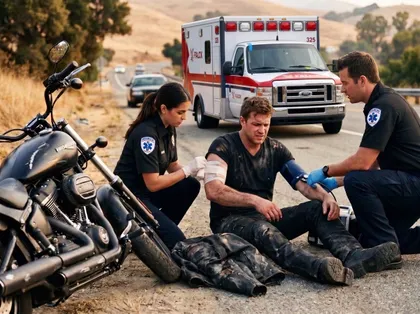
Possibly. California Vehicle Code (VC) §27803 requires all riders to wear a helmet, and not wearing one may affect what you could recover for head injuries, depending on how fault is shared. You may still be able to recover damages for other injuries, such as broken bones.
What If The Police Report Says I Was Partially At Fault?
A police report is not the final word on fault. An attorney can challenge it using accident reconstruction and independent evidence. However, in California, you can still seek compensation under pure comparative negligence rules.
What If The Other Driver Doesn’t Have Insurance?
If the other driver had no insurance, your own policy may still cover you. California law allows you to use your uninsured motorist (UM) coverage to pay for your injuries. An attorney can review your policy to confirm whether this coverage applies.
Is A Driver Automatically At Fault If They Hit Me While I Am Lane Splitting?
No. If you were lane splitting safely and a driver changed lanes without checking their mirrors, that driver is generally at fault. Lane splitting alone does not make you legally responsible for the crash.
Can A Government Agency Be At Fault For A Motorcycle Crash?
Yes. If a road defect (such as a large pothole or poor road design) caused your crash, the agency in charge of that road can be held liable. The six-month deadline for government claims is strict. Acting quickly protects your ability to seek compensation.
What If My Loved One Died In A Motorcycle Accident?
Surviving family members, such as a spouse, children, or, in some cases, parents, may be able to file a wrongful death claim under California Code of Civil Procedure §377.60. This claim can seek compensation for funeral and burial costs, loss of financial support, and loss of companionship. An attorney can help identify who is legally eligible to file and what deadlines apply.
How Long Do I Have To File A Motorcycle Accident Case In California?
You have two years from the accident date to file a lawsuit under Code of Civil Procedure (CCP) §335.1. If a city, county, or other government entity is involved, you have six months to present a formal claim to the public entity before filing a lawsuit.
If the accident resulted in death, surviving family members generally have two years from the date of death, not the date of the accident, to file a wrongful death claim.
Contact Our California Lawyers Handling Motorcycle Accident Cases
A motorcycle crash can leave you hurt, out of work, and facing insurers who won’t put your needs first. Delays can make it harder to gather evidence and meet legal deadlines, so taking timely action helps protect your right to seek compensation under California law.
Arash Law handles motorcycle accident cases on a contingency fee basis, meaning you pay no attorney fees unless we win your case. Our firm, also known as AK Law, has spent years representing injured riders across California. Call (888) 488-1391 to schedule a free case review.
While we can’t guarantee a specific outcome, our track record includes recoveries such as:
- $5,000,000: Our client was blamed on the police report and alleged to have been under the influence and speeding, with no motorcycle insurance, exposing him to California’s Prop 213 bar on pain and suffering damages. We proved the truck driver had violated his training and company policy by making an unsafe turn that caused the collision.
- $1,450,000: Our client, a motorcyclist, suffered head trauma and fractured ribs because of an uneven pavement at a construction site. Before the case was ultimately settled on the first day of trial, the contractors and the city tried to deny any liability.
- $1,000,000: Our client was listed as the at-fault party on the police report in a motorcycle-versus-truck crash. Through diligent investigation, we showed the truck driver was truly responsible and recovered policy limits on our client’s behalf.
These numbers reflect real outcomes, but past results do not guarantee future outcomes. Every case depends on its own facts and evidence.
Your recovery matters, and the right legal team can fight for fair compensation. Call us or reach out online for a free, no-obligation consultation.