TL;DR: Pedestrian violations were the most commonly recorded primary collision factor in California fatal and serious-injury pedestrian crashes in 2023, yet drivers may still be liable if they are distracted, speed, or fail to yield.
In California, pedestrian violations were the most commonly recorded primary crash factor in fatal and serious-injury pedestrian crashes in 2023, according to a 2025 analysis by UC Berkeley’s Safe Transportation Research and Education Center (SafeTREC) of provisional California crash data. This category can include conduct such as entering a roadway suddenly, failing to yield while crossing outside a crosswalk, or disobeying a pedestrian signal.
Although pedestrian violations are frequently recorded as a primary collision factor, that does not mean pedestrians are necessarily primarily liable. Under California law, drivers retain a duty to exercise reasonable care for pedestrians, and liability is determined under comparative-fault principles based on the circumstances of each collision.
Data note: SafeTREC’s 2025 analysis identifies the primary crash factors for California pedestrian crashes that resulted in a fatality or serious injury in 2023. It does not establish the most common factor across all pedestrian crashes of all injury severity levels. Within the fatal-and-serious-injury dataset, pedestrian violations were the most commonly recorded primary crash factor, accounting for 48.6% of crashes.
That legal weight matters practically. California’s Office of Traffic Safety has characterized the pedestrian fatality problem in the state as “bad and growing worse.” Nationally, 7,314 pedestrians were killed in motor vehicle traffic crashes in 2023 alone, according to the National Highway Traffic Safety Administration (NHTSA) Traffic Safety Facts 2023 Data report. California recorded 1,106 pedestrian fatalities that year.
Pedestrians can suffer fractures, traumatic brain injuries, spinal cord damage, and other serious injuries.
Key Facts About Pedestrian Accidents In California
- In California, 92% of fatal pedestrian crashes in 2023 occurred in urban areas, according to SafeTREC.
- Even when a pedestrian crosses outside a crosswalk, a driver’s duty to use due care for the pedestrian’s safety still applies (VC § 21954).
- California drivers must yield to pedestrians in any marked or unmarked crosswalk at an intersection (VC § 21950).
- A pedestrian who is partly at fault can still recover damages, reduced only by their percentage of fault.
- The official traffic collision report prepared by CHP or local police is a primary source of evidence. Request it immediately, as it documents driver-fault notations, contributing factors, and the point of impact.
Table of Contents

Pedestrian Violations: The Most Common Causes Of Pedestrian Accidents
“Pedestrian violations” are actions by pedestrians that violate traffic-safety laws. In California, they were the most frequently recorded primary crash factor in fatal and serious-injury pedestrian crashes in 2023. However, SafeTREC cautions that the classification does not establish which party was legally at fault.
Pedestrians can suffer fractures, traumatic brain injuries, spinal cord damage, and other serious injuries. SafeTREC also confirmed that California pedestrian fatalities are trending upward, even as walking gains popularity as a mode of transportation. Common examples of pedestrian violations include:
- Entering a crosswalk too suddenly. Stepping from the curb into the path of a vehicle that is close enough to pose an immediate hazard.
- Failing to yield outside a crosswalk. Crossing outside a marked or unmarked crosswalk can be risky. Always yield to vehicles that pose an immediate danger.
- Walking unsafely in the roadway. Walking or standing in a traffic lane without due care. Outside of business or residential areas, pedestrians should walk close to the left edge of the road.
- Disobeying a pedestrian signal. Entering a crossing against a steady “DON’T WALK” signal.
- Entering a restricted freeway or expressway. Walking on a freeway where pedestrian access is prohibited.
- Walking in a bike lane when an adequate pedestrian path is available. Pedestrians generally may not use a bicycle path or lane when a suitable adjacent pedestrian facility exists.
Driver negligence is another common cause of pedestrian accidents across California. The most common driver-related causes include:
- Distracted Driving: A driver reading a text, adjusting a navigation app, or reaching for something in the car can travel the length of a crosswalk without ever seeing the person in it.
- Speeding: Speed determines survival. Research shows that a person hit at 40 mph is much more likely to die than one hit at 20 mph. Also, at higher speeds, drivers have less time to brake if they see a pedestrian.
- Failure to Yield at Crosswalks: Vehicle Code (VC) § 21950 requires drivers to yield the right-of-way to pedestrians in both marked and unmarked crosswalks.
- Turning Without Checking: Drivers turning left or right at traffic signals often focus on oncoming cars. In doing so, they may overlook pedestrians already in the crosswalk, even when the walk signal is on.
- Driving Under the Influence: Impaired drivers react more slowly and see less around them. This increases the risk of missing or failing to stop for pedestrians at any crossing.
Under California law, drivers owe a duty of care to every person on or near the roadway. They must stay alert, follow speed limits, and yield when needed. Even when a pedestrian is cited for failing to yield while crossing outside a crosswalk under VC § 21954, fault may still be allocated to the driver. Courts and insurers look at whether the driver fulfilled their duty of care. It’s not just about whether the pedestrian was in a crosswalk.
Poor road design and missing crosswalks increase risks for drivers. This is especially true at busy urban intersections and near school zones. In those settings, both the driver and the infrastructure can be contributing factors.
Where Do Most Pedestrian Accidents Occur In California?
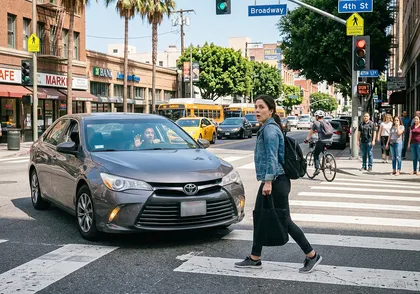
Fatal pedestrian crashes in California are concentrated in urban areas and on major arterial roads. SafeTREC reports that 92% of California’s fatal pedestrian crashes in 2023 occurred in urban areas. Principal and minor arterials accounted for 39% and 22% of fatal pedestrian crashes, respectively.
The most hazardous locations share recognizable features:
- Urban Intersections: Intersections are important crash locations. Wide, multi-lane roads often have turn-only lanes and heavy traffic. This situation can put pedestrians at risk. Drivers must juggle many visual tasks, making it harder to spot people crossing. Left-turning drivers pose a particular hazard. They check for oncoming vehicles, but often do not re-check the crosswalk before completing the turn.
- High-Speed Arterial Roads: Roads built to move vehicles at 40–50 mph through developed areas offer little tolerance for error. When a driver fails to see a pedestrian on a road built for speed, the resulting crash is far more likely to be fatal.
- Mid-Block Crossings and Parking Lots: Drivers operating between intersections rarely anticipate pedestrians entering the roadway. In parking facilities, the combination of backing maneuvers and the blind spots behind large vehicles poses a persistent hazard.
Each location type can have different evidence sources. At urban intersections, potentially relevant evidence may include traffic-signal timing records and footage from city, law-enforcement, transit, business, or privately operated cameras.
On arterial roads, road-maintenance and inspection records may document relevant conditions. At parking facilities, dashcam recordings and private surveillance footage may capture the crash sequence. The appropriate custodian depends on who owns or operates the roadway, signal, camera, or property involved.
City traffic departments, California Highway Patrol (CHP), and Caltrans are the primary custodians of that evidence. California’s Office of Traffic Safety (OTS) has identified a gap in road design. Roads focus on vehicles but ignore pedestrian needs. This gap contributes to rising pedestrian deaths and serious injuries in California. A pedestrian accident lawyer can gather all the key evidence from public and private entities before it’s deleted or overwritten.
California Pedestrian Right-Of-Way Laws
California’s Vehicle Code imposes overlapping duties on both drivers and pedestrians. Still, it does not excuse a driver from yielding merely because a pedestrian was not in a marked crosswalk.
- Vehicle Code § 21950 (Crosswalks): Courts look at several factors in crosswalk cases. They check if the driver yielded properly. They also consider whether the driver was traveling at a speed that allowed for a safe stop. Finally, they assess if the driver was distracted when the impact occurred. This section does not relieve a pedestrian from using due care for their own safety. The pedestrian should not unnecessarily stop or delay traffic while using a marked or unmarked crosswalk.
- Vehicle Code § 21952: This section establishes that pedestrians have the right-of-way on sidewalks. Drivers must yield to pedestrians when crossing a sidewalk. This duty applies when entering or exiting driveways, alleys, or shopping centers.
- Vehicle Code § 21954 (Outside a Crosswalk): Mid-block crashes require a different liability analysis. Under VC § 21954(a), a pedestrian crossing outside a crosswalk must yield to vehicles that constitute an immediate hazard. But subsection (b) expressly preserves the driver’s duty to exercise due care for the safety of any pedestrian on the roadway. In practice, the fault inquiry turns on whether the driver was attentive, traveling at a safe speed, and able to stop in time, regardless of where the pedestrian was crossing.
- The Freedom to Walk Act (AB 2147): Effective January 1, 2023, this law generally prevents police from stopping a pedestrian for specified crossing violations unless a reasonably careful person would recognize an immediate danger of collision with a moving vehicle or human-powered device. It did not eliminate pedestrians’ underlying duties to exercise due care or, when crossing outside a crosswalk, to yield to vehicles that constitute an immediate hazard.
The location of the crossing matters in fault analysis, but it doesn’t fully defend a driver who didn’t exercise care. Whether a pedestrian crosses in or out of a marked crosswalk, the driver’s duty to drive carefully still applies.
What If I Were Partly At Fault As A Pedestrian?
Being partly at fault does not end your claim in California. California follows a pure comparative negligence system, established by the California Supreme Court in Li v. Yellow Cab Co. (1975). Under that system, a pedestrian who bears 20% of the fault for a crash can still recover 80% of their total damages. This includes medical expenses, lost income, and non-economic losses like pain and suffering.
The percentage split is determined by the facts of the specific crash, not by a fixed formula. Insurers are well aware of this; they use it strategically. Their adjusters will push your share of fault as high as possible to reduce what they pay out.
Were you or a loved one hit by a vehicle in California? The window to preserve critical evidence, including traffic camera footage, phone records, and witness statements, closes quickly. Call Arash Law at (888) 488-1391 for a free case evaluation. Our experienced California accident attorneys handle the investigation while you focus on recovery.
What To Do After A Pedestrian Accident In California
The steps you take in the hours and days after an accident directly affect both your recovery and your legal options. If you don’t know what to do after a pedestrian accident, below are actions that most directly protect your right to pursue a claim.
- Call 911 Immediately: A police report is an official, contemporaneous record of the crash. It documents the driver’s information, the scene conditions, and any citations issued. Without it, a driver has little incentive to maintain an honest account of what happened.
- Seek Medical Care the Same Day: Shock, adrenaline, and soft-tissue swelling can mask serious injuries for hours. A same-day examination creates a medical record linking your injuries to the crash; a gap in treatment gives insurers grounds to argue your injuries were pre-existing or unrelated.
- Document the Scene While You Can: Photographs, video, and witness contact information are your independent record of what the scene looked like before anything was moved or cleaned up. If you are unable to gather these yourself, ask a bystander.
- Preserve Digital Evidence Now: Promptly identify any public or private cameras that may have captured the collision and send appropriate preservation requests. Whether footage exists, who controls it, and how long it is retained vary by agency and camera system, and some traffic cameras do not record footage at all.
- Do Not Give a Recorded Statement to the Driver’s Insurer: California law does not require you to speak to the at-fault driver’s insurance company. Recorded statements are used to establish admissions and to reduce or deny claims.
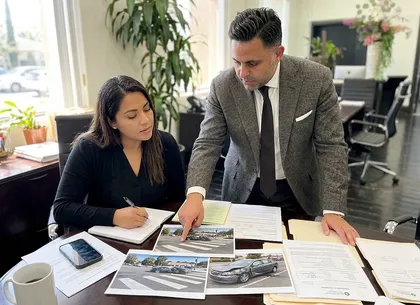
- Contact A Pedestrian Accident Lawyer: A lawyer can identify which camera custodians hold footage from the crash location and send preservation demands to them. They can also flag any government-entity involvement and handle all the communications with insurers.
What Arash Law Has Recovered For Pedestrian Accident Victims
Arash Law has recovered over $1 billion for injured clients across California, including in cases where insurers initially argued that pedestrian conduct, such as jaywalking, crossing against a signal, or stepping from between parked cars, reduced or eliminated their liability.
The following results illustrate what is at stake in these cases and the range of outcomes that capable representation can produce.
$10,000,000 Settlement: Our client was run over by a speeding vehicle and suffered serious injuries. Arash Law secured both a substantial financial recovery and access to the best available medical care and treatment team.
$5,000,000 Settlement: Our client was walking in the street, within the crosswalk, when he was struck by a large truck. The truck company tried to blame our client, claiming he was on his phone, looking down as he walked. Despite that, we won a recovery for our client, who suffered a mild traumatic brain injury.
Past results do not guarantee future outcomes. Every case is different, and results depend on the specific facts and evidence involved.
Frequently Asked Questions About Pedestrian Accidents
Pedestrian accidents leave victims with more questions than answers, especially regarding liability and who to sue. Below, we answer the most frequently asked questions about these cases in California.
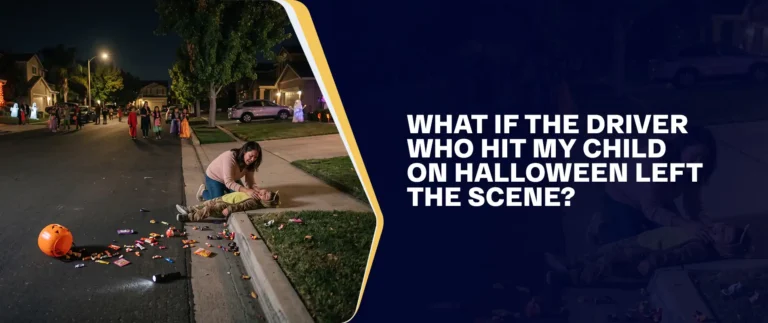
What Should I Do If The Driver Who Hit Me Fled The Scene?
Call 911 immediately and seek medical care. Note down every detail about the vehicle, including color, make, partial plate number, and direction of travel, as soon as possible, and collect contact information from any witnesses.
If the driver remains unidentified, your own Uninsured Motorist (UM) coverage could pay for your damages. California UM coverage generally requires that there be qualifying physical contact between the unknown vehicle and the injured person. The accident must also be reported to the police within 24 hours. Within 30 days after that report, the insured must provide the insurer with a sworn statement stating that they have a claim against an unidentified driver and describing the supporting facts.
How Long Do I Have To File A Lawsuit After Being Hit As A Pedestrian?
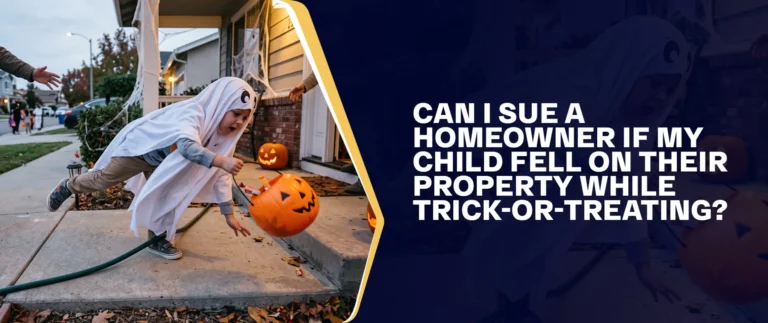
California Code of Civil Procedure (CCP) § 335.1 gives most injured pedestrians 2 years from the date of the accident to file a personal injury lawsuit against a private party. If the victim is a minor, this deadline may toll until they turn 18. This applies only to claims against private parties.
If a government entity, such as a city, county, or state agency, is involved, Gov. Code § 911.2 requires a written government tort claim to be presented to that entity within 6 months of the injury before any lawsuit can proceed.
Can I Sue The City If Poor Road Design Contributed To My Accident?
Yes, but claims against government entities are subject to a mandatory pre-lawsuit process. Cities and counties can be held responsible for dangerous road conditions, including faded crosswalk markings, broken or misaligned signals, missing pedestrian warning signs, or intersection designs that create predictable blind spots for drivers.
Under Gov. Code § 911.2, you must present a formal written government tort claim to the responsible agency within 6 months of the accident. For a claim against Caltrans seeking more than $12,500, the claim must generally be submitted to the California Department of General Services, Office of Risk and Insurance Management (DGS/ORIM) Government Claims Program. Qualifying Caltrans claims for $12,500 or less may instead be filed directly with the appropriate Caltrans District Claims Office. Because filing with the wrong agency can jeopardize a claim, the proper recipient should be confirmed before submission.
If the agency does not respond within 45 days, the claim is automatically treated as denied under California law. If the government agency provides a formal written rejection, you have only 6 months from the date the notice was mailed or delivered to file a lawsuit. If the agency fails to provide written notice, you generally have 2 years from the date of the incident/accrual to file.
What If The Driver Claims I Stepped Suddenly Into Traffic?
Independent evidence can directly counter that account. Traffic camera footage, intersection surveillance video, eyewitness statements, and accident reconstruction analysis can each establish your location, your movement, and the driver’s speed and attention at the moment of impact. California’s pure comparative negligence standard means that even if a jury finds you were partly at fault, you can still recover damages reduced only by your share.
Do I Need A Personal Injury Lawyer After A Pedestrian Accident?
Most pedestrian accident victims benefit from legal representation, particularly when injuries are serious, and the other driver’s insurer is involved. Insurers assign experienced adjusters whose job is to minimize what the company pays, including by arguing that your share of fault under California’s comparative negligence system is higher than it actually was. An attorney can conduct an independent investigation, send preservation demands for time-sensitive evidence, handle communications with the insurer, and evaluate any government-entity involvement.
Call Arash Law For Help With Your Pedestrian Accident Today
If you were hit by a vehicle in California, the time to act is now. Evidence disappears within days, and insurers begin building their case against you from the moment the crash is reported.
Arash Law has recovered over $1 billion for injured clients across California. Our attorneys handle every stage of a pedestrian accident claim, from the first preservation demand to the final settlement or trial, so that you can focus on your recovery.
Call (888) 488-1391 for a free case evaluation. We take pedestrian accident cases on a contingency basis, which means you owe no attorney fees unless we recover compensation for you.
Arash Law. Make ’em pay. Call AK.
Sources
California Office of Traffic Safety (OTS). Pedestrian Safety Campaign. ots.ca.gov
National Highway Traffic Safety Administration (NHTSA). Traffic Safety Facts 2023 Data: Pedestrians (DOT HS 813 727, June 2025). https://crashstats.nhtsa.dot.gov/Api/Public/ViewPublication/813727
UC Berkeley Safe Transportation Research and Education Center (SafeTREC). 2025 SafeTREC Traffic Safety Facts: Pedestrian Safety. https://safetrec.berkeley.edu/2025-safetrec-traffic-safety-facts-pedestrian-safety
California Legislature. California Code of Civil Procedure § 335.1: Two-Year Statute of Limitations for Personal Injury. https://leginfo.legislature.ca.gov/faces/codes_displaySection.xhtml?sectionNum=335.1&lawCode=CCP
California Legislature. California Vehicle Code § 21950: Driver Duty to Yield at Crosswalks. leginfo.legislature.ca.gov
California Legislature. California Vehicle Code § 21954: Pedestrian Duty Outside Crosswalks. https://leginfo.legislature.ca.gov/faces/codes_displaySection.xhtml?sectionNum=21950.&lawCode=VEH
California Legislature. Government Code § 911.2: Six-Month Government Tort Claim Deadline. https://leginfo.legislature.ca.gov/faces/codes_displaySection.xhtml?sectionNum=911.2.&lawCode=GOV
Disclaimer
Past results do not guarantee future outcomes. Every case is different. The information on this page is for general educational purposes and does not constitute legal advice. No attorney-client relationship is formed by reading or relying on this content. If you were injured, consult a licensed California personal injury attorney about your specific situation. Arash Law — (888) 488-1391.