TL;DR: Repetitive lifting at work can qualify for workers’ compensation in California when job duties cause or worsen a medical condition over time. It covers back and joint injuries from cumulative trauma, and workers must report the condition within 30 days of knowing it is work-related.
Highlights:
- Repetitive lifting injuries are eligible for workers’ compensation in California.
- Report work-related injuries within 30 days to secure your rights.
- Your employer must provide a DWC-1 form within 1 working day of your notification.
- Complete the DWC-1 claim form and get a signed receipt from your employer.
- Consult a doctor within your employer’s Medical Provider Network (MPN), if your employer has one.
- File within one year of discovering the injury to meet state deadlines.
- Appeal claim denials through the Workers’ Compensation Appeals Board.
Tip: Stick to factual reporting and avoid assuming the cause of your condition.
Table of Contents
Yes, repetitive lifting at work can qualify for workers’ compensation in California. Its benefits apply when job duties cause or worsen a medical condition over time. You can seek them since state law can consider your injuries as a form of cumulative trauma. Through a workers’ comp claim, you can pursue compensation for medical treatment, wage replacement checks, and permanent disability payments.
Key facts about cumulative trauma claims:
- Cumulative trauma is the legal term for injuries caused by repetitive motion.
- California law protects workers who develop wear-and-tear injuries over months or years.
- No single accident is required to file a workers’ compensation claim.
- Benefits may include doctor visits, surgery, and payments for lost work time.
Repeated lifting, bending, or carrying heavy objects can damage the body over time. Small daily movements can lead to serious injuries similar to a sudden accident.
California uses a no-fault workers’ compensation system. That means you do not need to prove your employer did something wrong. Instead, you must show that your job duties contributed to the injury.
Understanding Workers’ Compensation For Repetitive Stress Injuries
Repetitive lifting qualifies for workers’ compensation in California, even if it causes gradual rather than sudden physical damage. Any task involving constant strain on muscles, joints, or your spine is a workplace risk. If your work causes a medical condition, you may be entitled to workers’ compensation benefits.
Repetitive stress injuries do not happen in a single moment. They are the result of thousands of small “micro-traumas.” For example, a warehouse worker may lift hundreds of boxes during one shift. Years of performing the same task can slowly wear down the spine. Spinal discs may bulge or tear as strain builds over time. Medical professionals thus recognize repetitive lifting injuries as real workplace injuries that require proper diagnosis and treatment.
The California workers’ compensation system aims to provide a safety net. It ensures employees do not have to pay out of pocket for job-related health issues. Whether you are a nurse lifting patients or a construction worker hauling lumber, the law is on your side. You just need to link your medical condition to your daily work requirements.
How California Law Defines Cumulative Trauma Injuries
The California Labor Code defines a cumulative trauma injury as a condition caused by repetitive mentally or physically traumatic activities over time. These injuries often require medical treatment or result in disability. Understanding whether repetitive lifting at work qualifies for workers’ compensation can be your first step toward receiving the necessary medical treatment.
Cumulative trauma cases often involve parts of the body that handle the most stress. Common examples include:
- Back and neck pain from constant lifting or reaching.
- Carpal tunnel syndrome from repetitive hand or wrist motions.
- Shoulder injuries from lifting heavy objects overhead.
- Knee damage from constant squatting or kneeling.
For you to qualify for workers’ comp benefits in California, your work must be a “contributing cause” of the injury. You do not have to prove that work was the only cause of your condition. This standard means you can seek benefits if your job worsens pre-existing issues or causes degenerative changes.
California Workers’ Comp Deadlines Every Injured Worker Should Know
You have to report a repetitive lifting injury to your employer within 30 days of realizing that your pain is work-related. According to the Labor Code, you must give written notice to protect your right to benefits. Failing to report your symptoms on time can give the insurance company a reason to deny your claim.
Two key deadlines control most workers’ compensation claims in California:
- The Discovery Rule and the “Date of Injury”: Because repetitive lifting can damage the body over time, injuries might not appear right away. For injuries that develop over time, the deadline starts when you first know or reasonably should’ve known that your injury or illness is connected to your job.
- The Statute of Limitations for Filing: You generally have one year from the date of your injury to file a formal claim with the state. If you wait too long, you may permanently lose your eligibility for all benefits. Reporting your symptoms early helps your lawyer comply with these important legal timelines.
How To File A Repetitive Lifting Claim In California
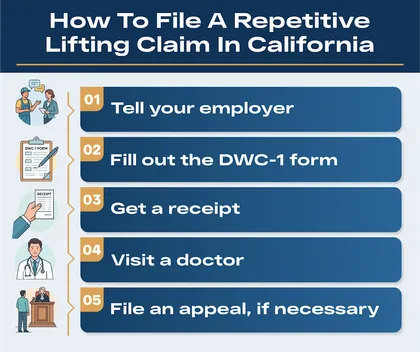
Filing a repetitive lifting claim involves a specific procedural path. You have to notify your employer and complete the state-mandated DWC-1 claim form. If you need assistance with these tasks, consider legal representation. Workers’ compensation attorneys for repetitive lifting injury cases can help throughout the claim process and reduce the risk of a denial.
Follow these steps to file your cumulative trauma claim:
- Report the Injury: Tell your boss about your symptoms and that they are work-related.
- Complete the DWC-1: Fill out the form and return it to your employer immediately.
- Get a Receipt: Your employer must give you a signed copy of the form.
- See a Doctor: Visit a physician within your employer’s Medical Provider Network (MPN).
- File an Application: If the insurance company is uncooperative, you can file an Application for Adjudication of Claim with the state.
Once you submit the DWC-1 form, the insurance company has 90 days to investigate your claim. Your employer must authorize up to $10,000 in medical treatment while they decide. If claims adjusters do not deny the claim within 90 days, the law generally presumes the injury arose from work. That means you can continue receiving workers’ comp benefits while your claim moves forward.
Common Back Injuries Caused By Constant Lifting
Repetitive lifting places repeated stress on the spine. It can thus injure spinal discs, vertebrae, and the surrounding muscles. Workplace safety data classifies many lifting injuries under overexertion and repetitive motion. These are the two leading causes of occupational harm.
According to the National Safety Council (NSC), overexertion, repetitive motion, and bodily condition injuries produced the highest number of Days Away, Restricted, or Transferred (DART) cases and the second-highest number of Days Away From Work (DAFW) cases between 2023 and 2024. The NSC also recorded 946,290 DART cases in 2024. This number includes 492,140 DAFW cases and 12 worker fatalities.
Many of these incidents involve repetitive lifting tasks that gradually damage the lower back and spine. If that is the case for your injury, a workers’ compensation attorney for back injuries from repetitive lifting can help prove that your condition is work-related.
Two common back injuries linked to constant lifting include:
- Herniated Disc and Nerve Pressure: Repeated lifting can weaken a spinal disc’s outer layer over time. That can cause its soft center to push through. As a result, the disc can press on nearby nerves, causing pain, numbness, or weakness.
Workers with a herniated disc may experience:
- Sharp pain that travels from the lower back down the leg.
- Tingling or “pins and needles” in the feet or toes.
- Difficulty lifting the foot or standing for long periods.
- Deep back pain that worsens after a long work shift.
- Chronic Muscle Strains and Soft Tissue Injuries: Repetitive lifting can constantly irritate and inflame muscles, ligaments, and tendons. Over time, workers may develop ongoing pain and reduced strength.
Common soft tissue injuries from repetitive lifting include:
- Tendonitis: Tendons become irritated after repeated reaching, lifting, or pulling.
- Bursitis: Small fluid sacs around joints swell and cause pain during movement.
- Myofascial Pain: Muscles and surrounding tissue develop long-term soreness and tightness.
- Ligament Laxity: Ligaments stretch over time and make joints feel unstable.
High-Risk Jobs For Repetitive Stress In California

Jobs that require heavy manual labor carry a much higher risk of cumulative trauma. Warehouse workers, nurses, and construction laborers face these risks every single day. If your shift involves constant physical effort, your body is likely sustaining micro-damage that could lead to a workers’ comp claim.
Workers in the following fields face a higher risk of repetitive stress injuries:
- Warehouse and Logistics Workers: They often lift heavy boxes for eight to ten hours a day. Many companies set strict productivity quotas. These could force workers to move too fast, leading to poor lifting form. Repeated bending and twisting under a heavy load can quickly destroy the lower back and shoulders.
- Healthcare and Nursing Professionals: Nurses and aides frequently reposition patients who are unable to move independently. This job requires massive physical force. These tasks often take place in cramped rooms or in awkward positions. Over time, healthcare workers may sustain chronic back pain and joint issues. They may need long-term medical care.
- Construction and Industrial Workers: Construction laborers perform heavy lifting, digging, and hauling throughout their entire shift. Operating vibrating tools can also damage the nerves in the hands and arms. These types of jobs cause the body to wear out much more quickly than in a standard desk job.
Why Some Insurance Companies Deny Repetitive Lifting Injury Claims
Insurance companies typically deny repetitive lifting claims when they believe work duties did not cause an injury. Adjusters review medical records and work history to understand the cause of the condition. Some denials happen when insurers believe age, past injuries, or other activities caused the pain.
Here are some of the most common reasons for a denial, with examples:
- Pre-Existing Conditions: They claim a past sports injury is the real cause of your pain.
- Aging: They argue that your spinal wear is just “normal” for your age group.
- Outside Hobbies: They suggest your exercise routine or home life caused the strain.
- Delayed Reporting: They claim that because you didn’t report it immediately, it must not be serious.
California law still allows you to collect benefits if work made an old injury worse. This situation is called “aggravation of a pre-existing condition.” If you receive a denial letter, you have the right to appeal. A workers’ compensation judge will review the medical facts and make a final decision.
A workers’ compensation lawyer can review the denial letter, examine medical records, and prepare evidence that explains how repetitive lifting at work contributed to the injury. They can also clarify the next steps in the appeal process and help organize the documentation required for a workers’ compensation hearing.
What Happens When Medical Treatment Gets Disputed In Workers’ Comp Cases
Medical disputes arise when an insurer questions a doctor’s treatment request or the cause of a workplace injury. California workers’ compensation law uses formal medical review systems to resolve these disagreements. These involve evaluating medical records and treatment guidelines to determine whether care relates to the work injury.
Key medical review processes include:
- Utilization Review (UR): Insurance companies review a doctor’s treatment request. A reviewing physician decides whether the recommended treatment meets California’s medical guidelines.
- Independent Medical Review (IMR): Workers can request an IMR when a UR denies treatment. An independent doctor reviews the records and decides whether the treatment should be approved. The decision is final.
- Qualified Medical Evaluation (QME): You may need a QME to provide a neutral medical opinion when workers and insurers disagree about the cause or severity of an injury. The evaluator examines the worker and writes a report that can influence the outcome of the claim.
Exclusive Remedy And Third-Party Claims
Workers’ compensation is usually the “exclusive remedy” against your employer for a work injury. Under the state’s Labor Code, you generally cannot sue your boss in a standard personal injury lawsuit. In exchange for this, you receive benefits regardless of who caused the accident.
However, you may have a third-party claim if someone else was responsible. Examples include:
- Faulty Equipment: A manufacturer’s lifting belt or cart failed.
- Outside Contractors: A different company’s employee caused your injury on a job site.
- Toxic Exposure: A chemical company provided a product that caused an occupational illness.
In these cases, you can pursue a workers’ compensation claim and a separate personal injury lawsuit against the third party. Filing a third-party claim allows you to seek compensation for pain and suffering. These intangible losses are not available in a standard workers’ compensation claim.
How A California Workers’ Compensation Lawyer Supports Your Claim

Handling a repetitive lifting injury claim can feel overwhelming. You may face medical paperwork, legal deadlines, and questions from the insurance company. A workers’ compensation lawyer helps organize the process and protect your rights. Legal guidance allows you to focus on treatment and recovery.
A lawyer can support your claim in several ways:
- Handling Legal Paperwork: They prepare and file required forms with the Division of Workers’ Compensation and track important deadlines.
- Building Medical Evidence: Attorneys work with doctors and medical evaluators to document how your job duties caused the injury.
- Reviewing Disability Value: They help estimate the value of permanent disability benefits and future medical care.
- Representing Workers at Hearings: Lawyers can present cases before the Workers’ Compensation Appeals Board during disputes.
Many injured workers worry about the cost of hiring a lawyer. California workers’ compensation lawyers usually work on a contingency fee basis. Under this structure, you don’t pay legal fees up front. So, if you’re still asking, “Do lawyers only get paid if they win?” the answer is yes under this structure. They only receive payment if they win your case or secure a settlement.
Essential Evidence For A Repetitive Lifting Claim
A repetitive lifting claim relies on strong evidence that shows how your job duties caused your injuries. Because no single accident occurred, medical records often explain how the injury developed over time. A workers’ compensation lawyer can help gather medical documentation and organize records that show how repetitive lifting affected the worker’s health.
Medical records that strengthen a claim include:
- Initial Medical Evaluation: The first medical report that describes symptoms and explains the physical demands of the job.
- Diagnostic Tests: MRIs, CT scans, or nerve studies that show damage in the spine, discs, or nerves.
- Consistent Symptom Reporting: Clear medical notes that link pain or limitations to lifting or repetitive lifting tasks.
- Treatment Records: Documentation that shows the injury’s progression and treatment needs.
Work history can also support the claim by showing how the injury developed over time. A workers’ compensation attorney can help review job duties and organize work records that document repetitive strain.
Helpful details workers can document include:
- Task Frequency: The number of hours each day spent lifting, bending, or repeating the same motion.
- Object Weight: The typical weight of items handled during a work shift.
- Work Conditions: Environmental factors such as temperature, flooring, or workspace layout.
- Symptom Timeline: Pain onset dates and the specific job tasks that worsen the condition.
Workers’ Compensation Benefits Available For Repetitive Lifting Injuries
If your employer’s insurer accepts your claim, you can receive benefits that cover your medical bills and lost income. These aim to support you while you recover and provide a safety net if you cannot return to work. The value of your benefits depends on your pre-injury wages.
Generally, workers’ compensation offers coverage for:
- Medical Care and Treatment
- This benefit covers all medically necessary care to cure or relieve the effects of your injury. It includes surgery, medication, and hospital stays. The California Labor Code generally caps chiropractic care at 24 visits. You may also get travel money for driving to and from your appointments.
- Disability Payments
- Temporary Total Disability (TTD): These are weekly checks that pay two-thirds of your average wages while you cannot work.
- Permanent Disability (PD): These payments compensate you if you do not fully recover. Your “disability rating” determines how much you receive.
- Job Retraining (SJDB): You may get a $6,000 voucher for school if you cannot return to your old job.
FAQs About Repetitive Lifting Injuries And Workers’ Compensation

Repetitive lifting injury claims often raise complex legal questions. The following answers can help injured workers understand how these cases work under California’s workers’ compensation law.
Can An Employer Fire Someone For Filing A Workers’ Compensation Claim?
No, California law protects you from retaliation. So, if you are wondering, “Can I be fired for filing a workers’ compensation claim?” the answer is no. It is illegal for an employer to retaliate or discriminate against you for exercising your right to benefits.
If you experience retaliation, you can raise the issue before the California Workers’ Compensation Appeals Board. You can file a “132a” petition for additional compensation and reinstatement of your job.
Can I Get Workers’ Comp For Back Pain Without A Specific Accident?
Yes, you can receive benefits for back pain that develops over time. In California, this is called a cumulative trauma claim. You must show that your daily work tasks, like repetitive lifting or bending, caused the pain. You do not need a single “event” or “fall” to qualify for help.
What Should I Do If My Employer Denies My Lifting Injury?
If your employer or their insurer denies your claim, consider consulting a lawyer immediately. You have the right to challenge the denial at the Workers’ Compensation Appeals Board. A lawyer can help you file a “Declaration of Readiness to Proceed” to get your case in front of a judge.
How Long Do I Have To Report A Repetitive Stress Injury?
You should report the injury within 30 days of realizing that your pain is work-related. Because RSIs develop slowly, the law allows you to report them once you “know or should have known” you sustained them at work. Delaying the report can give the insurance company an excuse to deny your benefits.
Does Workers’ Comp Cover Chiropractic Treatment For Back Pain?
Yes. However, California law often limits the number of visits you get. Chiropractic care is frequently used for repetitive lifting injuries to help align the spine and reduce pain. Your lawyer can help show the insurance company why it should authorize this treatment.
Discuss Your Repetitive Lifting Injury Claim With A Workers’ Compensation Lawyer
A repetitive lifting injury can disrupt your ability to work and enjoy life. You deserve a system that respects the hard work you put in every day. The law provides a path for you to get the care and support you need. Do not let a gradual injury go unaddressed.
Legal guidance is available to guide you through every step of the process. An attorney can help organize your medical evidence and track your filing deadlines. They work to support your claim so you can focus on your health.
Call Arash Law at (888) 488-1391 to discuss your situation. We offer free initial consultations to help you understand your legal options. Protect your health and your financial future today!