TL;DR: You can sue a driver for hitting you in a crosswalk if their negligence caused the crash, since California law requires drivers to yield to pedestrians at marked and unmarked crosswalks. You must prove the driver’s carelessness caused the crash to pursue compensation for your losses, but you usually have 2 years from the accident date to file your lawsuit.
Highlights:
- Understand that drivers must generally yield to pedestrians at all marked and unmarked intersection crosswalks under California Vehicle Code § 21950.
- You may still recover compensation if you contributed to the crosswalk accident, but California’s pure comparative negligence law reduces your damages based on your share of fault.
- File a claim against a government entity within six months of the accident. This deadline is much shorter than the standard two-year deadline.
- Preserve evidence immediately by photographing the scene, vehicle damage, your injuries, traffic signs, and collecting witness contact information.
- Never give a recorded statement to the driver’s insurance adjuster without consulting an attorney first.
- Get medical care as soon as you can, even if symptoms seem minor, because prompt treatment protects your health and creates records that may support your injury claim.
- Check whether a police report exists and request a copy for your records. If no officer investigated the crash, California law generally requires the driver to report an injury crash within 24 hours.
Tip: Collect and organize all medical bills, receipts, pay stubs, and documentation of losses early. This evidence can strengthen your claim if the other side disputes fault.
Table of Contents
Yes, you could potentially sue someone for hitting you in a crosswalk. California Vehicle Code (CVC) § 21950 generally gives pedestrians the right of way in marked and unmarked crosswalks, and drivers must yield when required by law. If they fail to do so and you sustain injuries and losses, you may have the right to file a personal injury claim against their auto insurance policy. Other parties may also be responsible depending on how the accident occurred.
You can generally negotiate with the at-fault party’s insurer for a settlement that covers your losses. If both sides cannot reach an agreement, suing may become an option. However, you only have a limited amount of time to file a lawsuit, and that clock starts ticking on the date of the crash itself.
When Can You Sue For A California Crosswalk Accident?
You can sue for a California crosswalk accident if someone else’s negligence caused your injuries. However, you usually have to file an insurance claim first. To do so, you must show four key elements of negligence.
Here’s what that would look like if a driver were responsible for the accident:
- Duty of Care: Under California’s right-of-way laws, the driver had a legal duty to use reasonable care and to yield to you while you were in the crosswalk.
- Breach of Duty: The driver failed to meet that duty, such as by speeding, texting, failing to yield, or acting carelessly.
- Causation: The driver’s actions caused your injuries.
- Damages: You suffered losses, including medical bills, lost wages, and pain and suffering.
You need to demonstrate all four elements to have a valid claim. Other parties you may be able to pursue compensation from include:
- The driver’s employer, if the driver was working at the time of the collision.
- A commercial vehicle company or vehicle owner.
- A rideshare company, depending on the circumstances.
- A public entity in charge of road maintenance.
After filing your claim, the other party’s insurer will review it and will either deny it or offer a settlement. You may appeal a denial or negotiate for another settlement amount, depending on the facts of your case.
Though many claims settle, some cannot be resolved due to disputes over liability, damages, or settlement value. If that occurs in your case, that is typically when you can sue.
What Evidence Can Prove A Driver Was At Fault?
Crosswalk accident claims often depend on evidence showing what you and the other party did before the collision. Because footage and physical evidence may disappear quickly, cases often rely on:
- Traffic and Pedestrian Signal Timing: Signal records can show whether the pedestrian had a walk signal and whether the driver had enough time to stop or complete a turn safely.
- Surveillance and Dashcam Footage: Video from nearby businesses, homes, buses, or other vehicles may capture the crash or the events leading up to it.
- Witness Statements: Testimony provided by people who saw the collision may describe the driver’s speed, distractions, failure to yield, or the pedestrian’s location in the crosswalk.
- Driver Phone Records: These records may help show whether the driver was calling, texting, or using an app near the time of the crash.
- Vehicle Data: Some vehicles store information about speed, braking, steering, and other actions immediately before impact.
- Skid Marks and Impact Location: Physical evidence may help determine where the collision occurred, whether the driver braked, and how fast the vehicle was traveling.
- Lighting, Visibility, Road Design, and Signs: Investigators may examine whether poor lighting, blocked views, missing signs, or an unsafe intersection design contributed to the crash.
- Earlier Crashes or Complaints: A history of similar incidents may be relevant when a dangerous crosswalk condition or government entity is involved.
How Does Crossing Unsafely Affect Your Case?
If your actions contributed to you getting hit in a crosswalk, you can still file an insurance claim or lawsuit. However, sharing fault can impact how much you can recover if you have to sue.
Though the CVC generally gives you the right of way as a pedestrian, you still need to use reasonable care to avoid a crash when using a crosswalk. These sections specifically prohibit actions such as:
- Entering the Path of an Approaching Vehicle (§ 21950(b)): A pedestrian may not suddenly leave a curb or other place of safety and enter the path of a vehicle that is close enough to create an immediate hazard.
- Stopping or Delaying Traffic in a Crosswalk (§ 21950(b)): Pedestrians may not unnecessarily stop or delay traffic while in a marked or unmarked crosswalk. This rule generally would not apply when an injury, disability, traffic condition, or other safety concern prevents the person from crossing more quickly.
- Following Pedestrian Control Signals (§ 21456): A pedestrian may proceed when facing a “WALK” signal, but must yield to vehicles already lawfully in the intersection.
Under California’s pure comparative negligence law, a judge or jury may reduce your compensation based on how much you contributed to the crosswalk accident, your injuries, and your losses, as long as the other party is still partially liable.
That said, if you suddenly darted into the street or stayed too long in a crosswalk, a court may assign you a percentage of fault and deduct it from your final award. For instance, if your total damages are $100,000, and a court finds you 20% liable, your final recovery would be $80,000.
However, the other party’s insurer may use pure comparative negligence to argue that you contributed more to the accident than you actually did. Keeping a record of every medical bill, lost wages, and physical setbacks makes your claim stronger.
What Compensation Is Available For Injured Pedestrians?
If a crosswalk collision hurts you, you may recover two types of compensation. Economic damages pay for your financial losses. Meanwhile, non-economic damages pay for personal, intangible losses. Both can be part of your claim, depending on the facts.
Economic damages are financial losses you can prove with bills and records. These include:
- Medical Bills: Hospital stays, surgery, medication, and physical therapy or chiropractic care.
- Lost Pay: Wages you missed during recovery. If the injury limits your ability to work long-term, you may also claim future lost earnings.
- Other Costs: Travel to doctor visits, home care help, and medical equipment you had to buy.
Non-economic damages cover losses that have no price tag. These include physical pain, emotional distress, and loss of enjoyment of life. Courts and juries do assign dollar values to these losses by weighing how severe the harm was, how long it lasted, and how it affected your daily life.
Punitive damages may be available in rare cases when the driver’s conduct was especially harmful, such as in some crashes involving drunk driving. California courts award these damages only when the law allows them. Courts use these to punish that behavior, not just to pay for your losses. Recovering any of these damages requires filing your claim on time, and California law sets strict limits on how long you have.
California Deadlines For Pedestrian Injury Lawsuits
You generally have two years to sue for personal injury cases involving pedestrian accidents, though exceptions may apply. Some filing windows can close much sooner than you expect. Missing the applicable legal deadline can prevent you from seeking compensation, so acting quickly can help protect your right to file a claim.
California law sets these key deadlines:
- Standard Two-Year Deadline: According to California Code of Civil Procedure § 335.1, you typically have two years from your injury date to file a personal injury lawsuit. This rule covers most claims against private drivers or property owners. Some exceptions might allow you more time to file.
- Six-Month Government Claims Deadline: If a public entity was involved, such as if a city bus hit you or a defective traffic signal contributed to the crash, you must file a claim under Government Code § 911.2 within six months after the accident in most cases. Missing this deadline can prevent you from suing the government, although limited exceptions may apply.
- Victims Who Are Minors: Under CCP § 352(a), the deadline pauses until the person turns 18. If a government entity was involved, the six-month deadline for the administrative claim doesn’t pause.
What To Do To Protect Your Case After A Crosswalk Accident
Get medical care, keep evidence safe, and avoid mistakes with the insurance company. The filing deadlines for lawsuits usually begin on the date you got hit and won’t pause during the claims process, so taking these steps early can help protect your case if you need to sue later on:
- Confirm Whether a Police Report Exists: California Vehicle Code § 20008 requires drivers to report injury crashes to law enforcement within 24 hours. If officers responded, ask the agency whether a report is available and request a copy for your records.
- Get Medical Care: Even if you feel okay, see a doctor as soon as you can. Early medical care protects your health and creates medical records that can support your injury claim.
- Preserve Evidence: Take photos of the scene, the vehicle that hit you, your injuries, traffic signs, and road conditions. Write down the names and phone numbers of any witnesses. Keep the clothing and shoes you were wearing, as they may show proof of impact.
- Be Careful With Recorded Statements: Consider speaking with a lawyer before giving a recorded statement to the other driver’s insurance company. Anything you say could lead to disputes that complicate and prolong settlement negotiations.
Finally, if you are thinking, “I need a personal injury lawyer,” consider consulting one. An attorney can manage all communication with the insurer. They can also keep you away from the recorded-statement trap. Seeking free advice from a pedestrian accident lawyer can clarify your rights and tell you how long you have to take legal action. That way, you can decide on your next steps without extra pressure.
Crosswalks And Pedestrian Representative Case Results
Every pedestrian accident is different, and past results do not guarantee future outcomes. These case results show how Arash Law has helped injured pedestrians recover compensation after serious crosswalk and pedestrian accidents.
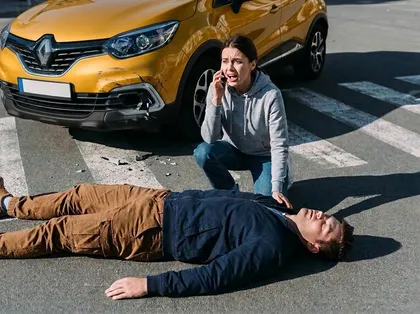
- $5,000,000 – Pedestrian Accident: Our client was walking in a crosswalk when a large truck hit him. The trucking company claimed he was looking at his phone while walking. We challenged that claim and recovered $5 million for our client, who suffered a mild traumatic brain injury.
- $1,700,000 – Crosswalk Accident: Our 79-year-old client was crossing in a crosswalk when the crash happened. The defense tried to blame her rather than accept responsibility. We continued fighting and secured a $1.7 million recovery.
- $1,750,000 – Auto vs. Pedestrian: An uninsured driver struck our client while crossing a dangerous intersection. We investigated the crash and found a history of accidents at that location. We then pursued a claim against the city for failing to address the hazard and recovered $1.75 million for our client.
Frequently Asked Questions About Pedestrian Accidents At Crosswalks
The answers below cover the questions pedestrians most often ask after a driver hits them in a California crosswalk. Each answer reflects how California law generally applies to these situations, based on the questions we hear most.
What Should I Do After A Hit-And-Run At A Crosswalk?
After a hit-and-run, call 911 and get medical care right away. Try to note the vehicle’s color, make, or direction of travel. Ask any witnesses to write down what they saw on their own. Check nearby businesses, traffic lights, and parked cars for security cameras. That footage can help identify the driver.
If no one can identify the at-fault driver, your auto insurance may also cover your losses if you opted to include uninsured motorist (UM) coverage when you took out your policy. A lawyer may also investigate whether you can pursue compensation from another potentially at-fault party, such as the driver’s employer, a vehicle owner, another motorist, or a government entity responsible for road maintenance.
What If I Were In The Crosswalk But The Signal Said “DON’T WALK”?
Crossing against a “DON’T WALK” signal does not automatically prevent you from filing a claim. If the driver also acted negligently, you may still recover damages. California’s pure comparative negligence law reduces your compensation based on your share of fault.
What Should I Do If A Commercial Vehicle Hits Me While I’m In A Crosswalk?
Consider consulting a lawyer. Although similar first steps, such as taking photos of the scene and collecting witness information, can still be helpful, commercial vehicle cases can involve employment records, driver logs, vehicle data, and insurance policies that may be difficult to obtain without legal help. Depending on the facts, you may also have a claim against the driver, the driver’s employer, the vehicle owner, a contractor, or another business involved in operating or maintaining the vehicle. These parties may have experienced claims experts or lawyers working on the case.
Since many commercial vehicles are also larger and heavier than private vehicles such as passenger cars, you may also sustain more severe injuries and extensive losses. Having an attorney on your side means someone can help you take legal action while you heal.
Hit In A Crosswalk? Get A Free Case Review!
Here at Arash Law (also known as AK Law), we have represented pedestrians injured in crosswalk accidents throughout California. Our legal team knows how insurers respond to these cases and how to build a claim that holds up. If a driver hit you while you were crossing the street, a lawyer can help you understand your options and guide you through the claims process.
We handle complex crosswalk cases across California, including disputed claims, hit-and-run accidents, and public entity claims. Arash Law also works on a contingency fee basis, so you pay no attorney’s fees unless the firm recovers money for you.
You can schedule a free initial consultation with us to describe what happened, ask questions, and get a clearer picture of your options. Call (888) 488-1391 to learn more about how we can help while you focus on healing.