TL;DR: Yes, you may be able to sue the trucking company if its driver was working at the time of the crash or the company’s negligence caused it.
Highlights:
- Confirm the driver was on duty when the crash occurred, then pursue the company’s commercial insurance coverage.
- Have your attorney send a preservation letter immediately to place the carrier on notice that potentially relevant evidence must be preserved.
- Request ELD records, EDR data, dispatch communications, maintenance logs, and hiring files before they are purged.
- Get medical care promptly — including chiropractic care — and preserve every bill, record, and diagnosis.
- Photograph the scene, both vehicles, cargo, road conditions, and your injuries as soon as it is safe to do so.
- Decline recorded statements to any insurance adjuster until you have spoken with an attorney.
- File a lawsuit within 2 years (CCP § 335.1). Claims involving a public entity — such as Caltrans for a road defect on I-15 — require a government tort claim within 6 months (Gov. Code § 911.2).
Tip: Write down everything you remember about the crash right now — speeds, lane positions, truck markings, and any contact the driver or company made with you — and share only confirmed facts with insurers.
Table of Contents

Potentially. A trucking company may be liable if the driver was acting within the scope of employment or agency, or if the company’s own negligence contributed to the crash. Trucking companies must follow federal rules that go far beyond standard traffic laws.
Commercial carriers operating on this corridor must comply with both California law and federal safety regulations that go well beyond ordinary traffic rules, and failing those obligations can make the company liable for the harm that results.
I-15 bisects Murrieta in southwestern Riverside County, carrying heavy freight between San Diego and the Inland Empire through grade changes, interchange merge points, and some of the heaviest commercial traffic in the region. Murrieta’s 2011 General Plan Final Environmental Impact Report, Section 5.4, analyzed traffic and circulation conditions affecting the I-15 corridor. When a loaded truck crashes at highway speed on this stretch, the injuries are often severe, and the responsible parties are rarely limited to just the driver.
A truck accident claim differs from a standard car crash case because it can reach an entire corporate entity — the carrier that hired the driver, maintained the equipment, set the schedule, and decided how much to load. Arash Law handles exactly this kind of multi-party investigation, and a free consultation with our attorneys costs you nothing upfront.
How California Law Allows You to Sue the Trucking Company
California recognizes two distinct legal theories for holding a trucking company responsible after a crash on I-15 in Murrieta, and either one or both may apply to your situation.
The first theory is vicarious liability, also called respondeat superior (Latin for “let the employer answer”). Under this doctrine, a company is legally responsible for harm its employee causes while performing job duties. If the truck driver was on a delivery run, following a dispatch order, or otherwise working at the time of the crash, you may hold the carrier liable without needing to prove the company made a separate mistake of its own. California Civil Jury Instructions (CACI) address this standard directly, and courts in Riverside County apply it routinely in commercial vehicle cases.
The second theory is direct negligence — the company’s own failures, independent of what the driver did in the moment. A carrier that hired a driver with a documented history of unsafe behavior, skipped federally required maintenance, or pushed drivers to violate hours-of-service limits can be held liable for those corporate decisions. These failures are often hidden in internal records that may be obtained through a subpoena.
Some carriers attempt to insulate themselves by classifying drivers as independent contractors — but California courts look past that label and examine the actual working relationship. See the FAQ below for how courts assess that question.
Why an I-15 Murrieta Crash Claim Targets the Company, Not Just the Driver
A trucking company may share liability when its driver causes a crash while working or when the company’s own negligence contributes to the collision. Trucking companies also typically carry commercial insurance with higher limits than an individual driver’s policy.
Company negligence may include:
- Overloading or improperly loading a trailer
- Delaying brake, tire, or mechanical repairs
- Hiring or retaining an unsafe driver
- Pressuring a driver to meet an unsafe schedule
- Allowing violations of applicable hours-of-service rules
These failures can be especially dangerous near the I-15 and I-215 interchange, where trucks must navigate highway-speed merges and changing grades.
Carriers and drivers subject to 49 CFR Part 395 must follow applicable hours-of-service and recordkeeping rules. Covered drivers generally use electronic logging devices, although federal exceptions may apply.
A qualifying safety violation may support negligence per se under California Evidence Code § 669. If the legal requirements are met, the violation creates a rebuttable presumption that the defendant failed to use reasonable care.
Trucking company liability is not automatic. Your claim must connect the company’s conduct to the crash and your injuries through records, electronic data, witness statements, and other evidence.
The I-15 Corridor and What Makes These Crashes Different
Interstate 15 is Murrieta’s primary commercial spine. Data tracked by the California Office of Traffic Safety (OTS) documents traffic injury and fatality victims across Murrieta. At the same time, the UC Berkeley SafeTREC Transportation Injury Mapping System (TIMS) maps collision patterns, including commercial vehicle incidents on the I-15 corridor.
What makes an I-15 truck crash in Murrieta factually distinct from a typical rear-end collision is the number of corporate systems that converge in a single moment: the driver’s hours-of-service compliance, the trailer’s weight and load security, the truck’s brake and tire maintenance history, and the carrier’s dispatch decisions. Identifying which of those systems failed — and which corporate actors made the decisions that caused the failure — requires a different kind of investigation than a two-car fender-bender.
The California Highway Patrol (CHP) Temecula Area office is the primary agency responsible for investigating collisions on I-15 within Murrieta’s city limits. When CHP investigates the collision, its Traffic Collision Report, commonly prepared on Form 555, may become an important part of the investigation. Obtaining it promptly through a California Public Records Act request helps establish the official record of what happened.
Multi-vehicle pileup, jackknife crashes, and rollover events on I-15 can also involve road condition issues attributable to Caltrans, California’s Department of Transportation. If a road defect on the interstate contributed to the crash, a separate claim against Caltrans may be available — but that path requires meeting a six-month deadline that applies only to government entity claims, not the standard two-year deadline for private parties.
Evidence That Proves a Trucking Company’s Fault
The most valuable evidence in a trucking case begins disappearing within hours of the crash — which is why knowing what to do after a truck accident in Murrieta matters just as much as knowing your legal rights. Some carriers send rapid-response teams to accident scenes to document conditions in a way that favors the carrier. Requesting that your attorney send a preservation letter may place the company on notice of anticipated litigation and identify potentially relevant evidence that should be preserved.
Under 49 CFR § 395.8(k)(1), carriers must retain driver hours-of-service records for a minimum of six months. That six-month period is a regulatory minimum. If litigation is pending or reasonably foreseeable, the carrier may be required to preserve relevant records beyond the ordinary retention period for as long as they remain relevant to the dispute. If a party intentionally conceals or destroys relevant evidence, a court may permit the jury to infer that the evidence would have been unfavorable to that party.
The following records are typically sought in an I-15 Murrieta truck accident investigation, each targeting a different layer of potential company fault:
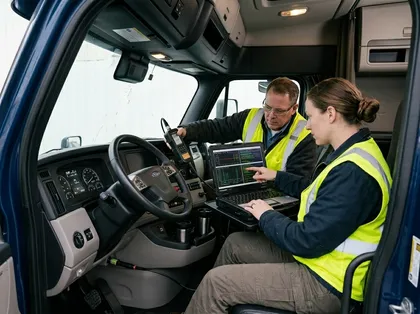
- Electronic Logging Device (ELD) Records: The ELD captures a driver’s duty status, GPS location, and hours of service in real time. A log showing the driver exceeded federal rest limits before the crash on I-15 supports a fatigue claim against the carrier.
- Event Data Recorder (EDR) Data: The EDR records vehicle speed, brake application, throttle position, and other performance data in the seconds around a crash — critical for reconstruction and for countering insurer arguments about your speed or position.
- Driver Qualification and Hiring Files: These reveal whether the carrier checked the driver’s crash history, drug-test results, and license status before putting the driver behind the wheel.
- Maintenance and Inspection Logs: These records show whether the company knew about brake wear, tire degradation, or other mechanical problems and chose not to fix them before the truck returned to I-15.
- Dispatch Records and Electronic Communications: Texts, emails, and dispatch instructions can show whether the company pressured the driver to deliver on a schedule that required violating federal rest rules.
- FMCSA Safety Measurement System (SMS) Records: These are publicly accessible through the FMCSA portal and can reveal the carrier’s inspection history, out-of-service orders, and safety fitness scores before the crash.
Beyond corporate records that establish fault, medical documentation is essential to prove the harm caused by that fault. Promptly seek an appropriate medical evaluation after the crash. Chiropractic care or physical therapy may be appropriate later when clinically indicated. Insurers can use gaps in treatment to argue that your injuries were not serious or were caused by something else. Consistent treatment records, including appropriate chiropractic records when clinically indicated, can document reported symptoms, examinations, and care, although causation and medical necessity may still be disputed.
Arash Law Case Results: Commercial Truck Crashes and Company Liability
Results vary from case to case. Past outcomes do not guarantee a similar recovery in any future matter.
$5,000,000 — Work Truck Crash: Red-Light T-Bone Collision. A work truck ran a red light and struck a husband and wife’s vehicle. The parties disputed the circumstances of the crash and the extent of the injuries before Arash Law secured a $5 million settlement after two years of litigation.
$5,000,000 — Truck vs. Motorcycle: Company Policy and Training Violations. The police report initially blamed the severely injured motorcyclist. Arash Law presented evidence that the truck driver violated his training and company policies and made a dangerous turn that contributed to the collision, securing $5 million for the client.
How California’s Comparative Fault Rule Affects Your Recovery
California’s pure comparative negligence rule lets you recover compensation even if you contributed to the crash — but your percentage of fault reduces the amount you receive. Understanding how this works in practice helps you evaluate what an insurance adjuster is actually offering when they dispute your role in what happened.
Here is how the math works under California law:
The figures below are hypothetical examples for illustration only and do not represent any specific case or expected recovery.
| Scenario | Total Damages | Your Fault Share | Your Reduction | Amount You Recover |
|---|---|---|---|---|
| Example A | $100,000 | 20% | $20,000 | $80,000 |
| Example B | $250,000 | 10% | $25,000 | $225,000 |
| Example C | $500,000 | 35% | $175,000 | $325,000 |
Legal basis: Li v. Yellow Cab Co., 13 Cal. 3d 804 (1975), establishing pure comparative fault; California Civil Code § 1431.2, governing several liability for non-economic damages.
Insurance adjusters for trucking companies focus on two driver behaviors in particular: lane position at the time of impact and speed before the crash. On I-15 near the I-215 interchange — where lane changes and merges are constant — an adjuster may argue that you were in the wrong lane or accelerating when the truck struck your vehicle. Those arguments exist specifically to raise your fault percentage and reduce the carrier’s payout.
An attorney at Arash Law can counter those arguments by analyzing the ELD and EDR data, the CHP collision report, and any available dashcam or traffic camera footage from the I-15 corridor. The goal is to keep your assigned fault percentage as low as the evidence supports, thereby protecting the amount you recover.
Filing Deadlines for a Truck Accident Lawsuit in Murrieta
- Two-year deadline — private trucking company: Under California Code of Civil Procedure § 335.1, you have two years from the date of the crash to file a personal injury lawsuit against a private carrier or driver. Missing this deadline almost always ends the case — courts in Riverside County do not routinely grant extensions, and insurers will cite a missed deadline to refuse any payment.
- Six-month deadline for government entity claims: If a dangerous road condition contributed to the crash, the responsible public entity depends on who owned or controlled the location. Caltrans may be involved if the defect was on I-15 or a state-controlled ramp. The City of Murrieta may be involved if the defect was on a city-controlled street, signal, sidewalk, or other local property. California Government Code § 911.2 generally requires a government claim to be presented within 6 months of the accrual of the cause of action.
- Minors and discovery exceptions: The two-year deadline may be paused for injured minors under CCP § 352. However, the six-month government claim deadline usually still applies. A late-claim application may be available under Government Code § 911.4, followed by a court petition under § 946.6 if denied. The discovery rule may also extend the deadline for injuries found later. An attorney can determine which timeline governs your specific situation.
General personal injury lawsuits are filed within the Riverside County Superior Court system. The Southwest Justice Center in Murrieta handles civil harassment, criminal, traffic, and juvenile matters. Still, the correct courthouse for a truck accident lawsuit depends on Riverside Superior Court’s current civil filing and venue rules.
How to Prepare for Your First Consultation with a Truck Accident Attorney
Walking into a consultation with organized information helps an attorney assess your case accurately and quickly. You are not expected to have everything — gather what you can.
- CHP or Police Crash Report Number, or the report itself, if you have already obtained it from the CHP Temecula Area office
- Photos and Video from the scene, including images of both vehicles, your injuries, skid marks, cargo spills, and road conditions
- Medical Records and Bills for all treatment received since the crash, including emergency care, follow-up visits, and any chiropractic records
- Insurance Information for both your vehicle and the truck involved, including any correspondence from the carrier’s insurer
- Employment Records showing lost wages or missed work since the injury
- A Written Timeline of what you remember — the date, time, lane positions, the truck’s company name or DOT number if visible, and any statements the driver or company representatives made at the scene
- Any Communication from the Trucking Company or Its Insurer — do not sign or agree to anything before speaking with counsel
One critical caution: do not give a recorded statement to the carrier’s insurance adjuster before consulting an attorney. Adjusters are trained to ask questions in ways that can produce answers used to raise your fault percentage or undermine your injury timeline. A statement given in good faith can still be used against you.
Your Legal Fees: How Contingency Representation Works
Truck accident victims in Murrieta retain Arash Law on a contingency fee basis. Under this arrangement, you pay no attorney fees upfront and owe nothing in legal fees unless and until your case results in financial recovery. Our fee comes as an agreed percentage of the amount recovered — whether through settlement or a successful trial result.
California Business and Professions Code § 6147 requires contingency fee agreements to be in writing and to disclose the fee percentage, how expenses are handled, and what happens if the case does not result in a recovery. Arash Law provides that a written agreement be in place at the outset of every representation, so you understand the terms before any work begins. California Rule of Professional Conduct 1.5 prohibits illegal or unconscionable fees and identifies multiple factors relevant to that determination, including the amount of the fee, the work required, the matter’s difficulty, and the results obtained.
The contingency structure means that the firm’s financial interest is aligned with yours: we pursue the strongest possible result because that is how both sides are compensated. If we do not recover for you, you do not owe us attorney fees. You may still be responsible for certain costs — such as court filing fees or expert witness fees — depending on the terms of your agreement, which will be explained clearly before you sign anything.

Frequently Asked Questions About Suing a Trucking Company After an I-15 Crash in Murrieta
Truck accident claims in Murrieta involve a specific mix of federal safety regulations, California civil procedure, and Riverside County court practice that creates questions most crash victims have never faced before. The answers below address the questions Arash Law hears most often from people in your situation. Each answer is self-contained, so you can read the one most relevant to your circumstances without needing to read the whole page.
Can I Sue Both the Truck Driver and the Trucking Company at the Same Time?
Yes. California law allows you to name multiple defendants in a single personal injury lawsuit. In a typical I-15 truck crash claim, you may sue the driver for negligent operation and the carrier for vicarious liability, direct negligence, or both. If a third party — such as a cargo loading company or a maintenance contractor — also contributed to the crash, they can be added as defendants as well. Filing against all potentially responsible parties from the start protects your recovery and avoids complications if one defendant later argues another party is solely at fault.
Does It Matter Whether the Driver Was a Company Employee or an Independent Contractor?
It matters in theory, but California courts look past the label. Carriers sometimes classify drivers as independent contractors to reduce their legal exposure. Still, courts examine the actual working relationship: who owned the truck, who assigned the routes, who set the schedule, and who had the authority to control how the work was done. If the carrier exercised meaningful control over the driver’s work — even under a contractor agreement — the carrier may still be held liable. An attorney can analyze the specific contract and working conditions to determine whether the contractor classification holds up.
What If the Crash Happened Near the I-15/I-215 Split and Involved Multiple Vehicles?
Multi-vehicle crashes at the I-15/I-215 interchange in Murrieta are among the most complex cases litigated in the Riverside County Superior Court system. When multiple vehicles are involved, fault may be distributed among several drivers and potentially the trucking company. California’s pure comparative fault system allows each defendant to be assigned a percentage of responsibility, and you can pursue compensation from each. These cases require thorough reconstruction of the collision sequence, which typically draws on CHP reports, EDR data from all vehicles, and expert analysis of the physical evidence from the I-15 merge zone.
What If a Road Defect on I-15 Contributed to the Crash?
If a dangerous condition of the road — such as a failed surface, absent lane markings, or a defective guardrail — played a role in the crash, Caltrans may share liability. However, suing a government entity follows a completely different timeline. You must file a government tort claim with Caltrans within six months of the crash under California Government Code § 911.2, not two years. Missing that six-month window typically eliminates the Caltrans claim entirely, even if your private lawsuit against the trucking company is still within the two years. An attorney should evaluate road conditions as part of the initial case investigation to ensure this deadline is not overlooked.
Will I Have to Go to Court?
Many truck accident claims in Riverside County resolve through settlement before trial. Trucking companies and their insurers often prefer to negotiate rather than expose internal records — maintenance logs, dispatch communications, and hiring files — to a jury. That said, Arash Law prepares every case as if it will go to trial, because carriers and insurers offer better settlements when they know the opposing attorney is genuinely ready to litigate in Riverside County Superior Court. If a fair resolution cannot be reached, Arash Law’s attorneys are prepared to take cases to trial.
What If My Injuries Were Not Obvious Right After the Crash?
Delayed symptoms are common after truck accidents. Some soft-tissue and concussion symptoms may not become noticeable until hours or days after a crash. Seeing a physician or chiropractor promptly — even before symptoms seem serious — creates a documented baseline that makes it harder for insurers to argue that your injuries arose from something other than the crash. If you waited to seek care, that gap can be addressed in your case, but it requires careful medical evidence and sometimes expert testimony to explain. The key is to seek treatment now and let an attorney help you explain the delay.
Injured on I-15 in Murrieta? Talk to Arash Law Today
Arash Law represents truck accident victims in Murrieta and throughout Riverside County and Southern California. Our attorneys understand how federal FMCSA regulations intersect with California civil law, and we know how to investigate corporate trucking records to build claims that reach the company — not just the driver.
Our Murrieta truck accident lawyers work on a contingency fee basis — there is no upfront cost and no attorney fee unless we recover compensation for you. If you were hurt on I-15 in Murrieta and want to understand your legal options, call (951) 461-5755 for a free, confidential case review.
Demand accountability. Call AK. Arash Law is ready to pursue every dollar supported by the facts.
About This Page
This page was prepared by Arash Law to help truck accident victims in Murrieta, California, understand their legal options after a crash involving a commercial carrier on I-15. The legal standards described here reflect California Code of Civil Procedure § 335.1, which establishes the two-year personal injury statute of limitations, California Government Code § 911.2, which sets the six-month government claim deadline, FMCSA Hours-of-Service regulations at 49 CFR Part 395 and § 395.8(k)(1), which governs ELD retention, and California’s pure comparative fault doctrine as established in Li v. Yellow Cab Co., 13 Cal. 3d 804 (1975).
Local procedural information references the Southwest Justice Center at 30755-D Auld Road, Murrieta, CA 92563, which handles traffic, civil harassment, criminal, and juvenile divisions for southwest Riverside County. Courthouse information was verified through the Riverside County Superior Court official website as of June 2026.
Crash data availability for Murrieta was confirmed through the California Office of Traffic Safety Crash Rankings tool and the UC Berkeley SafeTREC Transportation Injury Mapping System. The I-15 corridor framing references the City of Murrieta General Plan, Traffic and Circulation Element §5.4 (Iteris, Final September 2011). FMCSA carrier safety data is publicly accessible at fmcsa.dot.gov. All sources were accessed for general framework verification; specific crash counts for Murrieta were not extracted in this research pass and have not been cited as specific figures.
Results described on this page are not a guarantee of outcome. Every case is different. Past results for other clients do not predict or guarantee a similar result in your matter.
Sources
- California Code of Civil Procedure § 335.1 — Two-year personal injury statute of limitations. https://leginfo.legislature.ca.gov/faces/codes_displaySection.xhtml?sectionNum=335.1.&lawCode=CCP (accessed June 22, 2026)
- California Government Code § 911.2 — Six-month government tort claim deadline. https://leginfo.legislature.ca.gov/faces/codes_displaySection.xhtml?sectionNum=911.2.&lawCode=GOV (accessed June 22, 2026)
- FMCSA Hours-of-Service Regulations, 49 CFR Part 395. https://www.fmcsa.dot.gov/regulations/hours-of-service (accessed June 22, 2026)
- 49 CFR § 395.8(k)(1) — ELD/driver log retention requirement. https://www.ecfr.gov/current/title-49/part-395/section-395.8 (accessed June 22, 2026)
- Southwest Justice Center — Riverside County Superior Court. https://www.riverside.courts.ca.gov/location/southwest-justice-center (accessed June 22, 2026)
- UC Berkeley SafeTREC — Transportation Injury Mapping System (TIMS). https://tims.berkeley.edu/ (accessed June 22, 2026)
- California Office of Traffic Safety (OTS) — Crash Rankings. https://www.ots.ca.gov (Rankings accessible via the Research section; accessed June 22, 2026)
- City of Murrieta General Plan — Traffic and Circulation Element §5.4 (Iteris, Final September 2011). https://murrietaca.gov/documentcenter/view/786/05-04—traffic-and-circulation-pdf (accessed June 22, 2026)
- Caltrans — Contact / Claims Reference. https://dot.ca.gov/contact-us (accessed June 22, 2026)
- California Judicial Council Civil Jury Instructions (CACI) — Respondeat Superior / Vicarious Liability. https://courts.ca.gov/system/files/file/judicialcouncilofcaliforniaciviljuryinstructions_2026.pdf (accessed June 22, 2026)
Disclaimer: The information on this page is for general informational purposes only and does not constitute legal advice. Reading this page does not create an attorney-client relationship with Arash Law. Every case is different, and outcomes depend on the specific facts and applicable law in your situation. Do not rely on this page as a substitute for consultation with a licensed attorney. Arash Law is licensed to practice law in California.