After a truck accident in Murrieta, the first steps are to call 911, seek medical care, document the scene if safe, obtain the responding agency’s report number, and avoid making recorded statements to the trucking company’s insurer before speaking with a lawyer.
Murrieta sits at the I-15 / I-215 split, a major Inland Empire freeway junction with substantial commercial truck exposure. Truck crashes here can involve out-of-state motor carriers, brokers, shippers, and multiple insurance layers — and key evidence can disappear within days.
Truck cases are different from ordinary car crashes because federal FMCSA rules may control what records the carrier must keep. Truck computer data (ECM), dashcam footage, dispatch records, and driver logs can help show how the crash happened and who may be responsible. An attorney who knows the I-15 / I-215 corridor, CHP Temecula jurisdiction, and federal carrier rules can move quickly to preserve the right evidence.
Arash Law has recovered over $1 billion for injury clients across California. This page is reviewed by a licensed California personal injury attorney.
Call our Murrieta truck accident lawyers at (951) 461-5755 for a free, no-pressure consultation. No fee unless we recover for you. House, hospital, and virtual visits are available across Riverside County and Southern California.
Immediate Steps After a Murrieta Truck Accident
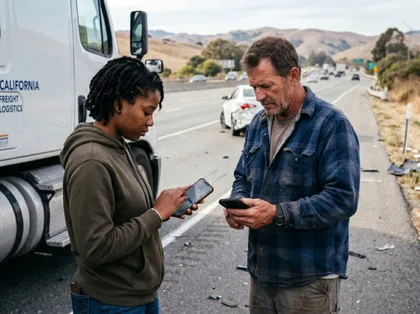
- Call 911 and get medical care the same day, even if you feel fine. Symptoms of internal injury and traumatic brain injury can be delayed.
- Photograph the truck’s DOT number, USDOT placards, trailer position, skid marks, and road conditions before anything is moved.
- Write down the truck driver’s name, the motor carrier name, all witness contacts, and the agency report number.
- If no officer responded, confirm whether a written crash report is required. File your DMV SR-1 within 10 days if anyone was injured or damage exceeds $1,000.
- Ask your attorney to send an evidence-preservation letter (sometimes called a spoliation letter) to the motor carrier immediately. Truck computer data (ECM) can be overwritten within days; dashcam footage often purges in 7 to 30 days.
- Decline recorded statements to the trucking company’s insurer and pause social media posts while the claim is pending.
- Keep a daily symptom log and save every medical bill, receipt, discharge paper, prescription record, and follow-up instruction. Important filing and reporting deadlines are explained below.
Table of Contents

Five Things That Actually Matter After a Murrieta Truck Accident
Most truck accident guides repeat the same generic advice: see a doctor, call the police, hire a lawyer. Those steps matter, but they do not separate a strong Murrieta truck case from a weak one. These five do.
- Truck crashes on Murrieta freeways route to CHP Temecula, not Murrieta PD. I-15 and I-215 fall under CHP jurisdiction for crash reporting. The Murrieta Police Department handles local city-street crashes; the Riverside County Sheriff covers unincorporated areas. Why it matters: the right agency controls the report, citations, and scene documentation.
- Federal FMCSA rules apply on top of California law. Commercial trucks on the road through Murrieta operate under federal FMCSA safety rules in addition to California law. Those rules cover hours of service, driver qualification, vehicle inspection, and post-crash testing. Why it matters: federal violations can expand liability theories and evidence requests beyond what state law alone provides.
- ECM and video evidence can disappear fast. ELD records have federal retention rules, but they still need preservation letters. Truck computer data (ECM), dashcam footage, and ELD hours-of-service logs can disappear quickly. ELD records are subject to federal retention rules, but they should still be covered by preservation letters — these require preserving relevant data and suspending routine deletion when litigation is anticipated. ECM data can be overwritten within days; dashcam video often purges in 7 to 30 days. Why it matters: an evidence-preservation letter sent early is one of the most important steps an attorney takes in any truck case.
- Multiple defendants are common in serious truck cases. A single truck crash can involve the driver, motor carrier, freight broker, cargo loader, maintenance contractor, trailer owner, and vehicle manufacturer. Each may carry a separate insurance policy. Why it matters: Identifying every liable party early can substantially expand the available recovery.
- Deadlines split: 2 years for private claims, 6 months for government claims. California law gives most truck accident victims two years to file a personal injury lawsuit. If a public entity contributed, a separate government claim must be filed within six months. Why it matters: missing either deadline can bar that claim entirely.
Why a Truck Accident in Murrieta Is Different From an Ordinary Crash
California’s traffic and personal injury laws apply statewide. What changes city to city is the procedural and infrastructure context: which agency takes the crash report, which courthouse hears the civil case, which freeways concentrate commercial traffic, and which federal regulations overlay the state law framework. In Murrieta, four facts shape every truck accident case.
1. The I-15 / I-215 split is a major Inland Empire freight corridor
Murrieta sits at the geographic convergence of two interstate freeways. I-15 connects San Diego to the Inland Empire warehouse cluster and on to Los Angeles. I-215 splits at Murrieta and connects east toward San Bernardino. The result is substantial commercial truck exposure concentrated near the freeway split. That gives Murrieta a commercial-vehicle exposure profile that is larger than its residential character alone might suggest.
2. CHP Temecula handles the freeway crashes
The California Highway Patrol Temecula Area Office covers I-15 and I-215 within Murrieta. CHP officers responding to commercial truck collisions are trained to identify FMCSA-regulated carriers and to document the kind of evidence federal rules later require. A lawyer unfamiliar with the CHP Temecula office can lose valuable time at the start of an Inland Empire truck case.
Crashes on local Murrieta streets may be handled by a different reporting agency. The Murrieta Police Department, reachable at (951) 696-3615 non-emergency, generally handles crashes on local Murrieta city streets, including Murrieta Hot Springs Road, Clinton Keith Road, Madison Avenue, and California Oaks Road. CHP may handle crashes on state routes or highways, including SR-79 / Winchester Road, depending on the exact location and jurisdiction. The reporting agency should always be verified by crash location, not assumed from the street name alone. The Riverside County Sheriff’s Department handles unincorporated areas bordering the city.
3. Federal FMCSA regulations create a parallel layer of law
Commercial trucks in interstate commerce are not just governed by the California Vehicle Code. They operate under federal carrier safety regulations published at 49 CFR §§390 through 399. These rules govern hours of service, driver qualification, vehicle inspection, drug and alcohol testing, and a wide range of safety standards. A violation of these rules may help show that the driver or carrier broke a safety rule that caused the crash. Federal jurisdiction sometimes applies when the carrier is from out of state, and the amount in controversy exceeds the diversity threshold.
4. Civil cases file at the Southwest Justice Center
Riverside County Superior Court’s Southwest District handles Murrieta civil personal injury cases through the Southwest Justice Center at 30755-D Auld Road in Murrieta. Filing venue depends on the case type, amount in controversy, and Superior Court assignment rules. For complex multi-defendant truck cases, the Southwest Justice Center is the typical home court. Some cases involving out-of-state carriers may also be eligible for federal court under diversity jurisdiction.
What the Local Data Shows on Truck Accidents in Murrieta
In Murrieta, the 2023 OTS Rankings report recorded 380 total fatal-and-injury victims (people killed or injured in crashes) and 96 speed-related fatal-and-injury collisions (crash events involving a death or injury) — ranking the city 7th out of 62 similarly sized California cities for speed-related collisions. California traffic-safety data draws on OTS city rankings and SWITRS-based tools like UC Berkeley’s TIMS, which distinguish between fatal and injury victims and fatal and injury collisions. Truck-specific city-level data is not published at the same granularity, so this analysis relies on verified corridor geography, agency routing, FMCSA carrier data, and case-specific evidence rather than pretending OTS provides city-level truck-only counts.
The takeaway: Murrieta’s truck accident exposure is substantially shaped by its geography. The freeway traffic that supports the Inland Empire’s economy also concentrates commercial-vehicle risk near the I-15 / I-215 split.
Speak With A Murrieta Truck Accident Lawyer Today — (951) 461-5755. Local Murrieta line: (951) 461-5755 · Main 24-hour California line: (888) 488-1391
Filing Deadlines for a Murrieta Truck Accident Case
Four separate deadlines and reporting rules apply to most Murrieta truck accident cases. A claimant must file a government claim before filing a lawsuit against a public entity. Missing the lawsuit filing deadline or the government claim deadline can bar that claim entirely — missing a reporting deadline can weaken evidence or create administrative problems that affect the case.
Two years to file the civil lawsuit
California Code of Civil Procedure §335.1 sets a two-year statute of limitations for personal injury claims, including truck accident cases. The clock starts on the date of the crash. If the injured victim is a minor, the deadline is tolled under CCP §352(a) until the minor turns 18. Evidence preservation cannot wait — ECM data, ELD records, dispatch logs, dash cam footage, and witness statements all need to be secured early.
Six months to file any government claim
If the crash involves a Caltrans roadway condition, a City of Murrieta vehicle, a Riverside County vehicle, or any other public entity allegedly contributing, a written government claim may need to be presented within six months under Government Code §911.2. Examples include a dangerous condition with prior notice, defective signage, a missing guardrail at a known dangerous location, inadequate striping, or a city or county employee operating a public-entity vehicle. Claim presentation must precede any lawsuit under Government Code §945.4.
After the government claim is filed, the split deadline for the resulting lawsuit
Once a government claim is filed, the lawsuit deadline splits depending on how the claim is resolved. If the agency DENIES the claim in writing, the lawsuit must be filed within 6 months of the rejection date under Government Code §945.6(a)(1). If the agency takes NO ACTION within the 45-day investigation window under Government Code §912.4, the claimant generally has up to 2 years from the date of injury to file suit. The longer window applies only when the agency is silent, not when it denies.
Ten days for the DMV SR-1
California Vehicle Code §16000 requires drivers involved in any crash with injury or with property damage exceeding $1,000 to file form SR-1 with the DMV within 10 days. The driver, an insurance agent, or the driver’s attorney can submit the form. A police report does not replace the SR-1 requirement.
Twenty-four hours for the written police or CHP report
California Vehicle Code §20008 requires drivers involved in injury or fatal crashes to submit a written report within 24 hours when no peace officer responded to the scene. Note that §20008 exempts common carrier vehicles in certain sub-provisions — if the vehicle is an FMCSA-regulated commercial truck, federal post-accident reporting and documentation obligations may apply in parallel or instead. If CHP, Murrieta Police, or the Riverside County Sheriff documented the crash at the scene, the on-scene report satisfies the §20008 requirement. The 24-hour written-report rule applies only as a fallback when no officer responded to the scene.
Where Your Murrieta Truck Accident Case Files
If a Murrieta truck accident case becomes a civil lawsuit, the filing venue usually turns on Riverside County Superior Court assignment rules, the amount in controversy, and whether any federal-court basis exists. Crash reports, DMV filings, and government claims are handled in the sections below.
| Procedural track | Where it goes | Deadline and key authority |
|---|---|---|
| Civil personal injury claim — the primary case | Riverside County Superior Court, Southwest Justice Center, 30755-D Auld Road, Murrieta, CA 92563. Filing venue depends on case type, amount in controversy, and assignment rules. Some cases may be filed in federal court under diversity jurisdiction if the carrier is from out of state. | Two-year lawsuit deadline from the date of the crash. California pure comparative negligence applies to fault allocation. |
The civil personal injury case files at the Southwest Justice Center, Riverside County Superior Court. For crash-report routing, DMV SR-1 requirements, and the government claim procedure, see the sections below.
How to Report a Truck Crash in Murrieta, CA
CHP generally handles crashes on I-15 and I-215 within Murrieta, while the Murrieta Police Department generally handles crashes on local city streets. The correct reporting agency depends on the exact crash location.
| Crash location | Agency and contact |
|---|---|
| I-15 or I-215 within Murrieta | California Highway Patrol — Temecula Area Office. CHP responds to freeway crashes and handles the report. For 24-hour CHP dispatch: 9-1-1 emergencies or *11 from a mobile phone. |
| Murrieta surface streets | Murrieta Police Department. Non-emergency: (951) 696-3615. Emergencies: 9-1-1. |
| Unincorporated areas bordering Murrieta | Riverside County Sheriff’s Department. |
| If no officer responded — written report fallback | If no officer responded, confirm whether a written crash report is required. For FMCSA-regulated commercial trucks, federal post-accident obligations may apply instead or in parallel. The report goes to CHP or local police, depending on jurisdiction. |
| Reporting to your own insurer | Notify your own carrier promptly as required by your policy. Avoid guessing about fault, injuries, or the mechanism of the crash. Do not give a recorded statement to the trucking company’s insurer before consulting an attorney. |
CHP generally handles crashes on I-15 and I-215 within Murrieta, while the Murrieta Police Department generally handles crashes on local city streets. The correct reporting agency depends on the exact crash location.
How to File a Government Claim for a Murrieta Truck Accident
If a public road, public vehicle, Caltrans issue, or city/county condition may have contributed to your crash, this section explains the shorter deadline that applies. If no public entity was involved, this section does not affect your claim.
If a public entity allegedly contributed to the crash — through a dangerous roadway condition, defective signage, a city or county vehicle, or other public-entity conduct — a separate claim under the California Government Claims Act may apply.
Follow these steps:
Step 1 — Identify the public entity: Determine which government body is responsible, such as the City of Murrieta, Riverside County, Caltrans, or another public agency.
Step 2 — File with the correct agency: Table 1 below shows where to file for each public entity, the filing deadline, and the statutory authority.
Step 3 — Track the agency response: The agency generally has 45 days to act. It may approve, deny, or take no action.
Step 4 — Calendar the lawsuit deadline: The deadline to file suit depends on whether the agency denies or ignores the claim. Table 2 below covers the investigation window and explains the split timing.
Table 1: Where to File
| Public entity | When it may apply | Where to file / what to verify |
|---|---|---|
| City of Murrieta | City vehicle, city street, city-controlled sign or signal, or city road condition. | City of Murrieta City Clerk for claims against the city. Verify the current claim-filing procedure and address at cityofmurrieta.org before submitting. |
| Riverside County | County vehicle, county road, sheriff-related issue, or unincorporated-area road condition. | Riverside County Clerk of the Board of Supervisors for claims against the county. |
| Caltrans / State of California | I-15 / I-215 state highway maintenance, signage, striping, guardrail, or other state-controlled roadway condition. | California Department of General Services for claims against Caltrans (state highway maintenance, signage, or other state-controlled roadway involvement on I-15 or I-215). |
Table 2: Rules After Filing
| Issue | Rule |
|---|---|
| Filing deadline | Most public-entity injury claims must be presented within six months of the crash. Late claims require a separate petition with statutory excuse grounds and are not guaranteed. |
| Statutory authority | California Government Claims Act. A claim must be presented before a lawsuit can be filed. |
| Agency investigation window | The agency generally has 45 days to act. It may approve, deny, or take no action. If the agency sends a written denial, the lawsuit deadline is usually six months from that notice. If the agency takes no action within 45 days, the lawsuit deadline may differ and should be calculated carefully with an attorney. |
| After the agency responds — lawsuit deadline | If the agency sends a written denial, the lawsuit deadline is usually six months from that notice. If the agency takes no action within 45 days, the lawsuit deadline may differ and should be calculated carefully with an attorney. |
Legal basis: Gov. Code §§911.2, 911.4, 912.4, 945.4, and 945.6.
The City of Murrieta does NOT accept claims on behalf of Riverside County, Caltrans, the Murrieta Valley Unified School District, the Riverside County Sheriff’s Department, or any other separate public entity. Each entity has its own claim procedure and its own 6-month deadline. Filing with the wrong agency or missing a deadline can bar that claim entirely.
Representative Results From Arash Law’s Truck Accident Practice
The results below are representative California truck accident cases from Arash Law’s practice. None are Murrieta cases specifically. Some are settlements; others were resolved in trial posture — meaning the case was fully prepared and ready for trial at the time of resolution. They illustrate the types of commercial-truck and catastrophic-injury claims the firm has handled, including the lead $5.5 million rollover-trucking case involving a spinal cord injury and traumatic brain injury sustained within the scope of employment.
$3,500,000 — Truck accident jury verdict — client suffered a traumatic brain injury in a 2017 commercial truck collision. The insurer initially offered $18,500, later raised the offer to $300,000. The jury awarded damages for past and future pain, suffering, and future medical care after hearing the medical testimony.
$1,150,000 — Auto vs. delivery truck — a large delivery truck rear-ended a middle-aged client on a freeway. The client suffered neck and back injuries. The defense attempted to attribute her injuries to weight and pre-existing conditions. Resolved at mediation before trial.
Past results do not guarantee future outcomes. Every case depends on its own facts, evidence, injuries, insurance, venue, and liability issues. The first two cases above involved traumatic brain injury components that substantially shaped the case value — TBI is a recurring issue in commercial truck crashes, given the kinetic energy involved. Contacting Arash Law does not create an attorney-client relationship. An attorney-client relationship is formed only when both parties sign a written fee agreement.
For Murrieta-area context, the firm also resolved a $5.25 million policy-limits case involving a Murrieta client paralyzed after being struck by a distracted driver. That case is not a commercial truck case — the at-fault vehicle was a paratransit van, not an FMCSA-regulated truck — but it illustrates the type of catastrophic-injury Murrieta case the firm has handled successfully. The firm also negotiated a $2.5 million workers’ compensation settlement in connection with the same incident.
In our experience, what separates a strong truck accident case from a thin one is early identification of the motor carrier’s primary and excess insurance layers, fast preservation of ECM and ELD data, and meticulous documentation of any FMCSA regulatory violations. Truck cases the firm has resolved at policy limits were built on careful federal regulatory analysis paired with state-court liability theory.
Red Flags When Choosing a Murrieta Truck Accident Lawyer
Truck accident litigation is a niche within personal injury. The lawyer-selection question is not whether a firm handles injury cases generally. Watch for the following signals.
- The firm pitches itself as a general personal injury practice and cannot articulate the difference between FMCSA federal regulations and California Vehicle Code violations. Federal truck-safety rules are central to commercial truck litigation.
- The firm is unfamiliar with 49 CFR §395 hours-of-service rules and how those violations may show the driver or carrier broke a federal safety rule. Hours-of-service violations are common in fatigue-related truck crashes.
- The firm proposes filing the civil case before sending an evidence-preservation letter to preserve ECM data, ELD logs, driver qualification files, and post-crash drug/alcohol test records. Most truck-case recoveries depend on evidence that the motor carrier controls.
- The firm cannot identify the CHP Temecula Area Office or the Riverside County Sheriff’s Department as the agencies responsible for crash investigations in Murrieta, nor does it understand that jurisdiction depends on where the crash occurred.
- The firm tells you the case is obvious because the truck was big. Size does not establish fault. Federal regulatory violations, driver negligence, motor carrier negligence in hiring or training, and cargo loading errors all require separate proof.
- The firm wants you to give a recorded statement to the motor carrier’s insurance adjuster before your medical workup is complete. Adjusters are trained to elicit statements that minimize injury severity before the full picture emerges.
How to Verify a Truck Accident Lawyer’s Track Record
Most lawyer-selection guidance is aspirational. Here is what you can verify in 15 minutes.
1. California State Bar Attorney Search
The California State Bar maintains a public attorney-search tool at apps.calbar.ca.gov/attorney/LicenseeSearch/QuickSearch. Look up any attorney by name to confirm active status, license number, year of admission, public disciplinary history, if any, and current bar address. Inactive or suspended attorneys cannot represent you.
2. Riverside County Superior Court case-search portal
Riverside Superior Court’s public case-access portal at riverside.courts.ca.gov allows civil-case searches by attorney name. A lawyer claiming regular Southwest District truck experience may appear in public civil filings. Public docket searches are not perfect — some cases settle pre-filing, some records list associated counsel differently. Treat the portal as a useful cross-check, not a complete proof of experience.
3. Three direct questions to ask in consultation
- How many commercial truck cases have you taken to verdict, settlement, or trial-prepared resolution in the last three years? Ask for a specific number, not a generality.
- Walk me through how you would preserve ECM and ELD data in my case. What’s the first letter you send and when? A lawyer who cannot answer specifically does not handle truck cases routinely.
- If a Caltrans roadway condition or a Murrieta city vehicle contributed to the crash, how would you evaluate the government claim? The right answer should identify the six-month government claim deadline and explain that a public-entity claim depends on whether the entity allegedly contributed through a dangerous condition, defective signage, or other public-entity conduct.
Common Murrieta Truck Accident Scenarios
Most Murrieta truck accident claims fall into one of six scenarios. Each carries its own evidence pattern, defendant-identification challenge, and insurance pathway.
1. Rear-end collision on I-15 or I-215
The rear-end collision is the most common Murrieta truck crash scenario. A commercial truck rear-ends a passenger vehicle on the freeway. Liability often comes down to hours-of-service violations under 49 CFR §395, distracted-driving evidence from dash cam or cell phone records, and following-distance analysis from ECM data. The motor carrier’s primary policy, plus any excess layers, determines the available recovery.
2. Truck-versus-auto at a Murrieta surface street intersection
Crashes at Murrieta Hot Springs Road, Clinton Keith Road, Madison Avenue, or California Oaks Road generally route to the Murrieta Police Department. For SR-79 / Winchester Road, CHP may have jurisdiction depending on the exact crash location — the reporting agency should be verified by location, not assumed from the street name. Intersection cases often turn on signal timing, right-of-way, and witness testimony. If the truck driver violated a California Vehicle Code rule, that violation may help show the driver broke a safety rule in addition to any FMCSA violations.
3. Underride collision
Underride crashes — where a passenger vehicle slides under a trailer — are catastrophic and frequently fatal. Federal rules require rear underride guards on most trailers under 49 CFR §393. A missing, damaged, or defective underride guard can support product liability or negligent maintenance claims against the trailer owner, separate from the driver and motor carrier.
4. Worker-on-employer-truck scenario
If the injured person was a truck driver or another worker hurt while on the job, this scenario explains how workers’ compensation and a civil claim may both apply simultaneously. When a truck driver is injured in a crash while working — for example, asleep in the cab when a co-driver was at fault, or thrown from the vehicle in a rollover — the case may involve both workers’ compensation and a parallel third-party civil claim. The workplace injury side of these cases is often the primary recovery vehicle for the injured trucker, with a civil claim against any at-fault third party running in parallel. Coordination between the two tracks matters because the workers’ compensation carrier holds a lien on third-party recovery.
5. Cargo-failure crash
Improperly loaded, secured, or balanced cargo can cause a truck to lose control, roll over, or shed its load on the highway. If the crash involved shifting cargo, a falling load, or an overloaded trailer, this scenario may expand the available defendants beyond the driver and motor carrier. Liability may extend to the shipper, the loading contractor, the carrier, and the broker — each governed by different sections of 49 CFR §392 (operation) and §393 (parts and accessories). Cargo-failure cases often expand the available defendants substantially.
6. Government entity involvement scenario
If a roadway condition under Caltrans District 8 jurisdiction allegedly contributed — defective signage, inadequate striping, missing guardrail, a known dangerous condition with no warning — a six-month government claim deadline may apply. The same applies if a City of Murrieta vehicle or a Riverside County vehicle was involved in the crash. The government claim does not replace the civil case against the motor carrier; it runs in parallel.
Murrieta Truck Accident Evidence Map — What to Preserve and Who Controls It
Each truck accident claim type has its own evidence preservation calendar and custodian. The first 7 to 30 days are decisive. A lawyer who knows the federal regulatory landscape and the local Murrieta procedural context can send the right preservation letters before evidence is overwritten, destroyed, or simply forgotten.
| Evidence type | Why it matters | Custodian |
|---|---|---|
| ECM black box data | May show speed, braking, throttle, and engine activity from moments before impact. Can be overwritten quickly; evidence-preservation letter is critical within the first week. | Motor carrier — typically the maintenance vendor or carrier headquarters |
| Electronic Logging Device (ELD) hours-of-service records | Records hours driven and rest time. Federal rules require six-month retention. May help show the driver broke a safety rule. | Motor carrier; ELD service provider; FMCSA, in some cases |
| Driver Qualification File (DQF) | Hiring and qualification records. May show the carrier should have known the driver was unsafe or unqualified. | Motor carrier headquarters |
| Post-crash drug and alcohol test results | Required after fatalities or qualifying injury crashes under federal rules. Alcohol testing has strict time cutoffs; drug testing must happen quickly. Early documentation is critical. | Motor carrier; testing laboratory; sometimes hospital |
| Dispatch and routing records | Show whether the driver was forced to violate hours-of-service rules. Support forced-violation theories. Retention varies by carrier — preservation letter needed. | Motor carrier; freight broker |
| Dash cam and onboard video | Captures actual driver behavior, weather, and lane positions. Typical retention is 7 to 30 days; some advanced systems retain longer. Preservation letter within the first week is critical. | Motor carrier; sometimes a fleet-management vendor |
| CHP / Murrieta PD / Sheriff crash report | Independent agency documentation of the crash. Identifies the driver, the motor carrier on placards, and citations issued at the scene. Available for purchase 10-14 days after the crash. | CHP Temecula Area Office; Murrieta PD; Riverside County Sheriff |
Preservation letters to each custodian above should be among the first letters out the door in any Murrieta truck case. Federal hours-of-service records have a minimum federal six-month retention rule under 49 CFR §395.8(k), but the carrier’s own policies often determine retention beyond that minimum. A delay of two weeks can mean the difference between a video-documented crash and a case dependent on witness memory.
How Lawyer Fees Work in a Murrieta Truck Accident Case
Two California rules govern contingency fee agreements for truck accident cases:
- California Business and Professions Code §6147 requires contingency fee agreements to be in writing and signed by both the lawyer and the client. A copy must go to the client. §6147 also requires specific disclosures: the fee is negotiable, fees are not set by law, and the agreement must state the percentage and how it is calculated.
- California Rule of Professional Conduct 1.5 separately prohibits unconscionable or illegal fees, regardless of whether the agreement is in writing. Rule 1.5 lists factors used to determine reasonableness.
The exact fee percentage, cost responsibility, and calculation method must be stated in the written fee agreement before representation begins. Truck accident cases often carry higher litigation costs than standard PI cases — FMCSA subpoenas, ECM data retrieval, accident reconstruction, and expert witness fees are common — so ask how costs are handled if there is no recovery.
What to Bring to Your Free Consultation
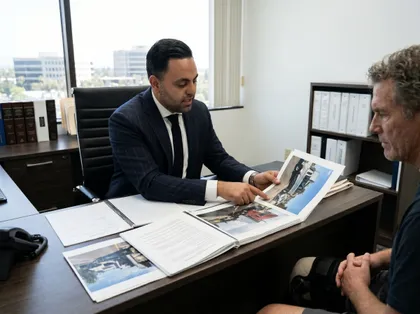 For a Murrieta truck accident case, bring the documents that anchor the federal regulatory and local procedural tracks. These include:
- Photos of the crash scene, vehicle damage, the truck (especially DOT number and trailer placards), skid marks, and road conditions.
- Photos of any visible injuries, and a running log of symptoms, medical appointments, and treatment costs starting from the day of the crash.
- Medical records and bills from any treating providers — Inland Valley Medical Center, Loma Linda University Medical Center – Murrieta, or any other facility.
- The CHP, Murrieta PD, or Riverside County Sheriff incident report number, if a report was taken
- Names, phone numbers, and addresses of any witnesses to the crash.
- The truck driver’s name, the motor carrier name, the DOT number, and any insurance information you obtained at the scene.
- Any recorded statements, letters, or correspondence from the motor carrier’s insurance adjuster — do not sign anything or give a recorded statement before this meeting.
- Your own auto insurance declarations page — the firm will check for underinsured motorist coverage, which matters when the motor carrier’s policy limits are disputed or insufficient.
- Information about any prior crashes or claims involving the same driver or motor carrier, if known.
- If you were on the job: workers’ compensation claim information and your employer’s accident report.
If you do not have all of these, bring what you have. The firm can subpoena, request, or pursue the rest as part of the case workup.
Frequently Asked Questions
How much does it cost to hire a Murrieta truck accident lawyer?
Most Murrieta truck accident cases are handled on contingency. No fee unless we recover for you. The fee agreement will be in writing, will identify the percentage, and will explain whether you may owe any case costs if there is no recovery. California Business and Professions Code §6147 requires contingency fee agreements to be in writing and signed before representation begins.
Do I still need to file an SR-1 if the police took a report?
Yes. California Vehicle Code §16000 requires every driver involved in a crash with injury or property damage exceeding $1,000 to file form SR-1 with the DMV within 10 days. A police report does not satisfy the SR-1 requirement. Every driver involved must file separately. Your insurance agent or your attorney can file the SR-1 on your behalf.
Is the truck driver always the only one at fault?
Generally no. The motor carrier, the freight broker, the cargo loader, the trailer owner, the maintenance contractor, a vehicle manufacturer, and a public entity may all share fault depending on the crash. Identifying every potentially liable party is upstream of filing a single-defendant lawsuit. For example, if you suffer an injury in a crash on I-15 in Murrieta and the truck driver was forced to exceed hours-of-service limits by dispatch, you may be able to sue the trucking company for negligent supervision.
Can I get a settlement without going to court in Murrieta?
Most likely. Many truck accident victims resolve their claims without going to court. You may need to go to court only if the motor carrier’s insurance company disputes liability, refuses fair compensation, or contests the federal regulatory analysis. Filing the lawsuit often triggers the discovery process that produces ECM data, dispatch records, and federal compliance audits — which can lead to settlement even after the suit is filed.
Should I give the insurance adjuster a recorded statement?
Speak with an attorney first. Insurance adjusters for motor carriers are trained to elicit statements that minimize injury severity or shift liability to the victim. They often call before the victim’s medical workup is complete. There is generally no obligation to provide a recorded statement to the at-fault carrier’s insurer before consulting counsel.
What evidence do I need for a Murrieta truck accident claim?
The strongest Murrieta truck accident cases are built on seven categories of evidence: scene and damage photos at multiple time points, the CHP or Murrieta PD crash report, ECM black box data, ELD hours-of-service logs, the Driver Qualification File, dispatch and routing records, and dash cam footage. Medical records documenting treatment and any planned future care complete the picture. Surveillance footage and ECM data can be overwritten quickly — send preservation letters within days, not weeks.
How is Murrieta different from neighboring cities for truck accident reporting?
Truck accident reporting in the Inland Empire varies by jurisdiction. CHP Temecula handles I-15 and I-215 commercial truck collisions within Murrieta. The Murrieta Police Department covers local Murrieta streets. The Riverside County Sheriff handles unincorporated areas. Each agency has its own protocol and contact information — do not assume the reporting path is the same just because a neighboring city is nearby.
What if the truck is from out of state?
Interstate motor carriers are subject to federal FMCSA regulations under 49 CFR §§390-399, the same as in-state carriers. The carrier’s USDOT number lets your attorney pull the FMCSA SAFER database history, including any prior out-of-service violations. If the at-fault carrier is from out of state and the amount in controversy exceeds the federal threshold, the case may be removed to federal court under diversity jurisdiction, which can affect strategy but generally does not affect the merits of the claim.
Other Injury Matters in Murrieta
A truck accident is one type of injury claim that arises in Murrieta. Other claims — passenger-vehicle crashes, rideshare collisions, premises injuries, and pedestrian incidents — have their own procedural and evidentiary patterns. For broader help with any injury claim in the city, see our Murrieta injury law firm overview. For passenger-vehicle crashes specifically, our Murrieta car accident lawyers page covers car-on-car collisions. For rideshare claims involving Uber or Lyft, our Murrieta rideshare claims page addresses the unique multi-policy framework those cases involve. If your case is a commercial truck accident specifically, our dedicated Murrieta truck accident lawyers page has more details on what to expect from a consultation.
Let Arash Law Help With Your Murrieta Truck Accident Case. Local Murrieta line: (951) 461-5755 · Main 24-hour California line: (888) 488-1391 · Free, no-pressure consultation. No fee unless we recover for you. House, hospital, and virtual visits are available across Riverside County and Southern California.
A truck accident can leave you with mounting medical bills, lost income, and a motor carrier insurer focused on minimizing what you recover. Whether the crash happened on I-15, I-215, at the I-15 / I-215 split, on Murrieta Hot Springs Road, Winchester Road, or anywhere else in the city, our Murrieta truck accident lawyers can help you understand your options under California law and the federal FMCSA regulations, identify the right insurance pathways, and build the case around the right evidence-preservation timeline.
Call (951) 461-5755 — our local Murrieta number — for a free initial consultation. Our main 24-hour California line is (888) 488-1391. We offer virtual, home, and hospital visits so you can speak with us from wherever you are recovering.
About This Guide
This guide applies California truck accident law to Murrieta-specific procedural facts. Sources include the City of Murrieta official website at cityofmurrieta.org, the California Highway Patrol at chp.ca.gov, the Riverside County Sheriff’s Department, the Riverside County Superior Court at riverside.courts.ca.gov, the California Department of Motor Vehicles at dmv.ca.gov, the California State Bar attorney search, the Federal Motor Carrier Safety Administration at fmcsa.dot.gov, and the California Office of Legislative Information for statutory text including Veh. Code §§20008 and 16000, CCP §335.1, Gov. Code §§911.2, 912.4, 945.4, and 945.6, and federal motor carrier regulations at 49 CFR §§390-399. It was reviewed by a California personal injury attorney for accuracy.
Sources
- California Highway Patrol — Temecula Area Office (handles I-15 and I-215 commercial truck collisions within Murrieta)
- Murrieta Police Department — (951) 696-3615 non-emergency (handles local Murrieta street crashes)
- Riverside County Sheriff’s Department (handles unincorporated areas bordering Murrieta)
- City of Murrieta — cityofmurrieta.org
- Riverside County Superior Court — Southwest Justice Center, 30755-D Auld Road, Murrieta, CA 92563 (riverside.courts.ca.gov)
- California Vehicle Code §20008 — written-report fallback when no officer responds — leginfo.legislature.ca.gov
- California Vehicle Code §16000 (10-day DMV SR-1 requirement for injury or >$1,000 property damage)
- California Code of Civil Procedure §335.1 (2-year SOL for personal injury)
- California Code of Civil Procedure §352(a) (minor tolling)
- California Government Code §§911.2, 912.4, 945.4, 945.6 (government claim deadlines and lawsuit windows)
- California Business and Professions Code §6147 (written contingency fee agreement requirement)
- California Rules of Professional Conduct, Rule 1.5 (prohibition on unconscionable or illegal fees)
- 49 CFR §§390 through 399 — Federal Motor Carrier Safety Regulations (fmcsa.dot.gov)
- 49 CFR §391 — Driver Qualification File requirements
- 49 CFR §395 — Hours of Service and Electronic Logging Device requirements
- 49 CFR §382 — Post-crash drug and alcohol testing requirements
- 49 CFR §393 — Parts and accessories necessary for safe operation, including underride guard requirements
- FMCSA SAFER database — for individual carrier history
- California Department of Motor Vehicles — dmv.ca.gov (SR-1 procedure)
- California State Bar Attorney Search — apps.calbar.ca.gov/attorney/LicenseeSearch/QuickSearch
- Inland Valley Medical Center (Wildomar, Level III Trauma Center)
- Loma Linda University Medical Center – Murrieta (28062 Baxter Rd, Murrieta)