TL;DR: You may need a lawyer for a workers’ compensation claim if benefits are denied, delayed, or disputed. Serious injuries, employer pushback, or insurance challenges can reduce medical care or wage payments, and missing the 30-day reporting deadline can end benefits.
Highlights:
- Consult a workers’ compensation lawyer if your claim is denied or delayed.
- Ensure medical treatments and wage benefits are accurately calculated and covered.
- Act within 30 days to report your injury to avoid missing benefits.
- Contact a lawyer if disputes arise over your medical care or disability rating.
- Prepare for disputes using a lawyer to help with IMR, UR, or QME processes.
- A lawyer can assist in negotiating fair settlements, especially for complex cases.
Tip: Legal support is crucial if you face disputes or delays with your claim to ensure you receive the full benefits you’re entitled to.
Table of Contents
You may need a lawyer to help you through the California workers’ compensation system, especially if your employer questions your injury or the insurance company denies care. A lawyer can help you seek the benefits the law allows and follow the rules set by the California Division of Workers’ Compensation (DWC).
A California workers’ compensation lawyer can help by:
- Pursuing full medical coverage for your specific workplace injury.
- Calculating accurate wage loss benefits based on your total earnings.
- Negotiating a fair settlement that covers future care.
- Representing your interests during a workers’ comp appeal or hearing at the Workers’ Compensation Appeals Board (WCAB).
Insurance companies do not always focus on what you need. They may try to deny your claim or reduce your benefits. If you find yourself thinking, “I need a personal injury lawyer,” it is likely because the system has become too complex to handle on your own. An experienced attorney acts as your advocate from the moment you report your accident. This support prevents you from missing critical legal deadlines that could result in a denial of benefits.
| Quick Answer: When You Should vs. Shouldn’t Hire a Workers’ Comp Lawyer
You may not need a lawyer if the insurance company accepts the claim promptly, approves medical treatment, and issues benefit payments correctly. However, you should consider hiring a California workers’ compensation attorney immediately if you encounter any of the following “trigger” events:
|
California Workers’ Compensation Timeline (Step-By-Step)
The California workers’ compensation process follows set steps from the time you get hurt until your case resolves. Each step may include reporting rules, medical reviews, insurance decisions, and possible hearings. Knowing the order helps you track deadlines, get care, and protect your right to benefits.
The process typically involves the following steps:
- Report the Injury: Tell your employer within 30 days. Missing this deadline can hurt your claim.
- File Form DWC-1: Your employer must provide this form within one working day after learning about the injury.
- 90-Day Rule: Once you file the form, the insurer has 90 days to decide whether to accept or deny the claim. During this window, they must authorize up to $10,000 in medical care while they investigate.
- Medical Treatment & UR: In California workers’ comp, the Medical Provider Network (MPN) is the insurer’s approved network of doctors you usually must treat with, and Utilization Review is the insurer’s review process that approves, changes, delays, or denies the treatment your doctor requests.
- MMI/P&S: Once your condition stabilizes, you reach Maximum Medical Improvement.
- Dispute Resolution: If issues remain, the case moves to the WCAB for hearings.
Why Having A Workers’ Compensation Lawyer Matters In California
A skilled lawyer serves as your legal advocate throughout the entire workers’ compensation claims process. While the law allows you to file alone, insurance companies have teams of experts working to protect their profits.
Your lawyer communicates with the claims adjuster, gathers medical records, tracks deadlines, and pushes for a fair settlement. Workers’ comp is a no-fault system, so you do not need to prove your employer caused the injury. You only need to show that the injury happened because of your work.
Even cumulative trauma from repetitive lifting at work can qualify for workers’ compensation benefits in California. However, the reality is that injured workers must jump through many hoops to get fair benefits. A workers’ comp lawyer reviews the claim and addresses issues that could delay or affect approval.
Situations Where Legal Representation Is Essential
When your claim becomes disputed or complicated, legal help becomes more important. Small injuries may be simpler, but serious injuries can involve long-term care and major time away from work. You may want free advice from a workers’ compensation lawyer if your employer or the insurer pushes back.
If you face a denial, a surgery dispute, or a fight over your PD rating, this is a key time to talk with a lawyer. You may benefit from legal representation if your claim involves any of the issues below. These situations often involve detailed rules and formal steps.
Obstacles Involving Employer Conduct And Cooperation
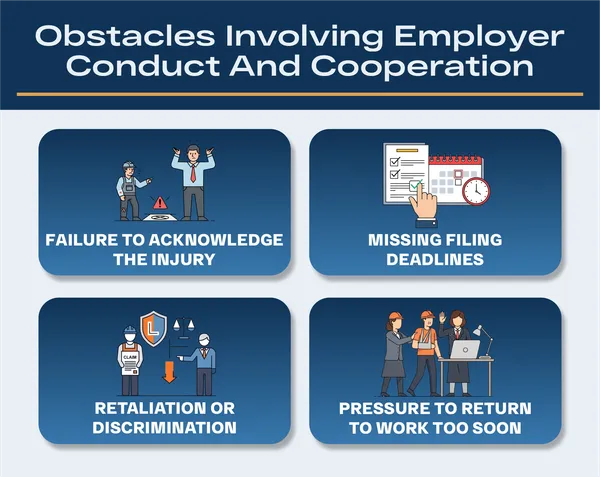
Your employer must comply with specific legal steps once you report an injury. If they fail to cooperate, it can jeopardize your ability to receive benefits on time. Workers’ compensation lawyers step in to see that your employer follows the law or faces legal consequences for their inaction.
Common ways employers may obstruct your claim include:
- Failure to Acknowledge the Injury: Your employer might claim the accident did not happen at work. A lawyer gathers witness statements and security footage to establish the accident location.
- Missing Filing Deadlines: They may delay providing the necessary claim forms. Your attorney tracks state deadlines and files the required documents to protect your right to seek compensation.
- Retaliation or Discrimination: Some employers fire or demote workers who file for benefits. If job concerns raise the question, “Can I be fired for filing a workers’ compensation claim?”, understanding legal protections becomes the first step. A workers’ compensation lawyer can review the situation and explain available legal options.
- Pressure to Return to Work Too Soon: Your employer might ask you to return to work before you are physically ready. An attorney intervenes to protect your health and helps you follow your doctor’s specific restrictions.
Medical Treatment And Diagnosis Disputes (UR, IMR, And QME)
A clear diagnosis supports a strong workers’ comp claim. If the insurer disputes your treatment, you may get less care and a lower disability rating. A lawyer can help you pursue proper treatment and respond to medical disputes.
Disputes regarding your medical care often involve the following factors:
- Improper Diagnosis of Injuries: A doctor may minimize your injury. A lawyer can help you seek another opinion and make sure records reflect your symptoms.
- Employer’s Medical Provider Network (MPN) Issues: You must often choose a doctor from a specific network. If that doctor is unhelpful, an attorney can help you change physicians in accordance with the MPN rules.
- The QME vs. AME Process: If medical disputes persist, you may need a Qualified Medical Evaluator (QME). If you have an attorney, they may negotiate the use of an Agreed Medical Evaluator (AME) to reach a more balanced medical opinion.
- Utilization Review (UR) & Independent Medical Review (IMR): When an insurance company denies a recommended treatment, it goes through UR. An attorney can help you appeal a UR denial through the IMR process.
- Disputes Over Chiropractic Care: Insurance carriers often fight against specialized treatments. A back injury from repetitive lifting may require chiropractic care or physical therapy to support recovery.
- Denial of Necessary Surgeries: Adjusters may claim a surgery is not medically necessary. Legal professionals use medical evidence to prove that the procedure is vital for your physical recovery.
Financial And Claim Disputes
The value of your claim depends on your wages and the severity of your disability. Insurers may underpay benefits or offer settlements that are too low. A lawyer can review pay records, calculate benefits, and fight for what the law allows.
Financial conflicts typically arise from the following insurance company actions:
- Denied Claims for Benefits: Getting a denial letter can be devastating for an injured worker. An attorney focuses on the workers’ comp appeal process to overturn the decision and help secure your payments.
- Benefits Are Lower Than Expected: The insurer might miscalculate your average weekly wage. Your lawyer audits your pay records to maximize your wage loss benefits and total payout.
- Inadequate Lump Sum Settlement Offers: You might receive a quick offer that seems large but fails to cover future costs. A lawyer evaluates the offer in light of your long-term financial needs.
- Disputes Over Permanent Disability Ratings: Your final payment depends on this specific percentage. Legal professionals fight for a higher rating that accurately reflects your lasting physical limitations.
Complex Legal Overlaps And Career Impacts
Some workplace injuries involve more than workers’ comp. You may also have a third-party claim if someone outside your job caused the injury. A lawyer can review whether other legal options exist and how they affect your recovery.
Examples include:
- Third-Party Liability: If a contractor or product maker caused the injury, you may have a separate personal injury claim outside workers’ comp.
- Disability Benefits: If you cannot return to work, you may qualify for Social Security Disability. A lawyer can help coordinate benefits.
- No Modified Work: Employers often should offer modified work when restrictions apply. If they refuse, you may qualify for a retraining voucher.
- Need for Vocational Retraining: You may qualify for a voucher to train for a new job. Repetitive lifting injuries, workers’ compensation attorneys handling repetitive lifting injury cases can address the issue with the insurance company and pursue the benefit so you can train for a new line of work.
Benefits Available In California Workers’ Compensation Claims

California workers’ compensation benefits can help cover medical care, lost income, and long-term work limits. You do not need to prove fault. You do need to show that the injury is job-related.
A workers’ compensation lawyer can review your claim to make sure the insurer follows state rules. The value of your claim depends on your injuries and your pre-injury wages. Many permanent disability payments follow a set schedule. In very serious cases, a life pension may apply.
Workers’ compensation benefits include:
- Medical Expenses Coverage: This benefit pays for all reasonable and necessary care related to your injury. It includes doctor visits, hospital stays, surgeries, and medication. You may also receive specialized care from a chiropractor or physical therapist.
- Temporary Total Disability (TTD): TTD benefits are typically two-thirds of your average weekly wage, but they are subject to statutory minimum and maximum caps. TTD is generally limited to 104 weeks for most injuries.
- Temporary Partial Disability (TPD): TPD applies if you can work light duty but earn less than your usual pay. The insurance company pays a portion of the difference. This partial wage replacement supports your transition back to full employment.
- Permanent Disability (PD) Benefits: You receive these if you never fully recover. The amount depends on your impairment rating and age. A lawyer fights for a rating that accurately reflects your condition based on the DWC Injured Worker Guidebook.
- Supplemental Job Displacement Benefits (SJDB): The SJDB voucher is worth up to $6,000 for retraining. It covers tuition, books, and professional licensing exams if you cannot return to your old job.
- Mileage and Travel Reimbursement: You are eligible for reimbursement for travel to medical appointments. Ensure you use the current mileage reimbursement rate from the DIR.
Settlements In California: Compromise & Release Vs. Stipulations
California workers’ compensation settlements occur after Maximum Medical Improvement is reached, which means the victim’s condition has stabilized or won’t improve further. Two settlement structures resolve most cases. Each option handles payments and future medical treatment differently.
Understanding the distinction helps injured workers evaluate long-term financial impact and access to continued medical care.
| Settlement Type | Description | Future Medical Care |
|---|---|---|
| Compromise & Release (C&R) | A lump-sum payment that closes your case entirely. | Closed (You pay for future care yourself). |
| Stipulations with Award | An agreement on your disability percentage paid biweekly. | Remains Open (The insurer pays for related care). |
Settlement decisions influence long-term medical coverage and financial stability. Many injured workers review settlement terms with a workers’ compensation lawyer to understand disability ratings, payment structure, and medical care obligations before finalizing an agreement.
What Does A Workers’ Compensation Attorney Do?
Workers’ compensation lawyers act as your legal advocate throughout the claim process. They handle the paperwork and legal requirements so you can focus on your health. From the initial filing through settlement discussions, your lawyer represents your interests during each stage of the case.
Here’s what workers’ compensation lawyers do:
- Gathering Evidence: Your lawyer works with doctors to collect reports that prove your injury. They document every symptom to support the need for compensation and medical care.
- Handling All Communication: Your attorney manages all correspondence with the insurance company. They handle calls and emails with the insurance adjuster.
- WCAB Representation: Your attorney handles all filings at the Workers’ Compensation Appeals Board, including the Declaration of Readiness to Proceed (DOR) for hearings.
- Representing You at All Court Hearings: If your case goes to trial at the WCAB, your lawyer is by your side.
- Negotiating Your Settlement Terms: Your attorney calculates the potential value of your future medical needs. They use this data to compel the insurance company to offer a fair lump-sum payment.
How Attorney’s Fees Work In California Workers’ Compensation Cases
California workers’ compensation attorney fees are governed by strict rules under the state’s Labor Code. If you’re unsure how workers’ compensation lawyers get paid, it’s important to know that a judge must review and approve every fee. Payment usually comes from the final settlement or disability award rather than upfront billing.
So, do lawyers only get paid if they win? Most lawyers, such as those at Arash Law, operate on a contingency fee basis, meaning legal fees depend on a successful recovery.
FAQs About California Workers’ Compensation Claims
The following FAQs address common questions injured workers ask as they navigate the workers’ compensation process.
What Is The Deadline To Report A Work Injury In California?
California law requires workers to report a workplace injury within 30 days. The deadline starts on the accident date or on the date the worker learns the injury relates to the job. Prompt reporting allows the employer to provide a DWC-1 claim form and arrange medical care. Late reporting can result in the denial of workers’ compensation benefits.
How Long Do I Have To File A Workers’ Comp Claim In California?

California law sets a one-year deadline to file a workers’ compensation claim. The period usually starts on the injury date or the date of the last benefit payment. A worker files the claim by submitting Form DWC-1 and opening a case with the system. Missing the deadline can prevent recovery of medical care and wage benefits.
What Is A QME, And How Does It Change If I Have A Lawyer?
A Qualified Medical Evaluator (QME) is a state-certified doctor who helps resolve medical disputes. The QME reviews records, examines you, and issues opinions on diagnosis, work limits, and disability. A lawyer can help gather records and prepare you for the evaluation.
What Is An MPN, And Can I Change Doctors In Workers’ Comp?
A Medical Provider Network (MPN) is a group of approved doctors for workers’ comp. You usually start care with a doctor in the network. You may be able to switch to another doctor within the same MPN for ongoing care.
Will Workers’ Comp Offer A Settlement Without A Lawyer?
Insurers sometimes offer settlements to workers without lawyers. Adjusters often rely on medical records and disability ratings. Some early offers are made before treatment ends or the rating becomes final. Reviewing terms carefully can protect your medical rights and your recovery.
Can I Sue My Workers’ Comp Adjuster?
Under California’s exclusive remedy rules, you generally cannot sue an adjuster or the insurer in civil court for claim-handling errors. If benefits are unreasonably delayed or denied, your remedy is seeking penalties through the WCAB, not a personal bad-faith tort suit.
How Long Does A Workers’ Comp Case Take To Settle?
Workers’ compensation cases usually settle after the worker reaches Permanent and Stationary (P&S) status. Doctors assign that status when the condition stabilizes, and major treatment ends. Medical evaluations then determine permanent disability ratings. Many cases resolve within several months, while complex injuries may take years to heal.
What If My Employer Does Not Have Workers’ Comp Insurance?
California requires employers to carry workers’ compensation insurance. Some employers fail to follow the law. Injured workers can seek benefits through the Uninsured Employers Benefits Trust Fund (UEBTF). The worker must file a case with the Workers’ Compensation Appeals Board and follow state procedures.
Speak With A Workers’ Compensation Lawyer About Your Claim
A workplace injury often leads to questions about workers’ compensation benefits and claim procedures. California workers’ comp law includes strict filing rules and documentation requirements. A legal professional can review the injury details and explain the steps involved in a claim.
Arash Law is here to help. We can assist in organizing medical records, wage information, and other documents required for a workers’ compensation claim. We handle paperwork, communicate with insurance companies, and address benefits-related disputes.
Call AK Law at (888) 488-1391 to discuss your situation with one of our workers’ compensation lawyers. Get a free initial consultation today!