TL;DR: Based on the most recent available California Crash Reporting System (CCRS) data, SR-14 (Antelope Valley Freeway) N/B at Newhall Avenue is Santa Clarita’s highest-incident intersection. SR-14 N/B also leads all roadways in the city by reported incident volume. Heavy commuter traffic, frequent turning movements at canyon-approach intersections, and high-speed merging along SR-14 on-ramps combine to make these corridors the city’s highest-risk locations. If you were hurt at one of these locations, understanding where the crash happened and who controls that roadway can directly affect your legal options.
Highlights:
- Slow down near the intersection of SR-14 N/B at Newhall Avenue, especially during morning and evening commute hours when turning volumes peak.
- Watch for sudden lane changes near SR-14 on-ramps and off-ramps, where merging traffic creates compressed decision windows.
- Increase your following distance in heavy traffic on Soledad Canyon Road and Sierra Highway to reduce rear-end collision risk.
- Stay alert on canyon roads like Bouquet Canyon Road and Soledad Canyon Road, where curves, narrow lanes, and limited sight lines increase crash risk.
- Avoid distractions at intersections with high turning and cross-traffic volumes, including Sierra Highway at Via Princessa.
- Be extra cautious when large trucks share travel lanes on SR-14 and I-5, as their longer stopping distances and wide turns create risk throughout the corridor.
Tip: Write down road conditions, signal status, and nearby traffic behavior immediately after a crash — these details can be critical to your claim.
Table of Contents

Traffic crashes happen throughout Santa Clarita, but certain corridors and intersections concentrate far more incidents than others. According to the most recent available data from the California Highway Patrol’s California Crash Reporting System (CCRS), SR-14 N/B at Newhall Avenue and Bouquet Canyon Road at Newhall Ranch Road ranked among the city’s highest-incident intersections. On the freeway side, SR-14 (Antelope Valley Freeway) recorded the highest reported incident total of any road in the area, with I-5 (the Golden State Freeway) following behind it.
These locations are not dangerous by chance. Canyon-approach geometry, high commuter volumes feeding into single signalized crossings, and the pressure of merging at freeway speed all create conditions where a lapse in attention becomes a collision. Motorcyclists, bicyclists, and pedestrians face the highest exposure because they absorb the force of a crash with no protective structure between them and the road.
A crash at one of these locations often involves more than one responsible party. The driver who struck you may share liability with a trucking employer, a vehicle manufacturer, or, at corridors like SR-14 and I-5, Caltrans itself. Knowing which agency controls the road where your crash occurred is a critical first step, because a strict six-month government tort claim deadline applies to most cases and must be met before any lawsuit can be filed against a public entity.
Data Transparency Note: This article relies on crash data from the California Highway Patrol’s California Crash Reporting System (CCRS). The statistics are based on 2025 CCRS raw data, which were last updated on July 16, 2026, at the time of access. These raw totals do not establish which location has the highest crash rate or injury risk. Because portions of the 2025 data may be subject to future revision, the figures presented reflect the data available as of that update.
Most Dangerous Intersections In Santa Clarita
An analysis of the most recent available CCRS data identified SR-14 N/B at Newhall Avenue as Santa Clarita’s highest-incident intersection. The corridor funnels commuter traffic coming off canyon roads into a single signalized crossing, creating left-turn conflicts, through-movement gaps, and rear-end stacking that repeat daily during peak hours.
The intersections below represent the locations with the most reported incidents in Santa Clarita per that same data set, listed in descending order by reported incident volume.
| Intersection | Number of Accidents in 2025 (Reported Incidents, Most Recent CCRS Data) |
|---|---|
| Newhall Ave & SR-14 N/B | 29 (highest) |
| Bouquet Canyon Rd & Newhall Ranch Rd | 26 |
| McBean Pkwy & Newhall Ranch Rd | 23 |
| Sierra Hwy & Soledad Canyon Rd | 21 |
| Placerita Canyon Rd & SR-14 N/B | 17 |
| Bouquet Canyon Rd & Soledad Canyon Rd | 17 |
| Golden Valley Rd & SR-14 N/B | 15 |
| Sierra Hwy & Via Princessa | 15 |
| Golden Valley Rd & SR-14 S/B | 14 |
| I-5 N/B & Magic Mountain Pky | 13 |
Listed in descending order by reported incident volume per the most recent available CCRS data. Specific figures are subject to operator verification before publication.
Raw counts tell only part of the story. A location with a lower reported incident volume may involve more severe injuries than one with a higher volume, depending on speeds, vehicle types, and point-of-impact geometry. What the rank order does confirm is that Newhall Ranch Road, Bouquet Canyon Road, Sierra Highway, Soledad Canyon Road, and Golden Valley Road function as Santa Clarita’s highest-incident surface corridors. Additionally, both of the city’s major freeway connectors (SR-14 and I-5) generate intersection-level crash records at their surface-grade crossing points.
Many of the collisions that bring people to intersection accident attorneys occur at busy crossings with heavy traffic, frequent turning movements, and complex merging patterns. Staying alert near these intersections may reduce your risk of a serious collision.
Most Dangerous Freeways In Santa Clarita
SR-14 recorded the most reported incidents of any road or freeway in Santa Clarita, according to the most recent available CCRS data, significantly more than I-5, which ranked second. The Antelope Valley Freeway carries a mix of long-haul commuters, commercial trucks, and regional freight traffic at sustained highway speeds, with on-ramp and off-ramp transitions that compress the available decision window for drivers changing lanes.
The table below shows the freeways with the highest incident rates in the city, listed in descending order.
| Roadway | Number of Accidents (Reported Incidents, Most Recent CCRS Data) |
|---|---|
| SR-14 N/B (Antelope Valley Freeway) | 156 |
| SR-14 S/B (Antelope Valley Freeway) | 103 |
| I-5 N/B (Golden State Freeway) | 99 |
Listed in descending order by reported incident volume per the most recent available CCRS data.
SR-14 and I-5 are part of California’s state highway system and fall within Caltrans District 7, which covers Los Angeles and Ventura Counties. If a dangerous road condition, a missing or inadequate sign, or another highway defect contributed to a crash, the injured person may have a claim against the State of California, acting through Caltrans, in addition to any claim against a negligent driver.
A claimant must still prove the legal requirements for public-property liability, including that the condition was dangerous, caused the injury, and was created by the public entity or existed long enough for the entity to discover and address it.
Portions of Soledad Canyon Road and Bouquet Canyon Road pass through canyon or lower-density areas, while substantial sections within Santa Clarita are multi-lane urban arterials. Risk conditions vary by segment. Curves, limited sight distance, narrow shoulders, busy intersections, turning traffic, and congestion may increase the risk of lane-departure, head-on, rear-end, and turning collisions.
Those same conditions can make freeway collisions more complex than crashes on local streets. Multiple vehicles, severe injuries, and disputed liability are common issues that freeway accident attorneys encounter when investigating serious highway crashes.
Types Of Traffic Accidents On Santa Clarita Roads
Rear-end collisions account for the highest reported incident volume in Santa Clarita, according to the same CCRS data set, followed by sideswipe collisions. These collisions may occur in congested traffic, where frequent braking, short following distances, merging, and lane changes increase the risk of contact. SR-14 is a major commuter route with documented congestion and unpredictable travel times, while Sierra Highway carries a mix of local and through traffic.
The collision types associated with the most reported incidents in Santa Clarita include:
- Rear-End Collisions: These can occur when a following driver fails to stop in time, often during sudden slowdowns on SR-14 or at the approaches to high-volume intersections such as Sierra Highway and Soledad Canyon Road.
- Sideswipe Collisions: The second-highest reported incident type, these may occur when lane changes on SR-14, I-5, and multi-lane segments of Sierra Highway go unchecked, particularly when drivers do not verify blind spots before merging.
- Broadside (T-Bone) Crashes: These are common at intersections where one driver fails to yield the right-of-way. Busy intersections, such as Sierra Highway and Via Princessa, can increase the risk of broadside crashes when drivers make turns or fail to yield.
- Fixed-Object Incidents: These occur when a vehicle leaves the travel lane and strikes a barrier, pole, or roadside feature. They’re especially likely to happen on canyon roads with tight curves, such as Bouquet Canyon Road and Soledad Canyon Road.
- Head-On Collisions: These are less frequent but often catastrophic. They occur most often on undivided two-lane roads when a driver drifts across the centerline or attempts a passing maneuver without adequate sight distance.
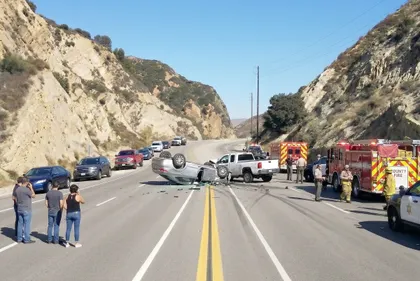
- Overturned Vehicle Crashes: These are associated with high-speed lane departures and rollover-prone vehicle types, which may occur on SR-14 and canyon road segments.
The cause behind the crash type matters as much as the crash type itself. A rear-end collision on SR-14 caused by a driver distracted by a phone raises different liability questions than one caused by an improperly maintained truck with failed braking equipment. Identifying the specific cause helps an attorney determine which parties bear responsibility.
What Causes These Crashes And Why It Matters For Your Claim
The underlying cause of a crash determines who can be held legally responsible. Santa Clarita’s high-volume corridors share several recurring factors that attorneys investigate when building a case.
Common contributing causes tied to Santa Clarita’s specific crash corridors include:
- Distracted Driving: A leading factor at signalized intersections like Sierra Highway and Soledad Canyon Road, where stopping and starting create opportunities for phone use and inattention.
- Speeding: A consistent factor on SR-14 and I-5, where the posted limits are high, and traffic flow sometimes pressures drivers to exceed them.
- Following Too Closely: Drivers who leave too little space may not have enough time to stop if traffic suddenly slows. This can contribute to rear-end crashes on freeways and busy city roads.
- Unsafe Lane Changes: Failing to check mirrors, blind spots, or surrounding traffic before changing lanes can lead to sideswipe and merging collisions on multi-lane roads such as SR-14, I-5, and Sierra Highway.
- Failure to Yield: Broadside and turning crashes may occur when a driver fails to yield to approaching traffic, pedestrians, cyclists, or vehicles with the right of way.
- Running Red Lights or Stop Signs: A contributing factor at high-volume intersections where driver impatience and signal timing create an incentive to push through.
- Driving Under the Influence: Alcohol or drug impairment can affect judgment, reaction time, coordination, and vehicle control. In some cases, the facts surrounding impaired driving may also support a claim for punitive damages in California.
- Fatigued Driving: A specific risk on SR-14 for long-haul commuters traveling from the Antelope Valley into Los Angeles, where early departure times and long distances combine.
- Poor Weather Conditions: Canyon roads like Bouquet Canyon Road and Soledad Canyon Road become significantly more dangerous in rain and fog, when surface water collects in curve approaches and visibility drops.
- Defective Vehicle Parts: Brake failures, tire blowouts, and steering defects that contribute to a crash may support a product liability claim against a manufacturer, separate from any claim against the at-fault driver.
Each cause may point to a different potentially responsible party. Santa Clarita car accident lawyers may review crash reports, photographs, video, vehicle data, maintenance records, phone records, witness statements, and other evidence to determine how the collision happened and who may be liable.
Who May Be Legally Responsible For Your Santa Clarita Crash
More than one party can share legal responsibility for the same crash. California uses a pure comparative fault system, meaning fault can be apportioned among multiple parties. Each at-fault party is generally responsible for their share of pain-and-suffering damages. However, one defendant may still have to pay the full amount of certain economic losses, such as medical bills and lost wages.
The parties most commonly investigated in Santa Clarita traffic crashes include:
- The At-Fault Driver: The primary focus of most claims, responsible for their own negligent driving decisions.
- A Driver’s Employer: An employer may be responsible under respondeat superior when an employee causes a crash while acting within the scope of employment. An employer may also be directly liable for negligent hiring, supervision, training, or vehicle maintenance.
- Commercial Trucking Companies: Commercial trucking companies may be responsible when poor driver screening, unsafe cargo loading, or inadequate vehicle maintenance contribute to a crash on SR-14, I-5, or another Santa Clarita roadway.
- Vehicle or Parts Manufacturers: A defective brake system, tire, or steering component that contributes to a crash may create a product liability claim independent of the driver’s fault.
- Government Entities: The City generally maintains city-controlled streets in communities such as Canyon Country, Newhall, Saugus, and Valencia. Los Angeles County generally maintains county-controlled roads in unincorporated communities such as Castaic, Stevenson Ranch, and Val Verde. Responsibility for the particular road or signal must still be confirmed if there is a possibility of a claim.
- Construction Contractors: Work zones that create temporary hazards, such as unmarked lane shifts, missing signage, or debris in the travel lane, can make a contractor liable for crashes that result.
Establishing legal responsibility generally requires proving four things: the party owed you a duty of care, the party breached that duty, the breach caused the crash, and the crash caused your injuries and losses. Evidence from police reports, signal maintenance records, Caltrans incident logs, and surveillance footage can support each of those elements.
Some insurance companies dispute fault and shift blame to others. For that reason, many victims seek free advice from motor vehicle accident lawyers to better understand their rights and legal options. A Santa Clarita personal injury attorney can investigate the crash, gather evidence, and identify all parties who contributed to the collision. A thorough investigation helps connect the negligent conduct to the injuries and losses suffered in the crash.
Key Deadlines If You Were Hurt In Santa Clarita
California’s filing deadlines for traffic injury claims depend on who you are suing. The rules differ for private parties and government entities, and missing either deadline generally eliminates your right to recover.
Claims Against A Private Driver Or Company
Under California Code of Civil Procedure § 335.1, an injured person generally has two years from the date of injury to file a personal injury lawsuit. For most claims, if the injured person was under 18 at the time of the crash, this deadline is generally suspended until they turn 18 under Code of Civil Procedure § 352(a).
A Santa Clarita accident case would generally fall within the Los Angeles County Superior Court system. The correct filing courthouse should be confirmed through the court’s Filing Court Locator because venue, case type, claim amount, defendant location, and case-distribution rules may affect where the action is filed or heard.
Claims Against Caltrans, The City, Or Los Angeles County
A government claim may be required if a road defect, broken signal, missing sign, or maintenance issue contributed to the crash. The responsible agency could be Caltrans, the City of Santa Clarita, Los Angeles County, or another public entity.
A government claim relating to personal injury, death, or injury to personal property generally must be presented within six months. If the injured person is a minor, it may support an application to present a late claim under Government Code §§ 911.4 and 911.6. If the agency sends a written rejection, the deadline to sue is usually six months from the date of that notice. A longer period may apply if no proper rejection notice is sent, but claimants should not rely on it.
The correct agency depends on who controls the road or signal. Canyon Country, Newhall, and Saugus are within the City of Santa Clarita, while Castaic, Stevenson Ranch, and Val Verde are unincorporated Los Angeles County communities. Still, the agency responsible for a specific road or intersection should be confirmed before filing a claim.
Two years may feel like a long time, but evidence degrades quickly. Dashcam footage from nearby businesses can be overwritten quickly. Caltrans incident logs and signal maintenance records are not automatically preserved after a crash. A preservation letter sent promptly — and a government tort claim filed well before the six-month mark — protects the evidence you need.
What Compensation Can You Pursue After A Santa Clarita Crash
California law divides recoverable losses into economic damages, which cover your measurable out-of-pocket costs, and non-economic damages, which compensate for harm that does not come with a receipt.
Economic damages you may be able to recover include:
- Emergency and Surgical Costs: Hospital bills, emergency room treatment, and any surgical care required immediately after the crash.
- Ongoing Medical Treatment: Physical therapy, chiropractic care, specialist visits, and prescription costs tied to your crash injuries. These ongoing costs can extend for months or years after the initial incident.
- Lost Income: Wages you were unable to earn while recovering from your injuries.
- Reduced Future Earnings: If your injuries limit your ability to work at the same capacity going forward, the reduction in your earning potential is a compensable loss.
- Property Damage: The cost to repair or replace your vehicle and any personal property damaged in the crash.
Non-economic damages cover losses that affect your quality of life:
- Pain and Suffering: Physical pain caused by your injuries, including pain during recovery and any permanent discomfort.
- Emotional Distress: Anxiety, post-traumatic stress, depression, or other psychological harm that results from the crash experience.
- Loss of Enjoyment: The inability to participate in activities, whether work-related, recreational, or personal, that you engaged in before the crash.
Punitive damages may be available in limited cases involving clear and convincing evidence of malice, oppression, or fraud under California Civil Code § 3294. Some impaired-driving cases may meet this standard, depending on the facts. Punitive damages are not normally available for ordinary negligence, and neither DUI nor leaving the scene automatically establishes a right to them.
Receipts, medical records, referrals, bills, and treatment notes may help show what care was provided, why it was needed, and how much it cost. Keeping these records organized can support a claim, but recovery still depends on the evidence, causation, reasonableness of the expenses, available insurance, and other case-specific factors. Santa Clarita accident lawyers can help you identify and preserve all qualifying expense records before they become difficult to trace.
Evidence That Supports A Santa Clarita Traffic Claim
Proving fault and documenting your losses requires specific evidence, much of which is held by public agencies or private businesses and must be secured quickly.
| Claim Type | Evidence | Who Holds It |
|---|---|---|
| Intersection crash | Traffic collision report | Santa Clarita Valley Sheriff’s Station or another responding agency |
| Freeway crash (SR-14 or I-5) | Caltrans incident and maintenance records | Caltrans District 7 |
| Traffic signal defect | Signal timing logs and maintenance history | City of Santa Clarita, Los Angeles County, Caltrans, or another agency that controls the signal |
| Any crash | Dashcam and surveillance video | Drivers, businesses, residences, or public agencies, if footage exists and was retained |
| Road defect claim | Prior maintenance complaints and work orders | City of Santa Clarita or Los Angeles County, depending on road control |
| Any crash | Crash history data | CCRS portal |
*Note: Video retention periods vary, and footage may be overwritten under the owner’s normal practices. A prompt, specific preservation request may help reduce the risk of losing relevant evidence. Filing a government claim does not by itself guarantee that every agency record or video will be preserved.
Video evidence from businesses along Sierra Highway, Soledad Canyon Road, and at the SR-14 corridor is particularly valuable because it can independently confirm signal status, road conditions, and driver behavior at the moment of impact. These could be details that a police report may not capture. A Santa Clarita traffic accident lawyer can send preservation demands to the right custodians before that footage is lost.
Frequently Asked Questions About Traffic Accidents In Santa Clarita
After a crash on one of Santa Clarita’s busy corridors, it is normal to have questions about your rights, your timeline, and what steps to take next. These answers address the most common questions from people hurt on these roads.
Does The Location Of My Crash In Santa Clarita Affect My Legal Options?
Yes. Where the crash happened can affect which public agency controls the road and whether a special claim deadline applies. For example, a crash on SR-14 or I-5 may involve the State of California, acting through Caltrans, if a dangerous highway condition contributed to it. A crash on a city street may involve the City of Santa Clarita. In contrast, a crash in an unincorporated community such as Castaic, Stevenson Ranch, or Val Verde may involve Los Angeles County.
A public entity is not responsible simply because it owns or maintains the road. You must have evidence that a dangerous condition, signal problem, maintenance issue, or another wrongful act contributed to the crash. Claims against a government entity generally must be presented within six months, so identifying the correct agency early is important.
What If I Were Rear-Ended At A Santa Clarita Intersection?
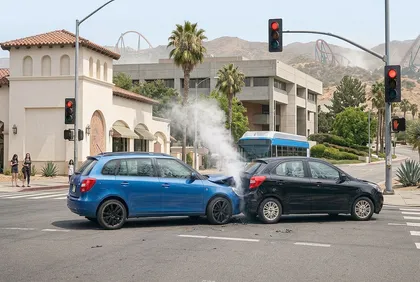
Rear-end collisions account for the highest reported incident volume in Santa Clarita, and in most cases, the following driver bears fault for failing to maintain a safe following distance. Insurers sometimes argue you contributed by stopping abruptly or failing to signal a lane change. If an insurer raises this argument, California’s pure comparative fault rule applies: fault can be divided among multiple parties, and your assigned percentage reduces your compensation. When insurance companies dispute fault after a rear-end crash on Sierra Highway or Soledad Canyon Road, you may need a personal injury lawyer to advocate on your behalf. An Arash Law attorney can evaluate the evidence and challenge any unfair allocation of blame.
Can I Sue The City Of Santa Clarita For A Traffic Signal Problem That Caused My Crash?
Yes, under certain conditions. California law allows claims against public entities for dangerous conditions on public property, including poorly timed or malfunctioning traffic signals. To succeed, you generally must prove that the signal condition created a substantial risk of injury when the property was used with due care, that the condition caused the crash, and either that a public employee’s negligent or wrongful act or omission created the condition or that the public entity had actual or constructive notice of it in time to take protective measures.
Generally, you must also file a government tort claim with the City of Santa Clarita within six months of your crash before any civil lawsuit can be filed. The same framework applies to Caltrans for signals at state highway intersections. An Arash Law attorney can investigate maintenance records and prior complaint logs to determine whether a signal defect contributed to your crash.
What If The Driver Who Hit Me Has No Insurance?
If the at-fault driver was uninsured, your own uninsured motorist (UM) coverage may cover your injuries and losses. California law requires insurers to offer this coverage, but you can reject it in writing. If the driver had some insurance but not enough to fully cover your damages, underinsured motorist (UIM) coverage may make up the difference. An Arash Law attorney can review your policy, confirm which coverage applies, and help you navigate your insurer’s claims process. Even when making a claim under your own policy, you must document your injuries and losses and comply with the policy’s notice, cooperation, and claim requirements.
How Long Do I Have To File A Personal Injury Claim After A Santa Clarita Crash?
For a claim against a private driver, California generally gives you two years from the date of injury under California Code of Civil Procedure § 335.1. That case may be filed at the Los Angeles County Superior Court.
If your crash involved a government entity, you must first submit a government tort claim within six months of the incident. Depending on where the crash occurred, the responsible entity may be Caltrans (for SR-14 or I-5 crashes), the City of Santa Clarita (for city street crashes), or Los Angeles County (for unincorporated-area crashes). Missing that six-month deadline generally bars your right to sue the government entity. Unless the consideration period is extended by written agreement, the claim is generally deemed rejected if the agency does not act within 45 days. If the agency later provides a proper written rejection notice, the claimant generally has six months from the date that notice is personally delivered or mailed to file suit. If no compliant written rejection notice is given, Government Code § 945.6(a)(2) generally allows two years from accrual of the cause of action.
Is There A Cost To Talk To Arash Law, And Do Lawyers Only Get Paid If They Win?
Arash Law offers a free initial consultation. There is no charge to speak with an Arash Law team member. Beyond that, Arash Law handles personal injury cases on a contingency fee basis. You pay no attorney’s fees unless the firm recovers compensation for you through a settlement or court award. The fee is a percentage of the recovery, set out in the written agreement you receive before signing. If there is no recovery, there is no attorney’s fee.
Arash Law Case Results: Dangerous Intersections & Freeway Accidents
Past results do not guarantee future outcomes. Every case is different, and results depend on the specific facts and evidence involved.
$2,100,000 — Car Accident: Intersection Collision With a Police Cruiser. The client was stopped at a two-way stop sign before proceeding into an intersection, where he was struck by a police cruiser traveling 70 mph, causing serious injuries. After years of legal wrangling against a government entity, Arash Law secured a $2.1 million settlement on the client’s behalf.
Get Legal Help After A Traffic Accident In Santa Clarita
Arash Law (also known as AK Law) represents people injured in traffic accidents throughout Santa Clarita and the surrounding Los Angeles County communities, including Canyon Country, Castaic, Newhall, Saugus, Stevenson Ranch, and Val Verde. Our Santa Clarita traffic accident lawyers can investigate the crash, send preservation letters for dashcam and signal footage before it is overwritten, identify every party that may share responsibility, and handle communications with insurance companies on your behalf.
If you were hurt at Sierra Highway and Soledad Canyon Road, along the SR-14 corridor, or anywhere else in the Santa Clarita area, call Arash Law at (888) 488-1391 for a free initial consultation. There is no attorney’s fee unless Arash Law recovers compensation for you. MAKE THEM PAY — CALL AK.
About This Page
This page was prepared by Arash Law to provide general information about high-crash locations in Santa Clarita and the legal framework that applies to traffic injury claims in this area. Crash location data is sourced from the California Highway Patrol’s California Crash Reporting System (CCRS), accessed via data.ca.gov. This page is reviewed periodically to reflect changes in available crash data and applicable law.
Government entity jurisdiction and filing procedures are based on the Caltrans District 7 profile at dot.ca.gov, the Santa Clarita courthouse location and jurisdiction record from the LA County service locator at locator.lacounty.gov, and the California Tort Claims Act requirements guide published by SacLaw Library at saclaw.org/resource_library/claims-against-the-government/. Filing deadline information reflects California Code of Civil Procedure § 335.1, which sets a two-year personal injury limitations period, and the California Tort Claims Act, which imposes a six-month government claim deadline. Last reviewed July 2026 by Arash Khorsandi, Esq.
This page is informational only. It does not constitute legal advice and does not create an attorney-client relationship. Crash data figures reflect the most recent available CCRS records and are subject to future revision by the California Highway Patrol. Procedural deadlines, including government tort claim deadlines, vary by defendant and circumstance. Consult a licensed California personal injury attorney for advice specific to your situation.
Sources
- California Highway Patrol — California Crash Reporting System: https://data.ca.gov/dataset/ccrs/resource/9f4fc839-122d-4595-a146-43bc4ed16f46
- Caltrans District 7 Profile (Los Angeles & Ventura Counties): dot.ca.gov/caltrans-near-me/district-7/district-7-popular-links/d7-profile
- Los Angeles County Superior Court — North Valley District, Santa Clarita: locator.lacounty.gov/lac/location/3176795/los-angeles-county-superior-court—north-valley-district—santa-clarita
- SacLaw Library — Claims Against the Government (California Tort Claims Act): saclaw.org/resource_library/claims-against-the-government/
- California Code of Civil Procedure § 335.1 (two-year personal injury statute of limitations): leginfo.legislature.ca.gov/faces/codes_displaySection.xhtml?sectionNum=335.1&lawCode=CCP
Disclaimer
This page contains general legal information about traffic accident risks and procedural requirements in Santa Clarita, California. It is not legal advice and does not create an attorney-client relationship. Crash data is sourced from the California Crash Reporting System (CCRS). Procedural deadlines, including government tort claim deadlines, vary by defendant and circumstance. Consult a licensed California personal injury attorney for advice specific to your situation. Past results described on this site do not guarantee a similar outcome in any future case.