TL;DR: If a speeding driver hit you while you were turning left, you may share fault under California law. T-bone collisions can cause serious injuries, and early evidence from black box data or traffic cameras helps determine liability.
Highlights:
- Left-turning drivers must yield to oncoming traffic under California law.
- Speeding can shorten gaps and make collisions unavoidable.
- Both drivers may share fault under California’s pure comparative negligence rule.
- Use black box data, dashcams, or traffic camera footage to prove speeding.
- Skid marks and vehicle damage can help experts reconstruct crash speed.
- File personal injury lawsuits within two years of the crash.
- File a government claim within six months if a government vehicle was involved.
Tip: Preserve all digital and physical evidence immediately to support liability assessments.
Table of Contents
You can seek compensation for your injuries if a speeding driver hit you while you were turning left. However, depending on the facts, you may share some fault, based on California’s right-of-way rules.
The other driver’s speed is one of the most important factors in your case. If they were going too fast for the conditions, that changes who bears responsibility for the crash. Proving they were speeding is essential to building a strong claim for damages.
State law requires the driver making a left turn to yield to oncoming traffic. That duty means fault investigations often focus first on the turning driver. This rule to yield before turning left at an intersection is the legal foundation for how fault gets analyzed in your crash.
How Does Speeding Change Fault In A Left-Turn Accident?
Speeding may shift the blame in a left-turn accident. Excessive speed contributes to collisions by reducing reaction time or making it difficult for others to accurately judge distance and closing speed.
State law starts with a clear rule: the left-turning driver must yield to oncoming traffic. Under § 21801(a) of the California Vehicle Code, you must wait for a safe gap to form before you turn. However, when the oncoming driver is speeding, that gap can close in a split second.
Failure to yield can break that law, and that violation of a traffic safety rule may create a legal presumption that the turning driver is usually at fault for a left-turn accident in California. In many left-turn collisions, insurers and investigators often closely examine whether the turning driver properly yielded, but fault is ultimately determined based on the totality of evidence. You must bring evidence to overcome it. Here are some factors that can affect liability in these cases:
- Visibility and Reaction Time: A driver can only yield to a hazard they can reasonably see and judge. If the oncoming car is traveling at an excessive speed, it may appear far enough away to make a safe turn.
- Distortion of Gap Judgment: A car going 20 mph over the limit can cover ground much faster than many drivers would expect.
- Possibility of Shared Fault: Both drivers may bear responsibility for a left-turn collision. The driver making the left turn has a duty to yield and ensure the turn can be completed safely. At the same time, the oncoming driver has a duty to operate their vehicle with reasonable care, including obeying speed limits.
As these cases can be complex, some victims seek free advice from left-turn accident lawyers to know what they can do when there is shared fault. These attorneys can advocate for a fair assessment of liability in these types of cases.
How Does California’s Comparative Negligence Rule Affect Your Claim?
California follows a pure comparative negligence rule. Under this legal doctrine, parties may share fault in an accident, even the victim. That means both drivers can share blame and still file a claim. However, the available compensation is reduced by their own percentage of fault.
In a left-turn crash, both drivers may share fault. You may have turned when the gap was too small. The other driver may have been going well over the speed limit.
Here’s an example scenario:
- A court finds you 30% at fault.
- The amount of your losses is $100,000.
- You can still pursue up to 70% of your damages, or $70,000.
Left-turn accident lawyers often use evidence to assess liability in these cases. You cannot prove speed just by saying the other driver looked fast. Courts and insurers will look for strong evidence that backs up your claim.
What Evidence Proves The Other Driver Was Speeding?
Traffic camera footage can show how the accident occurred. Meanwhile, black box data can show the other driver’s speed. An attorney can obtain these records while building a case. However, these forms of proof can be time-sensitive. Speeding-related accident attorneys can send a legal hold letter, a written demand that puts the other side on notice of its duty to preserve evidence, right away.
Here are some pieces of evidence that can prove the other driver was speeding:
- Vehicle Black Box Data: Many modern cars store driving data in an event data recorder. It logs the car’s exact speed and braking in the seconds before a crash. This data can provide hard evidence of how fast the other driver was going.
- Dashcams and Traffic Cameras: Video from traffic cameras, store cameras, or dashcams can show who had the right of way and how fast each car was moving.
- Accident Reconstruction Experts: These experts measure skid marks and crush damage to estimate the other driver’s speed using established formulas of physics. Their analysis provides courts with an objective, evidence-based reconstruction of how the crash likely occurred. Their input may carry more weight than unsupported eyewitness estimates.
Strong evidence directly affects how much you may recover. When an attorney gets this data early, insurers have less room to dispute your claim.
What Compensation Is Available After A Left-Turn Accident?
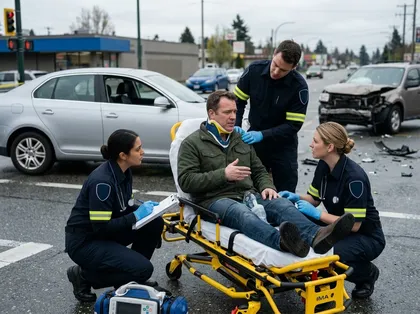
A car door offers very little protection in a T-bone crash. Without an engine or trunk to absorb the impact, the force goes straight to your chest, hips, and spine. These crashes can result in severe injuries in car accident cases. Your claim can seek compensation for the financial and personal losses they cause.
Economic damages (documented financial losses) include:
- Hospital Bills: Emergency room and follow-up care costs.
- Ongoing Treatment: Depending on the injury, it may include physical therapy, chiropractic care, or medication.
- Lost Wages: Income you missed while you could not work.
- Lost Future Income: If your injuries prevent you from returning to work or reduce your ability to earn a living in the future.
Non-economic damages cover pain and personal losses that are harder to quantify. These losses are real, even without a receipt. They include:
- Pain and suffering.
- Loss of enjoyment of life.
- Emotional distress.
Time is one factor that can limit all of this recovery. If you are thinking, “I need a personal injury lawyer to help me,” you are not wrong. An attorney can monitor key deadlines, handle procedural requirements, and help you file all necessary documents on time to protect your right to seek compensation.
What Are The Deadlines For Filing A Left-Turn Accident Case In California?
If you’re filing an insurance claim after a left-turn accident, the deadline depends on the policy. However, if you’re considering filing a lawsuit, strict deadlines may apply. It’s important to know which one you need to follow because a court can dismiss your case if you file it late.
Key deadlines to keep in mind include:
- Personal Injury Lawsuit: California Code of Civil Procedure § 335.1 gives most injury victims two years from the date of the crash to file a lawsuit. Exceptions may apply under certain circumstances.
- Government Claim: Under California Government Code § 911.2, if a government vehicle was involved, you must file an administrative claim with that agency within six months. An administrative claim is a formal written notice of your injury sent directly to the government agency. Under § 912.4 of the same code, you can only sue if the agency denies it or fails to respond within 45 days. From here, different filing deadlines may apply.
FAQs About Left-Turn Crashes Involving Speeding Drivers
After a left-turn crash, fault attribution, traffic tickets, and insurance demands can create real uncertainty about where your case stands. Below are answers to some common concerns about these types of collisions.
Are Left Turns Always Protected In California?
No. Most left turns are unprotected, meaning you must yield to oncoming traffic. A left turn is only protected when a green arrow signal stops opposing traffic and gives you the right of way.
Will A Traffic Ticket Stop Me From Getting Compensation?
No. A ticket is not a final ruling on fault in a civil case. If the evidence shows the other driver was speeding, you may still be able to seek compensation for your losses.
Am I Required To Give A Recorded Statement To The Other Driver’s Insurance?
No, you are not required to give a recorded statement to the other driver’s insurer. Statements made before all the facts are known can complicate the claims process. Your injury lawyer can handle communications with insurers on your behalf.
What Happens If Both Drivers Claim The Other Caused The Crash?
Insurance companies and attorneys rely on objective evidence to sort out conflicting claims. Black box data and traffic camera footage can reveal what actually happened.
Can I Still Recover Compensation If I Am Found Mostly At Fault?
Yes. California’s pure comparative negligence rule means you may still be able to recover damages even if you are mostly at fault. You can be 99% at fault and still be allowed to pursue 1% of your total damages.
Who Pays My Medical Bills If The Speeding Driver Was Uninsured?
If the at-fault driver has no insurance, you can file a claim through your own auto policy. According to the California Department of Insurance, uninsured motorist (UM) and Medical Payments (MedPay) coverage are optional coverages that could help pay for your medical bills. MedPay applies regardless of who was at fault, while UM applies when the uninsured driver was at fault and effectively stands in for the liability coverage the uninsured driver should have carried.
Arash Law Can Handle Your California Left-Turn Car Accident Case
Proving speed in a left-turn crash takes real investigative work. Our left-turn accident lawyers know what evidence to look for and how to move fast before key proof disappears. Arash Law (AK Law) can help preserve all available supporting evidence and partner with accident reconstruction experts to build a case that holds up in court. At our firm, our team investigates every angle so nothing gets missed.
You might wonder, “Do lawyers only get paid if they win?” In many personal injury cases, the answer is yes. Our lawyers work on a contingency fee basis. You pay no attorney’s fees unless we recover money for your case. Call (888) 488-1391 to schedule your free initial consultation.