TL;DR: After a truck accident in Los Angeles, move to safety, call 911, photograph the truck and scene, and get medical care right away. File a California DMV SR-1 form within 10 days. Failing to file the SR-1 can result in the suspension of your driver’s license. Missing the applicable deadlines — two years to file a lawsuit against private defendants, six months to present a written government claim as a prerequisite to suit — generally bars you from recovering compensation entirely.
Highlights:
- Move to safety, call 911, and photograph the truck’s USDOT number, license plate, trailer markings, and road conditions before anything is moved.
- Collect the trucking company name, driver’s license, vehicle registration, and insurance information during the required information exchange at the scene.
- File a California DMV SR-1 form within 10 days of the crash if there was an injury, a death, or more than $1,000 in property damage.
- Do not give a recorded statement to the trucking company’s insurer before speaking with a lawyer.
- Have your attorney send a spoliation letter immediately to preserve ELD records, maintenance and inspection records, and any available ECM/EDR data, telematics, and dashcam footage before the evidence is overwritten or deleted.
- Identify every party that may share liability: the truck driver, trucking company, cargo loader, maintenance contractor, truck manufacturer, or a public agency such as the City of Los Angeles, Los Angeles County, or Caltrans (if a government vehicle or road defect played a role).
- Know your deadlines: generally two years to file a personal injury lawsuit against a private defendant, but only six months to present a written government claim if a public entity is involved.
Tip: Truck accident claims are significantly more complex than standard car crashes because they involve federal safety regulations under FMCSA, multiple corporate defendants, and time-sensitive electronic evidence. Having an attorney send a preservation demand early and handle all insurer contact on your behalf protects your recovery from the start.
Table of Contents

After a truck accident in Los Angeles, the steps you take in the first hours and days determine what evidence survives, which deadlines you meet, and whether the trucking company’s insurer can use your own statements against you. Moving to safety, calling 911, documenting the scene, and getting medical care come first — then the legal process begins.
Los Angeles has some of the heaviest commercial truck traffic in the United States. The I-710 freeway runs north from the Ports of Los Angeles and Long Beach through a dense freight corridor connecting port terminals, rail yards, and inland distribution centers. The LAPD may investigate a crash on a city street in Los Angeles, while crashes on the I-405 or I-710 typically fall under the jurisdiction of the California Highway Patrol (CHP). Knowing which agency investigated your crash matters when you request the official collision report. That report is one of the first pieces of evidence your attorney will need.
Many commercial trucks and motor carriers are subject to Federal Motor Carrier Safety Administration (FMCSA) regulations governing driver hours, vehicle maintenance, cargo securement, and driver qualifications. California law also imposes related requirements on intrastate commercial operations, so the rules applicable to a particular truck depend on the vehicle, carrier, cargo, and type of operation.
Steps To Take Immediately After A Los Angeles Truck Accident
Actions you take at the scene, including statements, photographs, and information exchanges, may later affect your claim. A loaded tractor-trailer may weigh up to 80,000 pounds under general Interstate System limits, although lower limits or permitted exceptions may apply. Its greater weight can increase crash forces and the risk of serious injury compared with a typical two-car collision.
Follow these steps at the scene:
- Move away from traffic if you can do so safely. If you cannot, stay buckled and turn on your hazard lights.
- Call 911 and report injuries, blocked lanes, leaking cargo, or hazardous materials.
- Photograph everything before the scene is cleared. Examples include the truck, trailer, license plate, USDOT number stenciled on the cab door, company name, skid marks, debris, and road conditions.
- Note the exact cross streets or freeway location. On a city street, note the nearest cross street or address. On a freeway, note the nearest posted mile marker or on-ramp name.
- Exchange information with the truck driver, including their driver’s license, employer name, insurance carrier, policy number, and vehicle registration.
- Collect witness names and phone numbers. Bystanders and other motorists often leave the scene before police arrive.
- Ask the responding officer for the report number. The Los Angeles Police Department (LAPD) handles city street crashes. The California Highway Patrol (CHP) handles freeway and state highway crashes. Both agencies generate official collision reports that you can request later.
- Do not give a recorded statement to the trucking company’s insurer, a claims adjuster, or anyone claiming to represent the driver before speaking with an attorney.
- Get medical care as soon as possible, even if you feel fine. Injuries from high-force truck crashes, such as spine and soft tissue damage, internal injuries, and traumatic brain injuries, often do not produce obvious symptoms in the first hours after impact.
The Days Following The Crash: Deadlines And Evidence That Cannot Wait

The 10 days after a truck accident in Los Angeles carry more legal weight than most people realize. Two specific obligations kick in immediately, and the evidence you need to prove your claim begins disappearing on a separate clock.
- File the California DMV SR-1 Form within 10 days. If the crash caused any injury, any death, or property damage over $1,000, California law requires you to file a Report of Traffic Accident (SR-1) with the California DMV within 10 days. This form is separate from the LAPD or CHP collision report and separate from your insurance claim. You, your insurance agent, or your legal representative can file it. Failure to file can result in suspension of your California driver’s license. The SR-1 is available through the California DMV.
- Report the crash to your own insurer the same day. Your policy may require you to report accidents promptly, even if you didn’t cause them. Reporting does not mean providing a recorded statement; it means notifying your insurer that the crash occurred.
- Preserve electronic evidence before it is gone. FMCSA regulations set minimum retention periods for the records that prove your case. Early preservation is critical because data can be overwritten or lost before those minimums expire if no litigation hold is in place.
Key retention periods by record type:
- ELD (Electronic Hours-of-Service Log): Six months under 49 CFR § 395.8(k), held by the carrier.
- Annual Inspection Reports: 14 months under 49 CFR § 396.21. The motor carrier holds these records.
- General Maintenance Records: One year while the vehicle is under the carrier’s control, plus six months after it leaves the carrier’s control, under 49 CFR § 396.3.
- Driver Vehicle Inspection Reports: retained by the motor carrier for three months from the date the report was prepared, under 49 CFR § 396.11.
Engine Control Module and Event Data Recorder (ECM/EDR) data, which typically captures speed, braking, and throttle input in the seconds before impact, can be overwritten after subsequent ignition cycles. Images or video from businesses along the I-710 corridor, vehicles, Caltrans systems, or LAPD cameras, may or may not be recorded or retained. Availability depends on the particular system and agency.
A truck accident attorney can send a spoliation letter — a written demand to preserve evidence — to the trucking company, fleet telematics vendor, and relevant camera owners within hours of being retained.
Here is a post-crash timeline to keep on hand:
| When | What To Do | Why It Matters |
|---|---|---|
| At the scene | Call 911, move to safety, photograph the truck and scene, and collect witness information. | Protects your health and preserves basic crash evidence before anything is moved. |
| Same day | Get medical care and report the crash to your own insurer. | Medical records tie your injuries to the crash; prompt reporting satisfies policy requirements. |
| Within 24 hours | If injury or death occurred and no officer responded at the scene, verify whether a written report to CHP or local police is required. | The 24-hour reporting duty applies to injury and death crashes. Commercial vehicle rules run separately. |
| Within 10 days | File the California DMV SR-1 if the crash caused injury, death, or property damage over $1,000. | The SR-1 is independent of the police report and insurance claim. Missing the 10-day filing deadline may result in a license suspension. |
| As soon as possible | Have your attorney send spoliation letters for ELD records, ECM/EDR data, telematics, dashcam footage, and surveillance video. | Data is overwritten quickly. FMCSA sets minimum retention periods, but prompt preservation helps prevent untimely deletion. |
| Before any settlement | Review all injuries, future care needs, lost wages, and insurance coverage with your attorney. | Early settlement offers routinely undervalue long-term medical costs and income losses. |
Legal basis:
- Cal. Veh. Code § 20008: 24-hour duty to report injury/death crashes.
- Cal. Veh. Code § 16000: SR-1 10-day filing requirement.
- 49 CFR § 395.8(k): ELD 6-month retention.
- 49 CFR § 396.21: 14-month retention for annual inspection records.
- 49 CFR § 396.11: 3-month retention for Driver Vehicle Inspection Reports.
Who May Be Liable For Your Los Angeles Truck Accident?
Identifying every potentially responsible party is one of the most consequential steps in a Los Angeles truck accident claim. It requires legal analysis, not guesswork. More than one party may share liability, and each may carry its own insurance policy and legal team.
| Potentially Liable Party | Why They May Be Responsible |
|---|---|
| Truck driver | The driver may have been fatigued, speeding, distracted, impaired, or in violation of FMCSA Hours-of-Service rules. |
| Trucking company | The company may be liable for the driver’s on-the-job negligence, or directly for unsafe hiring, inadequate training, or scheduling that pressured the driver to violate rest rules. |
| Cargo loading company | A loader may be responsible if overloaded, improperly distributed, or unsecured cargo caused the crash or worsened it. |
| Maintenance contractor | A repair company may be liable if deficient inspections or repairs resulted in brake, tire, steering, or lighting failures that contributed to the accident. |
| Truck owner or leasing company | The owner may be liable if the truck was not maintained in accordance with FMCSA standards or entrusted to an unqualified operator. |
| Truck or parts manufacturer | A manufacturer may face strict products liability — a legal theory holding sellers and makers of defective products responsible for resulting harm — if a defective tire, brake component, or steering part contributed to the crash. Note: strict products liability applies to the product-defect chain of defendants, not to every truck accident claim. |
| City of Los Angeles | The City may be liable if a failed traffic signal, deteriorated pavement, or unsafe city street condition contributed to the crash. A written tort claim must be filed with the Office of the Los Angeles City Clerk within six months of the injury before any lawsuit may be brought. |
| Los Angeles County | The County may be liable for dangerous conditions on county-maintained roads. A signed, written claim must be delivered to the Executive Officer-Clerk of the Board of Supervisors within six months. |
| Caltrans (California Department of Transportation) | Caltrans, managed through District 7 for Los Angeles and Ventura counties, may be liable if a hazardous freeway condition contributed to the crash. The same six-month written government claim requirement applies. |
The legal framework that holds a trucking company liable for its driver’s actions is called respondeat superior. This rule makes an employer liable for a worker’s negligence when the worker was acting within the scope of their job. Truck cases often also involve direct negligence claims: allegations that the company itself failed to act reasonably through unsafe hiring practices, inadequate driver qualification checks, or scheduling that pushed drivers past legal Hours of Service limits.
Proving negligence in a Los Angeles truck accident claim requires showing that a defendant failed to meet the applicable standard of care and that the failure caused your injuries. In a Los Angeles truck case, the evidence supporting that showing can come from several sources, each with its own custodian and retention clock:
- ELD records documenting the driver’s hours of service, retained by the motor carrier for at least six months from receipt under 49 CFR § 395.8(k).
- ECM/EDR data capturing speed, braking, and throttle input before impact, held by the carrier or truck owner.
- Driver qualification files, training records, and driving history from the carrier.
- Maintenance and inspection logs, including roadside inspection reports, with retention periods varying by record type under FMCSA rules.
- Cargo loading records and weight tickets, held by the shipper or loading company.
- Post-accident drug and alcohol test results, when testing is required under FMCSA post-accident testing regulations.
- Dashcam footage from the truck cab, held by the carrier or its technology vendor, may be overwritten under device- or company-specific retention settings unless it is promptly preserved.
- LAPD or CHP collision reports, including the officer’s observations, witness statements, and any citations issued.
- Traffic camera snapshots or videos from Caltrans District 7 or LAPD installations. Retention varies by agency, so submit a preservation request within days of the crash.
Certain types of evidence can be challenging to obtain. An experienced truck accident lawyer can collect and preserve this evidence on your behalf.
Filing Deadlines For A Los Angeles Truck Accident Claim
The deadline to file a claim after a Los Angeles truck accident depends on who caused the crash. Getting this wrong does not just slow your case — it could end it.
- Against Private Defendants: Claims against a truck driver, trucking company, cargo loader, maintenance contractor, or manufacturer. California Code of Civil Procedure § 335.1 gives you two years from the date of injury to file a lawsuit in the Los Angeles County Superior Court (LASC). For most adults, missing this deadline bars their claim entirely.
- Against a Public Entity: Claims against the City of Los Angeles, Los Angeles County, or Caltrans. The California Tort Claims Act (Government Code §§ 911.2, 945.4) requires you to present a written claim to the public entity within six months of the date of injury. This written claim is a legal prerequisite to filing a lawsuit, not an optional step. Each entity has its own filing address and process:
- To claim against the City of Los Angeles: file a written claim with the Office of the Los Angeles City Clerk. Instructions are available at the City of Los Angeles website.
- To claim against Los Angeles County: deliver a signed, written claim to the Executive Officer-Clerk of the Board of Supervisors.
- To claim against Caltrans (for a freeway-condition crash): file a written tort claim under the California Tort Claims Act within six months of your injury.
If your case involves both a private defendant and a public entity, both deadline tracks run simultaneously. Waiting until the two-year private deadline approaches may cause you to miss the six-month government claim presentation deadline entirely.
Where Your Lawsuit Is Filed: Truck accident personal injury cases are filed in the LASC district courthouse for the location where the crash occurred, not at one central hub. Use the official court locator to identify the correct courthouse. One example is the Central District’s Stanley Mosk Courthouse, located at 111 N. Hill St., Los Angeles, CA 90012, which handles unlimited-jurisdiction civil cases. For more information about the claim-filing process, see our guide on filing a truck accident claim in California.
What Compensation May Be Available After A Los Angeles Truck Accident?
Truck crashes at highway speeds often produce injuries that require months or years of treatment — and compensation claims that reflect that reality. The categories below represent the types of losses that may be recoverable. The amount available in your specific case depends on the evidence, the severity of your injuries, and the available insurance coverage.
| Type of Loss | Examples |
|---|---|
| Medical costs | Emergency transport, ER care, surgery, prescription medication, follow-up appointments, chiropractic care, and inpatient rehabilitation. |
| Future care costs | Ongoing physical therapy, assistive medical equipment, future surgical procedures, and long-term care needs. |
| Lost income | Missed wages during recovery, reduced earning capacity, and lost employment benefits. |
| Pain and suffering | Physical pain, emotional distress, anxiety, post-traumatic stress, sleep disruption, and loss of enjoyment of daily activities. |
| Property damage | Vehicle repair or total-loss value, towing and storage fees, and personal property destroyed in the crash. |
| Wrongful death damages | For fatal cases: funeral and burial expenses, loss of financial support, and loss of companionship and guidance for surviving family members. |
How Arash Law Handles Los Angeles Truck Accident Claims
Trucking companies and their insurers move fast after a crash. Carriers may dispatch investigators to the scene within hours. Their legal teams are familiar with FMCSA regulations and know how to defend against claims involving driver fatigue, maintenance failures, and cargo liability. What they are counting on is that you do not.
Arash Law (also known as AK Law) represents truck accident victims across Los Angeles County. Our attorneys understand how freight carriers operate on corridors like the I-710 between the Ports of Los Angeles and Long Beach, how FMCSA violations connect to negligence theories under California law, and how to request and preserve the electronic records that make or break these cases. If you want to speak with an experienced California personal injury attorney about your rights before making any decisions, a case review with Arash Law costs you nothing.
When you work with us, our Los Angeles truck accident lawyers can:
- Send a preservation letter to the carrier, fleet telematics vendor, and surveillance camera owners within hours of being retained.
- Obtain the LAPD or CHP collision report and any citations issued at the scene.
- Secure driver qualification files, maintenance records, cargo loading documents, and post-accident test results.
- Handle all contact with the trucking company’s insurer, so you are not pressured into a recorded statement or an early low-ball settlement offer.
- Work with accident reconstruction specialists and medical experts to calculate the full value of your injuries, including future care costs.
- File government claims on your behalf against the City of Los Angeles, Los Angeles County, or Caltrans when a public entity defect contributed to the crash.
- Take your case to the appropriate Los Angeles County Superior Court district courthouse if the insurer refuses to offer a fair resolution.
Arash Law Case Results: Los Angeles Truck Accident Claims
These are examples of past results our attorneys have obtained in truck accident and related commercial vehicle cases involving disputed liability, serious injuries, and corporate or insurer pushback — the same issues at the center of many Los Angeles truck accident claims.
Past results do not guarantee future outcomes. Every case is different, and results depend on the specific facts and evidence involved.
$1,150,000 — Truck Accident (Rear-End): A large truck from a top-rated delivery company rear-ended a middle-aged client on the freeway, causing neck and back injuries. The defense attempted to attribute her injuries to her weight and pre-existing conditions rather than the crash. The matter was resolved at mediation before trial.
$1,000,000 — Auto vs. Truck: A reckless truck driver struck a family during what began as a peaceful drive. The crash resulted in serious injuries, and Arash Law recovered the maximum available insurance policy limits on the family’s behalf.
$1,000,000 — Motorcycle vs. Truck: A motorcyclist was listed as the at-fault party on the police report following a crash with a truck. Through diligent investigation, Arash Law demonstrated that the truck driver was actually responsible for the collision and recovered the available policy limits for the client.
Frequently Asked Questions About Los Angeles Truck Accidents
Truck accident claims in Los Angeles involve federal regulations, corporate defendants, multiple insurance carriers, and specific local filing procedures, which raise unique questions. The answers below address the questions Arash Law hears most often from people involved in truck crashes on LA’s freight corridors and city streets.
How Long Do I Have To File A Truck Accident Lawsuit In California?
Against a private defendant, such as the trucking company, the driver, a cargo loader, or a parts manufacturer, California Code of Civil Procedure § 335.1 gives you two years from the date of the injury. If a public entity such as the City of Los Angeles, Los Angeles County, or Caltrans played a role in the crash, you must present a written tort claim to that entity within six months of the injury under Government Code § 911.2. That written claim is a legal prerequisite to filing a lawsuit.
Unless a legal exception applies, missing these deadlines can end your case. Speak with an attorney quickly to learn which filing window you need to follow.
What If The City Of Los Angeles, The County, Or Caltrans Were Involved In My Crash?
Each public entity in Los Angeles has its own claim-filing address and process.
- Claims against the City of Los Angeles must be filed with the Office of the Los Angeles City Clerk. After filing, the claim is transferred to the City Attorney’s Office for handling.
- Claims against Los Angeles County go to the Executive Officer-Clerk of the Board of Supervisors.
- Claims against Caltrans are filed through the state’s current instructions to determine the proper filing channel. The Department of General Services currently directs Caltrans claims of $12,500 or less to Caltrans and claims over $12,500 to the Government Claims Program.
All three require a written claim within six months of your injury. Because these entities are legally separate, filing with one does not satisfy the requirement for the other. A California personal injury attorney can identify which entities may share responsibility and file the required claims before the window closes.
Do I Have To Call The Police After A Truck Accident In Los Angeles?
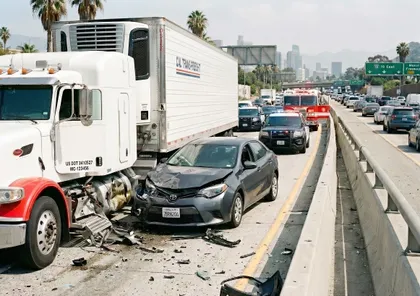
Call 911 if anyone is injured, traffic is blocked, or the truck is leaking cargo or hazardous materials. California Vehicle Code § 20008 generally requires an injury or fatal crash to be reported to law enforcement within 24 hours. An officer’s report may satisfy that requirement.
You must also file a separate SR-1 with the California DMV within 10 days if anyone was injured or killed, or if property damage exceeded $1,000. Property-damage-only crashes do not usually require the same 24-hour written report, but drivers must still stop and exchange information.
Can I File A Claim Against The Trucking Company If One Of Its Drivers Hit Me?
Yes, you can file a claim against the trucking company. The legal doctrine of respondeat superior — meaning an employer is responsible for a worker’s actions taken within the scope of employment — can make the trucking company vicariously liable for its drivers’ on-the-job negligence. The company may also face separate, direct liability if it negligently hired an unqualified driver, failed to conduct required drug and alcohol testing, or scheduled drivers in violation of FMCSA Hours of Service rules. Identifying and pursuing all liable parties, not just the driver, is one of the most important roles a truck accident attorney fills.
Does A Truck Driver Leaving The Scene Affect My Claim?
A truck driver’s departure from the scene does not bar your personal injury claim. If the driver left after the collision, your attorney can work with law enforcement records, traffic camera footage, and any available surveillance video to identify the driver and preserve evidence. The driver’s departure may itself become evidence of consciousness of fault. Leaving the scene of an injury crash is unlawful under California law, which is why calling 911 immediately and documenting everything you observed about the truck, such as the company name, plate number, pr trailer markings, is important. Those details give investigators and your attorney a starting point, even when the driver does not remain.
How Is A Truck Accident Claim Different From A Regular Car Accident In Los Angeles?
A standard car crash typically involves two drivers, two insurance carriers, and state traffic law. A truck accident can involve the driver, the carrier, a cargo loading company, a leasing company, a parts manufacturer, and one or more public agencies, each with its own insurer and legal team. Commercial trucks must comply with FMCSA regulations covering driver qualifications, Hours of Service, vehicle maintenance, and cargo securement.
Violations of applicable safety regulations may support negligence per se when the statutory elements are met. In California, this creates a rebuttable presumption that the defendant failed to use due care; it is not automatic or conclusive proof of negligence.
Truck cases often involve additional electronic evidence, including ELD records and commercial fleet telematics. Passenger vehicles may also contain EDR or telematics data, but truck cases typically involve a broader range of carrier-controlled records that should be preserved promptly.
Do Lawyers Only Get Paid If They Win My Truck Accident Case?
In personal injury cases, lawyers generally only get paid if they win. Arash Law handles truck accident claims on a contingency fee basis, meaning you pay no attorney fees unless we recover compensation for you. California Business and Professions Code § 6147 requires contingency fee agreements to be in writing, and your attorney will explain the exact fee structure in that written agreement before representation begins. There is no charge for your initial case review.
Contact Arash Law After A Los Angeles Truck Accident
Trucking companies respond quickly to serious crashes. Their insurers may open an investigation within hours of an incident on the I-710 or any other freight corridor in Los Angeles County. The evidence proving driver fatigue, a maintenance failure, or a cargo-loading violation starts disappearing on the same clock. Waiting gives the other side a head start.
Arash Law has handled truck accident claims across Los Angeles County for more than a decade. Our attorneys understand the federal and California commercial-motor-vehicle regulations that may apply to carriers operating through the Ports of Los Angeles and Long Beach, the filing procedures for Los Angeles County Superior Court district courthouses following the 2024 PI Hub closure, and the government claim deadlines that apply when a city street defect or Caltrans-maintained freeway condition contributed to your crash.
Many truck accident victims are dealing with medical bills, missed work, and financial pressure in the weeks after a crash on top of recovering from serious injuries. At Arash Law, we take truck accident cases on a contingency fee basis, so you pay nothing in attorney’s fees unless we recover compensation for you.
Call Arash Law at (213) 277-5878 to schedule your free case review. Tell us what happened, and we will tell you where you stand. MAKE THEM PAY, CALL AK.
About This Page
This page was prepared by Arash Law, a California personal injury firm representing truck accident victims across Los Angeles County. It covers post-accident steps, filing deadlines, liable party identification, and evidence preservation procedures specific to crashes in the City of Los Angeles and surrounding jurisdictions, including government claims against the City, the County, and Caltrans.
Legal information was reviewed against California Vehicle Code §§ 16000 and 20008, California Code of Civil Procedure § 335.1, California Government Code §§ 911.2 and 945.4, and FMCSA regulations at 49 CFR §§ 395.8(k), 396.11, and 396.21. Procedural information about Los Angeles County Superior Court venue routing reflects the September 21, 2022 announcement by the LASC regarding the closure of the Personal Injury Hub at the Spring Street Courthouse, with personal injury cases now filed in the district courthouse corresponding to the location of the incident.
This page was last reviewed in July 2026 by Arash Khorsandi, Esq., California State Bar #249405, admitted 2007.
Sources
- California Courts Self-Help Center — Personal Injury Cases. selfhelp.courts.ca.gov/civil-lawsuit/personal-injury. Accessed July 14, 2026. General two-year personal-injury filing deadline and venue guidance.
- California Legislative Information — Government Code § 911.2. leginfo.legislature.ca.gov/faces/codes_displaySection.xhtml?lawCode=GOV§ionNum=911.2. Accessed July 14, 2026. Six-month government claim presentation deadline.
- California Legislative Information — Vehicle Code § 20008. leginfo.legislature.ca.gov/faces/codes_displaySection.xhtml?lawCode=VEH§ionNum=20008. Accessed July 14, 2026. 24-hour duty to report injury/death crashes.
- City of Los Angeles City Attorney — Claims. cityattorney.lacity.gov/claims. Accessed July 14, 2026. City of LA tort claim filing requirement.
- Los Angeles County Board of Supervisors — Claims for Damages. bos.lacounty.gov/services/claims-for-damages/. Accessed July 14, 2026. County of LA claim filing — Executive Officer-Clerk of the Board.
- Judicial Branch of California — LASC Portal. www.lacourt.ca.gov. Accessed July 14, 2026. LASC district courthouse identification.
- FMCSA — How Long Must a Motor Carrier Retain ELD Records of Duty Status fmcsa.dot.gov/hours-service/elds/how-long-must-motor-carrier-retain-electronic-logging-device-eld-record-duty. Accessed July 14, 2026. ELD 6-month retention under 49 CFR § 395.8(k).
- FMCSA — Inspection, Repair, and Maintenance (49 CFR Part 396). fmcsa.dot.gov/safety/passenger-safety/inspection-repair-and-maintenance-motor-carriers-passengers-part-396. Accessed July 14, 2026. 14-month retention for annual inspection records § 396.21; 3-month retention for DVIR § 396.11.
- California Tort Claims Act Overview — Sacramento County Public Law Library. saclaw.org/resource_library/claims-against-the-government. Accessed July 14, 2026. Secondary overview of Government Code §§ 911.2, 945.4.
- Federal Highway Administration — Bridge Formula Weights, 23 U.S.C. § 127 (general 80,000-lb gross vehicle weight limit on the Interstate System). ops.fhwa.dot.gov. Accessed July 2026.
- California Department of Motor Vehicles — Report of Traffic Accident Occurring in California. Accessed July 2026. SR-1 ten-day filing requirement, $1,000 property-damage threshold, and possible license consequences.
- Electronic Code of Federal Regulations — 49 C.F.R. § 396.3. Accessed July 2026. Maintenance-record requirements and retention period.
- California Department of General Services — Government Claims Program. Accessed July 2026. Current Caltrans claim-filing channels and $12,500 distinction.
- Los Angeles Superior Court — Filing Court Locator and December 14, 2023 Notice to Attorneys. Accessed July 2026. Venue guidance and Central District personal-injury procedures effective January 8, 2024.
This page provides general legal information about the steps involved in truck accident cases in Los Angeles, California. It does not constitute legal advice and does not create an attorney-client relationship. Every case is different; consult a licensed California personal injury attorney for advice specific to your situation. Case results described elsewhere on this site are not a guarantee of future outcomes. Contingency fee arrangements are governed by a written agreement as required by California Business and Professions Code § 6147.