TL;DR: After a truck accident in Santa Maria, call 911, seek medical care, photograph the truck, and request preservation of the electronic log and crash data. Without prompt action, injured drivers and passengers can lose black-box evidence and miss California’s 2-year filing deadline, risking unpaid hospital bills and lost wages.
Highlights:
- Call 911 — within Santa Maria city limits, the Santa Maria Police Department responds. On US-101 and SR-135, the California Highway Patrol (CHP) generally takes jurisdiction.
- Photograph the truck, the scene, and the USDOT number painted on the cab before vehicles are moved.
- Collect witness names and phone numbers before they leave the scene.
- Seek medical evaluation quickly — save all records, including chiropractic visits and prescriptions.
- File DMV Form SR-1 within 10 days if the crash involved injury, death, or damage over $1,000.
- Notify your insurer promptly using basic facts only — do not speculate about fault or speed.
- Send a spoliation letter to the carrier demanding preservation of ELD, EDR, dashcam, and maintenance records immediately.
Tip: Back up every photo, video, and note to cloud storage right away, and keep original unedited copies for your insurer and your attorney.
Table of Contents

After a truck accident in Santa Maria, call 911, get medical care, photograph the truck’s identifying information, file any required DMV report, and request preservation of the truck’s electronic records as soon as possible. These steps help protect your health, create an official record, and preserve evidence before the trucking company controls or loses it.
A truck crash on US-101 or SR-135 is not the same as a two-car fender-bender. A loaded tractor-trailer can weigh up to 80,000 pounds under federal weight rules, and Santa Maria Valley’s agricultural corridors put freight traffic on the same roads local drivers use every day. A crash involving a vehicle that heavy can cause catastrophic injuries and may involve the truck driver, trucking company, cargo loader, maintenance contractor, and multiple insurance policies.
What separates a truck accident claim from an ordinary car accident claim is where the critical evidence lives. The truck’s electronic logging device (ELD), event data recorder (EDR), dashcam footage, and maintenance history are all held by the carrier, not you. Federal rules require carriers to keep certain driver records and ELD backup records for six months, and 49 CFR § 395.30 governs ELD edits, annotations, and certification.
The steps below explain what to do first, what to document, and which agencies or records may matter after a Santa Maria truck crash. Start with scene safety and emergency reporting, because those actions protect people first and create the official record that your claim may later depend on.
Step 1: Secure the Scene and Contact the Right Authorities
Your first priority after a truck crash is safety. If anyone is hurt, call 911 right away and do not move injured people unless they face immediate danger. If no one is hurt and your vehicle can be moved safely, pull out of traffic to the nearest safe location, turn on your hazard lights, and wait for help.
Which agency responds depends on where the crash happened. The Santa Maria Police Department generally handles crashes within city limits. The California Highway Patrol generally handles crashes on US-101 and other freeway segments in Santa Barbara County. Crashes on SR-135 may depend on the exact location, because parts of SR-135 run as Broadway through Santa Maria.
When you call 911, the dispatcher routes the call to the correct agency. Note which agency arrives, because that agency’s report may be important for your insurance claim and case investigation.
The CHP uses a standardized report called the CHP 555. A CHP crash report can be requested later by a proper party of interest through CHP’s crash report process. If the Santa Maria Police Department responds, request the collision report through its records process. California Vehicle Code § 20012 generally limits the release of the full report to people with a proper interest, including involved drivers, injured persons, property owners, and authorized representatives.
Tell the dispatcher about any injuries so paramedics are dispatched at the same time. When officers arrive, give accurate factual information about what you observed, such as the truck’s direction of travel, the point of impact, and the road conditions. Avoid these missteps:
- Do not guess about speed
- Do not estimate distances you are unsure of
- Do not offer opinions about who was at fault
Under California Evidence Code § 1160, expressions of sympathy are generally not treated as admissions of liability in a civil case. However, statements about responsibility can be used against you in a case.
If the authorities do not respond — for example, in a lower-speed parking lot contact — you can also reach the Santa Maria Police Department’s Communications Center for non-emergency reporting at (805) 928-3781 extension 2277.
While you wait for officers to arrive, the physical evidence at the scene is already at risk. Tire marks fade, debris gets moved by passing traffic, and other drivers leave. If you are asking what steps to take immediately after being injured in an accident, start by documenting the incident while you are safely off the roadway.
Step 2: Document the Truck and the Scene Before Evidence Disappears
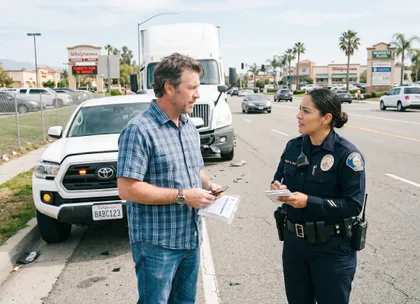
The most time-sensitive evidence at any truck crash scene is the truck itself — specifically the identifying information painted on its cab. Photograph the USDOT number, the carrier name, the license plate on the cab and trailer, any placard or cargo marking, and any visible damage before the truck is moved or towed.
If it is safe to do so, gather the following:
- Vehicle Damage and Scene Overview: Photograph all vehicles from multiple angles, including wide shots showing vehicle positions relative to lane markings, barriers, and road signs. Capture skid marks, fluid spills, and debris fields — these details help reconstruct how the crash unfolded.
- USDOT Number: The USDOT number on the cab can be used to locate publicly available federal information about the carrier. You can use it later to pull the company’s safety rating, inspection history, and prior crash data through the FMCSA Safety and Fitness Electronic Records (SAFER) System. Carriers operating on US-101 through Santa Maria and the Central Coast are often registered entities with searchable SAFER profiles.
- Witness Contact Information: Ask any bystander who stopped to observe for their name and phone number before they leave. Eyewitness accounts — especially from other drivers who saw the truck’s behavior before impact — can corroborate your account of how the crash happened. When Arash Law reviews a Santa Maria truck accident claim, witness information can help guide the early investigation before memories fade.
The most critical truck accident records are not at the scene — they are inside the truck’s onboard systems and the carrier’s dispatch office. Documenting the scene thoroughly provides a foundation, but preserving those electronic records requires a formal legal step outlined below.
If you are looking for Santa Maria truck accident lawyers who understand the full scope of evidence available in commercial crash cases, the USDOT number you photograph at the scene is often the starting point for a complete carrier investigation.
Step 3: Get Medical Care and Build Your Injury Record
Seek medical evaluation the same day as the crash, even if you feel well enough to drive yourself home from the scene. The adrenaline response your body produces during a collision can mask pain or symptoms from spinal injuries, internal bleeding, and concussions. By the time symptoms fully appear, the gap between the crash and your first medical visit can become a problem in your claim.
If paramedics at the scene recommend transport, accept it. Dignity Health – Marian Regional Medical Center, located at 1400 E Church Street in Santa Maria, provides emergency care and serves Santa Barbara County’s Central Coast communities. When you are evaluated — whether at the emergency department or by your own physician afterward — describe the crash to the provider accurately: how the impact occurred, which direction the force came from, and every area of your body that hurts, feels stiff, or feels different than before. Mention pre-existing conditions so the provider can distinguish new injuries from prior ones.
Save every document from every medical visit. Your injury record is the factual backbone of your damages claim, and gaps in that record give the trucking company’s insurer room to argue that your injuries were not serious or were not caused by the crash. The records to preserve include:
- Emergency department visit notes and discharge instructions
- Physician evaluations and specialist referrals
- Imaging studies — X-rays, MRIs, CT scans
- Diagnoses and treatment plans
- Chiropractic treatment records and visit logs
- Prescription records for medications related to the injury
- Physical therapy session notes and progress reports
Chiropractic care is common after truck accidents involving whiplash, neck strain, and lumbar injuries. These records are important evidence of your treatment and recovery and should be preserved in the same organized file. If you later need to file a truck accident claim in California, Arash Law’s attorneys use the complete medical record — from emergency intake through ongoing chiropractic and rehabilitation visits — to document the full scope of your injuries and recovery timeline.
Step 4: File the DMV Report and Notify Your Insurer
California law treats the DMV SR-1 filing as a driver obligation triggered by the crash itself — it is not a condition of recovery, but failing to file can result in a driver’s license suspension. Under California Vehicle Code § 16000, you must file DMV Form SR-1 within 10 days of the crash if it involved:
- Any injury or death, regardless of severity
- Property damage exceeding $1,000
This obligation applies to all drivers involved, regardless of fault, and it is separate from any police report the Santa Maria Police Department or CHP generates at the scene. Your attorney can assist with filing if you are hospitalized or otherwise unable to do so within the window.
Also, notify your auto insurer promptly. Most policies contain a cooperation clause that requires you to report accidents without unreasonable delay, and missing that requirement can jeopardize your own coverage benefits, including medical payments coverage and uninsured motorist protection. When you make your initial report, stick to verifiable facts:
- The date and general location of the crash
- The vehicles involved and their identifying information
- Which law enforcement agency responded
Do not estimate speed, do not assign fault, and do not speculate about the extent of your injuries before you have been fully evaluated. The trucking company’s insurer may contact you as well — speaking with them without legal guidance is generally not advisable, because their adjusters are trained to gather information that can reduce the value of your claim.
Step 5: Send a Spoliation Letter to Preserve the Truck’s Electronic Records
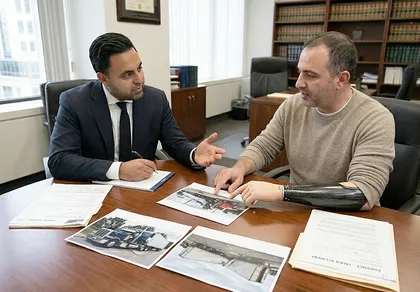
The most important legal step in a Santa Maria truck accident case is sending a formal written demand to the trucking company requiring it to preserve all electronic and documentary evidence related to the crash — a legal notice called a spoliation letter. This demand places the carrier on explicit notice of the potential claim and identifies the evidence that must be preserved.
Federal rules require motor carriers to retain drivers’ records of duty status, supporting documents, and ELD backup records for at least six months under 49 CFR § 395.8(k)(1) and 49 CFR § 395.22(i). Carriers also must not alter or erase original ELD and hours-of-service data under 49 CFR § 395.30.
The minimum retention period also serves as a deletion window. After that minimum period, ordinary retention policies may permit deletion, but evidence still must be preserved when litigation is reasonably foreseeable or another legal preservation duty applies… Some EDR systems on commercial trucks can also be overwritten after subsequent ignition cycles if not separately preserved. The spoliation letter must go out as quickly as possible after the crash.
The records the letter should demand include:
- Event Data Recorder (EDR) Data: Pre-crash vehicle dynamics, including speed, braking force, throttle position, and seatbelt status in the seconds before impact. This data can confirm or contradict the driver’s account of the collision.
- Electronic Logging Device (ELD) Records: Hours-of-service logs tracking how long the driver had been on the road before the crash. Fatigue caused by hours-of-service violations is a documented cause of commercial truck crashes, and this data is held by the carrier under 49 CFR § 395.30.
- Dashcam Footage: Forward-facing and cab-facing video from the truck, if equipped. This footage may capture the moments before and during impact, including driver behavior and road conditions.
- Maintenance and Inspection Records: Carrier maintenance logs, pre-trip inspection reports, and repair orders that may reveal mechanical defects or skipped service intervals that contributed to the crash.
- Driver Qualification File: Training records, license history, drug and alcohol test results, and prior violation history for the driver involved.
Because drafting a preservation demand that covers all necessary evidence categories requires understanding both California civil procedure and federal trucking regulations, consulting with a truck accident attorney who understands FMCSA rules at this stage is critical. Arash Law’s attorneys handling truck accidents draft and send spoliation letters as one of the first actions when a Santa Maria truck accident case comes in.
Understanding Your Deadlines: When You Must Act in Santa Barbara County
The two-year filing window under California Code of Civil Procedure § 335.1 is the standard deadline for filing a personal injury lawsuit in California — but several earlier deadlines can cut off your rights before that clock runs out. Missing the government tort claim deadline or the civil lawsuit filing deadline can bar your claim entirely.
If a government entity may share responsibility for the crash — for example, Caltrans for a defective road condition on US-101, or a public agency operating a vehicle — California Government Code § 911.2 requires you to file a government tort claim within six months of the crash date before you can sue that entity. This six-month government claim deadline is a mandatory prerequisite, not a procedural formality. Missing it can bar your claim against the public entity, although California law allows a limited late-claim application in some cases if acted on quickly.
If the public entity formally rejects your claim in writing, you have six months from the date of that written rejection to file a civil lawsuit (Gov. Code § 945.6). If the entity takes no action within 45 days of the claim’s presentation, the claim is deemed rejected by operation of law, and a two-year filing deadline from the date of the crash applies under Gov. Code § 945.6(a)(2).
If your case proceeds to a civil lawsuit in Santa Barbara County, the filing location depends on the case type, claim amount, and where the crash occurred. For Santa Maria-area truck accident cases, the Santa Barbara Superior Court — Cook Division is located at 312 East Cook Street, Building E, Santa Maria, CA 93454, and can be reached at (805) 614-6414. The Cook Division clerk’s office is open Monday through Friday, 8:00 a.m. to 3:00 p.m.
For cases filed at the main courthouse in Santa Barbara, the Civil Division is located at 1100 Anacapa Street, Santa Barbara, CA 93121, and can be reached at (805) 882-4520.
| What To File | Timeframe | Triggering Factor |
|---|---|---|
| DMV SR-1 form | 10 days from crash | Injury, death, or damage of over $1,000 |
| Government tort claim | 6 months from crash | When a public entity is a potential defendant |
| Personal injury lawsuit | 2 years from crash | When the case is against a private defendant |
Legal basis:
- CVC § 16000 (SR-1 filing)
- California Government Code § 911.2 (government claim)
- CCP § 335.1 (personal injury statute of limitations)
The trucking company’s legal team begins building its defense on the day of the crash — not the day you file a lawsuit. Every day without a preservation demand in place is a day the carrier’s electronic records inch closer to the deletion window.
What to Bring to Your First Consultation With an Arash Law Attorney
Coming to your consultation prepared shortens the time needed to evaluate your case and lets Arash Law’s attorneys identify the strongest evidence angles right away. No document is too small to bring — early records that seem minor often become significant later.
Organize what you have into these categories:
- Crash Documentation: The police or CHP report number, the crash report itself if you have obtained it, photographs from the scene, and any video you captured on your phone
- Truck Identification: The USDOT number, carrier name, license plate, and any photos of the truck’s cab and trailer
- Medical Records: Emergency department records, physician notes, imaging results, chiropractic visit logs, and prescription receipts from the date of the crash forward
- Insurance Information: Your own auto policy declarations page, any correspondence from the trucking company’s insurer, and notes from any conversations you have had with adjusters
- Lost Income Documentation: Pay stubs, employer letters, or records of self-employment income that document what you have missed while recovering
One important caution: if the trucking company’s insurer or representatives contact you and ask for a recorded statement, decline until you have spoken with a lawyer. A recorded statement given before your injuries are fully documented and before the truck’s electronic evidence is preserved can undermine your claim in ways that are difficult to correct later.
Frequently Asked Questions About Santa Maria Truck Accidents
Truck accident cases in Santa Barbara County involve federal regulations, multiple responsible parties, and deadlines that differ from ordinary car accident cases. The questions below reflect what injured people most often ask after a crash on US-101 or SR-135 in and around Santa Maria.
Who Can Be Held Liable in a Santa Maria Truck Accident?
Liability in a truck crash can extend well beyond the driver who was behind the wheel. Under the legal principle of vicarious liability, meaning one party is responsible for another’s actions, a trucking company can be held accountable for a driver’s negligent conduct on the job.
Other parties who may share responsibility include the company that loaded or secured the cargo, the maintenance contractor who last serviced the truck’s brakes or tires, the vehicle manufacturer if a component defect contributed to the crash, and, in some cases, the freight broker who arranged the shipment. Identifying every potentially liable party requires reviewing the carrier’s records, the driver’s qualification file, and the truck’s maintenance history — which is why preserving those documents early is so important.
What If the Truck Accident Was Partially My Fault?
California follows pure comparative negligence, meaning your share of fault reduces your recoverable damages proportionally — but does not eliminate your right to recover. If you are found to bear 25% of the responsibility for the crash, your damages are reduced by 25%, and you may still recover the remaining 75%. This rule applies in Santa Barbara County courts the same way it applies statewide. The trucking company’s insurer will typically argue that you share some fault to reduce its exposure, which is one reason why a thorough evidence file and an accurate crash reconstruction matter.
How Long Do I Have to File a Claim in Santa Maria?
Insurance claim deadlines vary by policy, and waiting even a few weeks after the crash can create gaps in your coverage rights, so report to your insurer immediately.
For a civil personal injury lawsuit against a private defendant, California Code of Civil Procedure § 335.1 gives you two years from the crash date to file in court. If a government entity — such as Caltrans for a road defect on US-101, or a public agency vehicle — may share responsibility, California Government Code § 911.2 requires you to file a government tort claim within six months of the crash before you can sue that entity. That six-month deadline is a strict prerequisite, not a suggestion.
If the public entity formally rejects your claim in writing, you have six months from that written rejection to file a civil lawsuit (Gov. Code § 945.6). If the entity takes no action within 45 days of the claim’s presentation, the claim is deemed rejected by operation of law, and a two-year filing deadline from the date of the crash applies under Gov. Code § 945.6(a)(2).
For Santa Maria-area cases, the Cook Division courthouse at 312 East Cook Street in Santa Maria may be the relevant courthouse, but the correct filing location can depend on where the crash occurred and court assignment.
What If the Truck Driver Has No Insurance or Not Enough Insurance?
Federal law requires most commercial motor carriers operating in interstate commerce to carry minimum liability coverage — but that coverage may still be insufficient to fully compensate for serious injuries. If the driver’s coverage falls short, your own uninsured motorist (UM) or underinsured motorist (UIM) coverage may apply if your policy includes it. California law requires insurers to include UM/UIM coverage in your auto policy by default — it is part of every bodily injury liability policy unless you expressly reject it in writing under California Insurance Code § 11580.2. Check your declarations page now to confirm what you carry.
Separately, the trucking company itself, the cargo owner, or the freight broker may carry their own insurance policies that your attorney can pursue independently of the driver’s personal coverage.
What Should I Do If the Trucking Company or Its Insurer Contacts Me?
Do not give a recorded statement to the trucking company’s insurance adjuster without first speaking with a lawyer. Adjusters are trained to ask questions in ways that can produce answers useful to the carrier’s defense, even when those questions seem routine. You are not legally required to give a recorded statement to the other party’s insurer. If you want free guidance on how to handle that call, consulting with a Santa Maria truck accident attorney before responding protects your rights without any upfront cost.
Do Lawyers Only Get Paid If They Win?
Most personal injury attorneys — including those at Arash Law — handle truck accident cases on a contingency fee basis, meaning they are paid only if they recover compensation for you. If your case does not result in a recovery, you owe no attorney’s fees. Under California Business and Professions Code § 6147, contingency fee agreements must be in writing and must specify how the fee is calculated, so you will know exactly what the arrangement covers before you sign anything. There are no upfront fees to begin a case review with Arash Law.
Get the Legal Support Your Case Requires After a Santa Maria Truck Crash
Arash Law’s truck accident attorneys representing Santa Maria clients know how commercial trucking claims work from the first spoliation letter to the last demand package — including the FMCSA hours-of-service regulations under 49 CFR Part 395, the carrier liability rules that determine who is responsible beyond the driver, and the evidence custodians who hold the records that make or break these cases. When a case involves multiple defendants, layered insurance policies, and electronic evidence with a short retention window, having a legal team that moves immediately makes a measurable difference.
Make Them Pay. Call AK. Arash Law offers a free case review — call (888) 488-1391 anytime, 24 hours a day. Tell us what happened on US-101, SR-135, or anywhere else in the Santa Maria area, and we will tell you exactly where your case stands and what your next steps are. Under California Business and Professions Code § 6147, all contingency fee agreements must be in writing and specify how the fee is calculated. There is no fee unless we recover compensation for you.
Arash Law Case Results: Truck Accidents
Though these results do not guarantee future outcomes, they exemplify how our team could help with your case. Still, every case is unique. The outcome of your case will depend on the specific facts and evidence involved.
$5,500,000 — Trucking Accident: Rollover Crash Causing Spinal Cord Injury and Mild TBI. A client suffered a spinal cord injury and a mild traumatic brain injury in a rollover trucking accident that occurred while he was working within the scope of his employment. Arash Law secured a $5.5 million settlement.
About This Guide
This guide was prepared by the attorneys and legal writers at Arash Law to help people injured in commercial truck accidents in Santa Maria and the surrounding Santa Barbara County area understand their legal rights and procedural obligations under California and federal law.
The procedural information in this guide — including courthouse locations, filing deadlines, and federal evidence retention rules — is drawn from the following verified sources:
- Santa Barbara Superior Court’s Cook Division at 312 East Cook Street, Santa Maria, CA 93454
- California Code of Civil Procedure § 335.1 (two-year personal injury statute of limitations)
- California Government Code § 911.2 (six-month government tort claim deadline)
- 49 CFR § 395.30 (federal ELD retention requirements for motor carriers)
- Dignity Health – Marian Regional Medical Center, 1400 E Church Street, Santa Maria, CA 93454
- FMCSA SAFER System at safer.fmcsa.dot.gov
No city- or county-level truck crash counts are cited in this guide because no specific, verified figure was retrieved during the research process. Readers seeking crash data for Santa Barbara County may query the UC Berkeley Transportation Injury Mapping System (TIMS) at tims.berkeley.edu.
Case results depend on individual facts and circumstances. Prior results do not guarantee a similar outcome. This page is for informational purposes only and does not constitute legal advice.
Sources
- Santa Barbara Superior Court – Santa Maria, Cook Division: 312 East Cook Street, Building E, Santa Maria, CA 93454 | (805) 614-6414 | https://www.santabarbara.courts.ca.gov/location/santa-maria-cook-division (accessed July 9, 2026)
- Santa Barbara Superior Court – Main Courthouse, Civil Division: 1100 Anacapa Street, Santa Barbara, CA 93121 | (805) 882-4520 | https://www.santabarbara.courts.ca.gov/general-information/locations-contact-info (accessed July 9, 2026)
- California Code of Civil Procedure § 335.1 – Personal Injury Statute of Limitations (two years) | https://leginfo.legislature.ca.gov/faces/codes_displaySection.xhtml?lawCode=CCP§ionNum=335.1 (accessed July 9, 2026)
- California Government Code § 911.2 – Government Tort Claim Deadline (six months) | https://leginfo.legislature.ca.gov/faces/codes_displaySection.xhtml?lawCode=GOV§ionNum=911.2 (accessed July 9, 2026)
- 49 CFR § 395.30 – Federal ELD Record Retention Requirements for Motor Carriers | https://www.law.cornell.edu/cfr/text/49/395.30 (accessed July 9, 2026)
- Dignity Health – Marian Regional Medical Center: 1400 E Church Street, Santa Maria, CA 93454 | https://www.commonspirit.org/find-a-location/dignity-health-marian-regional-medical-center-2662 (accessed July 9, 2026)
- FMCSA Safety and Fitness Electronic Records (SAFER) System | https://safer.fmcsa.dot.gov/CompanySnapshot.aspx
- California DMV Accident Reporting – Form SR-1 | https://www.dmv.ca.gov/portal/dmv-virtual-office/accident-reporting/ (referenced per CVC § 16000)
- UC Berkeley Transportation Injury Mapping System (TIMS / SWITRS) | https://tims.berkeley.edu/ (accessed July 9, 2026). Note: No city-level Santa Maria crash count was extracted from this source.
Disclaimer: The information on this page is for general informational purposes only and does not constitute legal advice or create an attorney-client relationship. Every case is different, and the outcome of your case depends on the specific facts and applicable law. Contact a licensed California attorney for advice about your particular situation. Arash Law is a California law firm.