TL;DR: The biggest car accident in history by vehicle count was the 2011 Rodovia dos Imigrantes pileup in Brazil, with about 300 vehicles in heavy fog. Such pileups can cause burns, brain injuries, and deaths. Fault is often shared, so gathering police reports, witness accounts, and video early can help establish what happened before evidence fades.
Highlights:
- Call 911 and request police and medical assistance.
- Photograph vehicles, positions, road conditions, and debris.
- Collect names and contact details from witnesses.
- Request nearby businesses to preserve camera footage.
- Get a medical evaluation, even if symptoms seem minor.
- Keep damaged items and repair receipts as evidence.
- Track all accident-related expenses and lost income.
Tip: Stick to facts when describing the crash and avoid guessing about causes or fault.
Table of Contents
The biggest car crash on record, based on the number of vehicles involved, is widely reported as the 2011 pileup on Brazil’s Rodovia dos Imigrantes highway, where heavy fog contributed to a crash involving around 300 vehicles.
Some crashes are remembered as the “biggest” because of the number of vehicles involved, while others are known for their death toll, such as the 1955 Le Mans disaster. The definition depends on whether size is measured by the number of cars involved or by the number of lives lost.
Road traffic accidents cause significant financial losses for individuals, families, and entire countries. The World Health Organization (WHO) reports that traffic accidents cost many countries about 3% of their gross domestic product (GDP).
Car accidents in the United States have deeply affected families and communities. Looking at some of the deadliest crashes shows why road safety matters.
A Closer Look At The Biggest Car Accidents Ever Recorded
Large crashes often happen when drivers face low visibility, bad weather, or unsafe road behavior. Many start with one crash and quickly turn into chain reactions. When drivers cannot see clearly or stop in time, more vehicles can get pulled into the collision.
Biggest Car Accidents Worldwide
Car accidents can lead to serious injuries or even worse outcomes. The following are three of history’s biggest car accidents worldwide:
- Braunschweig, Germany (2009) — On the Autobahn A2, heavy rain made the road wet and slippery. Drivers had trouble stopping and keeping control of their vehicles. As traffic moved through the storm on July 19, 2009, conditions kept getting worse.
One crash led to another, and the situation quickly turned into a chain reaction. About 259 vehicles were involved in the pileup. Around 66 people were injured, and some were in critical condition. Investigators later said the weather and slick roads played a big role.
- Vysocina, Czech Republic (2008) — A strong snowstorm hit the highway on March 20, 2008, between Brno and Prague. Snow and ice covered the road, and drivers struggled to see ahead.
As conditions worsened, vehicles began crashing into each other. 231 vehicles were involved, and several people suffered serious injuries. Officials closed the highway until crews could clear the road and the weather improved.
Deadliest Car Crashes Worldwide
Below are some of the deadliest car crashes in history. They show how technical failures, environmental issues, and human errors can lead to tragic outcomes.
- The 1955 Le Mans Disaster in France — During the 24 Hours of Le Mans race on June 11, 1955, two cars collided at high speed. One car flew into the air and crashed into the spectator area.
Pieces of the car hit people in the crowd. The crash killed 84 people, including the driver. It remains one of the deadliest racing accidents ever.
- The 2010 Congo Tanker Truck Explosion — On July 2, 2010, a fuel tanker lost control and crashed in a village in Sange, Congo. Not long after, it exploded.
The blast and fire spread quickly. Around 230 people died, and many others were injured. This tragedy shows how crashes involving fuel can become deadly very fast.
Car Accident Trends In The U.S. And California
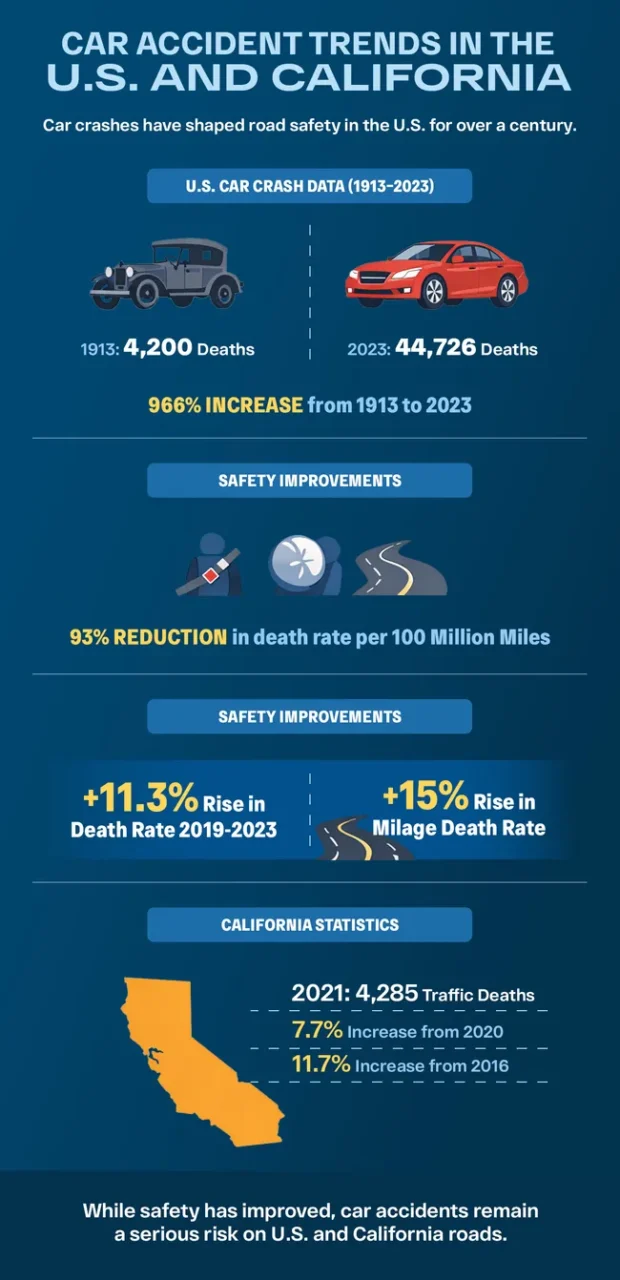
Car crashes have shaped road safety in the U.S. for over a century. Here’s what the data shows:
- From 1913 to 2023, motor vehicle deaths in the U.S. grew by 966%. In 1913, about 4,200 people died in crashes. By 2023, that number reached 44,762. This includes passenger cars, trucks, buses, and motorcycles.
- Safety improvements have made a difference. Seat belts, airbags, and better road design helped lower the death rate per 100 million miles driven by about 93% compared to earlier decades.
- Recent years show new concerns. From 2019 to 2023, the motor vehicle death rate increased by 11.3%, and the mileage death rate rose by 15%.
- California reflects similar patterns. In 2021, the state recorded 4,285 traffic deaths. That was a 7.7% increase from 2020 and an 11.7% increase from 2016.
These numbers show that while safety has improved, car accidents remain a real risk on U.S. and California roads. The sections below look at some of the largest and deadliest crashes to put these trends into perspective.
U.S. History’s Biggest Car Accident Pileups
Some of the deadliest car accidents in America were pileups that involved hundreds of vehicles. Harsh weather, low visibility, and insufficient car distancing contributed to these accidents.
- Los Angeles, CA (2002) — On November 3, 2002, thick fog covered Freeway 710, making it hard for drivers to see ahead. As traffic slowed, some drivers could not react in time, and crashes began to stack up.
The pileup involved about 216 vehicles. Five people suffered serious injuries, and around 45 motorcyclists were hurt. Many vehicles were badly damaged, and dozens were totaled. Investigators pointed to poor visibility as a major cause of the chain-reaction crash.
- Lansing, Michigan (2005) — One of the largest pileups on this list happened on I-96 in Lower Michigan. On January 12, 2005, thick fog settled over the highway, making it hard to see ahead.
The National Weather Service had issued a dense fog advisory, warning that visibility could drop to a quarter mile. Even with those warnings, crashes began and quickly turned into a chain reaction involving more than 200 vehicles.
The pileup led to two deaths and many injuries, showing how dangerous low-visibility conditions can be on busy highways.
- Mobile, Alabama (1995) — On March 20, 1995, Mobile, Alabama, experienced a major pile-up due to fog. This accident caused damage to approximately 200 cars and led to one fatality and 90 injuries. To this day, drivers remain extra cautious in these areas around the end of March because of the incident.
Deadliest Car Accidents In U.S. History
Many road accidents lead to injuries or property damage. However, a few are notable for the tragic loss of life. These vehicle accidents in U.S. history are remembered not just for the lives lost but also for the conditions that caused them.
- California Dust Storm (1991) — On November 29, 1991, a powerful dust storm swept across parts of California and hit the I-5 near Coalinga. The blowing dust made it very hard for drivers to see the road.
As visibility dropped, vehicles began crashing into each other. The pileup involved both cars and semi-trucks. In the end, 17 people died, and about 150 were injured. It remains one of the most serious dust-related crashes in U.S. history.
- Tennessee Fog Pile-Up (1990) — On December 11, 1990, dense fog covered I-75 near Calhoun, Tennessee. Drivers struggled to see ahead, causing collisions.
The chain-reaction crash grew into a 99-car pileup. The accident led to 12 deaths and 42 injuries. Fog often affects this area, and the region had seen other multi-vehicle crashes before this one.
- Florida Pileup At I-75 (2012) — On January 29, 2012, a mix of fog and smoke from a nearby brush fire settled over I-75 in Paynes Prairie, Alachua County. Visibility dropped quickly, and drivers could not see far ahead.
More than 20 vehicles were involved in the crash. The pileup caused 11 deaths and injured more than a dozen people. Emergency crews responded quickly, and some believe the nearby hospital helped victims receive faster care.
Top Causes Of Car Accidents On The Road
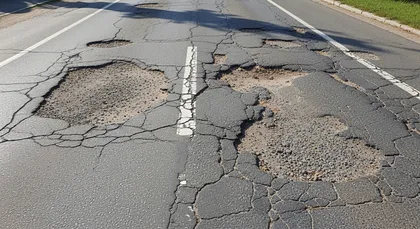
Car accidents occur for various reasons, but most fall into a few basic categories. The following are some of the most common causes of car accidents.
- Driver Behavior & Poor Decision-Making — Many car accidents occur when drivers ignore traffic laws or skip safety steps. These poor driving behaviors include distracted driving, speeding, tailgating, running red lights, and doing unsafe lane changes.
- Impaired & Drowsy Driving — Alcohol, drugs, and fatigue all slow reaction times. They affect judgment and significantly raise the chance of a crash.
- Road Design & Infrastructure Hazards — Poor road design, lack of maintenance, and dangerous layouts can cause accidents, even when drivers follow traffic rules.
- Vehicle Defects & Mechanical Failures — When a vehicle component breaks or a design flaw emerges, drivers may lose control unexpectedly, leaving little time to react.
Catastrophic Injuries From Car Accidents
Some vehicle accidents result in catastrophic injuries that drastically affect the victim’s life. These injuries require lifelong medical care and other treatments.
- Spinal Cord Injuries — Damage to the spinal cord can cause partial or total paralysis. This limits movement and independence. Often, it requires physical or chiropractic therapy.
- Traumatic Brain Injuries — These injuries can impact how people think, speak, and move. They often require extensive rehabilitation.
- Amputations — High-impact collisions can crush or immediately sever limbs. In some cases, severe injuries necessitate surgical removal.
- Internal Injuries — Organ damage, such as to the lungs, liver, or spleen, can be fatal and may go undetected.
Automobile accidents can also lead to psychological injuries. These include post-traumatic stress disorder (PTSD), depression, anxiety, and phobias.
How Fault Is Determined In Multi-Car Accidents
Multi-car crashes often involve shared blame. More than one driver can be responsible based on what each person did. In California, a driver may be legally accountable if their actions were a “substantial factor” in causing the crash, even if others were also involved.
To prove negligence, you must show three basic things:
- The driver had a duty to drive safely.
- The driver failed to do so, such as by speeding or following too closely.
- That failure caused injuries or property damage.
California follows a pure comparative negligence rule. This means an injured person can still seek compensation even if they were partly at fault. However, their recovery is reduced by their share of blame. For example, if someone is 60% at fault, they may still recover 40% of their losses.
Why Is Fault Hard To Determine In Multi-Car Crashes?
Drivers in a multi-car crash often tell different stories about what happened. Each person may blame someone else.
Several risky actions can occur simultaneously, such as tailgating, speeding, unsafe lane changes, or distracted driving. Because of this, it can be hard to pinpoint a single driver.
As a result, determining who is responsible often leads to insurance disputes, investigations, and, in some cases, lawsuits.
Frequently Asked Questions About Car Accidents
To obtain reliable information after a car crash, many people use online resources to find answers or seek free legal advice from an accident lawyer. Here are some common questions about car accidents and personal injury claims.
How Do Insurance Companies Handle Large-Scale Traffic Accident Claims?
Insurance companies handle traffic accident claims that involve multiple parties through detailed investigations. They check for liability, coverage limits, and loss amounts. Insurers also collect police reports, witness statements, traffic camera footage, and expert reconstructions.
What Makes Pileup Accident Injury Claims Complicated?
Pileup accidents usually involve many drivers, each with some share of fault. Victims often must file claims against multiple drivers and insurers simultaneously. Disputes over who bears responsibility and the amount of payment can delay the claims process.
What Factors Cause Car Accidents In California?
Causes of car accidents in California include distracted driving, drunk driving, speeding, and reckless driving. Other factors also play a role. Weather issues can increase the risk of accidents. Lack of driver training or experience, poor highway design, and faulty car parts can also contribute to these crashes.
What Is The Legal Deadline For Claims In Car Accidents In California?

In California, victims generally have two years to bring a personal injury claim after being involved in a car accident. If a government agency is involved, an administrative claim must be submitted within six months.
How Long Does It Take An Insurance Company To Determine Fault?
In California, an insurance company may take weeks or months to assess liability in a car accident. This depends on the situation. Multi-vehicle incidents, disputed claims, and accidents with serious injuries can take longer to evaluate. These cases may last months or even years.
What If Multiple Parties Were Responsible For The Auto Accident?
When many people share blame for a car accident, responsibility is often split among them. This depends on each person’s role in causing the crash. California follows a comparative fault system. Under this rule, an injured person may still seek compensation, but their level of fault will affect how much they receive.
Get Legal Assistance For Your Car Accident
If a catastrophic crash has affected you or a loved one, Arash Law is here to assist. Our law firm understands the pain and urgency that follow car accidents, and we are prepared to advocate for your rights. If you are thinking, “I need a personal injury lawyer,” do not hesitate to contact us.
Our car accident lawyers can assist you throughout the claims process. “Do lawyers only get paid if they win?” you may be wondering. We work on a contingency fee basis. This means you only pay attorney’s fees if we recover compensation for you.
To schedule a free initial consultation, contact AK Law at (888) 488-1391.