TL;DR: Wrong-side delivery parking can endanger suburban road users. It blocks visibility and pushes drivers and cyclists into traffic. This results in unpredictable movement when delivery vehicles depart. The risk may rise as residential deliveries increase, but specific California crash data on this issue are limited. In California, vehicles on two-way roads generally must park facing traffic. Delivery companies may share liability if unsafe parking leads to a crash.
Highlights:
- Move to safety and call 911 if anyone is hurt.
- Get a medical evaluation promptly, even if symptoms feel minor.
- Photograph the vehicle’s facing direction, curb position, and blocked sightlines.
- Record the license plate, company name, vehicle number, and driver information.
- Ask witnesses if they remember which direction the delivery vehicle was parked.
- Find nearby doorbell, dashcam, or security footage and ask that it be saved.
- Calendar deadlines – 2 years to sue, 6 months for public-entity claims.
Tip: Save original photos/videos and all receipts, and when reporting to insurers, stick to observed facts and avoid guessing.
Table of Contents
Wrong-side delivery parking can be dangerous. It puts a delivery vehicle where drivers, pedestrians, and cyclists don’t expect it. That can create accident hazards. For example, a delivery vehicle driver might cross opposing traffic to reach the wrong curb. In doing so, they may block sightlines during the delivery.
The problem may be growing in California’s suburbs. More residential deliveries mean more commercial vehicles on neighborhood streets. Currently, there is no data available on how many crashes delivery vehicles cause when parked against traffic. Instead, the hypothesis is that increased delivery activity increases the likelihood of this unsafe practice. It doesn’t mean California has recorded a specific rise in wrong-side parking crashes.
California law generally requires vehicles on two-way roads to park in the direction traffic normally moves. Commercial vehicles have a limited loading and unloading exception for some curb rules. However, this exception does not allow them to stop or park against oncoming traffic.
If you or a loved one were injured in an accident caused by a delivery vehicle parked against traffic or blocking a lane, you may be eligible to pursue financial compensation for losses such as medical bills and lost wages.
What Is Wrong-Side Delivery Parking?
Wrong-side delivery parking happens when a driver crosses a two-way street. They stop or park next to the curb, facing against the normal flow of traffic. It may happen when a delivery address is on the opposite side of the road, and it seems easier and faster to park and walk across the street.
The term does not simply refer to parking on the left side of every road. On a one-way street, California law generally allows vehicles to park next to either curb when they face the permitted direction of travel. The safety concern addressed here is a vehicle facing opposing traffic on a two-way roadway.
Why May Wrong-Side Delivery Parking Be Increasing In California Suburbs?
Currently, California does not publish statewide crash data on how often delivery drivers park against traffic or on the crashes caused by this behavior. Still, wrong-side delivery parking can be viewed as a potential emerging issue rather than a confirmed statewide crash trend.
Several conditions may make the practice more common or noticeable:
- More Residential Delivery Activity. There are no specific statistics on the number of deliveries to California’s suburbs. However, US Postal Service (USPS) data show that the service alone delivered to 157.8 million residential addresses nationwide in 2025. E-commerce trends indicate that online shopping is a significant contributor to overall residential delivery frequency in California, with a MobiLoud analysis revealing that the state currently has the highest weekly likelihood of making online purchases in the country (20.1% above the national average). That means deliveries may increase the likelihood of commercial vehicles parking on residential streets.
- Pressure to Complete Routes Efficiently. Delivery work commonly involves frequent stops and scheduled routes. A driver may be motivated to rush through deliveries if they have a quota to meet or are paid per delivery. To save time, they may choose the curb closest to the delivery address to avoid having to turn around, find a legal space, or cross the street on foot. This time pressure increases the risk of delivery accidents for drivers at companies like Amazon.
- Limited Loading Space. Many suburban neighborhoods have no commercial loading zones. Delivery vehicles may find it hard to stop without blocking traffic due to parked cars, narrow shoulders, bike lanes, and driveways.
- Street Designs That Can Conceal the Danger. Wide streets and light traffic may make wrong-side parking appear harmless. Suburban streets have curved roads, cul-de-sacs, and uncontrolled intersections. They also feature driveways, children, pedestrians, cyclists, and vehicles backing out of homes. A large delivery vehicle can block these road users from view.
These conditions don’t show that all delivery companies or drivers park against traffic. They explain why this practice may occur and how even a short stop can pose a serious hazard to the neighborhood.
Data Transparency Note: This discussion uses 2025 USPS data. It also leverages an e-commerce analysis from the mobile app developer MobiLoud, as reported by Chain Store Age in the December 2025 article “The State Most Obsessed With Online Shopping Is…” These statistics do not directly establish findings on the number of home deliveries in California suburbs. The blog will be updated with more relevant and recent data when it becomes available.
The Hidden Safety Hazards Of Wrong-Way Delivery Vehicles
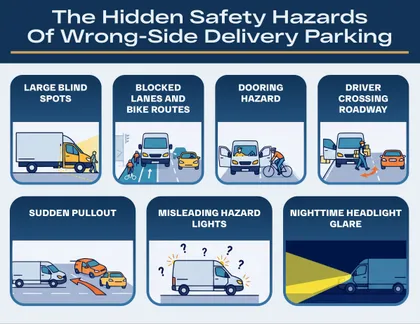
Wrong-side parking can be especially dangerous when it involves a delivery vehicle. Delivery drivers make frequent stops, often on streets without loading zones. They may stop suddenly, open doors into traffic, cross the road with packages, and pull away quickly after completing a delivery. When the vehicle faces against traffic, these routine delivery movements become less predictable for everyone nearby because they create hazards such as:
- Large Blind Spots: Delivery vans and trucks are often taller and wider than passenger cars, which already makes visibility challenging on suburban streets lined with parked vehicles. When a delivery vehicle is parked against traffic, it can block sightlines around driveways, intersections, mailboxes, and parked cars. Residents backing out of driveways may be unable to see approaching traffic or pedestrians hidden behind the delivery vehicle.
- Blocked Lanes and Bike Routes: In many suburban neighborhoods, streets are narrow and may not include bike lanes or wide shoulders. A delivery vehicle stopped on the wrong side can force passing cars, school buses, and cyclists to squeeze into the center of the road or cross into oncoming traffic. This increases the risk of head-on collisions, sideswipes, and crashes involving cyclists or pedestrians walking along the roadway.
- Frequent Door Openings: Drivers frequently open doors to retrieve packages or return to the vehicle. When parked against traffic, doors may open directly into the path of passing vehicles, cyclists, or even children walking home from school. An open door can also block visibility in already tight residential corridors.
- Drivers and Packages in the Roadway: In suburban neighborhoods, delivery drivers often need to cross the street to reach front doors. When parked on the wrong side, this crossing becomes more frequent and more dangerous. Large or bulky packages can limit the driver’s ability to see approaching traffic, and the delivery vehicle itself may block the driver from view until the driver steps directly into the roadway.
- Unpredictable Pullout Movements: After completing a delivery, drivers may need to re-enter traffic quickly to stay on schedule. In suburban areas with frequent stop-and-go driving, a wrong-way parked delivery vehicle may suddenly pull across one or more lanes to correct direction. Other drivers, including parents driving children or residents backing out of driveways, may not anticipate this movement because they expect the delivery vehicle to move in the direction it was facing.
- Misleading Hazard Lights: Flashing hazard lights are common during suburban deliveries, but they do not indicate the driver’s next action. A passing driver or cyclist may assume the vehicle is safely stopped when it is actually preparing to pull out, turn, or cross traffic. This uncertainty is especially risky on narrow neighborhood streets with limited passing space.
- Nighttime Headlight Glare: In suburban areas with limited street lighting, a delivery vehicle facing the wrong direction can shine headlights directly into oncoming traffic. This glare can make it harder for drivers to see pedestrians, children near the curb, pets, mailboxes, and other vehicles, increasing the risk of collisions during evening and early morning deliveries.
What Accidents Can Wrong-Side Delivery Parking Cause?
Wrong-side parking can contribute to several types of accidents, such as the following:
- A driver crosses opposing lanes to reach an address and collides with an approaching vehicle.
- A motorist swerves around a stopped vehicle and strikes another vehicle, cyclist, or pedestrian.
- A cyclist moves into the travel lane because the delivery vehicle blocks the shoulder or bicycle lane.
- A pedestrian emerges from behind the vehicle and is struck by a driver whose view was obstructed.
- A resident backing out of a driveway cannot see around the delivery vehicle.
- The delivery driver pulls away from the wrong curb and crosses into another vehicle’s path.
- Headlight glare from a wrong-facing vehicle prevents a driver from seeing a roadway hazard at night.
The delivery vehicle doesn’t need to hit the injured person to cause a crash. A driver or company can still be at fault if the vehicle’s unsafe position forces another road user to brake, swerve, or enter oncoming traffic.
Is It Illegal To Park Facing The Wrong Direction In California?
California Vehicle Code § 22502 generally requires a vehicle stopped or parked on a two-way roadway to face in the direction that traffic normally moves on its side of the road. Its right-hand wheels must generally be parallel to and within 18 inches of the right-hand curb or edge of the roadway. Although a commercial vehicle can change from the normal curb position to load or unload goods or passengers, it cannot stop or park against the flow of traffic.
Any code violations can become key evidence when someone is hurt. Under California’s negligence per se doctrine, a violation may create a presumption of negligence when specific requirements are met. The violation must be a proximate cause of the injury. The accident should be one that the law aims to prevent. Also, the injured person must be part of the group protected by the law. This legal theory affects your available next steps after a parking-related accident in the suburbs.
Your Legal Options After Wrong-Side Delivery Parking Accidents
California Civil Code § 1714 imposes a legal duty on everyone to exercise reasonable care and prevent harm. Parking on the wrong side of the road when making deliveries may be considered a breach of that duty. If that action directly causes an accident and your losses, the party responsible for it may be negligent under the law. That means you could file a personal injury claim against them.
The settlement you seek can cover documented losses, such as:
- Economic (financial) damages, such as emergency care, hospital treatment, future medical costs, lost wages, lower future earnings, and property damage.
- Non-economic (personal) damages, such as pain and suffering, emotional distress, or loss of enjoyment of life.
Who May Be Liable For A Wrong-Side Delivery Parking Accident In California?
More than one person or business may share liability. Responsibility depends on who caused the hazard, how the crash happened, and the link between the driver and the delivery company.
- The Delivery Driver: A driver can be liable for choosing to park against the flow of traffic instead of finding a legal spot, for crossing oncoming lanes to reach the wrong curb, or for pulling out into traffic without checking blind spots created by their own wrong-way stop.
- The Driver’s Employer: An employer, such as a delivery platform or parent company, may be liable for an employee’s mistake if the employee is involved in an accident while performing their job, or if the employer’s dispatch or route software directed the driver to the nearest curb without regard for which side of the street that put them on.
- A Delivery Service Partner or Contractor: Some companies route work through local delivery businesses, fleet operators, franchisees, or independent contractors. They may be liable if they were in charge of providing hazardous pickup/drop-off instructions that caused the driver to park on the wrong side of the road.
- Another Driver: A passing driver may share fault if they were speeding, distracted, or made an unsafe pass around a delivery vehicle parked on the wrong side of the road, rather than adjusting their driving to the conditions.
- A Public Entity: A city, county, or other public entity may be involved if a dangerous road condition contributed to the crash. Examples include poor sight distance, faulty traffic signals, or dangerous street designs.
California follows comparative fault principles. An injured person involved in the accident can still seek compensation. However, any recovery amount may be lowered based on their share of responsibility.
A delivery truck accident lawyer can look into how the driver, employer, contractor, vehicle owner, and delivery platform are connected and assess each one’s role in the accident that caused your injuries and losses. That matters because it can impact the insurance policy you file your claim against. That can be one or more of the following, depending on the facts:
- The delivery company’s commercial auto insurance.
- The driver’s employer liability coverage.
- A delivery service partner or contractor’s coverage.
- Another negligent driver’s liability insurance.
If you have uninsured or underinsured motorist coverage on your own auto policy, it may step in when the at-fault party does not have sufficient insurance to cover your losses.
What Evidence Can Prove How The Delivery Vehicle Was Parked?
The position of a delivery vehicle can change within minutes. Once the driver has left, it may be difficult to prove that the vehicle faced the wrong way, blocked a lane, or concealed another road user.
Important evidence may include:
- Photos and videos showing the delivery vehicle’s position and direction.
- The license plate, company logo, vehicle number, and driver information.
- Damage to the vehicles, bicycles, signs, curbs, or nearby property.
- Dashcam footage.
- Doorbell and residential surveillance recordings.
- Statements and contact information from witnesses.
- Police reports and parking citations.
- Delivery confirmations showing the stop time and address.
- GPS, routing, dispatch, and telematics information.
- Driver schedules and electronic communication with dispatchers.
- Company loading, parking, and safety policies.
- Vehicle ownership, employment, and contractor records.
Some evidence may be controlled by the delivery company or another business involved in the accident. Others are time-sensitive and may be deleted after a few days or weeks. A delivery van accident attorney can help you request the preservation of important records, such as GPS data, dispatch records, route info, video footage, employment documents, and vehicle records.
What Should I Do After An Accident Involving A Delivery Vehicle?
First, move away from moving traffic if it is safe to do so. Call 911 when anyone is injured, the roadway remains blocked, or the collision presents an immediate danger.
You should also consider taking the following steps:
- See a doctor, even if you feel fine. Some injuries are not immediately obvious after a crash. An appropriate medical professional should evaluate symptoms or increasing discomfort.
- Photograph the delivery vehicle’s direction and curb position before it is moved. Capture the way it was facing relative to traffic, and which side of the street it was parked on.
- Record the license plate, vehicle number, company markings, and driver’s information.
- Take photos of the sightline the vehicle blocked, such as the intersection, driveway, crosswalk, or lane it obstructed, and your own vehicle’s position relative to it.
- Ask witnesses for their names and contact information, and specifically whether they saw which direction the delivery vehicle was facing or how long it had been parked there.
- Search for nearby homes, businesses, doorbell cameras, or traffic cameras that may have captured the vehicle’s approach, parking position, or departure.
- Avoid arguing about fault or making assumptions about your injuries at the scene.
- Report the collision to the appropriate insurers.
- Keep medical bills, repair estimates, wage records, and correspondence related to the accident.
Frequently Asked Questions About Wrong-Side Delivery Parking Accidents
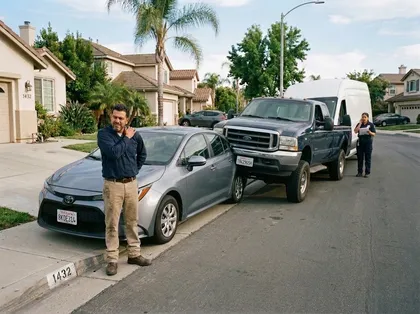
When delivery vehicles park the wrong way in California’s suburbs, they can put your safety at risk. Following an accident, you may be wondering how to report the incident and whether you have a case under the law.
How Can I Report A Wrongly Parked Delivery Vehicle In California?
Note the license plate and the company’s name. If the vehicle is an immediate hazard, call your local non-emergency police line. You can also report it through the company’s app or customer service.
Can I Sue Amazon If One Of Its Delivery Drivers Parked The Wrong Way And Caused My Accident?
Amazon may be involved in your case. However, because it heavily relies on third-party Delivery Service Partners (DSPs), the company isn’t always responsible when a driver’s wrong-side stop leads to a crash. Despite that, suing Amazon may still be possible, depending on the facts. Key factors a lawyer may look at include:
- Whether Amazon’s app or routing system directed the driver to the nearest curb, regardless of traffic direction.
- Whether Amazon set delivery-time pressures that discouraged drivers from finding a legal parking spot.
- Whether Amazon actually controlled the driver’s stop-by-stop instructions.
Contracts, route data, delivery records, and company parking policies can show whether Amazon’s own systems contributed to the unsafe stop.
Do I Have A Case If A Delivery Vehicle Blocking The Road Caused Me To Crash Into Someone Else?
Yes, you may still have a case. Do not assume that striking another vehicle automatically makes you solely responsible. The delivery driver or their company could share blame if the vehicle were in an unsafe spot, blinded you with high-beam glare, or blocked your view of other road users.
That holds even if you didn’t actually make contact with the delivery vehicle itself. However, these “non-contact” or “phantom vehicle” claims can be harder to prove to insurance companies. Third-party evidence, such as neighborhood doorbell camera footage, can help you show how the delivery vehicle contributed to the collision.
How Long Do I Have To Sue For A Wrong-Side Delivery Parking Accident In California?
California’s Code of Civil Procedure § 335.1 generally gives you two years from the date of an accident to file a personal injury lawsuit. The filing window may be extended in specific scenarios, such as cases involving minors. Different deadlines may apply if a public entity is involved:
- California Public Entities: Under the state’s Government Code § 911.2, you need to first file an administrative claim within 6 months of the accident. In most cases, you can only sue if your claim is denied or doesn’t receive a response in 45 days.
- Federal Entities: These cases, such as those involving USPS vehicles, generally fall under the Federal Tort Claims Act. That means a claim usually needs to be filed within 2 years of the accident date. If the Postal Service denies it, you must file a lawsuit within six months of the date of mailing of the denial letter.
Contact A Lawyer About Your California Delivery Vehicle Accident Today
Arash Law, also known as AK Law, represents people injured in delivery vehicle accidents throughout California. If you were injured because a delivery vehicle parked the wrong way in your suburb, our attorneys are ready to review your situation, identify who might be responsible, and explain your available options.
Our firm has helped victims of delivery accidents in the past. While these case results show how we’ve helped accident victims before, they can’t guarantee specific outcomes for your situation:
-
$1,150,000 — Truck Accident: Rear-End Collision with a Large Delivery Truck Company.
A large, top-rated delivery truck company rear-ended the firm’s client, a middle-aged woman, on the freeway, causing neck and back injuries. The defense attempted to attribute her injuries to her weight and pre-existing conditions rather than the crash. Arash Law resolved the matter at mediation before the case reached trial.
-
$1,000,000 — Food Delivery Accident: Inattentive App-Based Delivery Driver.
The firm represented a client injured by an app-based food delivery driver. The case highlighted the risks posed when delivery drivers are inadequately trained or do not pay attention behind the wheel, leading to dangerous road crashes. After extensive litigation, the firm secured a significant recovery for the client.
Our lawyers work diligently to pursue the maximum amount of compensation permitted by California law. Give us a call at (888) 488-1391 to arrange a free initial consultation today. If you decide to work with our firm, you pay no attorney’s fees unless compensation is recovered on your behalf.