TL;DR: Amazon drivers have so many accidents due to tight delivery schedules, pressure to speed, fatigue, and distractions from navigation apps. These factors, combined with risky delivery environments and inconsistent contractor oversight, increase the risk of accidents. The most affected are drivers, pedestrians, and cyclists.
Highlights:
- Seek medical care immediately and keep records of all treatments related to the accident.
- Preserve evidence like photos of the Amazon vehicle, dashcam footage, and delivery logs.
- Write down details such as the Amazon driver’s ID, route, and any app data while fresh.
- Notify your insurance promptly without guessing about the accident’s details.
- Request the police report and any available footage from nearby businesses or apartments.
- If applicable, file the California SR-1 report within 10 days after the crash.
Tip: Protect key digital evidence, such as app timestamps and GPS data, before it’s lost.
Table of Contents
Amazon drivers have so many accidents because the job can push them to move fast, make frequent stops, rely on navigation tools, and complete demanding routes under time pressure. That can lead to speeding, distraction, fatigue, unsafe backing, missed hazards, and rushed decisions while driving. Amazon’s massive delivery volume also means more vans, routes, and time on the road.
For injured people in California, the issue is not only why the crash happened. Another key concern is who may be legally responsible for it. Depending on the facts, liability may involve the driver, a Delivery Service Partner, an Amazon Flex policy, another contractor, or, in some cases, Amazon itself. That is why these claims often require fast evidence preservation and a careful insurance review.
Why Are Amazon Delivery Accidents So Common?
The shortest answer is this: Amazon delivery work can combine speed, pressure, fatigue, distraction, repeated stops, and contractor-based safety gaps. Those conditions raise the risk of a crash even before you get into the legal details. The following are some of the major reasons for the high number of Amazon driver accidents:
Tight Delivery Pressure Can Lead To Unsafe Driving
CBS News reported in late 2024 that at least 57 people died in more than four dozen crashes involving federally regulated carriers shipping for Amazon over the previous two years. That number does not capture every Amazon delivery crash, but it still shows that these incidents are not isolated.
Amazon also delivers an enormous number of packages. Pitney Bowes reported that Amazon handled 6.3 billion parcels in 2024, second only to the United States Postal Service, which handled 6.9 billion. That kind of volume helps explain why delivery speed, stop count, and route pressure can play such a big role in these crashes. In simple terms, the time pressure on Amazon delivery drivers increases accident risk because more packages usually mean more vehicles on the road and greater pressure to keep moving.
When drivers feel rushed, they may start cutting corners. That can mean speeding, tailgating, rolling through stop signs, making unsafe turns, or backing up without checking carefully. In a legal claim, that pressure can matter because it helps show not only what the driver did, but also how the job may have contributed to the unsafe choice.
Fatigue Can Slow Reaction Time And Judgment
Delivery driving for Amazon can involve long hours, constant motion, and little mental rest. The NHTSA reports that drowsy-driving-related crashes caused 633 deaths in 2023. The agency also notes broad agreement that drowsy driving is underestimated in crash data. Fatigue matters because it can reduce attention, slow reaction time, and weaken judgment.
In an Amazon crash case, fatigue can worsen depending on route length, delivery pace, break practices, scheduling, and how the trip was managed. A tired driver may miss stopped traffic, drift out of position, misjudge distance, or fail to react in time.
However, that number may not tell the full story. Drowsy driving is harder to prove after a crash than alcohol use or speeding. As a result, fatigue-related crashes may be undercounted.
Navigation And Delivery Apps Can Distract Drivers
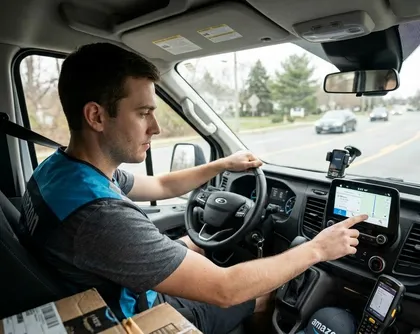
Amazon drivers do more than drive from one point to another. They check addresses, follow navigation prompts, confirm stops, scan packages, and manage delivery tasks throughout the day. NHTSA reports that distracted driving killed 3,275 people in 2023. That makes distraction one of the most common reasons why a delivery route can become dangerous.
In these cases, distraction may involve a phone, a delivery app, a GPS screen, or divided attention between the road and the next stop. Even a short glance away from the road can lead to a rear-end crash, a pedestrian collision, or a missed signal.
Constant Stops And Curbside Driving Create More Risk Points
Amazon drivers spend much of the day in areas with higher crash rates. They pull in and out of curbs, stop in neighborhoods, reverse in tight spaces, cross parking lots, enter apartment complexes, and search for addresses while staying on schedule. Each of those actions creates another risk point.
Crashes at delivery drop-off and pick-up locations may include:
- Rear-end collisions
- Backing accidents
- Sideswipes
- Pedestrian impacts
- Bicycle collisions
- Parking lot crashes
- Dooring incidents
That is one reason an Amazon accident is not always a standard truck crash. It may happen on a residential street, in a driveway area, inside an apartment complex, near a loading zone, or at the entrance to a shopping center.
In California cities, Amazon delivery crashes often happen in traffic patterns that create extra conflict points. That includes double-parking near curbside deliveries, backing near apartment complexes, crossing bike lanes, stopping in loading zones, and moving through pedestrian-heavy corridors.
These risks stand out in dense areas such as Los Angeles, San Francisco, San Diego, and Sacramento, where drivers may be navigating narrow streets, bike traffic, apartment entries, retail corridors, and crowded curbs all in the same route. That does not change the legal standard, but it can change the evidence, the witnesses, and the way fault is argued after the crash.
Amazon’s Contractor Model Can Make Safety Oversight Less Consistent
Amazon says its Delivery Service Partner program uses independent businesses that hire drivers and run delivery operations. Amazon Flex uses individual drivers who deliver in their own vehicles. That structure can make crash cases more complicated because the driver may not be a direct Amazon employee. Policy, supervision, and vehicle records may be spread across different entities.
That means the investigation has to answer several important questions: who hired the driver, who controlled the route, who insured the trip, who maintained the vehicle, and who kept the key records.
Amazon Flex Vs. DSP Vs. Direct Amazon Employee: Why It Matters After A Crash
Not every Amazon-related crash involves the same type of driver. That matters because the driver’s role can affect vehicle ownership, supervision, training, and which insurance policies may respond:
| Driver type | Who they work for | Vehicle setup | What may change after a crash |
|---|---|---|---|
| Amazon Flex driver | Individual delivery partner using the Amazon Flex app | Usually, a personal vehicle | The driver’s status during the delivery block matters, and Amazon Flex insurance may apply if the driver was actively delivering. |
| DSP driver | Delivery Service Partner, which is an independent business that contracts with Amazon | Usually, an Amazon-branded van or other fleet vehicle | Commercial coverage, employer records, training, supervision, and maintenance records may be maintained by the DSP. |
| Direct Amazon employee | Amazon | Company-controlled vehicle or operations | Employment status, company control, training records, and internal supervision may become more central. |
This distinction matters early. Before you can sort out liability, you need to know which category the driver falls into, who controlled the work, and which company kept the key records. Amazon says DSPs are independent businesses, while Amazon Flex uses individual delivery partners with separate insurance rules.
What Makes Amazon Accident Claims Different From Ordinary Car Crashes?
Amazon accident claims can be more complicated than a standard two-car crash because more than one company may be tied to the same delivery. The driver may be working through Amazon Flex, a Delivery Service Partner, or another contractor.
This unique setup can lead to disputes over who controlled the work, who insured the trip, who trained the driver, who maintained the vehicle, and who is legally responsible. That complexity is one reason Amazon truck accident lawyers look closely at who controlled the delivery, who insured the trip, and who kept the key records.
These cases can also involve evidence that does not last long. Important records may include:
- App data
- Route logs
- GPS history
- Onboard video
- Delivery timestamps
- Vehicle inspection records
- Contractor records
That is why the first question is not just, “Who hit me?” It is also, “Who was behind this delivery, and what records can prove it?”
What Should You Do Right After An Amazon Delivery Accident?
The most important steps do not end at the crash scene. In the hours and days that follow, medical care, documentation, and early evidence preservation can make a real difference.
Here are a few things you can do right after an Amazon delivery accident:
- Get medical care if you have not already done so.
- Follow your treatment plan and keep records of visits, test results, prescriptions, and referrals.
- Save the evidence you already have, including photos, dashcam footage, discharge papers, repair estimates, and messages about the crash.
- Write down what you remember while the details are still fresh, including where the crash happened, what the Amazon vehicle looked like, what the driver said, and whether any witnesses were there.
- Request or locate the police report if one was made.
- Notify your insurer promptly and be careful not to guess or overstate facts.
If your symptoms continue, follow up with the right provider. Depending on the injury, that may include an emergency doctor, primary care doctor, orthopedist, neurologist, physical therapist, or a chiropractor if chiropractic treatment fits your injury and care plan.
California also requires a DMV report within 10 days if anyone was injured or killed, or if property damage exceeded $1,000. That report is separate from the police report.
What Evidence Helps Prove Why The Crash Happened?
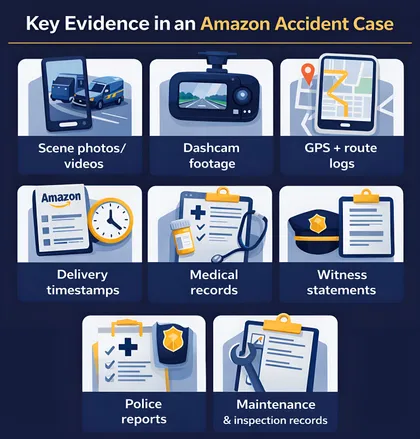
Strong Amazon accident claims tie the cause of the crash to real evidence. That may include:
- Scene photos and videos
- Dashcam footage
- Witness statements
- Police reports
- Vehicle damage patterns
- App timestamps
- GPS or route records
- Delivery logs
- Maintenance records
- Inspection records
- Medical records
- Proof of loss of wages
Timing matters. Delivery records and digital data may not stay available for long. A preservation request can help protect key evidence before companies start blaming each other or claim the records are no longer available.
Amazon delivery cases can involve details that do not show up in an ordinary car crash claim. If you or someone with you took photos, these details can be especially helpful:
- Van markings or Amazon branding.
- Any placards, route stickers, or fleet numbers.
- The route app or delivery screen, if it was visible and safely captured.
- Delivery tote labels or package identifiers.
- The driver’s badge or ID, if it was visible.
- The DSP company name, if the driver or vehicle disclosed it.
It also helps to send preservation requests early to the right targets. That may include:
- The driver.
- The DSP employer.
- Any fleet telematics or camera vendor.
- Any property owner with security cameras.
- Any nearby business or apartment complex with video coverage.
The point is simple: Amazon crash cases can turn on digital records and third-party records that disappear faster than people expect.
Who May Be Liable For An Amazon Delivery Accident?
Liability depends on the facts of the crash. The responsible party may include:
- The driver.
- The Delivery Service Partner.
- Amazon Flex.
- Another contractor or freight company.
- A vehicle owner.
- A maintenance company.
- Another driver.
- Amazon, if the evidence supports a direct claim against it.
Amazon says DSPs are independent third-party businesses, and Amazon Flex drivers work under a separate delivery model with its own insurance structure. That is why the legal analysis must go beyond the van’s logo.
California also follows comparative fault. That means more than one party can share blame. It also means a person’s recovery may be reduced by their share of fault, rather than being barred altogether.
Can You Sue Amazon Directly In California?
Sometimes, but not just because the van carried Amazon branding. The real question is whether the facts show that Amazon itself was negligent or exercised sufficient control over the delivery work to support a direct claim.
A case against Amazon may focus on theories such as negligent hiring or supervision, negligent entrustment, ostensible agency, or arguments about who actually controlled the work. In practical terms, the most helpful facts are those that demonstrate control and oversight, such as route requirements, training rules, performance metrics, dispatch communications, safety policies, and vehicle branding. Those documents help show whether Amazon was just connected to the delivery or had a more direct role in how the work was done.
What Insurance May Apply After An Amazon Crash?
The answer depends on the type of driver and what the driver was doing at the time of the crash.
If the collision involved an Amazon Flex driver who was actively making deliveries, Amazon says its commercial auto policy includes up to $1,000,000 in auto liability coverage, uninsured or underinsured motorist coverage, and contingent comprehensive and collision coverage. Amazon also says passengers are not covered under that policy.
If the crash involved a DSP van or another contractor, coverage may come from the employer’s commercial policy, another business policy, Amazon-related coverage, or more than one carrier. That is one reason these claims can lead to denials, delays, or low settlement offers.
What Compensation May Be Available?
An Amazon accident claim may seek money for:
- Medical bills
- Future treatment
- Lost wages
- Reduced earning ability
- Property damage
- Pain and suffering
- Emotional distress
- Permanent disability or scarring
- Wrongful death losses in fatal cases
The value of the claim depends on proof. Strong medical records, consistent treatment records, lost-income documents, photos, and clear evidence of how the crash changed your daily life all help support your damages claim.
How Long Do You Have To File An Amazon Accident Claim In California?
In many California injury cases, the deadline to file a lawsuit is two years from the date of injury under Code of Civil Procedure section 335.1. Missing that deadline can block the claim. However, some exceptions may apply.
That is not the only timing issue. California’s DMV requires an SR-1 report within 10 days if anyone was injured or killed, or if property damage exceeded $1,000. Insurance notice deadlines can also arise much sooner than the lawsuit deadline.
What California Rules Change What You Do Next?
California has a few rules that can affect what you do after an Amazon delivery crash. These include:
- The SR-1 Reporting Rule: California requires a driver, or the driver’s insurance agent, broker, or legal representative, to file an SR-1 report with the DMV within 10 days if the crash caused injury, death, or more than $1,000 in property damage. This rule applies even if police responded to the scene. Law enforcement does not file the SR-1 for you. You can get the form and instructions through the California DMV.
- Comparative Fault: California follows pure comparative fault. That means more than one person or company can share blame, and an injured person’s recovery is reduced by their own percentage of fault, not automatically barred. For example, if damages total $100,000 and the injured person is found 20% at fault, the recovery would be reduced to $80,000. California adopted this rule in Li v. Yellow Cab Co.
- Filing Deadlines: In many California injury cases, the deadline to file a lawsuit is two years under Code of Civil Procedure section 335.1. However, shorter deadlines can apply if a government defendant is involved. For example, claims against a public entity for personal injury or death generally must be presented within six months. That can matter if the crash involved a city vehicle, a county agency, a public roadway claim, or another government-related defendant.
Amazon Driver Accident FAQs
Amazon delivery crashes can raise issues that do not arise in ordinary car accidents. These are some of the questions people ask most after an Amazon-related crash.
Does Amazon Insure Its Drivers?
Sometimes. Amazon says Amazon Flex drivers have commercial coverage while actively delivering, but the answer depends on the delivery model and the driver’s status at the time of the crash. DSP and contractor crashes may involve different commercial policies.
Who Can Be Liable In An Amazon Delivery Accident?
The driver may be liable, but so might the Delivery Service Partner, another contractor, a maintenance company, another motorist, or, in some cases, Amazon itself. The answer depends on who controlled the trip, who employed the driver, and what the records show.
What Should I Do If Insurance Denies My Claim?
Read the denial letter carefully, identify the stated reason, gather more evidence, and track every deadline. If the insurer is acting unfairly, you may also file a complaint with the California Department of Insurance.
Do Lawyers Only Get Paid If They Win?
Many personal injury lawyers use a contingency fee. That means the attorney’s fee is paid from a recovery rather than an upfront retainer. The fee agreement should be in writing and should explain how fees and costs work before you sign.
When Should I Talk To A Lawyer After An Amazon Crash?
Early. These cases can involve multiple companies, overlapping insurance policies, and digital evidence that may not last. If you are thinking, “I need a personal injury lawyer,” an early case review can help you understand which evidence to preserve, which insurer may apply, and which deadlines matter first.
Learn Your Legal Options After An Amazon Delivery Accident
If you were injured in an Amazon delivery accident and want free advice from an Amazon accident lawyer, it is important to get clear answers early. These cases can become complicated quickly when different companies, insurance carriers, and delivery records are involved. Arash Law, also known as AK Law, can review what happened, explain your legal options, and help you protect the evidence that may support your claim. Call (888) 488-1391 for a free initial consultation.