TL;DR: An Uber accident settlement in California usually takes 3 months to over 1 year, depending on injury severity and fault disputes. Serious injuries or disputed coverage can delay payment for victims, and California’s 2-year statute of limitations sets the deadline to file suit.
Highlights:
- Get medical care immediately and follow treatment through maximum medical improvement.
- Report the crash to the police and to Uber in-app the same day.
- Collect photos, witness contact details, trip details, and screenshots of the driver app status.
- Track insurer deadlines – 15-day acknowledgment, 40-day decision, 30-day payment.
- Send a documented demand package with bills, wage loss, and repair estimates.
- Ask about mediation or arbitration if negotiations stall.
- Calendar the 6-month deadline if a government agency may be involved.
Tip: Save all records and communications, and when giving statements, stick to facts and avoid guessing about fault or injuries.
Table of Contents
An Uber accident settlement in California can take a few months or more than a year. Cases usually move faster when injuries are minor, fault is clear, and the records are easy to gather. Claims can take longer when injuries are serious, several parties are involved, or insurance coverage is disputed.
Uber accident claims are often more complex than regular car accidents. They may involve multiple layers of insurance, legal teams, and detailed documentation. These factors can all prolong resolution timelines and impact your ability to get a settlement.
The Short Answer To How Long An Uber Accident Settlement Takes
There is no fixed deadline for settling an Uber accident claim. A simple case with minor injuries and clear liability may settle in a few months. A more serious case may take a year or longer, especially if the insurer disputes fault, questions the injuries, or refuses to make a fair offer.
In many cases, the timeline turns on medical treatment. If doctors do not yet know the full extent of your injuries, it may be too soon to place a full value on your claim. That is one reason severe injury cases tend to move more slowly than minor ones.
Here is a simple way to think about it:
- Minor Injuries: These usually move faster because medical treatment is short. If liability is also clear, insurance companies may settle quickly. However, delays can still occur if evidence is missing or there are liability disputes.
- Severe Injuries: These often prolong claims. Total damages are usually estimated when you reach maximum medical improvement (MMI), which is when your condition stabilizes. In some cases, a personal injury lawsuit may be necessary if there are disputes with the settlement demand. Litigation can introduce further delays.
The Typical Phases Of An Uber Accident Settlement Timeline

Understanding the timeline for an injury case in pre-litigation can also help set expectations before a lawsuit is ever filed. After an Uber accident in California, filing a claim usually involves several phases. These can include medical treatment, insurance investigations, settlement negotiations, and, in some cases, litigation. Each phase takes a different amount of time. The duration depends on factors such as the treatment length and the complexity of the situation.
The Uber accident settlement timeline typically involves these phases:
- Medical Care and Evidence Gathering: Attend all doctor appointments and keep records of your treatment. Though you can pursue compensation while healing, waiting until you reach MMI can help reduce the risk of receiving an insufficient settlement. In the meantime, you can gather evidence that can help you show who was at fault and support your claim, including:
- Witness statements.
- Photos and videos of the accident.
- App data and traffic camera footage.
- Medical records and bills.
Some of these may be readily available, while others can be harder to obtain. That can affect the case’s timeline.
- Demand Letter and Settlement Negotiations: You or your lawyer sends a demand letter to the at-fault party’s insurer. It explains the accident and injuries. Additionally, it shows the damages you incurred, which may include:
- Medical Bills: Costs of urgent care, hospital stays, surgery, physical therapy, chiropractic care, or counseling.
- Lost Income: Reimbursement for wages lost during your physical recovery period. If the accident caused permanent injuries, your claim may include reduced earning capacity or loss of future income.
- Property Damage: Vehicle repair or replacement costs. It may also include damage to personal belongings, such as laptops or eyeglasses.
- Non-Economic Damages: Compensation for the emotional and psychological effects of an accident, such as pain and suffering.
Insurers might start with smaller offers or ask for more documentation. Settlement delays can occur if your lawyer needs to provide supporting evidence and arguments.
- Litigation (If Needed): If both parties cannot reach an agreement, your lawyer may file a lawsuit. Most cases still settle before going to trial.
During discovery, both sides share information, including:
- Written questions answered under oath (interrogatories).
- Documents like bills, records, and reports.
- Depositions from witnesses and experts.
You can opt for mediation or arbitration to resolve the case faster without going to court. Only a small number of accident cases go to trial. Preparation includes organizing evidence, expert testimony, and trial strategy. A jury may be selected, evidence presented, witnesses called, and arguments made. After the verdict, the losing side may appeal, which can add more time.
The duration of each phase can vary on a case-by-case basis. To illustrate how issues at each step can delay an Uber accident settlement, here’s a brief comparison of how long the claims process can take in the best-case VS typical scenarios:
| Uber Settlement Timelines in California: Best-Case VS Typical Scenarios | ||
|---|---|---|
| Phase | Best-Case Scenario | Typical Scenario |
| Medical Treatment | Immediate treatment, quick recovery (1-2 weeks) | Ongoing care for 3-6 months, possible delays |
| Investigation & Evidence | Minimal investigation, quick access to evidence | Collecting app records, police report, 1-3 months |
| Negotiation | Settlement in 1-2 months | Back-and-forths to resolve disputes may take 3-6 months |
| Window for Receiving a Settlement | Within 1 month after signing an agreement | Within 2-3 months after signing a settlement agreement |
| Litigation Milestones | None | Filing, discovery, mediation, 6-9 months |
What Happens After You Settle?
You can settle an Uber accident case at any point before trial. However, you usually won’t receive your payout right away. Instead, you’ll first have to sign a few documents, resolve any outstanding payments, and reimburse your insurer if necessary.
While the process varies, here’s what typically happens next:
- Signing a Release: Once you agree to the settlement, you’ll sign a release that formally ends your case. This agreement ensures that you can’t pursue any further claims against the Uber driver or their insurer for this accident.
- Lien Resolution: If you received treatment through your health insurance, Medi-Cal, or Medicare, they may have a lien on your settlement. That means they are entitled to recover some of the money they paid for your medical bills. Your lawyer will help negotiate these liens and settle them before you receive compensation.
- Insurer Payment Obligations: If your insurance paid for urgent expenses while you filed a claim, your insurer can ask for reimbursement. This process is called subrogation. It will recoup the costs it incurred from the settlement amount you accepted.
After taking these steps, you’ll receive your settlement check, typically in one lump sum. This process can take anywhere from a few weeks to a couple of months, depending on the complexity of your case and the insurer’s processing times.
Why Uber Accident Settlements Often Take Longer Than Expected

Uber accident settlements in California can take longer because multiple parties may be liable. These cases are different from regular car accidents. They can involve the driver and the rideshare company’s liability insurance.
Several factors influence how long a claim takes:
- Severity of Injuries: More serious bodily harm typically delays settlements because they require longer recovery periods. Insurers are also more likely to dispute severe injuries, as they often result in greater losses.
- Evidence Availability: Records such as surveillance footage, black box data, Uber app records, and other materials can take time to obtain. In some cases, certain evidence may require a court subpoena.
- Multiple Parties: Cases involving multiple vehicles or parties may involve negotiations and several rounds of back-and-forth. Insurance coverage can be confusing in these cases because policies overlap. The willingness of these parties to cooperate can further affect settlement timelines.
- Insurance Company Practices: Insurance companies follow specific procedures to review and process claims. Their duration can vary depending on the complexity of the case, the types of documents needed, and the steps required to validate the claim.
- Complexity of Uber Claims: Uber accidents often involve multiple parties. They also include corporate insurance and digital claim systems. These factors make settlements more complicated and time-consuming.
Liability Questions And Disputes
Under California’s Proposition 22, rideshare drivers are usually independent contractors, not employees. Still, that does not automatically protect Uber from every claim after a crash. Insurance coverage often depends on whether the driver was using the app and what part of the ride they were in when the accident happened.
For example, if the driver had the Uber app turned off, Uber’s rideshare coverage usually would not apply. In that situation, you may need to seek compensation through the driver’s personal auto insurance or another available policy.
Because of that, liability in an Uber accident can be more difficult to determine. More than one party may share responsibility, including:
- Uber Driver: If the driver acted carelessly, such as by running a red light or driving under the influence, they may be liable. Depending on the driver’s app status, either personal insurance or Uber’s commercial coverage may apply.
- Uber Technologies, Inc.: Uber may still face liability in some situations, even though its drivers are generally treated as independent contractors. That may happen if the facts show the company’s own conduct contributed to the crash.
- Other Parties: Another driver, a defective vehicle part, or a dangerous road condition caused by a city or public agency may also have played a role.
California also follows a pure comparative negligence rule. That means more than one party can share fault. An injured person may still recover damages even if they were partly responsible, but their percentage of fault will reduce their recovery. For example, if total damages are $100,000 and the injured person is 25% at fault, they may still recover $75,000.
Disputes over fault can slow down settlement talks. In these cases, an Uber accident lawyer may help injured passengers, pedestrians, cyclists, motorists, or drivers build a stronger claim and deal with negotiation strategies and the insurance process.
Uber Insurance Coverage And App Status
The complex insurance policies for Uber accidents can influence how long a settlement takes. Coverage also depends on the driver’s app status at the time of the accident. Unlike standard commercial liability insurance, rideshare companies like Uber must follow special rules. The California Public Utilities Commission (CPUC) sets specific insurance requirements for each “period” of a rideshare trip.
Here’s a quick overview:
- Period 0 (Uber App Off): Just like in any other car crash, the at-fault party’s auto insurance policy pays for damages. If the Uber app was off, the driver’s personal auto insurance usually applies, not Uber driver insurance. However, coverage disputes can still come up in some cases.
- Period 1 (App On, Waiting for a Ride): If the Uber driver is logged into the app and waiting for a ride request, the rideshare company provides limited liability coverage of up to:
- $50,000 for injuries per person.
- $100,000 for injuries per accident.
- $30,000 for property damage.
- Periods 2 & 3 (Driver Traveling or Carrying a Passenger): Uber’s full commercial insurance applies, with coverage of up to $1 million. It may also provide:
- Third-party liability insurance for medical bills and property damage if the driver is at fault.
- Uninsured or underinsured motorist (UM/UIM) coverage for passengers and the driver if the at-fault driver lacks sufficient insurance.
California Insurance Rules That Affect Settlement Timing
California has rules for insurance companies called the Fair Claims Settlement Practices Regulations. These explain how insurers must handle claims. They establish deadlines for acknowledging a claim, completing investigations, and deciding whether to accept or deny it. These rules aim to protect policyholders and prevent unfair or delayed settlements.
After receiving proof of your claim, insurance companies must follow these deadlines:
- Within 15 Days: Acknowledge receipt of claim and begin investigations.
- Within 40 Days: Accept or deny the claim. If more time is needed, the insurer must notify you in writing and explain why.
Insurers must then provide payment within 30 days of accepting the claim or receiving a proper release. If a claim is delayed, underpaid, or denied without a clear reason, you can file a complaint with the California Department of Insurance (CDI). Though it can investigate and take action against the insurance company, its role is primarily regulatory, and it may not intervene in individual claims.
It is important to understand these rules to know if an insurer is handling your claim fairly. An Uber accident lawyer can provide legal representation to victims in cases involving bad faith insurance.
Ways To Support An Efficient Uber Claims Process
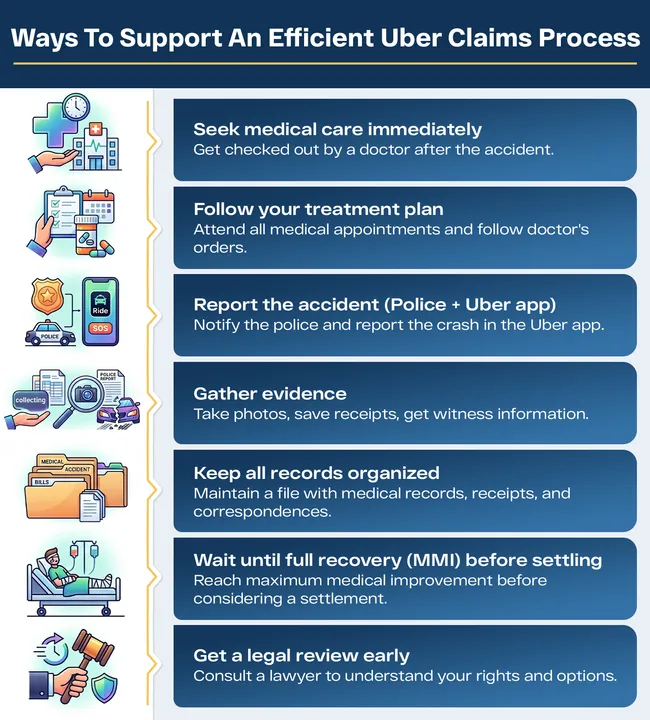
There are actions that accident victims can take to support their claims. These steps can also help insurers and legal representatives manage claims more efficiently.
Doing the following can thus help you avoid unnecessary delays when pursuing a settlement:
- Seek Medical Care Right Away: This helps protect your health and creates a record linking the injury to the crash. Insurers can dispute your claim if you cannot establish that connection.
- Report the Accident Immediately: Call 911 or report the accident to a nearby police or sheriff’s department. The authorities can provide an unbiased report about the accident. It can also help to notify Uber using its app. You can support your claim with records of the accident with a clear timeline.
- Follow the Treatment Plan: Comply with your doctor’s advice until you reach MMI. Gaps in medical care can cause insurers to question the true severity of your injuries.
- Compile Important Records: These include medical reports, receipts, trip details, photos, videos, and witness information. Uber accident lawyers can use them to review your accident and build your claim.
- Get Your Case Reviewed Early: An early legal assessment means you can understand your compensation options early, and, if you have a case, start the claims process as soon as possible. That can reduce the impact of any potential delays, such as fault and insurance disputes, on your settlement.
- Wait for Full Physical Recovery: The full cost of injuries may not be clear right away. Reaching MMI allows for a more accurate assessment of losses. Car accident compensation may include medical bills, lost income, and non-economic damages such as pain and suffering.
Frequently Asked Questions (FAQs) About Uber Accident Settlements
Dealing with the physical and financial impacts of an Uber accident can already be overwhelming. Though a settlement could help, pursuing one isn’t always straightforward. As such, you may be seeking free advice from an Uber accident lawyer online to understand your next steps. This section addresses common concerns victims have about rideshare crash compensation.
How Hard Is It To Sue Uber?
It can be moderately challenging. Uber is generally not responsible for crashes caused by its drivers, as they are independent contractors (not employees). That means you can rarely sue it directly. Even if you can, Uber has the resources to build a strong legal defense. A rideshare accident lawyer can help clarify your legal options and level the playing field.
Do I Get Compensation If My Uber Crashes?
It depends on the specifics of your case. You may have the right to seek compensation for your injuries and losses if someone’s negligence caused your Uber to crash. However, whether or not you’ll actually get it hinges on how well you can prove your damages to an insurer or court. Comparative fault can also impact your settlement.
How Long Do I Have To File An Uber Accident Claim In California?
California’s statute of limitations gives Uber accident victims two years from the date of the crash to file a personal injury claim. Within this period, you must build it, file it, negotiate a settlement, and submit a lawsuit if necessary. If you run out of time, the state’s courts will generally dismiss your case, no matter how strong it is.
However, exceptions can apply:
- The two-year time limit for injured minors only starts on their 18th birthday.
- If symptoms didn’t manifest immediately after the crash, the statute of limitations would only start on the day you became aware of your injury.
- You have only six months to file if your claim involves a government agency.
If a government entity is potentially at fault for your Uber accident, consider consulting a lawyer as soon as possible. Shorter and stricter timelines will likely apply to your claim. Understanding your options can help you decide what to do next.
Learn More About Uber Accident Settlement Timelines In California
Waiting for an Uber accident settlement can be stressful, especially if you’re dealing with severe injuries and extensive losses. In this scenario, you may be thinking, “I need a personal injury lawyer to help me streamline the process.” That’s where Arash Law can help.
Our experienced attorneys have helped clients across California handle rideshare injury claims. We know what factors affect Uber settlements and can anticipate challenges that can prolong resolution timelines. We can help you avoid delays. This includes curating the statements you give to insurers and addressing disputes from claims adjusters.
If you’re already concerned about legal costs, you may be wondering, “Do lawyers only get paid if they win?” The answer is yes at AK Law. Since we handle cases on a contingency fee basis, you won’t owe us legal fees unless we win or settle your case.
Call (888) 488-1391 to schedule a free case review with an Uber injury lawyer from our team.