TL;DR: Pedestrians can be at fault for causing an accident in California if their actions contribute to the crash, such as crossing outside a crosswalk or ignoring signals. Drivers may share fault if their actions also contributed. Liability depends on the facts of the case.
Highlights:
- Pedestrians can be at fault for accidents if their actions contribute to the crash.
- Pedestrians must follow traffic rules, including crossing at crosswalks and obeying signals.
- Fault may be shared if the driver also acted carelessly (e.g., speeding or distracted).
- California’s comparative negligence rule divides liability based on each party’s actions.
- Homeowners’ insurance, auto insurance, or UM/UIM coverage may cover damages if the pedestrian is at fault.
- California law limits the time to file claims: 2 years for injury, 3 years for property damage.
Tip: Stick to the facts and avoid guessing about fault when reporting an accident.
Table of Contents
If a pedestrian causes an accident in California, they can be held legally responsible for the resulting injuries. People often assume the driver is automatically at fault in a pedestrian crash, but California law does not create such a blanket presumption. Fault depends on the facts and may be shared.
California law does not limit a pedestrian to someone walking. It can also include certain people using human-powered devices, electric personal assistive mobility devices, or mobility devices because of a physical disability. If a pedestrian’s actions contributed to the crash, that pedestrian may share legal responsibility for the injuries that follow.
A driver may still share fault if speeding, distraction, poor visibility, or other careless conduct also contributed to the crash. Under California’s comparative negligence rule, liability can be divided between both sides, which is why these cases often turn on strong evidence such as video, witness statements, scene photos, signal timing, and police reports.
Can A Pedestrian Be At Fault For An Accident In California?
Yes. A pedestrian is at fault when their actions cause or contribute to a crash, meaning they failed to follow traffic rules or exercise reasonable care.
Some situations in which a pedestrian may be legally responsible include:
- Walking into the road outside a crosswalk and creating an immediate hazard.
- Crossing between signalized intersections instead of using a crosswalk.
- Stepping into a vehicle’s path without giving the driver enough time to stop.
- Ignoring pedestrian signals or other traffic control devices.
- Walking while distracted or impaired and misjudging traffic.
- Coming into the road from behind parked cars, where drivers cannot see them clearly.
- Moving into a driveway or traffic lane without yielding to an approaching vehicle.
What Laws Apply When A Pedestrian Causes A Crash?
The California Vehicle Code sets out several rules that can affect who is at fault when a pedestrian causes or contributes to a crash. These rules cover crosswalks, crossing outside a crosswalk, and pedestrian signals. In most cases, the main question is whether the pedestrian, the driver, or both failed to use reasonable care.
Here are the rules that matter most:
- Crosswalk Rules: Drivers must yield to pedestrians in marked and unmarked crosswalks. However, pedestrians also cannot suddenly step off the curb or into traffic when a vehicle is too close to stop safely.
- Crossing Outside a Crosswalk: When a pedestrian crosses outside a marked crosswalk, or outside an unmarked crosswalk at an intersection, they usually must yield to approaching vehicles that are close enough to be a hazard.
- Pedestrian Signals: Pedestrians usually start crossing on a WALK signal. If the signal starts flashing, they should finish crossing, but usually should not begin crossing at that point. They also should not start crossing on a steady DON’T WALK or WAIT signal.
- The Freedom to Walk Act: This law changed the circumstances under which police can stop or cite someone for jaywalking. It did not change who can be at fault in an injury claim. A pedestrian may still be legally responsible even if no ticket was issued if their actions helped cause the crash.
- General Negligence Rules: In a claim, courts and insurance companies look at whether each person acted carelessly and whether that carelessness contributed to the crash. Depending on the facts, fault can be shared by both sides.
In other words, these cases do not turn on a single rule or on whether someone got a ticket. They usually come down to what the pedestrian did, what the driver did, and whether either side created a dangerous situation.
Who Pays If A Pedestrian Causes An Accident?
If a pedestrian is at fault, their own insurance policies may actually cover the victim’s damages. Many people ask about this when they search for free advice from a pedestrian accident lawyer, because coverage is not always clear. Victims can still pursue compensation, but the source of payment depends on what insurance applies.
Common sources of payment include:
- Homeowners’ or Renters’ Insurance: These policies often include personal liability coverage. The policy may cover injuries or property damage caused by the at-fault party.
- The Pedestrian’s Auto Insurance: Some auto policies may apply in limited situations. Coverage depends on the policy terms and how the incident relates to vehicle use.
- Your Uninsured/Underinsured Motorist (UM/UIM) Coverage: If the pedestrian has no insurance or assets, you may need to use your own policy. UM/UIM coverage can help pay for your injuries and losses.
- Out-of-Pocket Payment: If no insurance applies, the pedestrian may be personally responsible for the damages. Recovery depends on their ability to pay.
Insurance issues can become complex in these cases. An early review of all available policies helps you understand which coverage may apply and how to recover your losses.
What Compensation May Be Available After A Pedestrian-Caused Accident?
The available compensation depends on what losses the crash caused. When a pedestrian causes an accident, injured drivers, passengers, bicyclists, or others can pursue claims for both financial and personal losses.
In practical terms, compensation may cover:
-
Economic Damages: These cover measurable financial losses.
- Medical Expenses: Include emergency care, hospital bills, surgery, medication, rehabilitation, and chiropractic care.
- Future Medical Care: Covers ongoing treatment and long-term needs.
- Lost Wages & Reduced Earning Capacity: Address income loss and future work limitations.
- Property Damage: Includes vehicle repair or replacement.
- Other Out-of-Pocket Costs: Include transportation to medical visits or paid help during recovery.
-
Non-Economic Damages: These address the parts of your life affected by the accident beyond the financial losses.
- Pain and Suffering: Includes physical pain and discomfort.
- Emotional Distress: Includes anxiety, stress, and trauma.
- Loss of Enjoyment of Life: Refers to limits on daily activities and hobbies.
An at-fault pedestrian can seek compensation, too. Their share of fault reduces the financial recovery, not the right to file.
How Do You Prove Liability When A Pedestrian Causes An Accident?
To prove liability when a pedestrian causes an accident, the key question is whether the pedestrian acted carelessly in a way that substantially contributed to the crash and caused real harm. Fault is based on the facts, and it can still be shared if the driver also acted carelessly.
In a pedestrian-caused crash, that may look like this:
- Reasonable Care: Both pedestrians and drivers must use due care on the road. California’s Vehicle Code sets out rules for crosswalks, crossing outside a crosswalk, and the duty to avoid creating an immediate hazard.
- Careless Conduct: A pedestrian may have acted carelessly by stepping into traffic too suddenly, ignoring a signal, crossing outside a crosswalk without yielding, or creating an immediate hazard.
- Causation: The question is whether the pedestrian’s conduct was a substantial factor in causing the harm. It does not have to be the only cause, and fault may still be shared.
- Damages: The injured person must show actual losses, such as medical bills, lost income, pain and suffering, or property damage. California courts’ self-help guidance treats negligence claims as those in which someone acted carelessly and caused injury.
How Does Shared Fault Work In California?
California applies a pure comparative negligence system. The law divides fault based on each party’s share of responsibility. Even if you are partially at fault, you can still seek recovery, though your percentage of blame reduces your award.
Example:
- If you have $100,000 in damages and you are 30% at fault, the court reduces your recovery by 30%. You can only seek up to $70,000.
Small changes in fault percentage can change the final amount you recover.
Who May Be Responsible Besides The Pedestrian?
More than one party can share fault in a pedestrian-caused accident. Liability depends on the facts and the evidence in each case. Even if a pedestrian started the sequence, other parties can still share responsibility if their actions contributed to the crash or worsened the harm.
Depending on the situation, responsible parties may include:
- The Driver: Driver error is among the top causes of pedestrian accidents. A motorist may be liable if they failed to yield, drove too fast, became distracted, or failed to use due care. The law requires drivers to stay alert and take reasonable steps to avoid collisions.
- The Vehicle Owner: They may be responsible under ownership-based liability rules. In some cases, negligent entrustment may apply if the owner allowed an unsafe or unfit driver to use the vehicle. California law may also limit how much an owner must pay in certain situations.
- An Employer: An employer may be held liable under the doctrine of respondeat superior. In simple terms, this means an employer may be responsible if the driver caused the crash while doing their job.
- Another Driver: They may be liable if their actions forced sudden braking, swerving, or other evasive movement. Fault can still apply even if that driver did not make direct contact.
- A Property Owner or Business: They may share liability under premises liability rules. This rule can apply if blocked sightlines, poor layout, or unsafe access points make the area dangerous.
- A Government Agency: They may be responsible if road design, signals, or maintenance created a hazard. These claims are subject to special procedures and shorter deadlines under California law.
Where Do Pedestrians Most Likely Get Into An Accident?
The places where pedestrian crashes become serious are not random. The National Highway Traffic Safety Administration (NHTSA) reported these 2023 data:
- Urban Vs. Rural: 84% of pedestrian fatalities occurred in urban areas.
- Location: 74% occurred away from intersections.
- Time of Day: 77% occurred in the dark.
The Centers for Disease Control and Prevention (CDC) also reports that most pedestrian deaths happen on high-capacity urban roads. These patterns match common crash locations seen in pedestrian-fault cases:
- Urban Intersections: Disputes usually arise over signals, turning vehicles, and who entered first. These cases often depend on signal timing, visibility, speed, and whether the pedestrian entered on a lawful signal.
- Non-Intersection Road Crossings: Crossing mid-block or outside a marked crosswalk can be dangerous because drivers may not expect a pedestrian. California law still requires drivers to exercise due care. However, it also imposes a yield duty on a pedestrian when crossing outside a crosswalk that creates an immediate hazard.
- Parking Lots, Driveways & Sidewalks: The NHTSA includes these in “other” locations tied to pedestrian fatalities. These areas create short-distance conflicts and limited reaction time for both pedestrians and drivers.
- School Zones & Residential Areas: These areas raise visibility and lookout issues for everyone. Children can act unpredictably, and drivers must stay alert for sudden entries into the roadway.
- Rural Highways & Dark Roads: Rural roads and dark corridors raise concerns about speed and visibility. A smaller share of pedestrian fatalities occurs in rural areas than in urban areas. High speeds, poor lighting, and fewer crossing controls can make these crashes severe.
What Should You Do If You’re In An Accident Caused By A Pedestrian?
Act fast, stay safe, and write down everything you can. Your actions right after the crash can affect your health, your claim, and the determination of fault.
Here are some steps to consider:
- Seek treatment right away and follow up if symptoms appear later.
- Get a copy of the police report if law enforcement responded to the scene.
- Keep photos that show vehicle positions, skid marks, debris, crosswalks, signals, lighting, and visible injuries.
- Gather statements from those who witnessed the crash.
- Keep phone logs, app activity, and repair estimates tied to the incident.
- Save dashcam footage and request nearby surveillance footage quickly.
- Report the crash to your insurer and stick to the facts.
- Keep all bills, medical records, estimates, and reports in one place.
What Deadlines Apply After A Pedestrian Accident In California?
In California, the general deadline, commonly known as the statute of limitations, for a personal injury claim is two years from the date of the accident. If you are only filing a claim for property damage, you generally have 3 years.
However, if the accident involved a government entity, such as a city-owned vehicle or a dangerous road design, you only have six months to file a formal administrative claim. Missing these deadlines will likely bar you from recovering any compensation through legal action.
FAQs About Pedestrian-Caused Accidents In California
Below are clear answers to common questions about fault, liability, and claims after a pedestrian-caused accident.
Can A Pedestrian Be Fully At Fault For A Crash In California?
Yes, and it does happen. If the evidence shows the pedestrian’s negligence was the significant factor, with no driver error or third-party issue, the pedestrian is entirely at fault.
Can A Driver Still Be Partly At Fault If The Pedestrian Crossed Unsafely?
Yes. A driver can still share responsibility even if the pedestrian broke a traffic rule. California law requires drivers to use due care at all times to avoid hitting pedestrians. Speeding, poor visibility, impairment, or distraction can all point to a driver who had a chance to avoid the crash and didn’t. The court assigns fault based on each party’s actions, not on a single violation.
Do Pedestrians Have The Right Of Way In California?
Not always. Drivers must yield in marked crosswalks and at intersections. Pedestrians must still act with reasonable care and avoid stepping into immediate danger. Outside a crosswalk, pedestrians must yield to vehicles that are close enough to create a hazard. Right-of-way depends on location and timing.
Who Decides Fault After A Pedestrian-Related Crash In California?
Insurance companies make early decisions during the claims process. If the dispute continues, the case can move to court. A judge or jury then reviews the evidence and applies the law. The final decision depends on proof, not initial reports.
What Happens If The At-Fault Person Has No Insurance?
Liability still applies even without insurance. You can still file a claim or lawsuit against the at-fault party. You can also rely on your own insurance for certain costs. For example, you can use your UM/UIM coverage or MedPay. Coverage depends on the policy terms and the facts of the case.
What Type Of Pedestrians Face The Highest Risk?
Adults aged 65 years and older face a higher risk of pedestrian death. The 2022 data from the Centers for Disease Control and Prevention (CDC) shows that this group accounts for 22% of all pedestrian deaths. Risk also increases at night, on high-speed roads, and outside intersections. Children also face risk, especially without supervision.
Who Counts As A Pedestrian Under California Law?
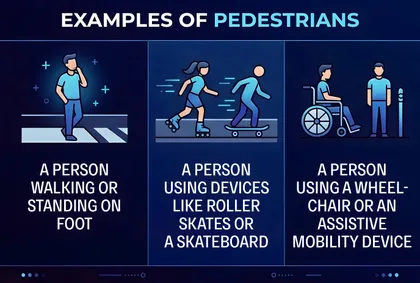
California uses a broad definition of “pedestrian.” It covers more than just people on foot, and that matters for how courts review fault after a crash.
A pedestrian includes:
- A person walking or standing on foot.
- A person using a device that is not a motor vehicle or bicycle, such as roller skates or a skateboard.
- A person with a disability using a tricycle, quadricycle, or wheelchair for transportation.
Call Arash Law If A Pedestrian Caused Your Accident
Pedestrian-caused accidents may involve comparative negligence, meaning fault gets divided rather than assigned entirely to one party. If you’re dealing with injuries, vehicle damage, or a dispute over who’s responsible, you don’t have to work through it alone. You may be thinking, “I need a personal injury lawyer.” That’s a reasonable place to be. These cases usually involve shared responsibility, and the details make a real difference in what you can recover.
The pedestrian accident lawyers at Arash Law work with you to:
- Review what happened and explain how California law applies to your situation.
- Identify all parties who may share responsibility.
- Gather and preserve key evidence, including reports, video, and witness statements.
- Handle communication with insurance companies and protect your claim.
- Calculate your losses and prepare a clear demand for compensation.
- Guide you through each step, from claim to possible litigation if needed.
Many people also ask, “Do lawyers only get paid if they win?” At AK Law, our team works on a contingency fee. You do not pay upfront fees. We only receive payment if we recover compensation for you.
Call (888) 488-1391 for a free initial consultation. Discuss your situation and ask questions about your options.