TL;DR: The most dangerous freeways in Ventura are US-101 and SR-126, and Victoria Avenue intersections see the most serious crashes. High speeds on narrow lanes cause rear-end or head-on crashes that injure commuters or pedestrians, and claims against the city must be filed within 6 months.
Highlights:
- Call 911 if necessary and get a police report number at the scene — the CHP responds to freeway crashes, and the Ventura Police Department handles city street collisions.
- Photograph the intersection layout, lane markings, traffic signals, skid marks, and vehicle damage before conditions change.
- Collect witness names and phone numbers and note any nearby cameras, as footage from businesses or dashcams may get deleted quickly.
- Get a medical evaluation promptly, even if you feel fine — soft tissue injuries and concussions often have delayed symptoms.
- Report the crash to your own insurer and ask specifically about Uninsured/Underinsured Motorist (UM/UIM) coverage.
- Decline recorded statements to the other driver’s insurer — you are not required to give one.
- If a public road or government agency contributed to the crash, file a government tort claim, in most cases within 6 months, under California Government Code §911.2.
Tip: Act early because the 6-month deadline for claims against public entities is separate from the 2-year deadline for claims against private drivers, and both clocks can run at the same time after a crash.
Table of Contents

US-101 and SR-126 are the most dangerous freeways in Ventura, and intersections along Victoria Avenue and Harbor Boulevard are among the most crash-prone. These corridors carry tens of thousands of vehicles daily. US-101 links Los Angeles to Santa Barbara through the city’s core, while SR-126 carries agricultural, freight, and commuter traffic east from Ventura through the Santa Clara River Valley. The route begins as the Santa Paula Freeway, while portions farther east beyond Santa Paula have historically developed a reputation for severe crashes.
A crash on US-101 or SR-126 is not just a traffic inconvenience. Collisions at high-speed freeway interchanges or busy city intersections frequently produce severe injuries — broken bones, traumatic brain injuries, and spinal damage — that affect your ability to work, drive, and manage daily tasks for months or years. The combination of heavy volume, aging infrastructure, and aggressive driving behavior makes these specific corridors particularly risky.
Identifying Ventura’s high-crash corridors and the risk factors behind them helps you make informed decisions after a collision on these roads. According to data from the California Crash Reporting System (CCRS), these routes exhibit identifiable risk patterns that go beyond simple driver error.
Data Transparency Note: Intersection-level crash patterns cited on this page are sourced from CCRS via data.ca.gov. Crash records are updated as investigations close. Figures may differ from future releases.
The Most Dangerous Intersections In Ventura
Victoria Avenue intersections are among the most dangerous in Ventura, with Victoria’s intersections at Telephone Road and Valentine Road appearing repeatedly in local collision records. Reported collisions at these locations include angle (broadside) crashes and pedestrian-involved incidents, patterns consistent with wide, multi-lane roads where drivers misjudge speeds and gap distances.
The following intersections in Ventura show consistently elevated crash risk based on road geometry, traffic volume, and reported collision patterns:
-
Harbor Boulevard & Seaward Avenue
According to raw data from the California Crash Reporting System (CCRS), the Harbor Boulevard-Seaward Avenue intersection recorded 12 accidents in 2025, resulting in 6 injuries. The intersection of Harbor Boulevard and Seaward Avenue sits at the gateway to Pierpont Beach and San Buenaventura State Beach, two popular coastal access points in Ventura. The combination of beachgoer traffic, the potential for impaired driving after evening events, and a pedestrian-heavy environment can create crash conditions distinct from those at inland intersections. Coastal fog can also reduce visibility on Harbor Boulevard during morning and evening commutes, compressing reaction time for drivers already navigating heavy foot traffic crossing toward the beach parking areas.
-
Telephone Road & Kimball Road
The Telephone Road-Kimball Road intersection recorded 10 accidents in 2025, resulting in 7 injuries. Crashes are more likely to occur here when vehicles travel well above the posted speed limit. Telephone Road and Kimball Road are wide, straight, multi-lane roads — the kind of geometry that encourages speeding because nothing in the road design prompts drivers to slow down. Vehicles approaching this intersection at speeds well above the posted limit have minimal time to stop when a light changes or another vehicle moves into the intersection unexpectedly. The straight-line sightlines that feel safe actually remove the natural friction that keeps speeds in check at more complex intersections.
-
Harbor Boulevard & Olivas Park Drive
Crashes at Harbor Boulevard and Olivas Park Drive involve a mix of regional commuters, visitors to the nearby Olivas Adobe Historical Park, and farm-adjacent traffic from the agricultural corridor south of town. Lighting conditions on the approaches and higher travel speeds along this segment of Harbor Boulevard can compound risk for pedestrians crossing here. According to CCRS, the intersection had 8 accidents that caused 3 injuries in 2025.
-
Victoria Avenue & Valentine Road
Victoria Avenue and Valentine Road meet immediately south of the US-101 southbound freeway off-ramp, and the transition from freeway speeds to a signalized city intersection can catch drivers off guard. Drivers decelerating from the ramp may not anticipate the Valentine Road traffic light, and the resulting angle crashes and rear-end pileups frequently involve vehicles still carrying highway-speed momentum, increasing the risk of serious injuries.
-
Victoria Avenue & Telephone Road
The Victoria Avenue-Telephone Road intersection recorded 6 accidents in 2025, resulting in 8 injuries. This intersection is a wide, multi-lane crossing, which means drivers trying to clear it on a yellow light often get caught mid-turn or stranded when the signal changes. The proximity to the County of Ventura Veterans Memorial and the commercial corridor along Telephone Road generates consistent pedestrian activity throughout the day, including mid-block crossing attempts that increase exposure. High-severity collisions, not just frequent fender-benders, define the risk profile here.
Two additional intersections in Ventura carry an elevated risk for specific populations:
- Victoria Avenue & Telegraph Road: Situated adjacent to Victoria Plaza and Buena High School, Victoria Avenue and Telegraph Road create peak-hour conflicts among student pedestrians, bicyclists, and commuters accelerating toward SR-126 on-ramps. Weekday school arrival and dismissal windows can create some of the most dangerous conditions, as drivers make aggressive lane changes to bypass slower student traffic.
- Main Street & Mills Road: Anchoring the commercial corridor near Pacific View Mall and Wood Ranch – Ventura, the intersection of Main Street and Mills Road sees heavy retail and weekend congestion. Distracted drivers checking navigation apps or exiting parking lots may cause low-speed rear-end and broadside collisions, particularly on weekend afternoons and during the holiday shopping season.
Injured at one of these Ventura intersections? Arash Law offers a free case evaluation — call Arash Law at (888) 488-1391.
The Most Dangerous Freeways In Ventura
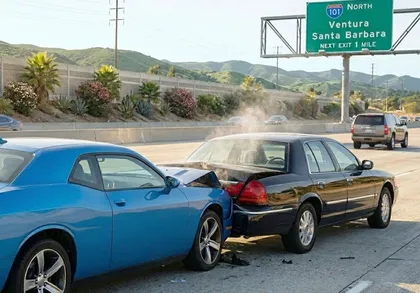
US-101 and SR-126 are the sites of many of the most serious freeway crashes within Ventura city limits, but they generate very different crash types. Rear-end collisions dominate on the 101, while head-on crashes define the danger on SR-126.
US-101 — Ventura Freeway
In 2025, there were approximately 331 accidents on US-101, resulting in around 178 injuries and 3 fatalities. These figures are only for the City of Ventura and are from CCRS. US-101 serves as the primary north-south arterial between Los Angeles and Santa Barbara, concentrating commuter volume through Ventura’s urban core during both morning and evening peak hours. The freeway carries high sustained speeds and sees significant weaving traffic as drivers merge between the city’s core interchanges.
The exits at California Street, Seaward Avenue, and Victoria Avenue are frequent crash sites on the US-101 Ventura segment. Drivers merging from on-ramps into fast-lane traffic or braking hard for congested off-ramps create rear-end and sideswipe conditions that repeat throughout the day. Rear-end collisions are the dominant crash type on this corridor, driven primarily by unsafe speeds and insufficient following distances during peak commute windows.
State Route 126 — Santa Paula Freeway
In 2025, there were approximately 95 accidents on SR-126, resulting in around 60 injuries and 1 fatality. These figures are specific to the City of Ventura and are from CCRS. SR-126 connects Ventura to the Santa Clarita Valley, carrying a mix of agricultural freight, commuter traffic, and recreational vehicles through terrain that has not kept pace with current demand. Farther east, beyond the Santa Paula Freeway segment, portions of SR-126 transition to an undivided highway where opposing traffic and passing movements can increase the risk of severe crashes.
Sections of SR-126 are sometimes called “Blood Alley” because of their record of severe and head-on crashes on older, undivided sections. Local reporting by the Ventura County Reporter has characterized crashes as occurring frequently on this stretch. On undivided portions of SR-126, frustrated drivers may attempt to pass slow-moving trucks by crossing the center line. These may result in head-on collisions, which can lead to catastrophic injuries. The infrastructure on this segment was designed for a different era of traffic volume and has not kept pace with current commuter and freight demands.
Who Can Be Held Responsible After A Crash On These Roads?
California does not limit fault to the driver who hit you. Road conditions, signal timing, and government maintenance failures can all create legal liability for parties other than a negligent driver. Identifying every responsible party determines the full value of what you may recover.
Other drivers are the most common defendants in California traffic crash claims. California’s negligence standard requires drivers to use reasonable care. A driver who rear-ends you on the 101 or runs a red light on Victoria Avenue has generally failed that standard. California also uses a “pure comparative negligence” system, which means your own share of fault — if any — reduces but does not eliminate your right to recover. If you were 20% at fault for a collision, you may still recover up to 80% of your documented losses.
Traffic crash liability is also not limited to moving violations. California’s daylighting rule generally prohibits stopping, parking, or leaving a vehicle within 20 feet of the vehicle’s approach side of a marked or unmarked crosswalk, or within 15 feet of a curb extension, subject to statutory and local exceptions.
The City of Ventura or Ventura County can also be responsible when a road defect contributed to the crash. Under California Government Code §830, a road or public property is considered in a “dangerous condition” when it poses a substantial risk of injury to a person using it with ordinary care in a reasonably foreseeable way. Poorly timed traffic signals, obscured stop signs, inadequate lane markings, and road surface failures can all meet that definition.
Once the liable parties are clear, the next question is what to do with that information. Ventura car accident lawyers can review the facts of your case and explain your potential next steps.
Before suing a public entity for a road-defect claim, you must file a government tort claim, generally within six months of the crash. The specific routing and deadlines are covered in the Filing Deadlines section below.
Was a dangerous road involved in your Ventura crash? Arash Law can evaluate whether a public entity may share responsibility — call (888) 488-1391 for a free initial consultation.
Filing Deadlines After A Ventura Intersection Or Freeway Crash
Two separate deadlines apply depending on who is responsible for your Ventura traffic crash, and missing either one can eliminate your right to recover from that party.
Claims against private drivers or businesses are governed by California Code of Civil Procedure §335.1, which sets a two-year deadline from the date of injury to file a personal injury lawsuit. This is the deadline most people are familiar with.
Claims involving a public entity, such as the City of Ventura, Ventura County, Caltrans, or another government agency, require an additional step that must happen first. Under California Government Code §911.2, you must file a formal government tort claim with the responsible entity in most cases within six months of the crash date. If you miss that six-month window, you generally lose the right to sue that public entity, even if the two-year window for private parties is still open.
Where to file your government tort claim:
- City Streets: File with the City Clerk via the City of Ventura claim form process, processed by City of Ventura Risk Management.
- County Roads or Facilities: File with the Board of Supervisors per the County of Ventura claim filing instructions.
- State Highways (US-101, SR-126): Identify Caltrans as the state agency involved, but present a claim against the State through the California Department of General Services under California Government Code §915.
Personal injury lawsuits in Ventura County are filed with the Ventura County Superior Court civil division, which accepts filings Monday through Friday, 8:00 a.m. to 4:00 p.m., excluding holidays.
What To Do After A Crash At A Ventura Intersection Or Freeway
Your actions in the hours and days after a traffic crash in Ventura directly affect your health and your legal options. The steps below are ordered by urgency. The earliest actions preserve the most time-sensitive evidence.
- Document the scene immediately. Photograph the full intersection layout, traffic signal positions, lane markings, skid marks, vehicle positions, and any visible damage. Road conditions and signal timing can change within hours. What you capture at the scene may be the only record of what existed at the moment of the crash. If you cannot photograph the scene yourself, ask someone nearby to do it.
- Seek medical evaluation the same day. Some of the most serious injuries from intersection and freeway crashes, such as soft tissue damage, concussions, and spinal compression, produce few or no symptoms immediately after the collision. See a doctor, visit urgent care, or consult a chiropractor who handles accident-related injuries to begin documenting the connection between the crash and your physical condition. A gap between the crash and your first medical visit can become an argument by the other insurer that your injuries are unrelated.
- Get the police report and preserve witness contacts. On a freeway, the CHP handles the traffic collision report. On city streets, request a Ventura Police Department response. At the scene:
- Ask for the report number before anyone leaves.
- Collect names and phone numbers from any witnesses.
- Note the locations of any surveillance cameras. City traffic systems, businesses, and dashcams can all contain footage that may be deleted or overwritten quickly.
- Report to your own insurer and ask about UM/UIM coverage. California law requires insurers to include Uninsured/Underinsured Motorist (UM/UIM) coverage in auto policies by default, which pays for your losses when the at-fault driver carries no insurance or insufficient coverage. You have this coverage unless you declined it in writing. Notify your own insurer of the crash promptly, but avoid providing a detailed recorded statement to the other driver’s insurer before consulting a legal professional.
- Consult an attorney before giving any recorded statement. The at-fault driver’s insurance adjuster may contact you quickly after the crash. You are not required to give a recorded statement to anyone other than your own insurer, and questions in those calls are often designed to minimize the payout. Freeway accident attorneys can review the facts of your case, identify all potentially liable parties, and handle communication with insurers while you focus on recovery.
Evidence That Supports Your Ventura Crash Claim
The strength of your Ventura traffic crash claim depends on the evidence available to connect the crash to your injuries and to demonstrate who was responsible. Different claim types require different evidence, and some of it disappears quickly.
| Claim Type | Key Evidence | Who Holds It |
|---|---|---|
| Driver negligence on any road | Traffic collision report (TCR). | CHP for freeways and state highways, or the Ventura Police Department for city streets. |
| Driver negligence on any road | Intersection or roadway surveillance footage. | City of Ventura Public Works / Traffic Engineering or adjacent businesses. |
| Driver negligence on any road | Medical records connecting the crash to the injury. | Treating hospitals, physicians, and chiropractors. |
| Road-defect / dangerous condition | Government tort claim filing records and road maintenance and inspection logs. | City of Ventura Risk Management, Ventura County, or Caltrans. |
| Crash history in the corridor | CCRS corridor crash data. | CCRS (data.ca.gov). |
| Uninsured motorist | UM/UIM policy documentation and insurer correspondence. | Your own insurance carrier. |
Legal basis: California Government Code §7920.000 et seq. (California Public Records Act) generally governs public records requests for agency maintenance logs and other nonexempt public records. Traffic collision reports are subject to separate access rules under California Vehicle Code §20012. They are generally released to people with a proper interest, including involved drivers, injured persons, vehicle or property owners, potential civilly liable persons, and their attorneys. Surveillance footage held by a private business is not subject to the California Public Records Act. A prompt written preservation request may help prevent routine deletion, but the letter alone may not compel an uninvolved third party to retain or produce the footage. A subpoena, court order, or other formal legal process may be necessary.
Frequently Asked Questions About Ventura Intersection And Freeway Crashes
After a crash at a dangerous Ventura intersection or on US-101 or SR-126, your most urgent questions usually center on deadlines, insurance, and what legal help actually costs. The answers below address those specific concerns with the timelines and rules that apply in Ventura. Because some deadlines are as short as six months, the distinctions here matter more than they might in a standard two-party car accident.
How Long Do I Have To File A Claim If A Dangerous Road Contributed To My Crash?
Two deadlines apply when a government agency may be at fault. In most cases, you must file a government tort claim with the City of Ventura, Ventura County, or Caltrans within six months of the crash date under California Government Code §911.2. That step is a legal prerequisite. You generally cannot sue a public entity for a road-defect claim if you miss it. Separately, California Code of Civil Procedure §335.1 gives you two years to file a personal injury lawsuit against private parties. Both clocks typically start on the crash date and run simultaneously. An intersection accident attorney can assess your case and help you manage strict filing deadlines.
Is The Other Driver Always At Fault If They Rear-Ended Me On The 101?
Rear-end collisions on US-101 most often result in the following driver being assigned fault, who is expected to maintain a safe following distance and pay attention to traffic ahead. However, fault is not automatic. The rear driver may argue that you share some responsibility if you braked suddenly without a clear reason, or your brake lights were not functioning, or they may claim a sudden mechanical failure on their own vehicle prevented them from stopping. California’s pure comparative negligence rule means that even if you share some fault, you can still recover compensation for your losses. Your percentage of fault simply reduces the total amount.
What If The Driver Who Hit Me Was Uninsured?
If the at-fault driver carried no insurance, your own Uninsured Motorist (UM) coverage steps in to pay for your medical bills, lost wages, and pain and suffering up to your policy’s limits. If the driver had insurance but not enough to cover your losses, Underinsured Motorist (UIM) coverage can fill the gap. California law requires your insurer to include both in your policy by default, so you have this protection unless you specifically decline it in writing. Check your declarations page or contact your insurer to confirm your coverage limits.
Do I Need A Personal Injury Lawyer For My Ventura Crash?
You are not required to hire a personal injury attorney after a crash in Ventura. For minor crashes with clear fault and straightforward insurance claims, many people handle the process themselves. A lawyer becomes most valuable when fault is disputed, when a government agency or public road may be involved, when your injuries are serious or produce ongoing costs, or when the insurer disputes the value of your claim. Look for a Ventura injury law firm that offers free case reviews. In that meeting, you can ask about how a lawyer can help and confirm whether you really need one.
Do Lawyers Only Get Paid If They Win?
Most personal injury attorneys in California handle injury cases on a contingency fee basis, meaning you pay no legal fees up front and owe attorney’s fees only if your case results in a settlement or award. If there is no recovery, there are no attorney’s fees. California Business and Professions Code §6147 requires contingency fee agreements to be in writing, so any reputable attorney will give you a written contract specifying the percentage before your case begins.
What Does A Chiropractor Have To Do With A Personal Injury Claim?
After a crash, soft tissue injuries — muscle strains, ligament sprains, and whiplash — are common and often invisible on standard X-rays. A chiropractor who handles accident-related injuries can document these conditions, provide treatment, and generate medical records that connect your physical symptoms to the crash. Insurers often challenge claims that lack consistent medical documentation; records from a chiropractor or other treating provider establish the ongoing nature of your injuries and support the calculation of your treatment costs.
How Do I Get Free Legal Advice About My Ventura Freeway Or Intersection Crash?
Many personal injury law firms that handle Ventura traffic crash cases offer a free initial consultation — sometimes called a case evaluation — at no cost to you. During that meeting, an attorney reviews your specific facts, explains the applicable deadlines, and gives you a practical assessment of your options. Searching online for “personal injury lawyer free advice” in Ventura is a reasonable first step to identify local firms that offer this, but confirm the consultation is genuinely free before scheduling. The most useful consultations focus on your specific intersection or freeway corridor, the agencies that may be responsible, and the applicable deadlines.
Contact Arash Law About Your Ventura Crash
Evidence fades fast after a freeway or intersection crash in Ventura. Surveillance footage overwrites within days, road conditions change, and witnesses become harder to locate. Acting promptly protects your options.
Arash Law represents clients injured in traffic crashes across California, including on US-101, SR-126, and Ventura’s most dangerous city intersections. Arash Law’s attorneys handle communications with insurance companies, identify all liable parties, including government agencies, and manage the legal aspects of clients’ cases so they can focus on recovery. The firm works on a contingency basis — you pay no legal fees unless we recover compensation for you.
Call Arash Law (also known as AK Law) at (888) 488-1391 for a free case evaluation. Make them pay — call AK.
Arash Law Case Results: Dangerous Intersection And Freeway Accidents
Our firm’s past results don’t guarantee that your case will have a similar outcome. However, they can help illustrate how Arash Law can help you after an intersection or freeway accident in Ventura:
A client was struck by an uninsured driver while crossing a hazardous intersection. With limited recovery options against the driver, the firm pursued a claim against the city for failing to address known dangers at that location, uncovering a documented history of prior accidents there. The case illustrates how a municipality can share responsibility when a dangerous intersection design or condition contributes to a crash — the same government-liability theory discussed for Ventura’s high-risk intersections.
$6,000,000 — Car Accident: Head-On Collision on a Two-Lane Highway
A client was driving with his wife and son on a two-lane highway when a drunk driver crossed the double yellow lines, causing a head-on collision that claimed the life of the client’s wife. The defense attempted to dispute coverage and liability but was unsuccessful, and the firm obtained the maximum available policy limits. This case mirrors the exact hazard described on SR-126’s undivided sections, where crossing the center line to pass slow-moving vehicles can result in catastrophic head-on crashes.
About This Page
This page was prepared by Arash Law to help Ventura-area residents understand crash risks on the city’s most dangerous corridors and the legal steps that follow a serious collision. Crash statistics referenced here are drawn from the California Crash Reporting System (CCRS), maintained by the California Highway Patrol and available at data.ca.gov.
Deadline information for government claims comes from the City of Ventura’s claim form process page, the City of Ventura Risk Management department, and the County of Ventura Board of Supervisors claim filing instructions. The SR-126 “Blood Alley” characterization is drawn from reporting by the Ventura County Reporter.
Sources
- California Highway Patrol — California Crash Reporting System (CCRS): https://data.ca.gov/dataset/ccrs
- City of Ventura — City Claim Form Process: https://www.cityofventura.ca.gov/1134/City-Claim-Form-Process
- City of Ventura — Risk Management: https://www.cityofventura.ca.gov/2711/Risk-Management
- County of Ventura — Board of Supervisors Claim Filing Instructions: https://vcportal.ventura.org/ceo/cob/docs/claims_summons.pdf
- Ventura County Superior Court — Civil Division: https://ventura.courts.ca.gov/divisions/civil
- Ventura County Superior Court — Locations: https://ventura.courts.ca.gov/locations
- California Legislature — CCP §335.1 (Two-Year Statute of Limitations): https://leginfo.legislature.ca.gov/faces/codes_displaySection.xhtml?sectionNum=335.1&lawCode=CCP
- VC Reporter — “Blood Alley: Highway 126 Remains a Dangerous Problem”: https://www.vcreporter.com/news/blood-alley-highway-126-remains-a-dangerous-problem/article_85402ced-a392-5e79-9a78-e78bee547a7e.html
Disclaimer: The information on this page is provided by Arash Law for general educational purposes only and does not constitute legal advice or create an attorney-client relationship. Crash data references are drawn from publicly available sources. Figures may change as investigation records are updated. Filing deadlines described reflect California Government Code provisions generally applicable in Ventura. Consult a licensed attorney regarding the specific deadlines and requirements of your situation. Prior results do not guarantee a similar outcome.