TL;DR: Traffic school may help reduce future crashes, but its effectiveness depends on more than education alone. Instead, it often works through a behavioral incentive and psychological deterrent tied to the possibility of losing the ability to mask future violations on repeat tickets. California drivers who attend can mask one minor moving violation from insurance companies within 18 months, protecting their rates from increases tied to that ticket.
Highlights:
- Traffic school reduces crashes by creating a behavioral checkpoint, not through classroom education alone.
- You must meet eligibility rules, including a valid license, an eligible one-point infraction, and no prior traffic school election for a violation within 18 months.
- The course covers defensive driving techniques, California traffic laws, and dangers of distracted driving and DUI.
- Masking keeps the ticket off your public DMV record visible to insurance companies, but the DMV retains an internal record.
- You still pay both the court fine and a separate traffic school fee even if you complete the course.
- If you skip traffic school, a point gets added to your record, and your insurance rates may increase.
Tip: After completing traffic school, focus on the specific safe driving habits emphasized in the course rather than viewing it as a one-time obligation that erases the violation.
Table of Contents
Traffic school can help reduce accidents, but not by making drivers smarter. It works because it changes behavior. It serves as a behavioral checkpoint, pushing drivers to correct bad habits before they lead to a crash.
AB 2499 was a California law that changed traffic school from a ticket-dismissal system to a masked-conviction system starting July 1, 2011. Under this system, eligible drivers can keep one qualifying conviction confidential once every 18 months, but the DMV still tracks the violation. California DMV research found that this post-AB 2499 system was linked to fewer later crashes and convictions, especially for drivers with less serious prior driving records.
Getting a ticket is stressful. Points on your record can raise your insurance rates for years. Traffic school gives many California drivers a chance to correct those habits and protect their record. California has tracked this effect with real data. What that data shows is more specific than most drivers expect.
How Traffic School Affects Crash Rates In California
Traffic school can reduce future crashes, but mainly because of behavior and consequences rather than education alone. The impact comes less from what is taught in the classroom and more from the incentives tied to avoiding future penalties.
- Behavioral Incentive: Drivers who attend traffic school may be able to mask a minor ticket, but they risk losing that option if they receive another violation. Under California law, eligible drivers can generally mask one minor moving violation from insurance companies every 18 months. The possibility of losing this benefit, along with potential insurance increases and added points on their record, can encourage safer driving habits.
-
Limited Impact of Education Alone: Historically, California DMV studies found that traffic school education alone had little effect on reducing crash rates, and masking tickets by itself did not consistently change long-term driving behavior. In this sense, education alone has not shown a strong impact on accident reduction.
Earlier DMV research found that California’s old traffic violator school citation dismissal policy was associated with about 12,300 additional crashes per year. California later changed the program under AB 2499, replacing simple dismissal with a masked-conviction system that creates stronger deterrence for repeat violations.
This effect is often strongest right after a ticket is issued, when the consequences feel immediate, and the reminder of safe driving rules is still fresh.
What Traffic School Teaches To Keep You Safe
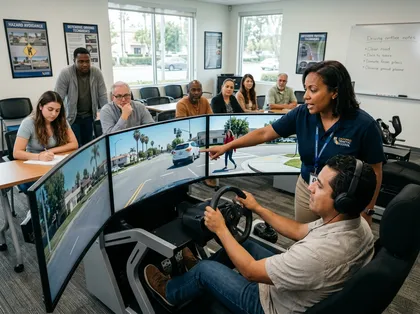
Traffic school’s 8-hour curriculum covers the skills most likely to prevent crashes. You review how to read the road and follow California traffic laws. You also learn to recognize behaviors that put other drivers at risk. These topics work together to make you a more aware, safer driver.
California traffic school is typically an 8-hour course. It ends with a final exam you must pass to finish the program.
The course focuses on the areas that affect your safety on the road:
- Defensive Driving Techniques: You learn to spot hazards early and react before they turn dangerous.
- California Road Laws and Updates: The course reviews current state traffic laws and recent rule changes.
- Dangers of Distracted Driving, Road Rage, and Driving Under the Influence (DUI): You learn why these behaviors cause crashes and how to stay safe around drivers who engage in them.
To get these benefits and protect your insurance rates, you must first qualify to take the course.
Who Can Take Traffic School To Protect Their Record?
Not every driver can take traffic school. The benefit it offers is record masking, not erasure, and it only applies to those who qualify. Under California Vehicle Code Section 1808.7, eligible drivers can hide one minor ticket from their insurance company. This keeps it off their public driving record and protects their rates.
Insurance companies often review public DMV records when setting rates. If a qualifying conviction is kept confidential after traffic school, the insurer generally should not see that point on the public record or raise premiums solely because of that masked conviction.
Not everyone qualifies for this protection. Here are the main eligibility rules:
- Valid Noncommercial License: You must hold a valid noncommercial driver’s license.
- Minor Moving Violation: The ticket must be for a minor moving violation, not for a violation involving drugs or alcohol.
- Speed Limit: You were not driving more than 25 mph over the posted speed limit.
- 18-Month Rule: You have not attended traffic school within the last 18 months.
Many drivers leave traffic school believing the ticket is gone forever. It is not. The DMV still has a full record of the violation. The masking only applies to what insurance companies can access on your public record. Many drivers who complete the course still want to know whether it also wipes out their court fine and whether the original citation stays on file.
Does A Traffic Violation Affect My Case If I Got Into An Accident?
It is important to understand that past traffic violations do not automatically make you at fault in a future accident. While opposing parties may try to use your driving record against you, liability is ultimately determined by the specific facts of the case. In most traffic accident claims, fault is based on negligence, which generally requires showing that:
- The other driver owed you a duty of care.
- The other driver breached that duty by failing to operate their vehicle reasonably safely.
- That breach caused the traffic accident.
- You suffered injuries and damages as a result.
Even if there is evidence that you were partially at fault, California law still allows you to recover compensation. Under the state’s pure comparative negligence rule, you may still pursue damages even if you share some responsibility for the accident, although your percentage of fault may reduce your recovery. Traffic accident lawyers rely on evidence, such as dashcam footage, black box data, and eyewitness accounts, to assess liability in shared-cause cases.
Keep in mind that being labeled as at fault in a traffic accident does not automatically prevent you from pursuing a claim. Our team here at Arash Law has helped clients recover compensation even when they were initially assigned partial or full fault for the accident.
- Motorcycle Vs. Truck Accident: A police report initially listed our client as the at-fault party in this motorcycle-truck collision. However, we were able to demonstrate that the other driver was responsible, ultimately recovering $1 million for our client.
- Auto Vs. Motorcycle Accident: We represented a client who was initially identified as the at-fault party in a crash based on an allegation of driving under the influence. Our client also lacked motorcycle insurance coverage, which limited recovery for non-economic damages. However, our team determined that the truck driver violated both training protocols and company policies by making an unsafe turn, which ultimately caused the collision. Had that maneuver not occurred, the crash would not have happened. We secured a $5 million recovery for our client.
Frequently Asked Questions
Dealing with a traffic ticket in California can be confusing. The rules around traffic school, fines, and your driving record are not always clear. You may be looking for free advice from a traffic accident lawyer. These answers address some common questions about California traffic school rules.
Does Traffic School Remove The Ticket From My California DMV Record?
No. Traffic school masks the ticket from your public record, but the DMV keeps an internal record of the violation. Insurance companies usually do not see a confidential traffic school conviction on the public DMV record. Still, the DMV retains the record, and courts may access it when allowed by law.
Do I Still Have To Pay The Fine If I Attend Traffic School?
Yes. You must pay the court fine for your violation. You also pay a separate fee to the traffic school itself.
Will My Auto Insurance Go Up If I Finish The Course?
Usually not. If you have a noncommercial driver’s license and complete traffic school, the point from the ticket does not appear on your public DMV record. As insurance companies check the public record, they may not raise your rates.
Is Traffic School Mandatory For A Moving Violation?
No. You can choose to just pay the fine instead of attending traffic school. If you do, the court will add a point to your DMV driving record for the moving violation, like speeding or running a red light, which may cause your insurance rates to go up.
What If I Was Injured In An Accident And Got A Ticket?
You might still qualify for traffic school if the ticket was for a standard moving violation. If you were hurt and need to see a doctor, a therapist, or a chiropractor, you can contact a personal injury lawyer. They can help you understand what your options are based on the specific details of your case.
Do Lawyers Only Get Paid If They Win An Injury Case?
Yes. Personal injury lawyers only get paid if they win your case, which is called a contingency fee. You pay no attorney fees unless they recover money for you. Serious accidents with injuries deserve a professional legal review.
Get Help After A California Car Accident
If you were hurt in a car crash, your biggest concern is not a traffic ticket. It is your medical bills, missed work, and recovery. California law gives you a limited time to file a personal injury claim. If you wait too long, you may lose your right to seek compensation for your injuries.
If you find yourself thinking, “I need a personal injury lawyer,” do not put it off. A lawyer can review your case, protect your rights, and deal with the insurance company for you. The sooner you take action, the better your chances of building a strong case.
Arash Law, also popularly known as AK Law, offers a free initial consultation with no upfront costs. You pay nothing unless compensation is recovered for you. Call (888) 488-1391 today to speak with our team and learn about your options.