TL;DR: Use only crash-tested harnesses, crates, or carriers certified by the Center for Pet Safety, and secure your dog to the vehicle, not to a collar. After an accident, stay calm and prioritize your and your dog’s safety. If another driver caused the crash, you can seek recovery for vet bills under California property damage law within 3 years. Shorter deadlines may apply if a government entity was involved in the crash.
Highlights:
- Use only crash-tested harnesses or crates certified by the Center for Pet Safety; never use walking harnesses or standard leashes.
- Secure harnesses directly to seat belts without extension tethers, and anchor crates to the cargo floor with vehicle-rated tie-downs.
- Keep your dog in the back seat away from front airbags, which deploy at extreme force and can cause fatal injuries.
- Prioritize finding strong vehicle anchor points for your dog, as an 80-pound dog generates around 2,400 pounds of force in a 30 mph crash and can become a deadly projectile.
- After a crash, gently cover your dog’s head with a blanket, avoid moving them unnecessarily, and get them to a vet immediately.
- If your dog is injured in a crash caused by another driver, file a property damage case within three years (or an administrative claim against a government agency within six months) under California law.
Tip: If it is safe and does not delay emergency veterinary care, take photos of the crash scene, vehicle damage, and your dog’s condition to help document an insurance claim.
Table of Contents
Securing your dog in the back seat with a crash-tested harness, crate, or carrier is the best way to keep them safe in a car accident. Your dog is family, and the thought of them getting hurt in a crash is something most pet owners never want to imagine.
The problem is that many dogs ride in cars without any restraint. Some hang their heads out the window. Others bounce freely between seats or ride on a driver’s lap. In a serious crash, all of these situations can be deadly for your pet.
Choose Crash-Tested Dog Car Safety Equipment
What separates safe gear from unsafe gear is how it was built and tested. A walking harness or standard leash may work fine on a trail, but it will not protect your dog in a crash. You need gear that is crash-tested and designed specifically for automotive use.
The Center for Pet Safety (CPS) is a non-profit that tests and certifies pet travel gear for crash safety. It conducts tests using an accredited test facility, and only products that pass earn CPS certification.
Here is what each type of certified equipment does and what to avoid:
- Crash-Tested Harnesses: A proper car harness clips directly to the vehicle seat belt, with no extension tether. Extension tethers are dangerous and disqualified by CPS testing. Never tether to a collar, as doing so puts the full force of impact on your dog’s neck and can cause spinal injuries or strangulation.
- Crash-Tested Crates: A crash-tested crate must be anchored to the cargo floor using vehicle-rated tie-downs. An unanchored crate becomes a projectile in a collision, no matter how sturdy it is. For optimal results, verify that your car’s cargo anchors and platform can support the load.
- Crash-Tested Carriers: For small dogs (usually under 20 pounds), a crash-tested soft or rigid carrier strapped into the back seat is ideal. The car’s seatbelt threads directly through structural loops on the carrier to lock it firmly in place.
- Mesh Barriers: Barriers keep your dog away from the driver and reduce distractions, but they will not protect your dog from those crash forces. If the barrier fails on impact, your dog can still be thrown against it or around the cargo area.
CPS certification is not a marketing label. It means testers evaluated the product under an independent laboratory crash-test protocol and performance criteria, and the product held up. Certified gear is built to protect your dog in a crash, not just keep it in place. California law adds a separate layer of requirements for how dogs must ride.
Preparing For A Dog-Related Emergency
A little preparation now can make all the difference if the worst happens. Here are some things you can prepare in case you face a dog-related emergency.
- Put a “pets inside” decal on your window with your vet’s number so first responders know to look for an animal if you’re incapacitated.
- Keep a spare leash and a basic pet first-aid kit in the car. Include medications and relevant veterinary records.
- If you have a barrier instead of a crate, make sure it’s rated to actually withstand a collision. Many barriers are just there to keep the dog from climbing to the front seat, not for crash protection.
- Practice calm-down cues. A dog in shock may run, hide, or become aggressive out of fear. Practicing basic commands like “stay” or “come” in a variety of settings can help you regain control more quickly in chaotic moments.
The Hidden Dangers Of An Unrestrained Dog In A Crash
An unrestrained dog can suffer severe or fatal injuries in a crash from forces most drivers do not expect. According to the American Automobile Association, an 80-pound dog generates around 2,400 pounds of force in a 30 mph collision. At that scale, the danger is not just to the dog. It reaches everyone in the vehicle.
There are distinct dangers your dog faces without a restraint:
- Projectile Force: In a crash, an unrestrained dog can become a high-speed projectile, generating thousands of pounds of force. Your dog can be thrown into the dashboard, windshield, or other passengers with enough impact to cause fatal injuries.
- Airbag Deployment: Passenger airbags are designed for adults. For a dog, especially a smaller breed, deployment in the front seat can cause severe head trauma or death.
- Post-Crash Fleeing: A panicked dog will often bolt through a broken window or open door after a crash. This puts your dog in the path of oncoming traffic. Some emergency workers report being unable to reach injured drivers because a frightened dog will not let them near.
Simply keeping your dog from roaming the cabin is not enough. The type of restraint you use determines whether it can absorb and redirect those crash forces or only delay impact.
Data Transparency Note: Statistics regarding the force generated by an unrestrained dog in a crash are sourced from the American Humane Society and a joint AAA/Kurgo Pet Passenger Safety Survey.
Follow California Laws For Transporting Dogs In Vehicles
California has no single “dog seatbelt” law. Still, several California Vehicle Code (CVC) sections control how you travel with your dog. Breaking any of them can lead to a fine or a criminal charge.
Here are the specific California laws you need to know:
- Blocked Control (CVC § 21700): This statute prohibits driving when your vehicle is loaded in a way that blocks your view or interferes with vehicle control. A dog on your lap can count as that kind of obstruction. If that causes you to drive with willful or wanton disregard for safety, you could also face a reckless driving charge under CVC § 23103.
- Truck Bed Rules (CVC § 23117): On highways, dogs cannot ride in an open truck bed unless secured by one of several accepted methods: an enclosed space, side and tail racks at least 46 inches high, a secured container or cage, vehicle-installed discharge prevention, or cross-tethering to the vehicle. Each method must stop the dog from being thrown, falling, or jumping out. This rule may not apply if the dog is being transported in connection with farming or ranching activities.
Even when you follow these laws and take every precaution, a negligent driver can still cause a serious crash. Being prepared for that possibility is just as important as knowing the rules.
Car accident lawyers rely on evidence to determine who was at fault for the crash. Even if you did not properly restrain your pet, that does not automatically mean you caused the accident. Liability depends on the facts of the collision, and these legal issues are often more complex than they appear at first.
What To Do If Your Dog Is Injured In A Car Accident
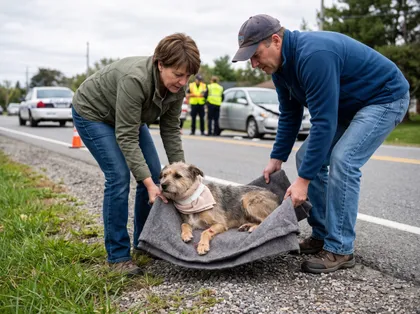
If a crash happens despite your precautions, the first few minutes matter most for your dog. Secure them gently, avoid unnecessary movement, and get to a vet as quickly as you can. Internal injuries may not show right away, so check even a calm dog. California law may allow you to seek compensation for vet bills as property damage if another driver caused the crash.
If your pet is with you in a car accident, get out of the way of oncoming traffic if it’s safe to do so and call 911 if anyone is injured. From here:
- Stay calm and approach carefully. Even a friendly dog may bite when scared or in pain.
- Gently cover their head with a blanket. This may help reduce shock and prevent bite injuries while you move them.
- Avoid moving them more than needed. If you suspect a spinal injury, use a blanket or board as a makeshift stretcher to keep their back stable.
- Get to a vet immediately. Some injuries, like internal bleeding, may not show up for days after the accident.
California law classifies pets as property. If another driver caused the crash, you may seek reasonable and necessary veterinary costs attributable to the injury. Under California Code of Civil Procedure § 338, most property damage cases must be filed within three years from the date of the accident.
You might understandably think, “I need a personal injury lawyer,” after a driver hits you and your dog. In a car accident, you and your dog can both be hurt. When this happens, you can pursue compensation for your injuries and other accident-related losses under California law.
How Does Insurance Cover A Dog Injured In A Car Accident?
If another driver caused the crash, their property damage liability coverage may cover reasonable and necessary veterinary care resulting from the collision. Potentially recoverable expenses include emergency treatment, diagnostic testing, surgery, medication, follow-up appointments, and other documented costs resulting from the injury. California courts have recognized that reasonable and necessary veterinary expenses are not automatically limited to a pet’s market value, which can be important when serious injuries require extensive care.
However, insurance coverage has limits. California’s minimum property damage liability limit is $15,000 per accident. The at-fault driver may carry higher limits, but you should not assume that enough coverage is available to pay every expense related to your dog’s injuries.
If the other driver is uninsured, leaves the scene, or disputes responsibility, coverage becomes more complicated. In California, uninsured and underinsured motorist bodily injury coverage applies to injuries suffered by people, not property damage involving a pet. Uninsured motorist property damage coverage is generally limited to damage to the insured vehicle and has its own requirements and limits. Depending on the circumstances, other possible sources may include:
- Pet insurance.
- Another applicable policy.
- A claim directly against the responsible driver.
What Evidence Can Support A Claim For My Dog’s Injuries?
The other party’s insurer may question whether the crash caused your dog’s injuries, whether the treatment your vet provided was necessary, or whether the amount charged was reasonable. Collecting evidence from the beginning can help connect the veterinary care and expenses to the collision and support your claim.
If it is safe to do so, preserve the following:
- Photos and Videos: Capture your dog’s position in the vehicle, visible injuries, the crash scene, and the resulting vehicle damage.
- Damaged Safety Equipment: Keep the harness, crate, carrier, straps, buckles, tie-downs, and other equipment involved in the crash. They may help demonstrate how the collision’s force affected your dog.
- Veterinary Records: Request examination notes, diagnostic results, treatment plans, discharge instructions, and records explaining how the injuries are consistent with the collision. These records can link your dog’s injuries to the accident.
- Itemized Bills and Receipts: Invoices for emergency care, surgery, medication, follow-up visits, rehabilitation, transportation, and replacement restraint equipment can help establish the crash’s financial impact.
- Witness Information: Obtain the names and contact details of passengers, bystanders, and anyone who saw your dog in the vehicle or observed their condition after the crash. Witnesses may also support your account of how the collision occurred.
- Collision Records: Keep the police or CHP report number, driver and insurance information, photographs of license plates, and any available dashcam or surveillance footage.
- Insurance Communications: Save claim numbers, emails, letters, recorded-statement requests, settlement offers, and notes from conversations with adjusters. Maintaining a clear record of communications can help you track how your dog’s claim is being handled.
What Happens If I Get Hurt Too?
If you get hurt as well, seek medical attention as soon as possible, even if your injuries seem minor. Keep records of your medical treatment, as these can be important if you file an insurance claim or pursue legal action. If another driver caused the accident, you may be able to seek compensation for:
- Medical Expenses: This includes emergency care, hospital bills, and follow-up appointments. If a doctor recommends certain treatments, such as physical therapy, chiropractic care, or prescription medication, you can also include their costs in the claim.
- Lost Wages: If your injuries prevent you from working, you may be able to recover income lost during your recovery. In some cases, compensation may also be available for reduced future earning capacity.
- Property Damage: This covers the cost to repair or replace your vehicle and other personal property damaged in the crash. Although you may treat your dog as part of your family, pets are legally considered property in California, so veterinary expenses or the pet’s value may be recoverable, depending on the circumstances of the accident.
However, you have to prove these four elements of negligence:
- Duty: The other driver owed you a legal duty to act with reasonable care behind the wheel.
- Breach: They failed to do so, such as by speeding or using their phone while driving.
- Causation: The breach directly caused the accident.
- Damages: You sustained actual losses, such as medical bills and lost wages.
If all these elements are present, you may be eligible to pursue compensation from the other driver’s auto policy. Filing a lawsuit may become necessary if both parties cannot agree on a settlement amount during negotiations. Unless an exception applies, you will have to sue within these general time limits or risk having courts dismiss your case:
- Two years for personal injury lawsuits.
- Six months for administrative claims if a government entity was involved (such as if a city bus or dangerous road conditions caused the crash).
Frequently Asked Questions About Car Crashes Involving Dogs
Traveling with your dog raises real questions about what is safe, what is legal, and what happens if something goes wrong. California has specific laws that apply to pets in vehicles, and the answers to these questions can protect both your dog and you. Whether you are planning a road trip or a quick errand, knowing the rules before you drive could save your dog’s life.
Can I Use A Normal Human Seatbelt For My Dog?
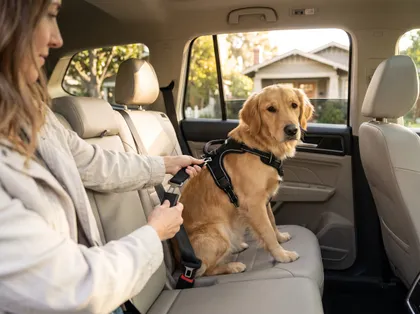
No. Human seatbelts are built for human weight and body shape. Instead, use the seat belt only with a crash-tested dog harness or carrier and follow the product manufacturer’s installation instructions.
What If The Person Who Hit My Car Leaves The Scene?
Report the accident to law enforcement and provide any details you have, including the vehicle’s license plate, make and model, the driver’s description, direction of travel, and information from witnesses or nearby cameras.
California law recognizes domestic animals as property. Under California Vehicle Code § 20002, a driver involved in a collision that damages property generally must stop and provide identifying information to the property owner. Leaving without fulfilling those duties may be considered a misdemeanor. The information you provide to law enforcement can help identify the driver, allowing you to pursue compensation for the harm your dog sustained.
Does Auto Insurance Cover My Dog’s Vet Bills?
Potentially. If another driver caused the crash, their property damage liability coverage may apply to reasonable veterinary expenses. Coverage limits, disputed fault, and hit-and-run accidents can affect payment. Some victims seek free advice from a car accident lawyer to understand what they can pursue against the at-fault driver or their own insurance policy.
Should My Dog Ride In The Front Or Back Seat?
Always the back seat. Front airbags deploy at extreme speed and force, enough to crush a dog on impact.
How Do I Know If My Dog’s Car Harness Is Safe?
Look for independent certification from the Center for Pet Safety. This organization crash-tests pet restraints to verify whether they meet its performance criteria, unlike products supported only by manufacturer claims.
Should I Replace A Harness Or Carrier After A Collision?
Yes. Collision forces can weaken stitching, webbing, buckles, structural frames, or attachment points, even when restraints aren’t visibly damaged. Stop using harnesses, carriers, crates, straps, and tie-downs until you have inspected them and checked the manufacturer’s instructions.
Replace any equipment that is damaged or that the manufacturer recommends replacing after a crash. Some manufacturers also offer crash-replacement programs.
What If My Dog Was Not Restrained When The Accident Happened?
The other party’s insurer may claim that the lack of a crash-tested harness, carrier, or secured crate contributed to the severity of your dog’s injuries. If your dog distracted you before the crash, such as by jumping into your lap and obscuring your vision, claims adjusters may also argue that you’re liable for the accident.
However, an unrestrained dog does not automatically mean you caused the collision or cannot recover compensation. The outcome will depend on the specific facts and whether the missing restraint actually contributed to the injuries or the accident itself. You may still be able to pursue compensation under California’s comparative fault rules, but a judge may assign you a percentage of fault and reduce your damages accordingly.
Do I Need A Lawyer After A Car Accident With My Dog?
You may want to consult a car accident lawyer if the crash resulted in serious injuries, high medical or veterinary costs, lost income, or the loss of your dog. A car accident lawyer can help evaluate your case, explain your options, and identify potential damages under your state’s laws.
Dog Hurt In A California Car Accident? Call Arash Law
After a California car crash, your injuries and your pet’s well-being both deserve serious legal attention. Arash Law (frequently referred to as AK Law) handles car accident cases across California, including claims for medical bills, vehicle damage, and vet costs. Our car accident lawyers know how to pursue compensation for your injuries and your pet’s losses under California law.
Some car accident cases we’ve won include the following:
- $6,000,000: Our client was driving with his wife and son when a drunk driver caused a head-on collision. The accident led to our client’s wife’s death. Despite attempts to dispute coverage and liability, we managed to obtain our client’s maximum policy limits.
- $5,250,000: Our team represented a client who developed paraplegia as a result of a car accident caused by an inattentive driver. We were able to recover the full policy limits.
- $4,100,000: Our client, a farm worker, suffered multiple fractures after a driver made an unsafe turn in front of them during heavy fog. After years of unsuccessful attempts to reach a fair settlement, we recovered fair compensation for our client.
While these are actual settlement amounts, it’s important to understand that the value and outcome of each case depend on its specific facts. No two cases are the same, and settlement values can vary widely depending on the circumstances.
Our car accident lawyers also work on a contingency fee basis. Under this arrangement, they only get paid attorney’s fees if they obtain compensation on your behalf. You pay nothing to get started.
Call us at (888) 488-1391 to schedule a free initial consultation.