TL;DR: California employers must identify pinning hazards and take steps to prevent workers from being crushed, caught, or trapped. Depending on the job, this can require machine guards, lockout/tagout procedures, equipment maintenance, and worker training.
California employers must identify and correct pinning hazards, guard dangerous machine parts, control hazardous energy, and train workers on the dangers they face. The exact rule depends on the equipment and work involved. Cal/OSHA has specific requirements for machinery, point-of-operation guards, lockout/tagout procedures, forklifts, and other workplace hazards.
Pinning injuries can happen when a worker gets trapped between moving machinery and a fixed object. They can also involve forklifts, shifting loads, falling equipment, or machines that start during maintenance.
Understanding what Cal/OSHA actually demands is the first step toward determining who may be responsible. Workers injured on the job may qualify for workers’ compensation. A separate claim may also exist when a manufacturer, contractor, or another third party caused the hazard.
Key Facts About California Employer Duties and Pinning Hazards
- Employers must identify hazards. Title 8, § 3203 requires an effective Injury and Illness Prevention Program that includes hazard assessment and correction.
- Dangerous moving parts need guards. Title 8, § 4002 requires guarding for hazardous machine actions, including pinch points and shear points, when other protection is absent.
- Points of operation need protection. Title 8, § 4184 requires guards or equivalent protection for covered machines when workers enter the danger zone.
- Hazardous energy must be controlled. Title 8, § 3314 applies when unexpected startup or stored energy could injure workers during covered servicing work.
- Workers need understandable safety training. Employers must provide required safety information and training in a form workers can understand.
- Serious injuries require prompt reporting. Employers generally must report a serious workplace injury, illness, or death to Cal/OSHA as soon as practical, but no later than eight hours.
Table of Contents

What Is a Workplace Pinning Hazard?
A pinning hazard exists when a worker can become trapped, squeezed, or crushed between objects.
These hazards often involve:
- Machine rollers, gears, presses, or other moving parts.
- Forklifts or other vehicles moving near workers.
- Equipment that starts while someone is cleaning or repairing it.
- Raised equipment or machine parts that fall unexpectedly.
- Materials or loads that shift, tip, or collapse.
- A moving vehicle that pushes a worker against a wall, rack, or other fixed object.
Pinning injuries can often cause:
- Fractures
- Amputations
- Nerve injuries
- Internal damage
- Traumatic brain injuries
- Other serious injuries
What Must California Employers Do To Prevent Pinning Injuries?
California employers must identify workplace hazards and use the safeguards required for the equipment and task.
Other industry-specific Cal/OSHA rules may also apply, including Construction Safety Orders governing vehicles, material storage, cranes, rigging, excavations, and other work that can create crushing or caught-between hazards.
Identify and Correct Pinning Hazards
Employers must have an effective written Injury and Illness Prevention Program (IIPP).
Under Title 8, § 3203, the program must include procedures for:
- Identifying and evaluating workplace hazards.
- Conducting required workplace inspections.
- Investigating occupational injuries and illnesses.
- Correcting unsafe conditions promptly.
- Communicating safety information to employees.
- Training employees and supervisors.
Employers must inspect for hazards when new equipment or procedures create a new risk. They must also respond when they learn about a new or previously unrecognized hazard.
If an imminent hazard cannot be corrected right away, § 3203 requires the employer to remove exposed workers from the area. Only workers needed to correct the problem should remain, with proper safeguards.
Control Hazardous Energy During Servicing
Employers must prevent machinery from starting unexpectedly while workers perform covered cleaning, repairs, servicing, setup, or adjustments.
Title 8, § 3314 requires employers to control hazardous energy when an unexpected startup or release of stored energy could hurt someone.
Depending on the task, the employer may need to:
- Stop the machine.
- De-energize or disconnect its power source.
- Lock or otherwise secure energy-isolating devices.
- Block moving parts when needed.
- Place required accident-prevention signs or tags.
- Verify that the energy controls work before servicing begins.
Employers must also develop and use written hazardous-energy control procedures when § 3314 applies.
The rule has limited exceptions for certain tasks, such as qualifying minor servicing during normal production. Those exceptions require other measures that provide effective protection.
Guard and Maintain Hazardous Machinery
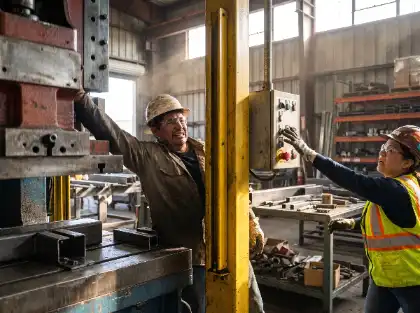
Employers must keep machinery in a safe condition and protect workers from hazardous moving parts.
Title 8, § 3328 requires machinery to be inspected and maintained when manufacturer recommendations are available. Equipment with defective parts that create a hazard cannot be used, and qualified people must perform covered repairs and maintenance.
Title 8, § 4002, separately requires guarding when hazardous moving parts are not already protected by the machine’s frame or by the machine’s location. These hazards can include:
- Pinch points.
- Shear points.
- Pressing or squeezing actions.
- Cutting or rolling parts.
- Reciprocating or revolving parts.
Point-of-operation hazards follow additional rules. Sections 4184 and 4186 require covered machines to use properly maintained guards or equivalent protection when workers may enter the danger zone.
Secure Stacked And Stored Materials
On construction sites, Title 8 §1549 requires stacked and stored materials, such as lumber, structural steel, sheetrock, plywood, masonry, to be secured against tipping, sliding, or collapsing. Plywood and similar sheet materials can’t be stacked on edge unless positively secured, and stored materials near floor openings or exterior walls must be barricaded or secured to prevent them from falling on workers below.
Keep Workers Clear of Forklift Crush Zones
Forklift operations can create serious pinning and crushing hazards, especially in tight work areas. These risks are common in many forklift accidents involving pedestrians and fixed objects.
Title 8, § 3650 prohibits an industrial truck operator from driving toward a person standing in front of a fixed object when the worker could become trapped between them.
Operators must also make sure people are clear before moving the forklift. Employers must provide required operator training. They must also remove unsafe forklifts from service until they are safe to use.
Protect Workers From Backing Vehicles
On construction sites, employers must also address pinning hazards created by vehicles and heavy equipment moving in reverse. Under Title 8 § 1592, covered operations may require backup alarms, spotters or flaggers, automatic braking devices, safe backing procedures, or keeping workers on foot out of the backing area.
Keep Workers Out of Suspended-Load Zones
Employers using cranes or other hoisting equipment must control operations to prevent workers from being exposed to overhead and suspended loads. California regulations restrict workers from entering fall zones except in specified circumstances and require loads to be properly rigged when employees must work within those areas.
Give Workers Safety Training They Can Understand
Employers must give employees safety information in a form that affected workers can readily understand.
Title 8, § 3203 requires training when:
- A new employee starts work.
- An employee receives a new job assignment without prior training.
- New equipment, substances, processes, or procedures create a hazard.
- The employer learns about a new or previously unrecognized hazard.
Supervisors must also receive training about hazards affecting workers under their direction.
For hazardous-energy work, § 3314 adds specific training requirements. Authorized workers need training on energy-control procedures. Other affected workers must understand the purpose and use of those procedures.
An employer should not assume that handing a worker an English-only document satisfies the rule. The key requirement is effective, understandable communication.
What Legal Options Are Available After A Pinning Injury?
A worker injured in a pinning or crushing accident may qualify for workers’ compensation. Depending on the cause of the accident, the worker may also have a claim against a third party. In limited cases, California law may allow a direct lawsuit against the employer.
Workers’ Compensation
California workers’ compensation generally covers work-related injuries without requiring the worker to prove employer negligence.
Benefits may include:
- Medical treatment.
- Temporary disability benefits.
- Permanent disability benefits.
- Supplemental job displacement benefits.
- Death benefits for qualifying dependents.
Third-Party Claims
A separate civil claim may be available when someone other than the employer contributed to the accident.
Labor Code § 3852 allows an injured worker to pursue damages against a responsible third party while also seeking workers’ compensation. Possible defendants may include:
- Machine manufacturers.
- Equipment suppliers.
- Contractors.
- Property owners.
- Maintenance companies.
- Other businesses at the jobsite.
For example, a worker may have a product liability claim if defective equipment caused the injury. Depending on the claim, the worker may need to show that:
- The product was defective.
- The defect substantially contributed to the injury.
A third-party claim can also provide damages that workers’ compensation does not cover. This may include qualifying pain and suffering.
Arash Law can review how the accident happened and whether another party may be legally responsible. Call (888) 488-1391 for a free case evaluation.
When an Employer Can Be Sued Directly
Workers’ compensation is generally the exclusive remedy against an employer for a work-related injury. This means an injured worker usually cannot sue the employer for ordinary negligence. Labor Code § 3602, however, recognizes limited exceptions.
One is the power press exception under Labor Code § 4558. It may allow a worker to sue an employer when:
- A qualifying power press had a point-of-operation guard that the manufacturer designed, installed, required, or otherwise specified. The manufacturer must also have conveyed that information to the employer.
- An employer knowingly removed the guard or knowingly failed to install it.
- The employer specifically authorized the removal or failure to install.
- They knew the condition created a probability of serious injury or death.
- The removal or failure to install proximately caused the worker’s injury or death.
This exception is narrow. It does not apply to every machine, missing guard, or unsafe workplace condition. Section 4558 defines a power press as a material-forming machine that uses a die to manufacture other products.
What Deadlines Apply After a Workplace Pinning Injury?
Different deadlines apply to different claims.
- Workers’ compensation notice. Under Labor Code § 5400, written notice to the employer is generally required within 30 days. Exceptions can apply.
- Workers’ compensation claim. Labor Code § 5405 generally provides a one-year limitations period measured from specified events.
- Third-party personal injury claim. Code of Civil Procedure § 335.1 generally provides a 2-year statute of limitations for suing a private third party for personal injury.
- Government claim. Government Code § 911.2 generally requires that a personal injury claim against a public entity be presented within six months of the injury. Separate deadlines govern any later lawsuit.
Different rules, exceptions, and trigger dates may apply. These deadlines do not necessarily run in sequence.
Workplace accident attorneys can evaluate your case and help determine the applicable deadline.
Steps to Take After a Workplace Pinning Accident
After a pinning accident, taking certain steps can help protect your health and potential legal claim. Evidence on a machine can disappear quickly. Employers may repair, adjust, or replace equipment after incidents, sometimes within hours.
- Report the injury. Tell your employer what happened as soon as possible.
- Complete the DWC-1 form. Your employer must generally provide the form within one working day of learning of the injury.
- Follow medical advice. Keep records of treatment, restrictions, and missed work.
- Preserve evidence. Save photographs, witness names, work orders, safety notices, and communications about the equipment.
- Identify the equipment. Record the manufacturer, model, owner, and any outside company that serviced it.
- Consider legal advice. A serious accident may involve workers’ compensation and a third-party claim.
A workplace pinning injury puts immediate pressure on you, medically and financially. The faster key evidence is preserved, and the proper claims are initiated, the stronger your position tends to be. If a third party contributed to the hazard, acting on the civil claim early matters. Machines get repaired, witnesses’ memories fade, and lockout/tagout logs get purged.
Frequently Asked Questions About Workplace Pinning Hazards in California
Can a Worker Report a Pinning Hazard Before an Accident Happens?
Yes. Workers can file a safety complaint with Cal/OSHA when they believe a dangerous workplace condition exists.
A worker does not need to identify the exact safety regulation before filing a complaint.
Does My Employer Have to Pay for My Medical Bills After a Pinning Accident?
Workers’ compensation generally pays for reasonable medical treatment required for a work-related pinning injury. After you file a DWC-1 claim form, the employer or claims administrator generally must authorize appropriate treatment within one working day, up to $10,000 while the claim is being investigated. If the claim is accepted, workers’ compensation continues to cover qualifying treatment needed to cure or relieve the effects of the injury.
Treatment may be provided through a Medical Provider Network upon application and may be subject to California’s treatment guidelines and utilization-review requirements.
Covered treatment can include:
- Emergency care
- Surgery
- Physical therapy
- Ongoing medical needs related to the injury.
Can I Be Fired for Reporting a Pinning Hazard?
 An employer cannot lawfully fire or otherwise retaliate against you because you reported a workplace safety hazard or exercised protected workplace safety rights. Labor Code § 6310 protects employees who report unsafe or unhealthy working conditions or practices to their employer or a government agency.
Labor Code § 132a separately prohibits discrimination against workers because they filed, or stated that they intended to file, a workers’ compensation claim. These laws do not prevent an employer from taking otherwise lawful employment action for legitimate reasons unrelated to the report or claim.
A violation of § 132a may increase workers’ compensation benefits by up to 50%, with a maximum increase of $10,000.
What If I Was Not Trained on the Equipment That Injured Me?
Failing to provide required safety training can violate Cal/OSHA requirements and may result in citations or penalties. Whether Cal/OSHA classifies a violation as “serious” depends on whether there is a realistic possibility that death or serious physical harm could result from the actual hazard.
If a third party was independently responsible for training, supervising, or controlling the hazardous work, failures in those areas may also be relevant to a third-party negligence claim. The employer’s own training failures, however, generally remain subject to California’s workers’ compensation exclusivity rules unless an exception applies.
Do Attorneys Only Get Paid If They Win?
It depends on the type of claim. Third-party personal injury cases are often handled on a contingency fee basis. Those agreements generally must comply with Business and Professions Code § 6147. Workers’ compensation attorney fees work differently.
An attorney cannot directly charge an injured worker for representation before the Workers’ Compensation Appeals Board (WCAB). The fee must be approved or set by WCAB. An attorney can explain which fee arrangement applies to each claim.
Can I Claim Workers’ Comp If The Accident Was Partly My Fault?
Yes. California workers’ compensation is a no-fault system. Your own negligence does not bar you from receiving benefits for medical treatment and lost wages. Report the injury and file the DWC-1 form regardless of how the accident happened.
Results Arash Law Has Recovered for Workplace Injury Clients
Arash Law has years of experience advocating for the rights of injured workers across California. We represent individuals injured in the workplace, including those involved in construction accidents.
$9,000,000 — Personal Injury: A case was initially believed to be exclusively a workers’ compensation construction case. Arash Law’s aggressive discovery and deposition revealed third-party liability. The case resolved at maximum policy limits within three weeks.
Past results do not guarantee future outcomes. Every case is different. Results depend on the specific facts and evidence involved.
Consult Arash Law About Your California Workplace Injury Claim
A serious pinning injury can raise questions about the claims process. The right legal path depends on how the accident happened and who controlled the equipment or worksite.
Arash Law’s workplace accident attorneys can review your case and determine the cause of your accident.
Call (888) 488-1391 for a free case evaluation. We can assess the facts and explain which claims may apply.
Arash Law. Make ‘Em Pay. Call AK.
Sources
- California Department of Industrial Relations. Cal/OSHA, General Industry Safety Orders.
https://www.dir.ca.gov/title8/sub7.html- California Department of Industrial Relations. Title 8, § 3203, Injury and Illness Prevention Program.
https://www.dir.ca.gov/title8/3203.html- California Department of Industrial Relations. Title 8, § 3314, Control of Hazardous Energy.
https://www.dir.ca.gov/title8/3314.html- California Department of Industrial Relations. Title 8, § 3328, Machinery and Equipment.
https://www.dir.ca.gov/title8/3328.html- California Department of Industrial Relations. Title 8, § 3650, Industrial Trucks.
https://www.dir.ca.gov/title8/3650.html- California Department of Industrial Relations. Title 8, § 3668, Powered Industrial Truck Operator Training.
https://www.dir.ca.gov/title8/3668.html- California Department of Industrial Relations. Title 8, § 4002, Moving Parts of Machinery or Equipment.
https://www.dir.ca.gov/title8/4002.html- California Department of Industrial Relations. Title 8, § 4184, Guarding Required.
https://www.dir.ca.gov/title8/4184.html- California Department of Industrial Relations. Title 8, § 4186, Maintenance and Use of Point-of-Operation Tools and Guards.
https://www.dir.ca.gov/title8/4186.html- California Department of Industrial Relations. Title 8, § 342, Reporting Work-Connected Fatalities and Serious Injuries.
https://www.dir.ca.gov/title8/342.html- California Department of Industrial Relations. Cal/OSHA, File a Workplace Safety Complaint.
https://www.dir.ca.gov/dosh/Complaint.htm- California Department of Industrial Relations. Division of Workers’ Compensation, Workers’ Compensation Benefits.
https://www.dir.ca.gov/dwc/workerscompensationbenefits.htm- California Legislature, Labor Code § 132a. Workers’ Compensation Discrimination.
https://leginfo.legislature.ca.gov/faces/codes_displaySection.xhtml?lawCode=LAB§ionNum=132a.- California Legislature, Labor Code § 3600. Conditions of Workers’ Compensation Liability.
https://leginfo.legislature.ca.gov/faces/codes_displaySection.xhtml?lawCode=LAB§ionNum=3600.- California Legislature, Labor Code § 3602. Workers’ Compensation Exclusivity and Exceptions.
https://leginfo.legislature.ca.gov/faces/codes_displaySection.xhtml?lawCode=LAB§ionNum=3602.- California Legislature, Labor Code § 3852. Third-Party Claims.
https://leginfo.legislature.ca.gov/faces/codes_displaySection.xhtml?lawCode=LAB§ionNum=3852.- California Legislature, Labor Code § 4558. Power Press Exception.
https://leginfo.legislature.ca.gov/faces/codes_displaySection.xhtml?lawCode=LAB§ionNum=4558.- California Legislature, Labor Code § 5400. Notice of Workplace Injury.
https://leginfo.legislature.ca.gov/faces/codes_displaySection.xhtml?lawCode=LAB§ionNum=5400.- California Legislature, Labor Code § 5401. Workers’ Compensation Claim Form.
https://leginfo.legislature.ca.gov/faces/codes_displaySection.xhtml?lawCode=LAB§ionNum=5401.- California Legislature, Labor Code § 5405. Workers’ Compensation Limitations Period.
https://leginfo.legislature.ca.gov/faces/codes_displaySection.xhtml?lawCode=LAB§ionNum=5405.- California Legislature, Labor Code § 6310. Retaliation for Workplace Safety Complaints and Reports.
https://leginfo.legislature.ca.gov/faces/codes_displaySection.xhtml?lawCode=LAB§ionNum=6310.- California Legislature, Code of Civil Procedure § 335.1. Personal Injury Statute of Limitations.
https://leginfo.legislature.ca.gov/faces/codes_displaySection.xhtml?lawCode=CCP§ionNum=335.1.- California Legislature, Government Code § 911.2. Government Claim Presentation Deadline.
https://leginfo.legislature.ca.gov/faces/codes_displaySection.xhtml?lawCode=GOV§ionNum=911.2.- California Legislature, Business and Professions Code § 6147. Contingency Fee Agreements.
https://leginfo.legislature.ca.gov/faces/codes_displaySection.xhtml?lawCode=BPC§ionNum=6147.- Arash Law. Case Results.
https://arashlaw.com/case-results/Disclaimer
The information on this page is for general educational purposes and does not constitute legal advice. No attorney-client relationship is formed by reading or relying on this content. If you were injured, consult a licensed California personal injury attorney about your situation. Arash Law. Call (888) 488-1391.