TL;DR: Most pedestrian crashes are concentrated in the evening and nighttime hours. Fatal pedestrian crashes nationwide occur mostly between 6 p.m. and midnight; serious-injury crashes peak slightly earlier than fatal crashes, according to UC Berkeley SafeTREC. Inadequate street lighting, driver fatigue, missing crosswalk markings, and reduced visibility can increase the risk of pedestrian accidents.
Most pedestrian accidents occur in the evening and at night. The Traffic Safety Facts 2023 from the National Highway Traffic Safety Administration (NHTSA) reveals that most accidents involving injured pedestrians (49.7%) occur between 3 p.m. and 9 p.m. Meanwhile, pedestrian fatalities were most concentrated (43.7%) between 6 p.m. and midnight.
UC Berkeley’s Safe Transportation Research and Education Center (SafeTREC) reports patterns similar to those reported by the NHTSA. Its data shows that 51% of fatal pedestrian crashes occurred between 6 p.m. and midnight. During that period, 44.6% of serious-injury pedestrian crashes also occurred.
Liability for a nighttime pedestrian accident in California may rest with the driver, a public entity, or both. Drivers may be negligent when they speed, drive distracted, misuse headlights, or fail to check for pedestrians. A city, county, agency, or Caltrans may share responsibility if dangerous public property conditions contributed to the crash.
Key Facts About Pedestrian Accident Timing
- 51% of fatal pedestrian crashes in 2023 occurred between 6 p.m. and midnight, per UC Berkeley SafeTREC.
- 47.2% of fatal pedestrian crashes in 2023 occurred on Friday, Saturday, and Sunday.
- California Vehicle Code (CVC) §22350 requires every driver to adjust speed to actual road conditions, including darkness, and may form a basis for a liability claim when a driver fails to do so.
- Most California personal injury lawsuits against private parties have a two-year statute of limitations under California Code of Civil Procedure (CCP) § 335.1.
- Claims involving a government entity generally must be presented within 6 months under Government Code § 911.2.
Table of Contents

When Do Pedestrian Accidents Happen Most Often In California?
Pedestrian accidents can happen at any time, but injury-related incidents are common in the late afternoon and early evening. These hours often involve heavier traffic and people walking home, using transit, running errands, or crossing busy roads. Risk may increase as daylight fades and drivers have more difficulty noticing pedestrians.
Based on SWITRS 2023 data, the 2025 SafeTREC Traffic Safety Facts: Pedestrian Safety from UC Berkeley reported that 60% of California’s fatal pedestrian crashes in 2023 occurred between 6 p.m. and 6 a.m. Of these crashes, 51% occurred between 6 p.m. and midnight, and 9% occurred between midnight and 6 a.m. Furthermore, Friday, Saturday, and Sunday together accounted for 47.2% of all fatal pedestrian crashes in California in 2023.
Here is more information about when pedestrian accidents occur:
- The peak period for all serious-injury pedestrian crashes in 2023 was Tuesday evening between 6 p.m. and 9 p.m. (SafeTREC).
- The peak period for all fatal pedestrian crashes in 2023 was Friday evening between 6 p.m. and 9 p.m. (SafeTREC).
- In 2024, 76% of pedestrian fatalities in the United States occurred in dark conditions, with another 4% occurring at dusk or dawn (NHTSA).
Pedestrian accident patterns depend on more than the time displayed on a clock. Traffic volume, vehicle speed, driver distraction, impairment, street design, weather, and lighting can affect when collisions occur and how serious they become. Therefore, daytime and nighttime crashes may involve hazards such as reduced visibility.
Why Evening And Nighttime Pedestrian Crashes Are More Dangerous
Darkness limits what a driver can see and how fast they can react. At night, reduced visibility can shorten the distance at which a driver first detects a pedestrian.
Several hazards combine to make nighttime especially deadly on California roads:
- Poor Street Lighting and Missing Crosswalk Markings: When roadway lighting is inadequate or crosswalk markings are difficult to see, drivers may have less time to detect pedestrians after dark.
- Alcohol Impairment: It can increase the risk of pedestrian crashes. NHTSA reports that alcohol use was reported in 43% of all fatal pedestrian crashes in 2024, involving a driver and/or pedestrian with a blood alcohol concentration of 0.01 or higher.
- Driver Fatigue: Driver fatigue reduces alertness, slows reaction time, and impairs judgment. A tired driver may overlook a pedestrian, miss a crosswalk signal, drift out of their lane, or react too late to avoid a collision. In severe cases, the driver may briefly fall asleep.
- Reduced Visibility: At night, reduced visibility may shorten the distance at which a driver first detects a pedestrian, leaving less time to react.
- The Legal “Reasonable” Speed Standard: California Vehicle Code §22350 requires drivers to travel at a reasonable and prudent speed, taking into account conditions such as visibility, weather, traffic, and the roadway. A speed that’s legal at 2 p.m. may violate the basic speed law at 9 p.m. if conditions don’t support it.
Are Pedestrian Accidents More Dangerous In Winter?
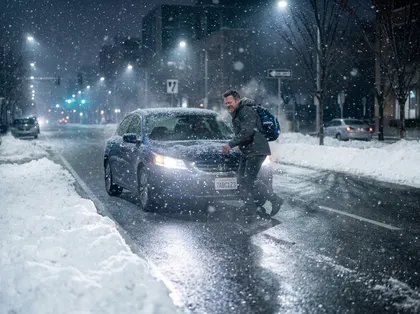
Pedestrian crashes are more dangerous in winter. This is mainly because it gets dark earlier in the evening. Research shows that fatal crashes involving pedestrians and bicyclists rise after the switch to standard time in the fall. Evening trips that used to be in daylight now happen after dark. The effect appears to be closely tied to changing light conditions rather than winter itself.
Earlier nightfall can reduce visibility during busy evening travel times, leaving drivers less time to detect pedestrians. Rain, fog, and wet roads may further reduce visibility and increase stopping distances. In California, drivers must travel at a reasonable and prudent speed based on conditions such as visibility, weather, traffic, and the roadway.
Understanding Liability For Nighttime Pedestrian Accidents
In a nighttime pedestrian crash, liability may fall on the driver, a government entity, or both. Factors such as vehicle speed, visibility, lighting, headlight use, and where the pedestrian was crossing can all affect how responsibility is assessed.
Drivers must exercise reasonable care under the circumstances. At night, reduced visibility may require slower speeds, greater attention, and proper use of headlights. If a driver fails to act reasonably and strikes a pedestrian, that conduct may support a negligence claim. Some examples of negligence include:
- Driving while distracted by a phone, navigation system, or passenger.
- Turning without checking for pedestrians.
- Failing to use headlights when required.
- Backing up without checking mirrors and blind spots.
A public entity, such as a city, government agency, Caltrans, or a county, may also share fault when a dangerous condition on public property contributes to a pedestrian accident. Examples include:
- Broken or malfunctioning traffic signals.
- Crosswalk markings that are severely faded or missing.
- Inadequate street lighting at a dangerous crossing.
- Missing, damaged, or concealed warning signs.
- Traffic signals that do not provide enough time to cross safely.
- Defective sidewalks that force pedestrians into traffic.
A dangerous condition alone does not establish public-entity liability. The claimant must generally show that the condition caused the injury and created a reasonably foreseeable risk. The public entity must have created the condition or had sufficient notice and time to address it. Claims involving public property have special deadlines. A person seeking compensation from a California public entity generally must present an administrative claim within six months of the injury (Government Code § 911.2).
Pedestrians must also use reasonable care. They may share fault for entering traffic suddenly, crossing against a signal, or failing to yield outside a crosswalk when a vehicle presents an immediate hazard. However, crossing outside a crosswalk does not automatically make a pedestrian responsible for the accident.
California follows pure comparative negligence under Li v. Yellow Cab Co., 13 Cal.3d 804 (1975). An injured pedestrian may recover compensation despite sharing fault, but the recovery is reduced by the percentage of fault assigned to the pedestrian.
Critical Steps To Take After A Nighttime Pedestrian Accident
Your immediate actions can protect your health and preserve important evidence. Nighttime crashes require special attention because lighting conditions and surveillance footage can change or disappear quickly.
- Call 911 Immediately: Request emergency medical assistance and a police response. Adrenaline may temporarily hide symptoms of internal bleeding, brain injuries, or other serious trauma. Ask the responding officers how to obtain the collision report once it becomes available.
- Document the Nighttime Conditions: Photograph the scene, lighting, streetlights, crosswalk markings, traffic signals, road conditions, vehicle damage, and visible injuries.
- Collect the Driver’s Information: Obtain the driver’s name, contact details, license number, registration information, license plate number, and insurance details.
- Identify Witnesses and Cameras: Collect witness contact information and note nearby homes, businesses, buses, or intersections that may have cameras. Footage may be overwritten quickly.
- Avoid Detailed Insurance Statements: Do not tell an insurer that you feel fine or provide a recorded statement without understanding your rights. Your injuries may not yet be fully apparent.
- Preserve Documents and Damaged Property: Keep medical records, receipts, photographs, clothing, footwear, and damaged personal items. These materials may help establish your injuries and losses.
- Consider Speaking with an Attorney Promptly: Early legal assistance can help preserve evidence and manage insurance communications. California usually gives two years for personal injury lawsuits (CCP § 335.1) against private parties. However, claims against government entities must be filed within six months. Deadlines for lawsuits can vary.
You may have questions about what to do after a pedestrian accident. Our lawyers can walk you through the process, including communicating with insurers and addressing medical liens.
What Arash Law Has Recovered For Pedestrian Accident Clients
Arash Law has obtained significant results for clients injured in pedestrian accidents across California. The following settlements and verdicts illustrate the range of injuries and circumstances the firm handles.
$10,000,000 — Compensation: A client suffered serious injuries after being run over by a speeding vehicle. Arash Law secured financial recovery and coordinated best-in-class medical treatment throughout the process.
$6,100,000 — Compensation: A 6-year-old client was injured in a pedestrian accident. Arash Law recovered more than $6 million on behalf of the child and family.
Past results do not guarantee future outcomes. Every case is different, and results depend on the specific facts and evidence involved.
Our pedestrian accident lawyers handle claims throughout California. Were you or a family member struck by a vehicle while walking? Arash Law offers a free case evaluation. Call (888) 488-1391 to speak with a California pedestrian accident attorney today.
Frequently Asked Questions About When Pedestrian Accidents Occur In California
Knowing what time of day pedestrian accidents typically occur is a starting point. Fault, evidence, and legal deadlines are additional considerations to understand before speaking with an insurer or the opposing party.
Where Are Pedestrians More Likely To Be Hit By A Car?
High-speed arterials in cities carry much of this risk: roads with high traffic volume and few barriers between vehicles and people on foot. When vehicles move fast, and visibility is low, the reaction time available to a driver shrinks to almost nothing.
Can I Get Compensation If I Was Hit While Crossing Outside A Crosswalk?
Yes, under California’s pure comparative fault rule, explained in the Liability section above, crossing mid-block can reduce but may not eliminate your potential recovery, depending on the facts. Under CVC §21954, a pedestrian crossing outside a marked crosswalk or an unmarked crosswalk at an intersection must yield to vehicles close enough to constitute an immediate hazard. A driver who was speeding, distracted, or impaired may still be liable if that conduct contributed to the collision, even if the pedestrian crossed mid-block.
What Should I Do If The Driver Who Hit Me Fled The Scene?
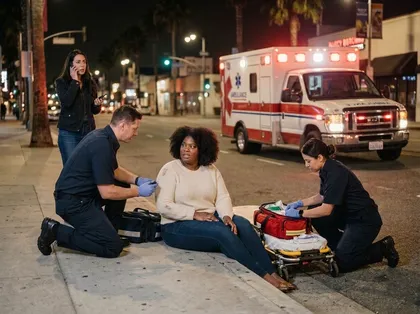
Call 911 immediately and describe the vehicle and direction of travel. Then seek medical care, even if you feel fine. If the driver cannot be identified, you may be able to recover under your own Uninsured Motorist (UM) coverage.
For a UM claim involving an unidentified hit-and-run driver, California Insurance Code §11580.2 generally requires qualifying physical contact, a report to the appropriate law-enforcement agency within 24 hours, and a sworn statement to the insurer within 30 days.
What If The Driver Claims I Suddenly Stepped Into Traffic?
A driver’s account is not the only evidence in the case. Evidence, including skid marks, vehicle damage, road debris, traffic camera footage, and witness statements, can show how fast the driver was going and whether they had enough time and distance to stop.
If physical evidence conflicts with the driver’s account, it may be used to challenge that version of events. Accident reconstruction analysis, scene measurements, witness statements, video footage, and information documented in a police collision report may help evaluate vehicle speed, sightlines, and available reaction distance.
Does Wearing Dark Clothing At Night Make Me At Fault For The Accident?
Wearing dark clothing may be raised by an insurer or defense attorney as a contributing factor under California’s comparative negligence framework. If so, any compensation you receive could be reduced by your assigned percentage of fault, but you are not barred from recovering damages.
Drivers remain legally required under CVC §22350 to maintain speeds appropriate to the conditions of visibility; dark clothing alone does not eliminate that duty. The core question is whether a reasonably attentive driver traveling at a proper speed could have seen you and avoided the collision.
Talk To Arash Law About Your California Pedestrian Accident Claim
If a vehicle struck you or someone you love while walking, Arash Law is ready to help. Medical bills, lost income, and disputes over who caused the crash can quickly create additional stress and financial strain when injuries are serious.
With over $1 billion recovered for injured Californians, Arash Law has the resources and a proven track record in the courtroom to pursue pedestrian accident claims against private drivers or government entities. Arash Law handles every pedestrian accident case on a contingency fee basis: you pay no attorney fees unless the firm recovers compensation for you.
Call (888) 488-1391 to speak with a California pedestrian accident attorney. Free case evaluation. Available 24 hours a day.
Arash Law: Make Them Pay, Call AK.
Sources
UC Berkeley Safe Transportation Research and Education Center, SafeTREC. 2025 SafeTREC Traffic Safety Facts: Pedestrian Safety, using SWITRS 2023 data. safetrec.berkeley.edu
California Department of General Services / Office of Risk and Insurance Management (DGS/ORIM). File a Government Claim. dgs.ca.gov/orim/file-a-claim
National Highway Traffic Safety Administration (NHTSA). Traffic Safety Facts 2024: Pedestrians (DOT HS 813 818). crashstats.nhtsa.dot.gov
California Legislative Information. California Code of Civil Procedure §335.1; Government Code §911.2; Vehicle Code §22350; Vehicle Code §21954; Insurance Code §11580.2. leginfo.legislature.ca.gov
Arash Law. Case Results. arashlaw.com/case-results
Disclaimer
Past results do not guarantee future outcomes. Every case is different. The information on this page is for general educational purposes and does not constitute legal advice. No attorney-client relationship is formed by reading or relying on this content. If you were injured, consult a licensed California personal injury attorney about your specific situation. Arash Law: (888) 488-1391.