TL;DR: Yes. A work-related dog bite may support workers’ compensation and a separate claim against the dog owner. Both claims are more likely when your employer and the dog owner are different parties. If the homeowner employed you, workers’ compensation rules may limit your ability to file a separate lawsuit against that homeowner.
Yes. A dog bite while working at someone’s home may support two separate claims under California law. Workers’ compensation focuses on whether the bite happened during covered employment. A personal injury claim focuses on whether another party is legally responsible for the injury.
The key question is who employed you. If your employer and the dog owner are different parties, you may be able to file a claim against each party.
Key Facts About Work Dog Bites in California
- Workers’ comp and third-party claims can overlap. Labor Code §3852 allows an employee to pursue damages against a third party for the same injury.
- California generally holds dog owners liable for bites. Civil Code §3342 applies when a dog bites someone in public or lawfully on private property, regardless of prior viciousness.
- Workers’ comp can cover job-related dog bites. Labor Code §3600 provides compensation for qualifying injuries arising out of and occurring during employment, regardless of negligence.
- Workers’ comp usually replaces lawsuits against employers. Labor Code §3602 generally makes workers’ compensation the employee’s exclusive remedy against a covered employer, subject to statutory exceptions.
- Some animal-care workers face different liability rules. In Priebe v. Nelson, the California Supreme Court limited strict liability when a worker took professional custody of a dog.
- Workers’ comp has separate notice and filing rules. Labor Code §5400 generally requires injury notice within 30 days, while §5405 sets one year from specified events.
Table of Contents

How California Law Handles Work-Related Dog Bites
A work-related dog bite can involve both workers’ compensation and a separate personal injury claim. Whether both apply depends on who employed you and who owned the dog.
Workers’ Compensation
California Labor Code §3600 can cover qualifying injuries that arise out of and occur during employment. You generally do not need to prove fault.
Labor Code §3602 usually makes workers’ compensation the exclusive remedy against a covered employer. That rule can limit a separate personal injury lawsuit against the employer.
Personal Injury Claim Against the Dog Owner
A separate claim may be available when the dog owner is someone other than your employer. Civil Code §3342 can hold a dog owner liable for qualifying bites in public places or while the victim is lawfully on private property.
The law does not require proof that the owner acted carelessly. It also does not require a previous bite or known history of aggression.
When Both Claims Can Apply
Labor Code §3852 allows an employee to pursue a civil claim against a responsible third party. For example, a worker sent to a customer’s home may have workers’ compensation through the employer and a separate claim against the dog owner.
When Does Workers’ Comp Cover a Dog Bite?
Workers’ compensation can cover a dog bite when the injury arises out of and occurs during covered employment.
Under Labor Code §3600, two basic requirements usually apply:
- You were an employee covered by workers’ compensation.
- The bite arose out of and occurred during your work.
A covered claim may provide:
- Medical treatment for the bite and related injuries.
- Temporary disability benefits for qualifying wage loss.
- Permanent disability benefits for lasting impairment.
- Supplemental job displacement benefits for qualifying workers who need retraining.
Workers’ compensation does not pay pain and suffering. It can still cover qualifying treatment and disability tied to physical or psychological injuries.
Who May Qualify After a Work-Related Dog Bite?
Dog attacks remain a documented workplace hazard for employees who enter homes and yards.
The U.S. Postal Service reported more than 5,200 dog attacks on postal employees nationwide in 2025. California recorded 673 dog-bite and dog-related incidents, the highest total of any state. The federal workers’ compensation system covers postal employees, but the data illustrate the occupational risks faced by workers who regularly enter residential properties.
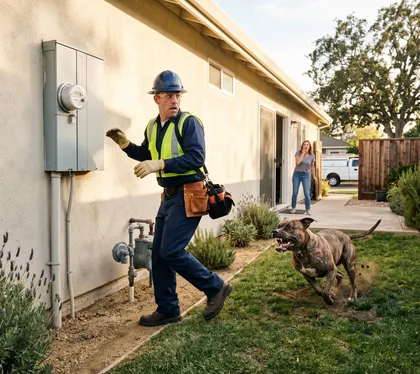
Many workers enter private homes as part of their jobs. A dog bite can qualify if it occurs while they are performing assigned duties.
Examples include:
- Delivery Drivers: A driver may be bitten while approaching a home, porch, gate, or delivery area.
- Home Health Workers: Caregivers may encounter dogs while providing services inside a client’s home.
- Utility Workers: Meter readers and technicians may enter yards or other areas where dogs are present.
- Landscapers and Pool Workers: These workers often perform jobs in yards where dogs may be kept.
- Cable and Appliance Technicians: Service calls may require workers to enter homes where dogs are unrestrained.
- Property Professionals: Agents, inspectors, and managers may enter occupied homes during showings, inspections, or maintenance visits.
- Process Servers and Investigators: These workers may approach homes while performing assigned duties.
- Plumbers and Contractors: Tradespeople may encounter dogs during repairs or installations.
The worker’s job title does not determine coverage on its own. The employment relationship and the circumstances of the bite control the analysis.
What if I Am Classified as an Independent Contractor?
Independent contractors generally do not receive workers’ compensation benefits as employees. However, a company’s label does not always decide a worker’s legal status.
Labor Code §2775 uses the ABC test for many California worker-classification questions. The hiring business must prove all three parts when that test applies:
- (A) Freedom from Control: You must be free from the hiring company’s control and direction while performing the work.
- (B) Work Outside the Business: Your work must fall outside the usual course of the hiring company’s business.
- (C) Independent Business: You must regularly operate an independent trade, occupation, or business involving the same type of work.
If the hiring company cannot prove all three parts, the worker is generally treated as an employee under that test.
Some occupations follow different classification rules or statutory exceptions. App-based transportation and delivery workers can also fall under separate rules.
A worker who was misclassified may still qualify for workers’ compensation. The answer depends on the type of work and the classification rule that applies.
If you are genuinely an independent contractor and workers’ compensation does not cover you, that does not automatically prevent a claim against the dog owner. An invited contractor may still pursue a claim under Civil Code §3342 if the statute’s requirements are satisfied. Other rules affecting contractor claims can depend on how the injury occurred and the parties’ relationship.
Do Animal-Care Workers Follow Different Rules?
Yes. Some animal-care workers may face different rules when making a separate civil claim against the dog owner.
In Priebe v. Nelson, the California Supreme Court addressed the case of a kennel worker who was bitten while caring for a boarded dog.
The court held that the primary assumption of risk barred her strict-liability claim under Civil Code §3342 under those facts.
The ruling focused on a professional who had accepted custody and control of the dog. It does not create a general exception for every worker.
Workers’ compensation may still cover an animal-care worker who is bitten on the job.
Other civil claims can also depend on what the dog owner knew and disclosed. For example, liability may arise from failing to disclose known dangerous behavior.
A work injury attorney can review the employment relationship and whether workers’ compensation applies to the bite.
When Can I File an Injury Claim Against the Dog Owner?
A separate injury claim may exist when the dog owner is a third party. California’s dog bite statute often serves as the primary basis.
Civil Code §3342 holds a dog owner liable for qualifying bites in public places or while the victim is lawfully on private property.
The statute does not require a prior bite. It also does not require proof that the owner knew the dog was dangerous.
A worker can be lawfully on private property through an express or implied invitation. That often includes workers invited to perform authorized services.
Strict liability does not guarantee recovery in every dog-bite case. Defenses may apply depending on the circumstances, including whether the worker lawfully entered the property, assumed a particular risk, or engaged in conduct that contributed to the injury.
A dog bite claim can seek damages that workers’ compensation does not provide. Depending on the evidence, those damages may include:
- Pain and suffering.
- Past and future lost earnings.
- Scarring and disfigurement.
- Future medical costs.
- Other proven losses caused by the bite.
Experienced dog bite lawyers can assess your accident and determine whether your case qualifies for both workers’ comp and a separate personal injury claim.
What if the Homeowner Hired Me Directly?
A separate lawsuit becomes more complicated when the homeowner is also your employer. California law treats some residential workers as employees.
Labor Code §3351 includes certain people hired by a homeowner for duties connected with the home. It can include household and residential work. However, Labor Code §3352 excludes some residential workers from that definition.
The exclusion can apply when the work in the 90 days before the injury was, or was contracted to be, for less than 52 hours. It can also apply when the employment was, or was contracted to be, for wages of not more than $100 during that period.
If workers’ compensation covers the relationship, Labor Code §3602 generally makes it the exclusive remedy against the employer. That rule can block an ordinary personal injury lawsuit against the same homeowner-employer. Statutory exceptions can change the result in some cases.
The work arrangement needs careful review. A person hired for a short-term job can face different rules than a regular household employee.
If the exclusion applies, workers’ compensation generally does not cover the injury, and the exclusive remedy rule does not block a claim against the homeowner. In that situation, the worker may be able to pursue a dog-bite claim under Civil Code § 3342.
If the worker does qualify as a residential employee, coverage may already exist. California Insurance Code §11590 generally requires policies providing comprehensive personal liability insurance to include workers’ compensation coverage for qualifying residential employees, subject to statutory exceptions and other applicable coverage.
How Do Workers’ Comp and the Injury Claim Work Together?
Workers’ compensation and a third-party injury claim can arise from the same dog bite. However, you generally cannot recover twice for the same loss.
When workers’ compensation pays benefits, the employer or carrier may seek reimbursement from the third-party recovery. Labor Code §§3852 and 3856 govern these rights.
The carrier may assert a lien for benefits it paid. Attorney fees, case costs, and other legal rules can affect the amount repaid.
Employer fault can also affect reimbursement rights. Under Witt v. Jackson and later California Supreme Court decisions applying comparative-fault principles, an employer’s negligence may reduce or eliminate its right to reimbursement or credit from the employee’s third-party recovery.
The final amount depends on the benefits paid, the settlement or judgment, and any applicable reductions.
Insurance That May Cover a Dog Bite in California
Homeowners or renters insurance may provide liability coverage when a dog owner is responsible for a bite. Coverage depends on the specific policy.
Important coverage issues can include:
- Policy Limits: The policy sets the maximum amount available under the applicable liability coverage.
- Animal Exclusions: Some policies exclude certain dogs or animal-related claims.
- Liability Sublimits: A policy may impose a lower limit for dog bites or other animal injuries.
- Umbrella Coverage: A separate umbrella policy may provide additional liability coverage.
- Other Responsible Parties: A landlord or property manager may face liability under limited circumstances based on knowledge and control.
Insurance does not determine whether the dog owner is legally responsible. It determines what coverage may be available to pay a valid claim.
Understanding homeowners’ insurance and dog bite claims in California can help in identifying coverage that may apply to your case.
Immediate Steps to Take After a Dog Attack While Working
Take care of the injury first, then preserve records for both possible claims. Early records can help show how the bite happened and why you were there.
- Get medical care. A medical provider can treat the wound and document injuries caused by the bite.
- Report the bite to your employer. Give notice promptly and explain that the bite happened while you were performing work.
- Request and return the DWC-1 form. Your employer must provide it in qualifying cases after receiving notice or knowledge of the injury.
- Report the bite to local animal control. Animal control or another local authority may document the dog and ownership information.
- Photograph the injury and property. Save images of the wounds, gate, signs, yard, and other relevant conditions.
- Keep your work records. Preserve work orders, delivery records, schedules, messages, and other proof showing why you were at the property.
- Identify the dog owner and insurance. Keep the owner’s contact details and any homeowners or renters insurance information you receive.
- Consult a work injury lawyer. They can review the work relationship and workers’ compensation issues involved.
Do not discard damaged clothing or other physical evidence. Keep copies of medical records, work restrictions, claim forms, and agency reports.
If a dog bit you while you were working, Arash Law can help determine whether a third-party claim exists alongside workers’ compensation. Call (888) 488-1391 for a free case evaluation.
Important Deadlines for Dual Claims
Workers’ compensation and personal injury claims follow different deadlines. Meeting one deadline does not protect the other claim.
| Requirement | Time Limit | What It Means | Legal Basis |
|---|---|---|---|
| Workers’ comp injury notice. | Generally, within 30 days after the injury. | Give your employer notice of the work-related bite. Exceptions can apply when the employer already knows about the injury. | Labor Code §§5400–5402 |
| DWC-1 claim form. | File promptly after receiving it. | The employer must generally provide the form within one working day of learning of a qualifying injury. | Labor Code §5401 |
| Workers’ comp proceedings. | Generally, one year from one of several specified events. | The period may run from the date of the injury, the date of certain disability payments, or the last qualifying medical benefit. | Labor Code §5405 |
| Personal injury lawsuit against a private dog owner. | Generally, two years from the injury. | A lawsuit against a private dog owner usually must be filed within two years of the bite. | CCP §335.1 |
Filing the completed DWC-1 can pause the Labor Code §5405 time limit in certain cases. The pause can continue until the claim is denied or becomes presumed compensable. Minor status and other circumstances can change some filing periods.
Experienced dog bite attorneys can review which deadlines apply to each potential claim.
Frequently Asked Questions About Work-Related Dog Bites in California

Can I Sue My Employer for the Dog Bite?
Usually not for an ordinary covered work injury. Labor Code §3602 generally makes workers’ compensation the exclusive remedy against a covered employer.
California law provides limited exceptions. For example, Labor Code §3706 allows a civil action when a required employer failed to secure workers’ compensation coverage.
What if the Dog Knocked Me Down but Did Not Bite Me?
Civil Code §3342 specifically covers injuries caused by a dog bite. A non-bite injury may require negligence or another liability theory.
For example, a loose dog may knock a worker to the ground, causing a fracture. Liability would depend on the facts and applicable law.
Can I Get Fired for Filing a Workers’ Comp Claim After a Dog Bite?
California law prohibits certain discrimination against workers who file or plan to file workers’ compensation claims. Labor Code §132a addresses discharge, threats of discharge, and other discrimination tied to protected workers’ compensation activity.
If your employer fires, demotes, reduces your hours, or otherwise discriminates against you because you filed or announced your intention to file a workers’ compensation claim, you may be able to file a Labor Code §132a discrimination petition with the Workers’ Compensation Appeals Board. Available remedies can include reinstatement, lost wages and benefits, and increased compensation of up to $10,000. Depending on the facts, you may also have a separate civil claim, such as wrongful termination or disability discrimination.
What if the Dog’s Owner Rents Rather Than Owns the Property?
You can still pursue a claim against a dog owner who rents the home. Renters insurance may provide liability coverage, depending on the policy.
The landlord is not automatically responsible for the tenant’s dog. California courts generally require proof that the landlord knew the dog was dangerous.
The landlord must also have had the right or ability to prevent the harm. That can include requiring the tenant to remove the dog.
Knowing that a tenant owns a dog is not enough by itself. The evidence must support actual knowledge of the dog’s dangerous behavior.
How Much Does It Cost to Hire a Dog Bite Lawyer?
Many dog bite lawyers handle personal injury cases on a contingency fee basis. The lawyer receives an agreed-upon fee if the case results in a recovery.
The exact percentage can vary by lawyer and case. California law does not set one standard contingency fee for ordinary dog bite claims.
Business and Professions Code §6147 requires most contingency fee agreements to be in writing. The agreement must state the fee rate and explain how costs affect the client’s recovery.
Workers’ compensation fee arrangements follow different rules. Section 6147 specifically excludes contingency agreements for recovering workers’ compensation benefits.
You can ask your lawyer about the fees and costs during your initial consultation.
What Arash Law Has Recovered in Work and Animal Injury Cases
Arash Law has handled cases where workers’ compensation and personal injury claims overlap, which is the exact scenario a work-related dog bite can create. Selected results from Arash Law’s dog bite case results page:
$2,300,000 — Dog Bite: An unleashed dog attacked an elderly client on his daily walk, causing him to fall and strike his head on the pavement. Arash Law secured a maximum policy limits recovery from the dog owners’ homeowners’ insurance policy.
Past results do not guarantee future outcomes. Every case is different, and results depend on the specific facts and evidence involved.
Protect Your Rights After a Work-Related Dog Bite
If you were bitten by a dog while working at someone’s home, two legal claims may be available to you. Protecting both requires acting before evidence disappears and deadlines pass.
Arash Law handles the third-party personal injury claim against the dog’s owner, pursuing losses that workers’ comp does not cover, while coordinating with your workers’ compensation attorney to ensure your full recovery is protected.
Arash Law is a California personal injury firm that has recovered over $1 billion for injured clients across the state. Every case is handled on a contingency fee basis: you owe no attorney fees unless Arash Law wins for you.
Call (888) 488-1391 for a free case evaluation, 24 hours a day. Arash Law. Make ‘Em Pay, Call AK.
Sources
- California Civil Code Section 3342. Dog Bite Liability. California Legislative Information. leginfo.legislature.ca.gov/faces/codes_displaySection.xhtml?sectionNum=3342.&lawCode=CIV
- California Labor Code Section 3351. Definition of Employee, Including Certain Residential Workers. California Legislative Information. leginfo.legislature.ca.gov/faces/codes_displaySection.xhtml?sectionNum=3351.&lawCode=LAB
- California Labor Code Section 3352. Exclusions From Employee Status, Including Certain Residential Workers. California Legislative Information. leginfo.legislature.ca.gov/faces/codes_displaySection.xhtml?sectionNum=3352.&lawCode=LAB
- California Labor Code Section 3600. Conditions for Workers’ Compensation Liability. California Legislative Information. leginfo.legislature.ca.gov/faces/codes_displaySection.xhtml?sectionNum=3600.&lawCode=LAB
- California Labor Code Section 3602. Workers’ Compensation as the Exclusive Remedy Against a Covered Employer. California Legislative Information. leginfo.legislature.ca.gov/faces/codes_displaySection.xhtml?sectionNum=3602.&lawCode=LAB
- California Labor Code Section 3852. Employee and Employer Rights Against Responsible Third Parties. California Legislative Information. leginfo.legislature.ca.gov/faces/codes_displaySection.xhtml?sectionNum=3852.&lawCode=LAB
- California Labor Code Section 3856. Distribution of Third-Party Recoveries, Attorney Fees, Costs, and Reimbursement. California Legislative Information. leginfo.legislature.ca.gov/faces/codes_displaySection.xhtml?sectionNum=3856.&lawCode=LAB
- California Labor Code Section 2775. ABC Test for Employee and Independent Contractor Classification. California Legislative Information. leginfo.legislature.ca.gov/faces/codes_displaySection.xhtml?sectionNum=2775.&lawCode=LAB
- California Labor Code Section 5400. Notice of a Work-Related Injury. California Legislative Information. leginfo.legislature.ca.gov/faces/codes_displaySection.xhtml?sectionNum=5400.&lawCode=LAB
- California Labor Code Section 5401. Employer Duty to Provide the DWC-1 Claim Form. California Legislative Information. leginfo.legislature.ca.gov/faces/codes_displaySection.xhtml?sectionNum=5401.&lawCode=LAB
- California Labor Code Section 5402. Workers’ Compensation Claim Investigation and Presumption Rules. California Legislative Information. leginfo.legislature.ca.gov/faces/codes_displaySection.xhtml?sectionNum=5402.&lawCode=LAB
- California Labor Code Section 5405. Time Limit for Starting Workers’ Compensation Proceedings. California Legislative Information. leginfo.legislature.ca.gov/faces/codes_displaySection.xhtml?sectionNum=5405.&lawCode=LAB
- California Labor Code Section 132a. Discrimination Related to Workers’ Compensation Claims. California Legislative Information. leginfo.legislature.ca.gov/faces/codes_displaySection.xhtml?sectionNum=132a.&lawCode=LAB
- California Labor Code Section 3706. Civil Action Against an Employer That Failed to Secure Required Workers’ Compensation Coverage. California Legislative Information. leginfo.legislature.ca.gov/faces/codes_displaySection.xhtml?sectionNum=3706.&lawCode=LAB
- California Code of Civil Procedure Section 335.1. Two-Year Personal Injury Lawsuit Deadline. California Legislative Information. leginfo.legislature.ca.gov/faces/codes_displaySection.xhtml?sectionNum=335.1&lawCode=CCP
- California Business and Professions Code Section 6147. Requirements for Contingency Fee Agreements. California Legislative Information. leginfo.legislature.ca.gov/faces/codes_displaySection.xhtml?sectionNum=6147.&lawCode=BPC
- California Division of Workers’ Compensation. Workers’ Compensation Benefits. California Department of Industrial Relations. dir.ca.gov/dwc/workerscompensationbenefits.htm
- Priebe v. Nelson (2006) 39 Cal.4th 1112. California Supreme Court Decision on Dog Bite Liability for Workers With Professional Custody of a Dog. scocal.stanford.edu/opinion/priebe-v-nelson-33669
- Witt v. Jackson (1961) 57 Cal.2d 57. California Supreme Court Decision on Employer Negligence and Workers’ Compensation Reimbursement Rights. scocal.stanford.edu/opinion/witt-v-jackson-27120
- Judicial Council of California Civil Jury Instructions (CACI) No. 1013. Landlord’s Liability for Dangerous Dog Kept on Property. California Courts. courts.ca.gov/system/files/file/judicial_council_of_california_july_2025_supp_3.pdf
- U.S. Postal Service. 2025 Dog-Bite and Dog-Related Incident Data for Postal Employees. about.usps.com/newsroom/local-releases/ca/2026/0609ma-usps-releases-national-dog-bite-rankings-van-nuys.htm
- Arash Law. Case Results. Personal Injury, Workers’ Compensation Crossover, and Dog Bite Results Cited in the Blog. arashlaw.com/case-results/
Disclaimer
The information on this page is for general educational purposes and does not constitute legal advice. No attorney-client relationship is formed by reading or relying on this content. If you were injured, consult a licensed California personal injury attorney about your specific situation. Arash Law. (888) 488-1391.