TL;DR: After a car accident, court involvement is uncommon, since insurers often settle claims before trial. Litigation may follow when liability is contested, coverage is denied, or compensation demands exceed available insurance, especially for people with serious injuries.
Highlights:
- Insurance settlements typically avoid court involvement after a car accident.
- Litigation may happen if liability is disputed or insurance coverage is inadequate.
- Serious injuries and significant losses can push a case to court.
- Multiple parties and comparative negligence can complicate legal proceedings.
- Unresolved settlement negotiations may result in a court case.
- California law sets a 2-year statute of limitations for personal injury lawsuits.
Tip: Stick to facts and preserve evidence, especially for serious injuries or liability disputes.
Table of Contents
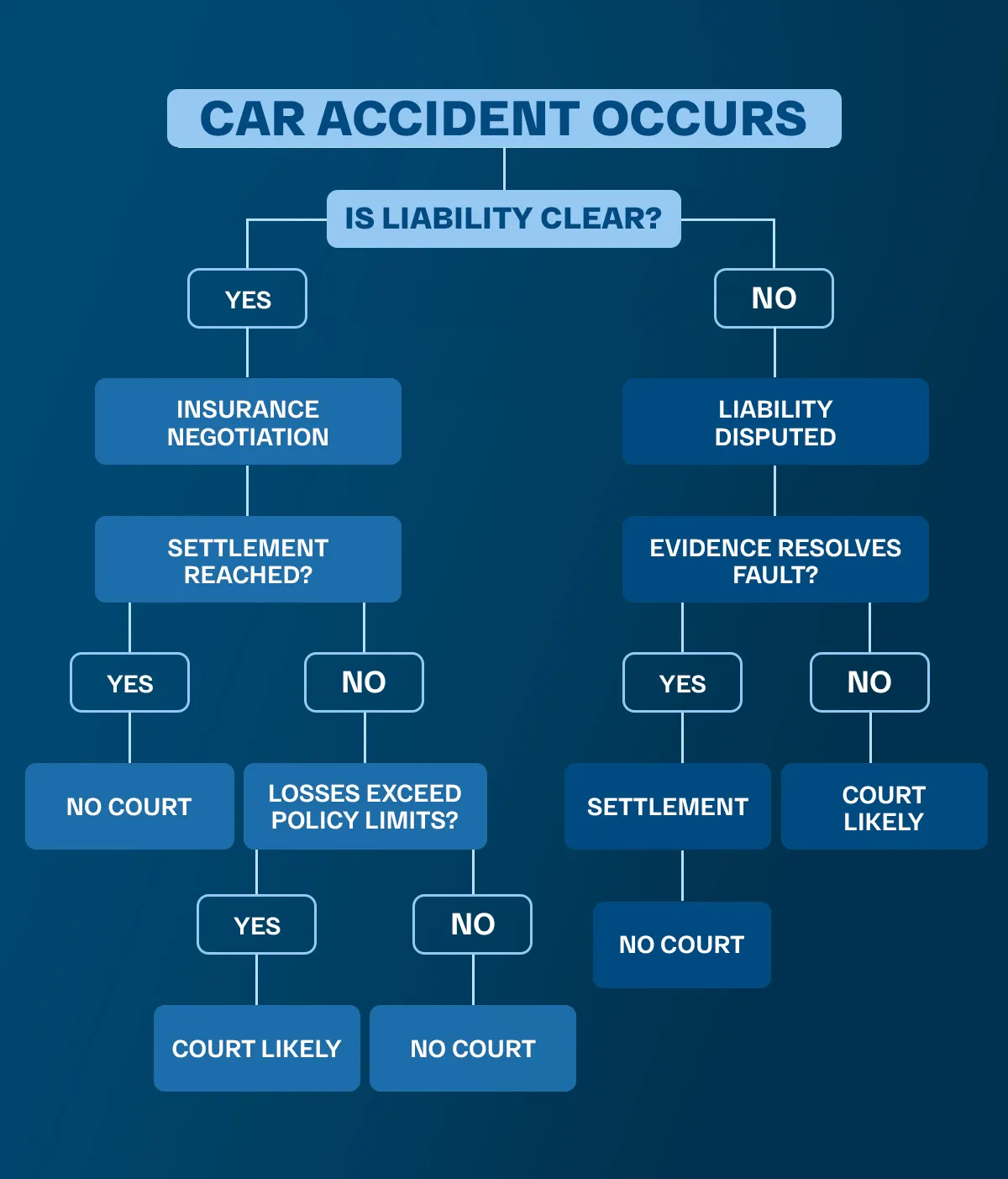
After a car accident in California, you usually won’t have to go to court. You might only need to do so in limited situations involving:
- Failed settlement talks.
- Disputes over liability.
- Losses exceeding policy limits.
- Severe injuries and substantial losses.
- Cases involving traffic citations or crimes.
Most car accident claims go through the insurance process first before victims consider legal action. Additionally, filing a lawsuit does not mean a case will automatically go to trial. The parties involved can still negotiate and settle a case, even after it is filed in court. A trial generally occurs only if these efforts are unsuccessful and the dispute cannot be resolved otherwise.
While exact numbers vary, only a small percentage of car accident cases ever reach trial. The vast majority are resolved through insurance settlements or negotiated agreements, even after a lawsuit is filed. In practice, court trials are the exception rather than the rule.
Reasons Your Car Accident Case May Go To Court
Though every case is unique, there are generally a few common reasons why crash victims take further legal action to pursue compensation. The following may be among the factors you and your lawyer consider when deciding whether to take your car accident to court.
Severe Injuries And Significant Losses
Some car accidents can cause serious injuries, resulting in significant losses for victims. Since these often require victims to request higher settlement amounts, disagreements can sometimes arise. In this scenario, a car accident case may proceed to court.
Why do severe injuries lead to more losses? It’s because the economic impact of these injuries is generally more significant. They may include:

- Medical Expenses — These may involve costs of urgent care, surgeries, and follow-up checkups. Some injuries may require treatments such as physical therapy, chiropractic care, and prescription medication.
- Long-Term Impact — If you sustain injuries that affect your ability to work, you can incur more losses, such as lost wages or reduced earning capacity. Other potential costs may include:
- Home care or childcare.
- Assistive devices or ongoing medications.
- Modifications to your home to accommodate your needs.
- Intangible Losses — Serious injuries can also result in non-economic damages. These are harder to quantify, but they can still significantly affect a victim’s overall well-being. These losses may include:
- Pain and suffering
- Emotional distress
- Scarring and disfigurement
- Loss of quality of life
Major collisions can also lead to significant property damage. Vehicle repairs or replacement costs may result in substantial losses. These are the common reasons why severe injuries in car accidents lead to higher settlement demands.
However, insurers often place these losses under closer review. They may question whether the requested compensation is essential for a victim’s recovery. For example, they might dispute the severity of an injury or argue that a specific medical treatment was excessive, unrelated, or unnecessary. If these issues can’t be resolved during settlement negotiations, you may have to go to court.
Legal Complexities And Liability Disputes
Some legal challenges may lead to car accident cases going to court. These problems usually arise during the standard claims process, but cannot be resolved through insurance negotiations. Some of these issues can include:
- Claims Involving Multiple Parties — California follows a pure comparative negligence rule, which means parties can share liability. That can include injured victims who may have contributed to a car crash or their injuries. Though they can still pursue compensation, the court may reduce their damages by their percentage of responsibility.
Cases where comparative negligence applies can become complicated. For example, a multi-car crash can involve individuals, commercial vehicles, and contractors. In this scenario, disputes are more likely to arise over:
- Amount of damages involved.
- Each party’s percentage of fault.
- The total losses they may be liable for.
-
Liability Disputes — At-fault parties may deny responsibility, delaying the claims process. These can be common in the following types of car collisions:
- Side-impact collisions
- Multi-vehicle crashes
- Rear-end accidents
If your evidence supports your claim, but the fault is still being contested, your case may go to court. There, a judge or jury will decide on liability.
In some situations, you may need to go to court if the at-fault driver faces criminal charges. You could be asked to testify.
It’s important to understand that civil claims and criminal cases serve different purposes. A civil claim focuses on whether an injured person should receive financial compensation. A criminal case focuses on punishing someone for breaking the law.
A civil claim can proceed even while a criminal case is ongoing.
Policy Limits And Settlement Disagreements
In some instances, insurance companies may refuse to fully compensate victims for their losses. That raises the question: What happens when a settlement cannot be reached? The matter may proceed to court for a judge or jury to decide.
Here are some typical insurance scenarios that could lead to a car accident case going to court: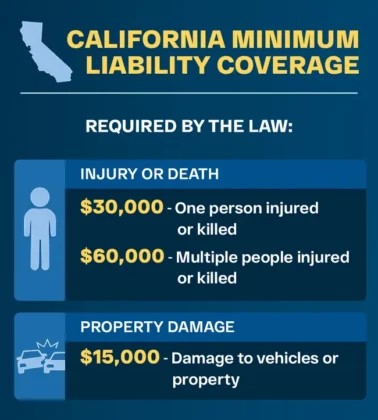
- Losses Exceed Policy Limits — Insurance usually helps compensate crash victims for their losses. In California, drivers must carry minimum liability coverage, which includes:
- $30,000 for injury or death of one person.
- $60,000 for injury or death of multiple people.
- $15,000 for property damage.
If your total losses exceed the policy limits, it may be possible to pursue the remaining damages through legal action against the at-fault party. This situation can happen if the other driver is underinsured.
- Uninsured Motorist — If the at-fault driver is uninsured, you may have the option to file a lawsuit and seek damages from them directly.
- Failed Settlement Negotiations — Sometimes, the liable party may not agree to your settlement demand. That can happen if they do not accept responsibility or if they believe the requested amount is too high. If an agreement can’t be reached through negotiation, litigation may be necessary.
- Unjustified Claim Rejection — If a claim gets denied, you have the right to request an explanation. Insurers are generally required to provide reasons for a denial. When there’s a denial of a claim without a reasonable basis, and significant losses are at stake, it may be appropriate under certain circumstances to pursue the matter in court.
How Liability And Evidence Influence Potential Litigation
Filing a case in court after a car accident can be complex. It usually takes more time and resources than an insurance claim, and the outcome is never certain. More importantly, you need to clearly identify the potentially liable party and present substantial evidence to support a lawsuit. As a result, you may think, “I need a personal injury lawyer to help me take legal action.”
In this scenario, consulting an attorney can help determine whether you really need to go to court. Car accident lawyers can assist by:
- Identifying the Potentially Liable Party — Knowing who you should file the case against is vital in a lawsuit. In car accident cases, these can include:
- Another Driver — A car accident case generally focuses on the person most responsible for the accident, whether due to carelessness or a violation of the law. In California, the at-fault driver is usually liable for damages, though fault can sometimes be shared.
- A Company — If you get hit by a driver who was on the job at the time of the accident, their employer may be responsible for their actions.
- A Government Agency — In some cases, public vehicles or poor road conditions can lead to an accident.
- Insurance Companies — In insurance claims, investigations should be fair and show the extent of each party’s fault. Victims can also pursue claims against insurers if the company acts in bad faith, such as through unreasonable denials, delays, or coverage disputes.
-
Compiling Evidence for the Case — If the case goes to court, the court will base its decision on the available evidence of a collision. Some forms of proof that can support a car accident lawsuit may include:
- Police reports
- Medical records
- Surveillance footage
- Photos/videos taken shortly after the crash
- Eyewitness statements
- Expert testimonies
The defendant can challenge evidence by presenting countervailing evidence. In California court cases, this can lead to arguments between the parties about what really happened. Lawyers may question witnesses, present documents, or offer expert testimony to support their case.
Deadline For Filing A Car Accident Case
If your car accident case goes to court, it’s crucial to know how long you have to file it. In California, the statute of limitations sets these deadlines. For personal injury cases involving car accidents, you usually have two years from the accident date to file. Some exceptions include the following:
- Injured Minors — The two-year clock starts when they turn 18.
- Delayed Injuries — If injuries appear later, the deadline may start from the date symptoms were discovered or should have been discovered.
- Government Agencies — If a government agency is involved, you must first file an administrative claim within six months. If you receive a denial, you have another six months to file a lawsuit. However, if you don’t get a response within 45 days, the typical two-year deadline applies.
For property damage lawsuits, the legal deadline is 3 years from the date of the accident. You can ask a car accident lawyer to review your case and determine how the statute of limitations applies to your situation.
When Your Car Accident Case May Not Go To Court
After outlining common reasons for going to court, it may be helpful to know when parties can settle a car accident case without a trial. Here are some scenarios where court procedures may not be necessary.
- Minor Accidents — Some collisions typically result in only minor injuries or property damage. In these cases, going to court is usually not necessary.
- Clear Liability — If there is enough evidence to demonstrate who caused the accident, your case can likely be resolved through insurance claims.
- Accepted Settlement Demand — If you accept an insurer’s settlement offer, the case does not need to go to court.
- Successful Pre-Trial Negotiation — Settlement talks can continue even after you file a lawsuit. If you and the other party reach an agreement during this time, your case doesn’t have to proceed to trial.
Consider seeking free accident lawyer advice to understand if your case needs to go to court. The process for your case depends on the unique details of your accident. The scenarios mentioned may not apply to every situation.
What To Expect If Your Car Accident Case Goes To Court
If a car accident case cannot be resolved through settlement, it may proceed to trial. Here’s a general overview of what can happen if you decide to go to court:
- Trial Preparation — Car accident lawyers gather evidence, plan opening statements, and decide on which witnesses to call.
- Selecting a Jury — Attorneys try to select jurors who will fairly consider the case.
- Opening Statements — Lawyers explain the main points and tell the jury what they hope to prove. These statements set the stage for the evidence to come.
- Presenting Evidence — The plaintiff must provide proof first. Substantial evidence, such as medical bills and expert testimony, can help demonstrate the severity of their injuries and losses.
- Closing Arguments — After presenting all the evidence, lawyers summarize their case and remind the jury why their side should win.
- Jury Deliberation — The jury discusses the case in private. Deliberations can last from hours to days. The jury considers the evidence and arguments before deciding who is at fault. If the defendant is responsible, the jury decides how much money the plaintiff should receive.
Possible Outcomes
You may ask, “How long does a car accident trial last?” The timeline depends on the case’s complexity, the number of witnesses, and the evidence. After the trial, either side can ask the court to review the decision. However, appeals are rare.
- Plaintiff Wins — The court finds the defendant responsible and orders payment for the damages. These may include medical bills, lost wages, property damage, and other non-economic losses.
- Defendant Wins — The plaintiff receives no compensation.
- Partial Outcome — Both parties may share responsibility if both drivers were partly at fault. Courts follow California’s rules on comparative negligence to divide damages fairly.
- Appeal — If a party believes the court made a mistake, they can appeal. This scenario is uncommon because the burden of proof is high. In other words, the plaintiff or defendant must provide clear evidence to support their case.
Frequently Asked Questions (FAQs) About Car Accident Lawsuits
It’s valid for accident victims to have several questions about going to court. Below are some answers to common legal concerns about car accident cases.
Will Insurance Companies Settle Out Of Court?
In most car accident cases, insurance companies prefer to settle out of court rather than go to trial. Even after a lawsuit is filed, insurers often remain open to negotiations to avoid the time, cost, and uncertainty of litigation. However, the company’s decision to settle may depend on the specific details of the case.
What Is The Maximum Amount You Can Sue For A Car Accident?
It depends on the value of your claim. Several factors can influence the amount you can sue for after a car accident, such as the severity of your injuries, property damage, fault, and the financial impact of the crash. Cases involving serious or catastrophic injuries often result in significantly higher compensation because they result in substantial costs related to current and future medical care and lost income.
Is It Better To Settle Or Go To Court?

There are benefits and drawbacks to both. In many cases, settling may be preferable because it is less time-consuming and costly than filing a lawsuit.
However, settling may not be the best option in every situation, especially when:
- Your injuries are severe, and the losses are substantial.
- The other party was extremely careless.
- The parties fail to reach a fair settlement.
In rare instances, going to court can help set an example for similar cases in the future. However, every car accident is different. Whether going to court or settling is the better option depends on your specific situation.
Seek Legal Counsel If Your Case Has To Go To Court
Car accidents can cause serious physical and emotional harm to victims and their families. Thinking about going to court can make an already difficult situation even more stressful. Most car accident cases do not proceed to trial, but some do. Certain factors can increase the likelihood of this happening.
It’s understandable to think of legal costs and ask questions like “Do lawyers only get paid if they win?” If this is your concern, know that our team here at Arash Law works on a contingency fee basis. In other words, our car accident lawyers only charge legal fees if they obtain a settlement or court award on your behalf. To learn more about how AK Law can help, call us at (888) 488-1391 to schedule a free initial consultation.