TL;DR: In California, you generally cannot turn while someone is crossing the street. Drivers must yield to pedestrians in marked or unmarked crosswalks. However, pedestrians may still share fault if they cross unlawfully, ignore signals, or suddenly step into traffic when a driver cannot stop safely.
Highlights:
- Call the police and request an official traffic collision report.
- Photograph the crosswalk, signals, skid marks, vehicle damage, and injuries.
- Get witness names and phone numbers before anyone leaves the scene.
- Get medical care promptly and follow through with PT or chiropractor/chiropractic referrals.
- File the DMV SR-1 within 10 days if there’s injury, death, or $1,000+ damage.
- Track lawsuit deadlines – 2 years for personal injury, or 6 months for government claims.
- If you’re thinking, “I need a personal injury lawyer,” get free accident lawyer advice from AK Law and ask, “Do lawyers only get paid if they win?”
Tip: Preserve dashcam footage, surveillance links, and receipts, and give insurers only fact-based statements without guessing.
Table of Contents
Usually, no. In California, you must yield before turning left or right when a pedestrian is crossing in a marked crosswalk or an unmarked crosswalk at an intersection. You may complete the turn only when the pedestrian is safely out of your path, and the turn will not create a danger.
That rule does not mean drivers are always automatically at fault. Pedestrians must also cross with care, follow pedestrian signals, and avoid suddenly stepping into the path of a vehicle that is too close to stop safely.
If a pedestrian crosses unlawfully or creates an immediate hazard and you crash while trying to avoid them, fault may fall on the pedestrian, the driver, or both. The answer depends on the location, traffic signal, visibility, speed, and available evidence.
Why You Can’t Turn If Someone Is Crossing The Street
You can’t turn when someone is crossing the street because the California Vehicle Code (CVC) requires drivers to yield to pedestrians. Before turning, slow down, check the crosswalk, and wait until the pedestrian clears your path.
The California Driver’s Handbook also emphasizes the importance of checking for and yielding to pedestrians before turning because:
- Not all crosswalks are marked or have flashing lights.
- Pedestrians who make eye contact are ready to cross. You need to yield to them even if they haven’t entered the roadway yet.
- People may need extra time to cross, especially children, older adults, and pedestrians with disabilities.
If you fail to yield when making a turn and cause an accident, you may be responsible for the pedestrian’s injuries and losses. Sometimes, however, the pedestrian may be at fault for the collision.
When Are Pedestrians At Fault For Causing An Accident During A Turn?
In most situations, pedestrians in California have the right of way in marked and unmarked crosswalks. Since they don’t have the physical protection that vehicle occupants do, they’re more likely to sustain serious injuries. However, they still have a legal duty to cross the street with caution.
Understanding the common causes of pedestrian accidents can also help clarify when a pedestrian’s actions may shift or when liability may be shared in a turning collision.
A pedestrian may be at fault or share fault if they cross in a way that creates an immediate hazard. For example, they may be responsible if they suddenly leave the curb, run into the path of a vehicle that is too close to stop, start crossing against a steady “Don’t Walk” signal, or cross outside a crosswalk where the law requires them to use one.
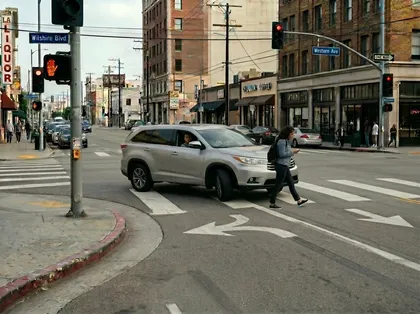
Simply put, pedestrians should not:
- Step into the road when a vehicle is too close to stop safely.
- Start crossing on a steady “Don’t Walk” signal.
- Cross outside a crosswalk between adjacent intersections controlled by traffic signals.
- Suddenly dart into your path while you are making a lawful turn.
In these cases, pedestrians may be at fault for an accident. A pedestrian’s violation of traffic rules may also support a negligence per se argument. This means a violation of a safety law can be used as evidence of negligence. However, you still need to show that the violation caused the crash and your losses.
If you can prove those facts, you may be able to pursue compensation for medical bills, lost wages, property damage, and pain and suffering caused by the accident.
What If You Were Partially At Fault?
The CVC establishes the pedestrian’s responsibility to cross streets cautiously. However, that does erase your responsibility to yield and use reasonable care. If you contributed to the collision, you may still be able to pursue compensation under California’s pure comparative negligence rule.
For example, suppose you failed to check for pedestrians or made a turn while driving slightly too fast. Those actions may not completely bar your claim, but they can reduce your recovery. To illustrate, if you’re assigned 30% of the fault, you may only recover 70% of your total damages.
The pedestrian’s insurance company or defense lawyer may argue that you contributed more to the accident than you actually did. Advocating for a fairer allocation of fault will depend heavily on what you’re able to preserve after the crash.
That is why many victims seek free advice from intersection accident attorneys who can help them gather time-sensitive evidence. Important evidence includes surveillance footage and witness accounts.
Crucial Steps To Take After A Pedestrian Causes Your Crash
After a pedestrian causes a crash while you’re making a turn, the steps you take next can affect your health, insurance claim, and legal options. If the crash just happened, act now. If it has been a few days, some evidence may still exist, and your doctor can still provide medical documentation.
In the hours following the crash:
- Call the Police: Law enforcement officers can create an official accident report. This document establishes the basic facts of the crash and identifies the pedestrian responsible.
- Document the Scene: Photograph the intersection, the vehicle, any traffic signs, and your visible injuries.
- Collect Witness Information: Get the names and phone numbers of anyone who saw what happened.
- Get Medical Attention: See a doctor immediately, even if you feel fine.
Meanwhile, you can accomplish these steps in the next few days:
- Notify the DMV: If the accident caused an injury, death, or more than $1,000 in property damage, file an SR-1 form with the California DMV within 10 days of the accident.
- Tell Your Insurer: Your insurance carrier may require you to notify it of any accidents you’re involved in, even if you didn’t cause them. The reporting deadline varies, so ask your insurance agent how long you have if you’re unsure. Notifying your provider may allow you to seek benefits from your own policy when the at-fault pedestrian has little or no insurance.
- Continue Medical Care: Follow your doctor’s treatment plan and attend all follow-up appointments. That includes visiting a physical therapist or chiropractor if your doctor recommends it. Your medical team’s records track your injuries and recovery as time goes on.
- Consult Dedicated Legal Counsel: A lawyer can review the specific facts of your accident, tell you if you have a case, and explain what you can do next.
How An Attorney Can Support Your Intersection Accident Case
After an intersection accident, you may be thinking, “I need a personal injury lawyer,” because pursuing claims against negligent pedestrians can be challenging. Since the law generally expects drivers to yield to pedestrians, it can be harder to prove the other party’s liability. An intersection accident attorney can help you build a well-supported claim for compensation.
A pedestrian accident lawyer who has experience with these cases can:
- Independently investigate your accident to determine how it happened and who caused it.
- Consult experts such as accident reconstructionists when further analysis is needed.
- Gather time-sensitive evidence that can be difficult for you to obtain on your own, such as surveillance footage.
- Estimate the full value of your claim by documenting your losses, such as:
- Current and future medical care costs.
- Lost wages and loss of earning capacity.
- Property damage.
- Pain and suffering.
- Submit your claim and negotiate a settlement with the pedestrian’s insurance company on your behalf.
- File a lawsuit if negotiations fail and represent you in court, if necessary.
If finances are a concern following an intersection accident, it’s natural to wonder about the costs of legal representation. In this scenario, you may be asking, “Do lawyers only get paid if they win?”
Intersection accident attorneys who work on a contingency fee basis will likely say yes. Rather than charging you up front, they’ll only ask you to pay them if they win or settle your case.
FAQs About Turning When Someone Is Crossing The Street
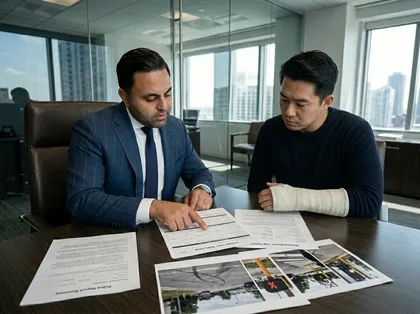
If a pedestrian who carelessly crossed the street caused an accident while you were turning and you sustained losses, it’s easy to think that you don’t have options for recovery. However, you may actually have legal rights under California law. Below are answers to some of the questions victims most frequently ask after these incidents.
Can I Turn Right On Red If A Pedestrian Is In The Crosswalk?
No. You must yield to any pedestrian in the crosswalk before completing the turn. The red light does not give you the right to proceed if they are already crossing lawfully. However, if a pedestrian unlawfully darts in front of you while you are completing a legal right turn on red, they may be held liable for failing to exercise caution.
Who Has The Right-Of-Way When I Am Making A Left Turn?
Under California law, pedestrians in a marked or unmarked crosswalk generally have the right of way. However, they cannot suddenly walk into your path when you’re making a left turn. You may have a claim for compensation if a pedestrian crosses carelessly in this situation and causes you to crash.
What Happens If I Didn’t See The Pedestrian Who Caused The Crash?
You could use this as a defense, but it depends on the facts of the case. If you didn’t notice the pedestrian because you were distracted or failed to check for people crossing the street before turning, this argument won’t support your claim. However, this issue may help your case if you didn’t see the pedestrian because they suddenly darted onto the road.
Do I Have A Case If The Pedestrian Crossed On A “Don’t Walk” Signal?
Possibly. For example, you may not have a case if the signal changed from “Walk” to “Don’t Walk” while the pedestrian was crossing the street. However, you may have a case if the pedestrian unexpectedly crossed against a Don’t Walk signal while you were turning and the road was clear.
What If The Pedestrian Who Caused My Crash Was Distracted By Their Phone?
You’re likely eligible to pursue compensation from them. California law requires pedestrians to avoid creating immediate hazards for drivers. If they cross the street while looking at their phone, they could be breaching that legal duty of care. Phone records and surveillance camera footage can help show whether the pedestrian who caused your crash was distracted by their phone.
How Long Do I Have To File A Claim After A Pedestrian Accident In California?
In most cases, you have two years from the date of the accident to file a personal injury lawsuit in California. If poor road conditions or a malfunctioning traffic signal contributed to the crash, you may have as little as six months to file a government claim before any lawsuit can proceed. Exceptions may alter these time limits in specific cases. However, California courts can dismiss your case if you miss the applicable deadline. That could mean losing your right to pursue compensation entirely.
We Can Review Your Case If A Pedestrian Caused A Crash While You Were Turning
In California, you generally cannot turn while someone is crossing the street. However, if a pedestrian crosses carelessly and causes an accident while you’re turning, the crash may not actually be your fault. Arash Law can determine whether you have a case.
In a free initial consultation, we’ll review the facts and discuss your legal options. This way, you’ll know how much your claim may be worth and what it will take to seek compensation. That way, you can decide what to do next. If you choose to work with us, we can also handle the claims process on your behalf.
Call AK Law at (888) 488-1391 to speak with one of our intersection accident attorneys.