TL;DR: There is no reliable published California statistic showing how many commercial window cleaners fall from buildings each year. Federal occupational data generally group window washers with other janitors and building cleaners, and fatality statistics capture only deaths, not all falls. As a result, the available data cannot establish a specific annual fall rate for commercial window cleaners.
Highlights:
- Get a medical evaluation immediately and follow the treatment plan closely.
- Report the injury within 30 days and file a workers’ comp claim within one year.
- If the site is government-owned, file the required government claim within 6 months.
- Photograph the scene, anchor points, equipment, and weather conditions as soon as possible.
- Secure and tag any failed gear so it can be inspected later.
- Request the building owner’s written assurance that safety devices meet Title 8 requirements.
- Identify third parties (owners, contractors, manufacturers) for potential claims beyond workers’ comp.
Tip: In reports and insurer calls, stick to observable facts and avoid guessing what caused the fall.
Table of Contents
Reliable data do not show exactly how many commercial window cleaners fall from buildings each year in California. Available federal statistics provide a broader occupational context but cannot establish a fall rate specific to window cleaners.
For a worker and their family, a fall from dozens of stories up is a sudden and violent event. It stops income and forces urgent choices about medical care and legal rights. California law gives injured workers specific protections, and knowing who can be held responsible matters from day one.
Because available statistics do not establish a specific fall rate, examining reported incidents, workplace hazards, and required safety measures provides useful context about the risks commercial window cleaners face.
What Are The Main Causes Of Window Washing Accidents?
Window-washing accidents can occur in a variety of circumstances involving work at height, where even minor issues can quickly lead to serious injury. Because cleaners rely on suspended platforms, ropes, and harnesses, these incidents often raise important questions about safety practices and responsibility.
Common factors that may contribute to window-cleaning falls include :
- Snapped Cables: Cables can break under load when they are not checked or replaced on time.
- Defective Safety Harnesses: A worn or badly fitted harness can fail when a worker needs it most.
- Improperly Secured Scaffolding: Scaffolding that is not anchored can shift or collapse while workers are on it. This can endanger both workers and bystanders, and pedestrians can sue for scaffolding injury when another party’s negligence causes them harm.
- Unsafe Weather Conditions: High winds and storms make it much harder to control equipment at height.
Accidents also happen when employers rush jobs, skip safety checks, or fail to fix worn gear. This is called employer negligence, meaning a failure to take basic steps to keep workers safe. It is a known cause of window-washing falls. Cal/OSHA has set strict safety rules for high-rise cleaning work precisely because these hazards are serious and predictable.
Understanding Commercial Window Cleaning Accidents
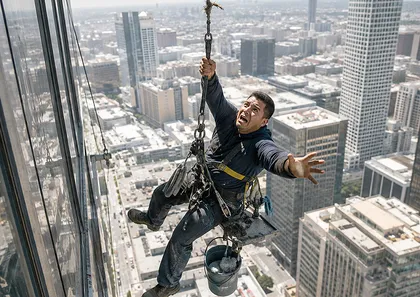
Professional crews in commercial window cleaning use multiple layers of fall protection. California requires safety measures appropriate to the window-cleaning method being used. Depending on the operation, these may include verified anchorages, inspected ropes, suspended scaffolds, boatswain’s chairs, controlled-descent equipment, and personal fall-arrest systems.
For boatswain’s chairs and controlled-descent apparatus, support and safety lines must generally be attached to separate approved anchorages.
No system, however, is perfect. When anchors are defective, gear goes unchecked, or required steps are skipped, those protective layers can fail all at once. Failures involving these protective measures can increase the risk of a serious fall.
Broader occupational fatality data provide some context, although they do not show how many commercial window cleaners actually fell. In California, the broader category of building and grounds cleaning and maintenance occupations recorded 39 workplace fatalities in 2024, down from 40 in 2023. Of the 2024 total, 16 involved building-cleaning and pest-control workers, according to the U.S. Bureau of Labor Statistics.
However, these figures should not be interpreted as window-cleaner fall statistics. They cover much broader occupational groups and include fatalities from causes other than falls.
California Safety Standards For High-rise Cleaners
California law sets strict safety rules for high-rise window cleaning. Cal/OSHA enforces them under Title 8, Article 5. These are legal rules that employers must follow, and Cal/OSHA can cite those who do not comply.
Section 3282 requires window-cleaning work to be performed with safe access, appropriate equipment, and properly trained workers. Section 3282(p) also requires building owners to provide employers with written assurance that the building’s safety devices and equipment comply with applicable requirements.
Section 3291 requires qualifying roof tie-back assemblies and anchorages to withstand a 5,000-pound load applied in any direction without permanent deformation.
Section 3284 requires belts, harnesses, and associated lanyards to be visually inspected before each use, while Section 3286 contains additional training and inspection requirements for boatswain’s chairs and controlled-descent apparatus.
If these rules are broken and a worker is hurt, liable parties may face legal consequences. A Cal/OSHA violation can support a civil claim that goes well beyond the worker’s direct employer.
Who Is Liable For A Window-Washing Accident?
When a window washer is hurt on the job in California, more than one party may share the blame. Liability often extends well beyond the employer to include building owners, contractors, and equipment makers. Each of those parties may be liable if they had a legal duty, breached it, and it caused damages and injuries.
California law does protect employers in one key way. Under Labor Code §3602, workers’ comp is generally the only legal option a worker has against their direct employer. You cannot sue your employer in civil court for negligence, which means failing to use reasonable care. Your claim against your employer stays in the workers’ comp system.
However, civil claims against an employer may still be available in limited circumstances recognized by California law.
That protection does not apply to other parties. If someone apart from your employer caused your injury, you can file a civil lawsuit against them. Parties who may be held liable include:
- Building Owners: Problems with anchor points, building safety devices, or access areas may contribute to a fall. Depending on the circumstances, a building owner may be among the parties investigated for potential liability.
- General Contractors: Contractors oversee job site safety. If their safety failures contributed to the accident, they may be held responsible.
- Equipment Manufacturers: Faulty or substandard harnesses, ropes, or scaffolding can cause serious harm. If gear failure was to blame, the maker may face a product liability claim, a legal action against a manufacturer for a defective product.
A third-party lawsuit can help you seek damages that workers’ comp does not cover. These can include pain and suffering, as well as financial losses, depending on your case.
If you think “I need a personal injury lawyer,” window cleaning accident lawyers can review your case and find every party that may be held liable. These cases can involve multiple defendants, each with different insurance and filing rules, so acting quickly is essential.
What Are The Deadlines To File A Window Washing Accident Claim?
California sets strict deadlines for injury claims, and missing an applicable deadline can jeopardize your right to pursue compensation. The deadline often runs from the date of injury, although exceptions may affect the applicable period.
Under California Code of Civil Procedure §335.1, you have two years from the date of injury to file a personal injury lawsuit. Filing after the applicable deadline can result in dismissal of the lawsuit.
There is a key exception for government-owned buildings. If a city, county, or public agency owns the site, Government Code §911.2 requires you to file a government claim within six months of the injury. Window washers on city or county buildings often miss this shorter deadline and lose their chance to sue.
Workers’ compensation has its own deadlines: report your injury to your employer within 30 days to protect your benefits, and you typically have one year to file a formal workers’ comp claim.
Prompt medical care after a window-washing fall matters for your health and your legal record. Prompt evaluation by an appropriate medical provider can document your injuries and create a medical record of your condition.
Getting free advice from a window cleaning accident lawyer can help you understand how these deadlines may apply to your situation. Investigating a window-washing fall takes time, so do not delay in taking action.
Frequently Asked Questions
Window washing accidents raise specific questions about liability, workers’ compensation, third-party claims, and available damages. Here are answers to several common questions.
What Is The Number One Hazard Faced By Professional Window Cleaners?
Falls from heights are the top hazard for window cleaners. Equipment failure, unsecured anchors, and broken suspension lines are among the leading causes of these falls.
 What Types Of Damages Can I Recover In A Window Cleaning Lawsuit?
 What Types Of Damages Can I Recover In A Window Cleaning Lawsuit?
Through a third-party claim, you may seek medical costs, lost wages, and pain and suffering. If you are concerned about legal costs, many personal injury attorneys handle these cases on a contingency fee basis. This generally means attorney fees are owed only if compensation is recovered, although separate case-related costs may apply.
Do Skyscraper Window Cleaners Need Their Own Insurance?
No. California employers generally must secure workers’ compensation coverage, either through an authorized insurance policy or approved self-insurance. An employee who suffers a work-related injury may be eligible for benefits under that system.
What If A Loved One Was Killed In A Window Washing Accident?
A wrongful death claim is a legal case filed when someone dies due to another party’s negligence. A successful claim can cover funeral costs, lost income, and loss of companionship.
How Do I Know If I Have A Third-Party Claim?
An investigation can reveal if a property owner, contractor, or equipment maker helped create unsafe conditions. If any of those parties share responsibility, you may have grounds for a claim beyond workers’ comp. Talking with an attorney can help you understand which path forward fits your situation.
Schedule A Free Consultation With Our Injury Lawyers
If you were hurt in a construction or high-rise accident, your case may involve more than one party at fault. Arash Law has represented workers injured in serious scaffold accidents, including cases involving falls and significant injuries. Examples of our case results include:
- $2,500,000: For a client who fell from a scaffold and sustained a mild traumatic brain injury and other orthopedic trauma.
- $1,650,000: A Workers’ Compensation Appeals Board judge approved this settlement for a client who fell from a scaffold while working on the wing of an aircraft.
Past results do not guarantee or predict future outcomes. Each case is different and depends on its specific facts and circumstances.
There are no upfront costs to get started. Also known as AK Law, we handle every personal injury case on a contingency fee basis. You only owe attorney fees if money is recovered for you.
Call (888) 488-1391 to schedule your free consultation. Acting quickly helps preserve evidence and protect any potential claim you may have.