TL;DR: Passengers and pedestrians face different risks: drivers account for the majority of traffic casualties, followed by passengers, while pedestrians face a higher risk of severe injury. In California, injury claims generally must be filed within two years, with shorter deadlines for many government claims.
Highlights:
- Seek prompt medical care, even if injuries initially seem minor.
- Document seating positions, seatbelt use, vehicle damage, crosswalks, signals, and sightlines.
- Collect driver, insurance, employer, and witness information at the scene.
- Preserve damaged clothing, shoes, seatbelts, and personal devices.
- Report the crash to insurers, but stick to facts and avoid guessing.
- Track California deadlines: two years for lawsuits; six months for many government claims.
- Ask whether drivers, employers, agencies, or manufacturers may share responsibility.
Tip: Request nearby surveillance footage quickly because recordings may be overwritten.
Table of Contents
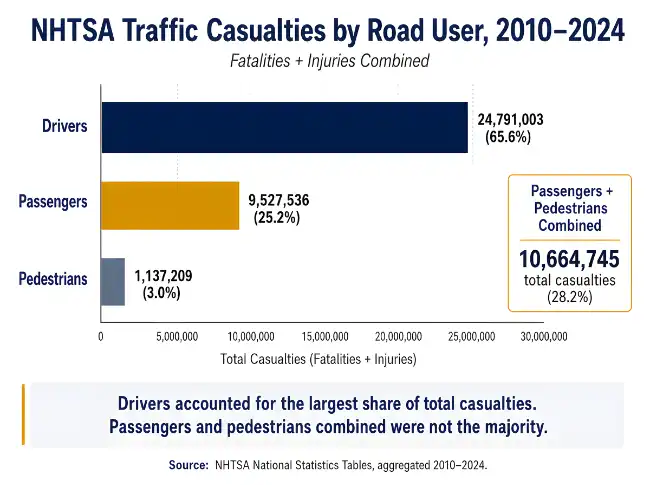
While passengers and pedestrians often get hurt or lose their lives in traffic crashes, they together don’t make up the majority of all traffic-related deaths and injuries. In fact, NHTSA data show that drivers accounted for the most total crash deaths and injuries over the years from 2010 to 2024, followed by passengers.
Even though passengers and pedestrians are not the majority, both groups face serious risks. Passengers can suffer broken bones, spinal injuries, traumatic brain injuries, and internal organ damage despite being protected by a vehicle. Their injuries may depend on factors such as seating position, seatbelt use, the direction of impact, and the vehicle’s performance during the crash. Pedestrians are especially vulnerable because they have no vehicle frame, seatbelt, or airbag to absorb the force of a collision.
To be clear, pedestrians and passengers together do not account for most traffic casualties. Passengers account for a substantial share because they are common road users, and a single crash can injure several people. Pedestrians represent fewer total victims but face a much greater risk of severe or fatal harm when struck.
What Does “Casualties” Mean In A Traffic Crash?
A “casualty” is anyone injured or killed in a crash. However, the total number of injuries does not equal the severity of those injuries.
Casualty totals, casualty rates, and injury severity measure different things. Totals show how many people were injured or killed. Rates compare those casualties with factors such as population, trips, or miles traveled. Severity describes how serious the resulting injuries were. A group can have fewer total casualties but a greater likelihood that each crash will cause catastrophic or fatal harm.
In crash data, “vehicle occupants” usually includes both drivers and passengers. This article uses “passengers” when referring only to people riding in a vehicle who were not driving. Keeping the categories separate is important because drivers account for more overall casualties than passengers.
Drivers and vehicle occupants account for a larger share of crash victims simply because people spend more time traveling in cars. Pedestrians make up a smaller group of road users, but they face a much higher risk of serious injury or death if hit by a vehicle. Because of this, pedestrians and passengers make up a big portion of people hurt in severe crashes.
Why Pedestrians Suffer Catastrophic Injuries
Pedestrians are highly vulnerable because their bodies absorb the direct force of a collision. Driver conduct, vehicle design, visibility, and road conditions can all affect the seriousness of their injuries.
Other specific factors raise the risk of severe injury:
- No Physical Protection: Pedestrians have no safety equipment. Even a low-speed hit can cause serious harm. The body has nothing to slow the blow.
- Impact Speed: As vehicle speed increases, the pedestrian absorbs more force, and the driver has less time and distance to stop. Higher-speed impacts increase the likelihood of severe head, chest, spinal, and internal injuries. Speed can also determine whether the pedestrian is thrown onto the vehicle, pushed forward, or run over after the initial impact.
- Pickup Truck Design: Pickup trucks and other vehicles with tall, blunt front ends are more likely to cause serious injuries to a pedestrian’s torso and head. The bumper, grille, and headlights may also injure the legs, hips, and thighs. Instead of rolling onto the hood, a pedestrian may be thrown forward in front of the vehicle, increasing the risk of being run over after the initial impact.
- Driver Negligence: A driver acts negligently when they skip a crosswalk yield or drive while distracted, meaning they failed to use proper care. California Vehicle Code § 21950 requires drivers to yield to pedestrians at crosswalks and to take due care, meaning careful attention, around them.
- Poor Lighting and Road Design: Dim streets and wide intersections make it hard for drivers to see pedestrians in time.
Why Vehicle Passengers Face Hidden Dangers In Car Crashes
 Passengers cannot control how the vehicle is driven or react in the same way as the driver. Their injury risk may also depend on their seating position, seatbelt use, vehicle design, and the direction of impact.
Crashes cause many types of injuries to passengers. Whiplash is one of the most common. It is a soft-tissue injury to the neck caused by a sudden impact. It can take weeks or months to heal, and people may need specialized medical treatment to fully recover.
The severity of a passenger’s injuries may affect which insurance policies and responsible parties become relevant to a claim.
Why Can One Crash Injure Several Passengers?
A single collision involving a full car, van, rideshare vehicle, or bus can injure several people at once. The severity of each passenger’s injuries may depend on:
- Where the passengers are seated
- Which side of the vehicle was struck
- The angle and force of the collision
- Whether the passenger’s compartment is crushed or penetrated.
This helps explain why passengers can account for a substantial share of casualty totals. A collision involving a car, van, rideshare vehicle, or bus can injure several passengers at once. Although it remains one crash, each injured or killed occupant is counted as a separate casualty. Higher vehicle occupancy can therefore increase passenger casualty totals without showing that every passenger faces greater individual risk than a driver.
Vehicle safety has improved significantly, but some protections have reached the front seats before the rear seats. The Insurance Institute for Highway Safety found that many seatbelt improvements were only implemented in the front seats.
Not wearing a seatbelt makes things much worse. Passengers without a seatbelt are far more likely to die or be thrown from the vehicle in a crash. Driver distraction also raises crash risk. A driver who texts or talks with passengers is less able to react in time to avoid a collision.
Which Pedestrians And Passengers Face Greater Risks?
Passengers are not physically unprotected in the same way as pedestrians. They may benefit from seatbelts, airbags, and the vehicle’s structure, but they cannot control the driver’s speed, impairment, distraction, following distance, or evasive actions. Their injury risk depends heavily on where they are seated, whether they are properly restrained, which side of the vehicle is struck, and whether the passenger compartment remains intact.
Children and older adults may be especially vulnerable in traffic crashes.
Children are smaller and may be struck higher on the body by the front of a vehicle. They may also have difficulty judging vehicle speed or distance, or determining when it is safe to cross. Inside a vehicle, children need a car seat, booster seat, or seatbelt appropriate for their age and size.
Older adults may have reduced vision, hearing, balance, or walking speed. They may also be more likely to suffer fractures, internal injuries, or other serious complications from the same force that causes a less severe injury in a younger person.
People with disabilities may face additional risks if street design, broken signals, blocked sidewalks, or inaccessible crossings prevent them from moving safely. These factors may also be important in determining how the crash occurred and whether a driver, property owner, or government agency is responsible.
Why, then, do pedestrians and passengers appear so often in discussions of serious traffic casualties? Passengers account for a substantial share of casualties because a single crash can injure several people in the same vehicle.
Pedestrians represent fewer overall casualties, but their lack of physical protection makes severe and fatal injuries more likely when they are struck. These groups face different risks and should not be combined as though the same factors explain their casualty numbers.
What Should An Injured Pedestrian Or Passenger Do After A Crash?
What you do after a crash can protect both your health and your ability to document what happened.
Call 911 and request medical assistance if anyone is injured. Seek medical care even if your symptoms initially seem minor because pain, concussion symptoms, and soft-tissue injuries may not become obvious immediately.
When you can do so safely:
- Photograph the vehicles, road, traffic signals, crosswalk, lighting, and visible injuries.
- Get the drivers’ names, contact information, license numbers, and insurance details.
- Ask witnesses for their names and contact information.
- Request the police report number.
- Preserve damaged clothing, shoes, child restraints, and personal items.
- Write down what happened while the details are still fresh.
- Avoid posting details of the crash or your injuries on social media.
- Report the crash to the appropriate insurance companies.
Passengers and pedestrians should identify all potentially applicable insurance policies, including any auto coverage available through their household.
Who Is Liable For Pedestrian And Passenger Injuries In California?
More than one party can be legally responsible when a pedestrian or passenger is hurt. At Arash Law, we review each case to identify all parties who may be liable.
Here are the parties who may be held responsible:
- At-Fault Driver: A driver may be liable if their negligence contributed to the crash. Examples include speeding, distracted driving, impaired driving, or failing to yield the right of way.
- Employer: If the driver was working at the time of the crash, such as making a delivery, their employer may also be liable. California law can generally hold employers responsible for injuries their employees cause on the job.
- Government Agency: California law allows claims against government agencies when bad road design, malfunctioning traffic lights, or unsafe crosswalks are at issue. These claims require extra legal steps before you can file a lawsuit.
- Vehicle Manufacturer: If a car part fails, such as bad brakes, the maker may be at fault. This falls under product liability law.
- Passengers: Passengers are rarely at fault. A passenger may be liable if they interfered with the driver or otherwise contributed to the crash.
Once you know who may be responsible, California’s strict legal deadlines make acting quickly essential to protecting your claim.
What Compensation May Be Available?
An injured pedestrian or passenger may be able to seek compensation from one or more responsible parties. The available compensation depends on the injuries, insurance coverage, fault, and other factors related to the crash.
A claim may include compensation for:
- Emergency treatment and hospital bills
- Follow-up appointments and medication
- Physical therapy and rehabilitation
- Future medical care
- Lost wages
- Reduced ability to earn income
- Pain and suffering
- Emotional distress
- Disability or disfigurement
- Damage to personal property
When a crash causes a death, certain surviving family members may be able to bring a wrongful death claim for eligible losses.
Legal Deadlines To Protect Your Injury Claim
Filing too late permanently ends your right to seek compensation, no matter how strong your case is. Under CCP §335.1, you have two years from the date of your injury to file a lawsuit. When a government entity is involved, that window shrinks to six months. Missing either deadline generally eliminates your right to recover.
That two-year clock starts on the day of the injury. It does not pause while you recover, wait for a police report, or negotiate with an insurance company.
Government Code §911.2 sets a stricter rule. If a government agency played a role in your accident, you must file an administrative claim (a formal written notice sent to the agency before any lawsuit can begin). That law gives you six months from the date of injury to present that claim. Missing that deadline generally bars you from any compensation, though limited exceptions may apply.
If the injured person is a minor, different timelines may apply, so speak with a lawyer right away. If you find yourself thinking, “I need a personal injury lawyer to meet these deadlines,” acting quickly is the right call. Reviewing the frequently asked questions below is a good next step before reaching out for help.
Frequently Asked Questions About Pedestrian And Passenger Casualties
If you were injured as a pedestrian or a passenger, understanding your legal rights can feel overwhelming, especially while recovering. In California, you still have options to seek compensation, even if you were partly at fault, the driver had no insurance, or it was a hit-and-run. The answers below address the most common concerns victims face and explain how the law protects you.
Can I Still Recover Compensation If I Was Jaywalking?
Yes. California uses a pure comparative negligence rule, meaning you may still be able to recover compensation even if you crossed outside a crosswalk. Your share of fault will reduce any potential recovery, but you can still pursue a claim.
What If The Driver Who Hit Me Did Not Have Insurance?
You may be able to use uninsured motorist coverage, but it does not automatically apply to every pedestrian. You must qualify as an insured under the policy, such as the named insured, the named insured’s spouse, or a qualifying relative who lives in the same household.
Coverage also depends on the policy’s terms and limits. In California, a named insured may reject uninsured motorist coverage in writing or select coverage limits lower than the policy’s bodily injury liability limits. An attorney can review the available policies and determine whether coverage applies to the pedestrian’s injuries.
What Should I Do If A Rideshare Driver Hits Me?
Uber and Lyft both carry commercial insurance that depends on what the driver was doing in the app at the time. The coverage amount depends on whether the driver was waiting, heading to a pickup, or had a passenger on board.
Can I Get Compensation If The Driver Fled The Scene?
Possibly. If you identify the hit-and-run driver, you may be able to pursue a claim against the driver and any applicable insurance. If the driver remains unknown, your uninsured motorist coverage may apply.
For an unknown-driver claim in California, uninsured motorist coverage generally requires physical contact between the unidentified vehicle and you or the vehicle you occupied. The crash must also generally be reported to the appropriate law enforcement agency within 24 hours, and a sworn statement supporting the claim must be filed with the insurer within the required 30-day period.
Camera footage, witness statements, vehicle debris, and other evidence may help police identify the driver or support an insurance claim.
Does Wearing Dark Clothing At Night Make Me At Fault?
Not automatically. An insurer may argue that dark clothing made the pedestrian harder to see and contributed to the crash. Under California’s comparative negligence rule, any percentage of fault assigned to the pedestrian may reduce their compensation. However, the driver may still be responsible for speeding, failing to keep a proper lookout, or failing to use reasonable care under the circumstances.
Where Do Most Pedestrian Accidents Happen In California?
Most pedestrian accidents in California happen at busy intersections and multi-lane roads. According to UC Berkeley SafeTREC’s 2023 Traffic Safety Facts, principal arterial roads accounted for 37% of fatal pedestrian crashes in California in 2021.
Get Help From A California Injury Lawyer
If you were hurt as a passenger or pedestrian, seek free advice from a car accident lawyer to learn more about your options. Pedestrian and passenger injury claims can involve several drivers, insurance policies, and responsible parties.
The following case results show how we have assisted victims of accidents in the past, but they can not guarantee certain outcomes for your situation:
- $12,000,000 – Auto vs. Pedestrian: On the eve of trial, we resolved a high-stakes case for a 74-year-old pedestrian who was violently struck while crossing the street. Sustaining severe injuries that required extensive medical care, she relied on our dedicated, concierge-level legal representation from start to finish to get the justice she deserved.
- $10,000,000 – Pedestrian Accident: After being run over by a speeding vehicle, our client suffered severe, life-altering injuries. Our firm secured a monumental financial recovery while simultaneously connecting him with a premier, nationwide medical team to ensure the highest standard of care throughout his recovery. We are honored to have brought peace of mind and closure to a wonderful family.
We offer a free consultation at no cost to you. No attorney fees unless we recover compensation for you. Our attorneys fight hard to get you the most compensation California law allows. To schedule a free consultation, call Arash Law at (888) 488-1391 today. AK Law handles pedestrian and passenger injury claims on a contingency fee basis.