TL;DR: Fire trucks and other fire department emergency vehicles are involved in thousands of crashes annually. According to NFPA estimates, there were 16,900 accidents in 2024, resulting in approximately 650 firefighter injuries. Between 2019 and 2023, there was an average of 17,865 accidents per year. If hit by a fire truck in California, you have only 6 months to file a government claim with the proper public entity before your right to sue may be permanently lost.
Highlights:
- File a formal administrative claim with the proper public entity within six months of injury under California Government Code §911.2.
- Preserve dashcam footage and photos of the scene immediately, as footage can be overwritten quickly.
- Get medical attention right away, even if you feel fine, and follow up with specialists as needed.
- Request the official police report from the responding agency as soon as it is ready.
- Consult an attorney before giving any recorded statement to the city’s risk office.
- Understand that fire trucks running red lights during emergencies must still drive with due regard for safety under CVC §21056.
Tip: If the agency provides a written rejection notice that complies with Government Code §913, a lawsuit generally must be filed within six months after that notice is personally delivered or mailed. Missing either deadline may permanently bar your case.
Table of Contents
There are thousands of fire truck accidents every year. In 2024, the National Fire Protection Association (NFPA) estimated that about 16,900 fire department emergency vehicles were involved in collisions in the United States, resulting in about 650 firefighter injuries. The NFPA figure is a nationwide estimate. No specific statewide data is available for California.
NFPA’s estimate is broader than just fire engines. It covers fire department emergency vehicles involved in collisions while responding to or returning from incidents. The 650-injury estimate includes firefighter injuries only. It does not count all civilians hurt in those crashes.
Data Transparency Note: This blog relies on data from the National Fire Protection Association and the National Safety Council. As of July 2026, there are no available statistics on the frequency of fire truck accidents in California. This blog will be updated as more recent, state-specific data becomes available.
Why Fire Truck Accidents Occur So Often
Fire truck accidents rarely have a single cause. Instead, they typically result from a mix of vehicle size, emergency-response conditions, and the split-second decisions other drivers make when a fire truck approaches.
Understanding common factors can help clarify how a specific crash happened and who may be responsible. Some common situations that can show up in California fire truck crashes include:
- Running Red Lights: When a fire truck enters an intersection on red, other drivers may not see or hear it in time to stop. Even with lights and sirens on, not every driver clears the way fast enough.
- Wide Turns: A fire truck needs far more space to turn than a regular car. That extra swing can catch other drivers and pedestrians off guard. Busy intersections are especially dangerous.
- Large Blind Spots: A driver seated high in the cab cannot see everything around the vehicle, especially to the sides and rear. Smaller vehicles in those zones are difficult to see.
- Driver Fatigue: Firefighters often work 24-hour or 48-hour shifts. Tired drivers react more slowly and miss hazards they would otherwise catch. This is among the most common causes of truck accidents.
- Dangerous Road Conditions: Rain, standing water, debris, poor visibility, and other roadway hazards can make a large emergency vehicle harder to stop or control.
- Center of Gravity: Fire apparatus, particularly tankers, can be vulnerable to rollovers because of their size, weight distribution, and high center of gravity.
- Roadway Blocking: Fire engines are routinely parked diagonally across highway lanes to shield existing crash scenes and protect first responders. Approaching drivers may crash into the parked truck due to distracted driving, poor weather, or target fixation (unconsciously steering toward the bright flashing emergency lights).
Intersections are recognized as hazards during emergency response, primarily because drivers may fail to yield. Even with lights and sirens active, there is no guarantee that every driver on a cross street will stop in time. Dense urban traffic, such as in Los Angeles, San Jose, and Oakland, can make it harder for motorists and emergency-vehicle drivers to navigate intersections safely.
While there are no available statewide stats, the NFPA registered an average of 17,865 accidents involving fire department emergency vehicles between 2019 and 2023. In 2022, there were 20,300 fire department vehicle accidents, the highest on record. That number has decreased each of the last two years.
Though these statistics show that accidents involving fire trucks are occurring less frequently, these crashes still remain a serious safety concern. Fire truck accidents can cause severe injuries due to their size, weight, and high speeds during emergency responses. Injury severity depends on several factors. These include the collision force, impact point, and the victim’s situation. They can include head, back, and neck injuries, bone fractures, and internal organ injuries.
That’s part of the reason why, according to the National Safety Council (NSC), crashes involving emergency vehicles, including fire trucks, killed 225 people in 2024, and 56% of those killed were occupants of non-emergency vehicles.
In these cases, state law may allow injured victims to pursue compensation for their injuries and losses from the at-fault party.
What Laws Apply After Fire Truck Accidents In California?
The California Vehicle Code (CVC) gives emergency vehicle drivers certain exemptions from standard traffic rules, but that leeway isn’t unlimited. Fire truck drivers are still required to operate with reasonable care for everyone else on the road. Understanding where those emergency privileges end and a driver’s duty of care begins is often the key to determining your legal options after a crash:
- CVC §17004: A public employee may be free of personal civil liability in certain emergency-response situations. That immunity may apply when they operate an authorized emergency vehicle in the line of duty while responding to an emergency call, pursuing a suspected law violator, or responding to (but not returning from) a fire alarm or other emergency call.
- CVC §17001: Depending on the facts, a public entity may be liable for injuries caused by its employee’s negligent or wrongful operation of a motor vehicle within the scope of employment.
- CVC §21055: An authorized emergency vehicle may be exempt from specified traffic rules when responding to an emergency call, engaged in rescue operations, pursuing a suspected law violator, or responding to a fire alarm. The driver must display a lighted red lamp visible from the front and sound a siren as reasonably necessary.
- CVC §21056: The exemption in §21055 does not relieve the driver of their duty to drive with due regard for the safety of all people on the road.
Ultimately, state law may protect an individual fire truck driver or a department if they were performing job-related duties. However, these entities may still be liable if they failed to exercise reasonable care when doing so. Emergency-response status does not automatically eliminate legal responsibility.
Other Potentially Liable Parties In A California Fire Truck Accident
The most confusing part of a California fire truck accident is identifying responsibility. Beyond the fire truck driver or department, you may have a claim against another negligent party, depending on the facts.
Examples include:
- Another negligent driver
- A government agency responsible for road maintenance
- A fire truck parts manufacturer
A truck accident lawyer with experience handling cases involving emergency vehicles can help identify all potentially liable parties in your situation.
Your Legal Options After A Fire Truck Crash
Under §1714 of the California Civil Code, everyone has a duty of care to prevent harm to others. If they breach that duty, they may be responsible for the resulting injuries and losses. As such, injured victims may be eligible to file a claim for damages after a fire truck accident. These damages may include:
- Medical expenses, past and future
- Lost income and reduced earning capacity
- Property damage
- Pain and suffering and other non-economic losses
However, since fire trucks are emergency vehicles often operated by public agencies, the claims process may differ from that when the at-fault party is a private entity.
- Claims Against a Fire Department or Another Public Entity:
- You must generally present a written administrative claim to the correct public entity before filing a lawsuit (California Government Code §911.2). The claim should identify the incident, describe the injuries or property losses, and provide other information required by the Government Claims Act.
- The agency generally has 45 days to accept, reject, or otherwise act on the claim. If it does not act within that period, the claim is ordinarily deemed rejected.
- A lawsuit for damages generally cannot proceed until the agency rejects the claim or the claim is deemed rejected. Different lawsuit filing deadlines will apply in each scenario.
- Claims Against a Private Party:
- The claim will usually begin with investigating the accident, determining fault, documenting losses, and submitting a settlement demand to the responsible party’s liability insurer.
- The insurer may offer a settlement, and you can negotiate for another amount if the initial offer doesn’t cover your documented losses.
- If the claim does not settle, the injured person may file a personal injury lawsuit within two years of the accident date (California Code of Civil Procedure §335.1).
The same crash may support claims against both a public entity and one or more private parties. Each claim must follow the procedures and deadlines that apply to that defendant.
More importantly, these deadlines are strictly enforced. California law allows late government claim applications in rare cases and may also toll the filing deadline for personal injury lawsuits in specific scenarios. However, these exceptions are narrow and not guaranteed. Getting a truck accident lawyer involved early can help clarify your options so you can take action within the correct time frame.
Can I File A Claim If I Was A Firefighter Injured By Another Driver?
If you were injured on duty because another driver was negligent, you are not limited to workers’ compensation. Under California Labor (Lab.) Code § 3852, an injured employee’s right to workers’ compensation benefits does not eliminate a separate civil claim against the at-fault third party who caused the injury. This means you can typically pursue both:
- Workers’ compensation benefits through your fire department, which cover medical care and a portion of lost wages regardless of fault.
- A third-party civil claim against the negligent driver, which can seek damages workers’ comp doesn’t cover, such as full lost wages, pain and suffering, and other non-economic losses.
There’s an important exception to be aware of: California’s exclusive-remedy rule can bar a civil claim if the driver who caused the crash is considered a “co-employee” under workers’ compensation law. An example is another employee of the same city or public entity that employs you, even if they work in a different department. In Vann v. City and County of San Francisco (2023), a firefighter injured by a city bus driver was barred from suing because California courts read “employer” and “co-worker” broadly in this context. If the at-fault driver was a private citizen unrelated to your employer, this exception typically doesn’t apply.
Keep in mind that if you recover compensation from a third-party claim, your employer’s workers’ compensation carrier may be entitled to reimbursement for benefits already paid, through a lien on your settlement (Lab. Code § 3856). Standard filing deadlines also apply: two years to sue a private driver, or the shorter government-claim deadlines discussed above if a public entity or its vehicle was involved. An attorney can help sort out which of these tracks (or both) applies to your specific situation.
What To Do If You Are Hit By A Fire Truck
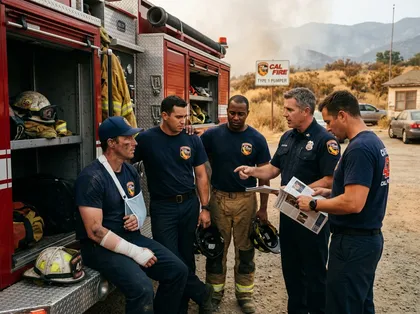
After a fire truck crash, focus on four steps: get medical care, save your evidence, get the police report, and talk to a lawyer before speaking to the city. These actions protect your health and your right to file a claim.
- See a Doctor Right Away: Even if you feel fine, get checked out. Follow-up care may involve a chiropractor, orthopedic specialist, or neurologist based on your symptoms.
- Preserve Evidence: Save your dashcam footage right away. Footage and photos of the scene, along with witness contact details, matter too. Other potential evidence to be preserved includes security camera footage (which can be overwritten within hours or days), GPS data, and vehicle inspection and maintenance records.
- Request the Official Police Report: A police report can contain important information about the crash, including identified parties, witnesses, roadway conditions, and the investigating officer’s observations. It does not by itself conclusively determine civil liability. Ask the responding agency for a copy as soon as it is ready.
- Talk to an Attorney Before Giving a Statement: The city’s risk office may ask for a recorded statement. Most attorneys suggest speaking with a lawyer first, so you know how your statement may affect your claim.
Frequently Asked Questions About Fire Truck Accidents
After working through liability and evidence, you may still have specific concerns. Fire truck cases involve California laws on fault, deadlines, and insurance that are often unclear. The questions below address the most common edge cases in these claims.
Who Is At Fault If A Fire Truck Hits My Car?
Fault depends on the facts. Emergency vehicle exemptions under California law do not relieve the driver of the duty to act with reasonable care. If the driver ran a red light carelessly or failed to slow down, the city or fire department may still be liable for your injuries and losses.
Do Fire Trucks Always Have The Right Of Way In California?
Not always. Under California Vehicle Code Section 21806, you must pull to the right and stop when an emergency vehicle approaches with active lights and sirens.
Under Vehicle Code §21806, motorists must yield when an authorized emergency vehicle approaches while sounding a siren and displaying a visible red lamp. Whether the emergency driver may rely on the traffic-law exemptions in §21055 depends on the circumstances and compliance with that section’s requirements.
Can I Still File A Claim If I Was Cited For Failing To Yield To A Fire Truck?
Yes, if the fire truck also contributed to the accident. California follows a “pure comparative negligence” system, which means you can still pursue a claim and recover damages even if you share some of the blame for the crash. Because fire trucks operate with lights and sirens, responding police officers frequently cite the civilian driver for failing to yield to an emergency vehicle (CVC §21806). However, an emergency exemption does not excuse a fire truck driver from operating safely.
If the emergency driver was also negligent, such as blowing through a blind intersection too fast and failing to drive with due regard for public safety (CVC §21056), liability can be shared. In this scenario, you can still recover compensation, but your total financial award would simply be reduced by your assigned percentage of fault.
Will My Insurance Cover A Crash With An Emergency Vehicle?
It depends on your policy. Collision coverage may pay for damage to your vehicle, regardless of who was at fault. Uninsured motorist coverage typically does not apply, since a government agency is not an uninsured driver. Review your policy and speak with an attorney, because claims against public agencies follow different rules than standard car accident claims.
What Happens If The Fire Truck Did Not Have Its Sirens On?
Whether the emergency-vehicle exemption applies depends on whether the driver satisfied Vehicle Code § 21055, including displaying a visible red warning light and sounding a siren as reasonably necessary. A failure to meet those requirements can affect the available exemptions and the liability analysis.
Get Help For Your Fire Truck Accident Case From Our Attorneys
Under the California Government Claims Act, you typically have six months from the date of the incident to file a claim against a responsible government agency. Missing that window may permanently bar your case.
The truck accident attorneys at Arash Law can handle commercial and government vehicle claims throughout California. They know how to move these cases forward, from the first administrative filing to the final resolution. Though these case results do not specifically involve fire truck accidents, they show how our firm has handled claims involving public entities in the past:
-
$1,075,000
Belanger v. City of Simi Valley: Our client received compensation after being hit by a vehicle while working as a crossing guard, leading to orthopedic injuries and a traumatic brain injury.
-
$1,750,000
Auto vs. Pedestrian: Our client was involved in a collision caused by an uninsured driver at a hazardous intersection. Faced with limited options, we filed a negligence lawsuit against the city. Our investigation uncovered a concerning pattern of accidents at that site, which supported our case and led to compensation for our client.
Past results do not guarantee future outcomes. Every case is different, and results depend on the specific facts and evidence involved.
Contact us to schedule a free consultation. If you reach out, our team can review the facts of your case and walk you through your legal options with no obligation.
Clients often ask, “Do lawyers only get paid if they win?” At Arash Law, the answer is yes. You pay no attorney fees unless we recover compensation for you.
Call (888) 488-1391 to get started. AK Law has represented injured Californians in government vehicle cases.