TL;DR: Yes, driving with a nail in your tire is dangerous because low pressure can cause a blowout and sudden loss of control. Drivers and passengers can suffer serious injuries, and liability depends on whether poor maintenance, a road hazard, or a defective tire caused the failure. In California, you generally have 2 years to file a personal injury claim.
Highlights:
- Pull over safely, hazards on, and inspect from a safe spot.
- If pressure drops fast or the tire is flat, stop driving and tow.
- If a blowout happens, steady wheel, ease off the gas, and pull over.
- Photograph the nail, puncture path, tread, sidewall, and warning lights.
- Keep the tire and wheel – tell shops not to discard them.
- Save dashcam/video, towing receipts, and all tire maintenance records.
- If a road defect caused it, file a government claim within six months.
Tip: When talking with police, insurers, or repair shops, stick to facts and ask in writing that the tire be preserved.
Table of Contents
Yes, it is dangerous to drive with a nail in your tire. Even a small puncture can cause air to leak out, reduce traction, affect steering, and build up heat inside the tire. That loss of pressure can make the tire fail without much warning, especially at higher speeds. If the tire blows out, you can lose control of the vehicle and cause a serious crash.
If a crash happens, the legal issue is not just that a nail was in the tire. The key question is why the tire failed and who may be responsible. Liability may involve poor tire maintenance, careless repair work, a dangerous road hazard, or a defective tire. In California, your right to seek compensation will depend on the cause of the failure, the evidence you preserve, and how quickly you act after the accident.
Why Is It Dangerous To Drive With A Nail In Your Tire?
Driving with a nail in your tire is dangerous because even a small puncture can affect pressure, traction, and control. A nail may cause a slow leak, leaving the tire underinflated and increasing friction with the road, which can lead to heat buildup. That heat can weaken the tire’s internal structure and raise the chance of a sudden failure.
Potential dangers of driving with a nail in your tire include:
- Slow air loss
- Underinflation
- Tire overheating
- Weakened tire structure
- Poor handling
- Longer braking distance
- Reduced traction
- Loss of control
- Sudden blowout
- Greater danger in wet or high-speed driving conditions
These risks can make your vehicle less stable during turns, lane changes, or sudden stops. As the tire loses pressure, steering may feel less responsive, and the car may take longer to brake safely. If the tire blows out, the driver may lose control and cause a serious collision.
Even if the tire does not fail right away, ignoring the problem can turn a minor maintenance issue into a major safety and financial risk.
What Should You Do Right Away If You Find A Nail In Your Tire?
Treat a nail in the tire as a vehicle safety issue, not a minor inconvenience. The National Highway Traffic Safety Administration (NHTSA) warns that poor tire maintenance can lead to flat tires, blowouts, or tread separation. Additionally, underinflated tires are often hard to spot at a glance.
Take these steps in order:
- Turn on your hazard lights and move to a safe shoulder, parking lot, or service area.
- Inspect the tire from a safe position without putting yourself in traffic.
- Do not keep driving on a tire that is rapidly losing air or already flat.
- If the tire blows out while you are moving, keep both hands on the wheel, ease off the accelerator, stabilize the car, and pull off the road when it is safe to do so.
A tire pressure monitoring system (TPMS) warns you when a tire is underinflated. NHTSA emphasizes that the TPMS doesn’t replace regular tire checks. If a warning light comes on, inspect the tire and check the pressure right away.
What Evidence Matters After A Nail-In-The-Tire Crash?

Evidence disappears fast in tire-failure cases. Shops may throw away the tire. Road debris gets cleared. Dashcam footage gets overwritten. A vehicle gets repaired before anyone documents the tread, sidewall, puncture path, or wheel damage.
Focus on preserving:
- The tire itself, plus the wheel if it was damaged.
- Close-up photos of the nail, puncture area, tread, sidewall, and dashboard warnings.
- Dashcam, surveillance, or phone video.
- Towing service invoices, roadside assistance records, and repair shop paperwork.
- Tire purchase records, rotation records, alignment records, and prior repair invoices.
- Recall notices, prior complaints, or the tire identification information on the sidewall.
- Photos of potholes, debris, broken pavement, or other roadway hazards.
- Witness names, police report details, and scene photos showing lane position and skid marks.
If you’re wondering, “What happens if the tire gets thrown away?” A court might respond by penalizing the responsible party or assuming the missing evidence would have helped your case. California does not allow a separate lawsuit just for destroying evidence. To protect your case, do not authorize disposal and immediately send a written preservation request to the repair shop or your insurer.
Accident attorneys can use available evidence to identify who may be at fault. These records can also help determine who is at fault, especially when more than one party may be responsible. California follows a pure comparative negligence rule, so more than one party may share fault for an accident. Even if the vehicle with the nail in the tire caused the crash, the person or party responsible for the nail can also be held partially liable.
What Legal Claims Can Follow A Tire-Failure Crash In California?
A nail in the tire does not automatically create a lawsuit. The accident claim depends on why the tire failed and whether that failure caused actual harm. In a California negligence case, the injured person must prove that someone failed to use reasonable care, that the failure was a substantial factor in causing harm, and that damages resulted.
Here are some possible legal paths for victims in these cases:
Negligence Claim
A negligence claim may fit when someone had a duty to act carefully but failed to do so. Possible liable parties in this type of claim are the following:
- Vehicle Owner: Responsible if they failed to maintain the vehicle properly, leading to tire failure.
- Driver: May be liable if they ignored low-pressure warnings or drove on a visibly damaged tire.
- Maintenance or Repair Companies: Could be responsible if a tire inspection or service missed a nail or other damage.
Product Liability Claim
A nail in the tire does not automatically mean the incident was unavoidable. If the tire fails in a manner beyond normal puncture behavior, the claim may shift from ordinary negligence to product liability. Liable parties can be the tire:
- Manufacturer
- Distributor
- Seller
For example, a product liability claim may arise if:
- The tire had a design flaw that made it unusually vulnerable to punctures or rapid air loss.
- The manufacturer failed to provide adequate warnings about how the tire would behave after a puncture.
In product liability cases, you generally do not need to prove negligence. The focus is on whether the tire was defective and whether that defect caused injury during reasonably expected use, as recognized under California product liability law.
Road Hazard Or Premises Claim
Sometimes the puncture is only the first event. The real legal issue is what caused it. A deep pothole, broken pavement edge, sharp debris in a business lot, or another dangerous condition may point toward a claim against the party that controlled and failed to address that condition. In these cases, the parties that can be responsible are:
- Government Entities: Can be liable if a dangerous public road condition caused the puncture, and the legal notice rules are met.
- Businesses or Contractors: Construction companies, suppliers, or other businesses may be responsible if their work or materials left nails on the road that caused the accident.
What If The Road Debris Is Unknown Or Untraceable?
Even when the source of road debris cannot be identified, victims may still have coverage options. Depending on your policy, collision coverage can help pay for damage to your vehicle, and underinsured/uninsured motorist (UIM) coverage may apply if another driver caused an accident related to the debris.
Tire accidents can have many causes, especially when a nail puncture is involved. Some victims seek free advice from a defective tire injury attorney to understand who may be liable in their accident case.
What Harm Can A Nail-In-The-Tire Crash Cause?
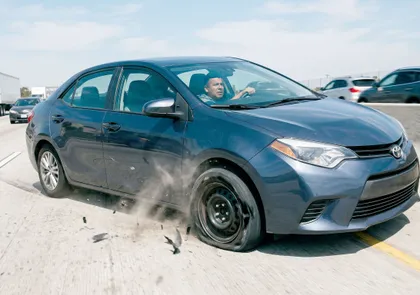
The puncture itself does not cause the injury. The danger lies in how a damaged tire can affect a vehicle’s movement and response. A nail in the tire can lead to several dangerous crashes, including:
- Rear-end collisions
- Sideswipe crashes
- Run-off-road crashes
- Spinouts or skids on wet or slick roads
- Intersection crashes
- Rollovers
Rear-end collisions are common after sudden tire failures, especially when drivers are unable to maintain a safe following distance in heavy traffic.
These crashes can cause:
- Head injuries and concussions
- Neck and back injuries
- Broken bones and soft tissue injuries
- Chest or internal injuries
- Spinal cord injuries
- Emotional distress after a sudden loss-of-control crash
These injuries could lead to high medical costs or time away from work, depending on the severity. For instance, traumatic brain injuries (TBIs) can lead to cognitive issues, which could lead to impairment. In some cases, spinal cord damage may leave victims paralyzed. For severe cases, victims may suffer fatal injuries. In 2023, 646 people died in tire-related crashes on U.S. roads, according to NHTSA.
What Compensation Can An Injured Person Seek?
If another person caused or contributed to the crash, you can pursue damages. California jury instructions recognize categories like medical expenses, lost earnings, and pain. They also include mental suffering and emotional distress.
Depending on the facts, a claim may cover:
- Past and Future Medical Care: These can encompass costs of urgent care and hospital stays. It may also include necessary treatments, such as physical therapy, chiropractic care, and prescription medication.
- Lost Income: If injuries led to time away from work, victims can seek compensation for lost wages. They may also include reduced earning capacity if the injuries led to disability.
- Property Damage: A claim can also include the cost of repairing or replacing your vehicle.
- Non-Economic Damages: Sometimes, victims also experience other intangible damages that they can recover through a claim. These can include:
- Pain and suffering.
- Mental suffering and emotional distress.
- Loss of enjoyment of life.
The value of a claim depends on proof. Severe injuries, lengthy treatment, permanent limitations, and strong evidence of fault can significantly change the case. Defective tire injury lawyers review available evidence to determine what damages may apply to the cases of their clients.
How Long Do You Have To File A Claim In California?
In California, you usually have two years to file a personal injury lawsuit. Section 335.1 of the Code of Civil Procedure states this rule. It applies when someone else’s wrongful act or neglect causes your injury. However, in property damage claims, the legal time limit is three years from the date of the accident.
If the case involves a public entity, such as a city or county road defect, Government Code section 911.2 generally requires a written claim within six months of the date the claim accrued. That deadline arrives much faster than many people expect.
Even when the outside deadline seems far away, tire failure evidence rarely lasts that long. That is why these cases should be evaluated early.
Frequently Asked Questions (FAQs)
Before you act, it helps to have clear answers to the most common questions people ask after a puncture, blowout, or tire-failure crash.
Can You Drive With A Nail In Your Tire?
You may still be able to move the car physically, but that does not make it safe. NHTSA says underinflated tires can be hard to detect visually, a TPMS warning means the tire is already significantly underinflated, and a blowout can cause loss of control.
The safer approach is to move only as needed to reach a secure location, then have the tire inspected. If the tire is flat or rapidly losing air, do not continue normal driving. In other words, do not keep driving as usual. Only move the vehicle far enough to get out of danger, and stop in a safer place.
What Does The TPMS Light Mean In Terms Of How Underinflated The Tire Is?
Under Federal Motor Vehicle Safety Standard No. 138 (FMVSS No. 138), a U.S. regulation that sets requirements for tire pressure monitoring systems, the TPMS warning light must illuminate when:
- One or more tires are at or below 25% under the recommended placard pressure; or
- The tire pressure reaches the system’s minimum activation pressure.
Whichever threshold is higher. With these facts, it means that:
- The system does not warn you as soon as pressure starts to drop.
- It alerts you later in the deflation process.
- By the time the light comes on, your tires may already have lost significant pressure.
For this reason, we should treat TPMS as a backup system. It does not replace regular manual tire pressure checks.
Can I Still Recover If I Kept Driving After The Warning Light Came On?
Possibly, but the defense may argue that your own choices helped cause the crash. California follows a pure comparative fault rule. Under this legal doctrine, individuals may share fault for an accident, even the victim. However, the available compensation is reduced depending on their portion of fault.
That issue is fact-specific. These are the key questions: How clear were the warning signs? How far did you drive? What was the tire condition? Did another party cause the danger? A defective tire accident lawyer can assess the evidence and help you understand your situation.
How Much Do Lawyers Charge For Defective Tire Accident Cases?

The cost of hiring a lawyer in California after a nail-in-the-tire accident depends on the complexity of the case, which often determines the time and resources required to handle it.
If your concern involves the question, “Do lawyers only get paid if they win?” Some defective tire lawyers in California work on a contingency fee basis. It means they only get paid attorney’s fees if they can obtain compensation for their clients. This compensation can be either from a settlement or a court award.
Can You Repair A Nail Puncture, Or Do You Need A New Tire?
In many cases, a nail puncture can be repaired if it is in the tread area, at least one inch away from the sidewall. During repairs, it is important to follow tire safety rules, which include avoiding the shoulder and the outside edge of the pavement.
According to the Bureau of Automotive Repair (BAR), a tire puncture is considered repairable only if it is 1/4 inch or smaller and has not caused internal damage. Repairs must include:
- Sealing the puncture from the inside.
- Installing a cured rubber plug through to the outside.
Punctures in the sidewall, bead, tread shoulder, or belt edge cannot be repaired. Tires with big punctures, internal damage, or temporary sealant repairs aren’t safe. They can’t be used on public roads without proper follow-up.
Does Insurance Cover Tire Damage?
Insurance usually does not pay for tire damage caused by driving over a nail, because it’s considered normal tire wear. Even comprehensive or collision coverage typically won’t cover this type of damage. However, if you hit the nail and cause a car accident that damages your vehicle, your auto insurance may cover the repair costs.
Speak With Our Dedicated Legal Team To Discuss Your Case
A nail in the tire can look like a small problem, but the legal issue after a crash is much bigger than the nail itself. The real question is why the tire failed, who had control over the risk, and what evidence still exists to prove it. If a puncture, blowout, or suspected tire defect led to a California crash, our defective tire accident lawyers at Arash Law can review the evidence, explain the claim path that fits your case, and help you protect the deadlines that apply.
If you find yourself thinking, “I need a personal injury lawyer” after a tire-related accident, our team is here to help. In addition to these cases, we provide legal support to victims of car accidents, truck crashes, and rideshare incidents. To schedule a free initial consultation with AK Law, call us at (888) 488-1391.