TL;DR: A school bus accident in California sets a strict 6-month claim deadline for public school districts that applies even to injured minors. Claims against private companies or other drivers generally have a 2-year filing period, although special tolling rules may extend the deadline for an injured minor.
Highlights:
- Arrange a medical evaluation and schedule follow-ups if symptoms appear or continue.
- Ask where your child was taken, examined, and released, and to whom.
- Photograph the bus number, seat area, visible injuries, and scene when safe.
- Request the CHP or police case number, crash report, and school incident report.
- Ask for passenger lists, seating charts, and route or attendance records.
- Send a written request to preserve bus video, GPS data, and dispatch recordings.
- Keep a daily symptom log and save bills, receipts, and missed-work documentation.
Tip: Put preservation requests and any statements in writing, and stick to observable facts instead of guessing.
Table of Contents
After a crash, the driver should stop safely, protect the students, assess immediate hazards, request emergency help when needed, and follow the district and CHP reporting process. School officials generally follow district procedures for notifying families. Emergency medical personnel may assess students at the scene or transport them when needed.
Hearing that your child was on a bus that crashed is frightening, and their health is the priority. Have them checked by a doctor as soon as possible, even if they seem fine at first.
Public school districts are government entities. This means special legal rules apply to injury claims against them. California law sets strict deadlines for these cases. Understanding what happens at the crash scene is the first step toward protecting your child’s rights.
Emergency Response After A School Bus Accident
After a California school bus crash, events unfold quickly. The driver secures the bus, activates emergency protocols, and checks for injuries to passengers and themselves. Impact, rollovers, airbags, broken glass, or secondary collisions can also hurt drivers. Emergency responders may assess children and injured adults at the scene. School personnel begin accounting for students and notifying families in accordance with district procedures.
For qualifying school bus accidents, the carrier must ensure the crash is reported to the California Highway Patrol (CHP) and the school district superintendent within 24 hours. If the driver cannot make the immediate report due to their injuries, the carrier must do so once it learns of the crash.
Emergency medical personnel may check passengers for:
- Visible injuries
- Pain
- Confusion
- Breathing problems
- Loss of consciousness
They may look for any signs that might need quick treatment. Students with serious or suspected injuries may be transported to a hospital.
At the same time, school personnel and first responders account for every passenger. They may compare the students at the scene with route records, attendance lists, seating information, or a passenger log.
The accounting process needs to find out which students stayed, who went for medical care, and who were released to an authorized adult. School personnel should document when and to whom each student is released.
Students who do not need hospital care may remain at the scene, return to school, transfer to another bus, or be released to an authorized adult. Parents should ask where their child was taken, whether the child was examined, and who authorized the release.
An on-scene assessment can’t always replace a full medical evaluation. This is especially true if symptoms appear later. A medical exam also helps build a record that may support the link between the injury and the crash. Once your child’s health is secure, the next question is who is responsible for what happened.
The Investigation After A School Bus Accident
 After emergency needs are handled, law enforcement investigates the school bus accident. Under California Vehicle Code (CVC) § 12517.1(b), the CHP must investigate all school bus accidents in the state. The main exception involves property-damage-only incidents that occur entirely on private property and involve no Vehicle Code violation. School officials may also prepare their own incident reports and records.
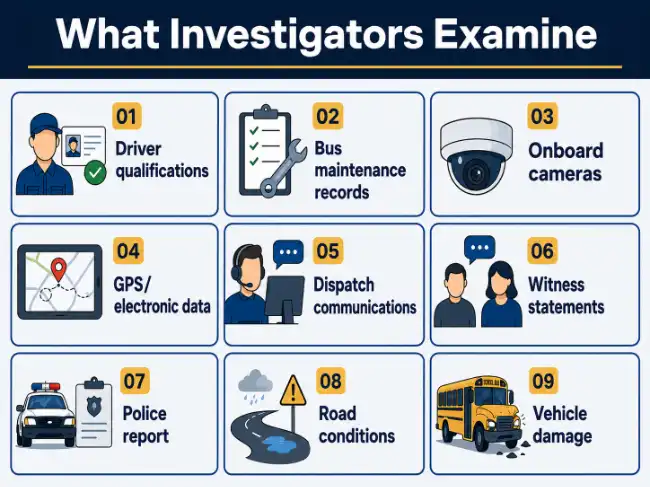
Investigators may review several key areas to understand what caused the crash, including:
- The bus driver’s qualifications and route history.
- Maintenance and inspection records.
- Onboard camera footage, electronic data, and dispatch communications.
- Compliance with California Highway Patrol (CHP) school bus safety requirements. These may include terminal inspections, periodic safety inspections, and driver certification standards.
The bus may also be taken out of service. Before it can return to transporting students, it will be inspected for mechanical damage or safety issues. Depending on the findings, it may be:
- Towed from the scene.
- Preserved for further inspection.
- Repaired and cleared for service.
- Removed from service.
It is important to act quickly, as some evidence may not be preserved indefinitely. Under routine retention policies, certain records can be overwritten or deleted. Key evidence may include:
- Interior and exterior bus camera footage.
- GPS and electronic vehicle data.
- Dispatch recordings.
- Driver qualification and employment records.
- Passenger lists and seating charts.
- Photos of the bus and accident scene before repairs are made.
These findings show who may be liable for the school bus accident in California. More than one party can be legally responsible for these incidents. Liability refers to legal responsibility for the crash and resulting harm. The answer depends on who caused the crash and whether they are connected to the bus operator or employer.
Several parties may be liable, depending on the facts:
- Bus Driver: The driver may be liable for careless or reckless driving. Youth bus drivers need a valid certificate from the California Department of Motor Vehicles (DMV). They must complete the required training and pass the CHP exams. Failure to comply may support negligence claims and increase liability.
- The School District or Private Bus Company: Employers may be liable for their employees’ careless actions while on the job. This is based on the legal principle of vicarious responsibility (respondeat superior). If the district or business fails to train the driver, do background checks, or maintain the bus, they could be held personally responsible.
-
Third-Party Motorist: A driver who illegally passes a stopped school bus with flashing red lights may violate CVC § 22454. If that violation causes an accident, they can be responsible. Liability can come from several actions, such as:
- Speeding in a school zone
- Tailgating
- Unsafe lane changes
- Not yielding to children
- Distracted driving
- Improper turns near a bus stop
- Vehicle Manufacturer: If faulty brakes or another defect caused the crash, the manufacturer may be liable. Product liability law holds manufacturers responsible when their defective products cause harm.
- City or County Government: Accidents can occur due to poor road conditions. Broken traffic lights or poorly designed intersections can also cause them. In these cases, city, county, or state agencies might be at fault.
When several parties share fault, each may receive a percentage of responsibility. That percentage can affect how much each party must pay, although the rules may differ depending on the type of damages.
Different standards apply when someone tries to blame an injured child. Very young children may be considered legally incapable of negligence. An older child’s conduct is generally compared with that of a reasonably careful child of similar age, intelligence, knowledge, and experience.
Pursuing a claim against a public school district means following a different legal process than a standard injury case. Talking to school bus accident lawyers early can help a family find the right party and save evidence before it’s gone.
Students Can Get Injured In A Bus Accident
School bus accidents can cause injuries ranging from minor bruises to serious trauma. Students may be injured when they are thrown against a seat, window, wall, or another passenger. They may also be injured while boarding or leaving the bus, or by being struck by another vehicle.
Common injuries include:
- Cuts and Bruises: Broken glass, loose objects, or contact with seats and bus surfaces can cause scrapes, cuts, and bruising.
- Broken Bones: A strong impact, rollover, or fall inside the bus can fracture the arms, legs, ribs, or other bones.
- Head Injuries: A student may hit their head on a window, seat, floor, or another object during the crash.
- Neck and Back Injuries: Sudden stopping, twisting, or impact can strain the neck, back, muscles, and spine.
- Internal Injuries: Seat restraints, blunt impact, or crushing force may injure internal organs.
- Psychological Injuries: Children may develop fear, anxiety, nightmares, or other emotional symptoms after a frightening crash.
Some injuries are not obvious right away. Pain, dizziness, confusion, or emotional symptoms may appear hours or days later. When a child is injured, the family may be able to seek compensation for the resulting costs and hardships.
Legal damages are monetary compensation awarded for injuries and losses from a California school bus crash. School bus claims include two types of damages:
Economic damages cover costs you can calculate and document:
- Hospital Bills and Surgery: Emergency care, hospitalization, and surgical costs.
- Ongoing Treatment: Chiropractic care, physical therapy, and future rehabilitation needs.
- Caregiving Costs and Missed Work: In some cases, families may seek compensation for reasonable caregiving expenses or income lost while caring for an injured child.
Non-economic damages cover the personal harm that does not show up in a bill:
- Pain and Suffering: Physical pain caused by the crash and its aftermath.
- Emotional Harm: Post-traumatic stress disorder (PTSD), anxiety, and lasting psychological effects.
- Reduced Quality of Life: Loss of the activities and experiences your child enjoyed before the injury.
California Government Code § 818 bars punitive damages against public agencies. If the school district or transit authority caused the accident, your family can pursue only economic and non-economic damages.
Filing A Claim: The Strict 6-Month Deadline For Public School Buses
Whether your deadline is six months or two years depends on one question: who operated the bus. If it were a public school district, you would not file a standard personal injury claim. You are filing against a government entity, and the rules are far stricter. Missing this distinction can end your case entirely.
Under California Government Code § 911.2, you have six months from the date of injury to file a written notice of claim with the school district. This notice must precede any lawsuit.
Your written notice generally includes information such as:
- Your Name and Mailing Address: Full name and postal address of the person making the claim.
- Date and Location of the Accident: The specific date, place, and circumstances of what happened.
- Description of the Injury: A general description of the harm or loss your child suffered.
The California Tort Claims Act (CTCA) covers claims against government entities. However, it does not apply to private charter bus companies or other private parties who may be responsible. California Code of Civil Procedure § 335.1 generally sets a two-year filing window for claims against these private parties.
What Counts As A School Bus Accident
A school bus-related crash is any accident involving a school bus or other school vehicle while transporting students. These accidents can occur due to driver error, poor road conditions, technical issues, or other drivers’ actions. Since multiple individuals or organizations may share culpability, identifying the cause is crucial.
Under California Vehicle Code § 12517.1, a school bus accident may include:
- A crash with a school bus or similar student-transport vehicle that causes injuries or over $1,000 in property damage.
- A collision involving a student or school bus driver crossing the road while the bus’s red warning lights are required or while the bus is stopped to load or unload students.
- An incident in which a student is injured inside the bus because of sudden stopping, starting, turning, or other movement.
School bus accidents may also take several forms, including:
- Direct Collisions: For example, a collision between a school bus and a car.
- Single-Vehicle Collisions: This includes rollovers, driving off the road, and hitting stationary objects such as light poles.
- Strikes to Pedestrians or Cyclists: A person walking or riding a bike is struck by the moving bus.
- Door-Trap and Drag Incidents: A child could get caught in the bus door while boarding or exiting.
- Slip-and-Fall Accidents Caused by Bus Conditions: Students can fall when getting on or off the bus. This can happen due to mechanical issues, broken handrails, or slippery ice and wet areas inside the bus.
How A Lawyer Can Help With A California Bus Accident Case
 The legal process after a school bus crash can feel overwhelming while your child is still recovering. If you find yourself thinking, “I need a personal injury lawyer,” an attorney can handle the legal work while you focus on your child’s health.
A school bus accident lawyer can:
- Identify whether a public school district or a private company operated the bus.
- Determine which deadlines apply, including the six-month government claim deadline.
- Send preservation requests for bus camera footage, dispatch logs, maintenance records, and driver records.
- Review police reports, school incident reports, medical records, and witness statements.
- Investigate whether the driver, school district, bus company, another motorist, or a public agency may be responsible.
- Document medical expenses, future care needs, pain, emotional harm, and other losses.
- Handle communications with insurers, school officials, and government agencies.
- Negotiate a settlement or prepare the case for court when necessary.
If a lawsuit is filed on behalf of a child, the court usually appoints a guardian ad litem. This is often a parent or legal guardian who represents the child’s interests. A lawyer can help with that process and seek court approval of any settlement involving the child.
Frequently Asked Questions About California School Bus Accidents
After a school bus accident, families often have questions about medical bills, liability, and their legal options. The answers below explain some common concerns.
Who Pays For My Child’s Medical Bills After A School Bus Accident?
The party responsible for the crash may ultimately have to pay your child’s medical expenses and other damages. Liability insurance may cover those losses. If a school district is responsible, the district’s insurance or risk-management program may pay the claim.
Medi-Cal, your child’s health insurance, or medical payment coverage, may pay some bills first. Medi-Cal or a health insurer may later seek reimbursement for related medical expenses from a settlement or judgment.
What Happens If A School Bus Hits Your Car And Flees?
If a school bus hits your car and leaves, treat it as a hit-and-run, report it to the police immediately, and document the scene for insurance and any claim.
Are School Buses Required To Have Seat Belts In California?
Yes. California requires passenger restraint systems on school buses based on the bus type and the manufacturing date under CVC § 27316. The requirement began July 1, 2004, for Type 2 buses and July 1, 2005, for Type 1 buses. By July 1, 2035, all school buses used in California must have passenger restraints.
Can A School District Claim Immunity From A Bus Accident Lawsuit?
Yes. A school district may raise statutory immunities and other legal defenses. However, California law also allows claims against public entities when there is a valid legal basis for liability. You generally must present a government claim to the district within six months before filing a lawsuit.
Does My Child Have To Testify In A School Bus Accident Case?
Not necessarily. Many cases settle before trial, so the child may not have to testify in court. However, the defense may ask to question the child during a deposition if the crash or injuries are disputed.
A California court may issue protective orders to prevent unwarranted annoyance, embarrassment, oppression, or undue burden. An attorney can also seek steps that reduce unnecessary stress for the child.
How Are Settlements Approved For Minors In California?
A settlement of a child’s disputed injury claim generally requires court approval through the minor-compromise process. A formal hearing isn’t always needed. Some qualifying settlements can get quick approval. The court reviews the settlement to ensure it protects the child’s interests and properly manages the settlement funds.
Contact Arash Law After A Bus Accident In California
If a public school district is part of your child’s crash, you might have only six months to file a government claim. This notice is needed before you can sue a public entity. Bus footage and district records can be overwritten within days, so acting quickly is essential to protecting your case.
Every family has the right to seek legal support from a school bus accident lawyer before deciding how to proceed. Arash Law handles every personal injury case on a contingency fee basis. You pay no attorney’s fees unless your family recovers compensation. Contact AK Law today at (888) 488-1391 to schedule a free initial consultation and understand your options.