TL;DR: If the insurance company says you’re partly at fault after a car accident, your compensation may be reduced according to your percentage of responsibility. Drivers in this situation risk lower payouts and higher insurance rates if evidence supports shared blame, so acting quickly to dispute fault helps preserve claims and protect financial interests.
Highlights:
- Ask your insurer for a written fault explanation and evidence list.
- Get the police report and review diagrams, citations, and witness notes.
- Photograph vehicle damage, the scene, and road conditions as soon as possible.
- Collect witness contact info and written statements while details are fresh.
- Organize medical records, bills, wage proof, and repair estimates in one file.
- Dispute the fault decision in writing and keep copies of everything sent.
- Calendar deadlines: 2 years to sue; 6 months for government claims.
Tip: Preserve dashcam video and request EDR data quickly, before it’s overwritten or inaccessible.
Table of Contents
If your insurer claims you are partially responsible for your car accident, do not admit fault and do not accept their decision immediately. You can challenge their assessment by taking specific steps and learning about your state’s comparative fault laws.
Here’s what you can do to protect your rights if you’re partly blamed after a car accident:
- Review the insurer’s explanation and ask for details behind their decision.
- Collect evidence, such as photos, videos, and witness information.
- Submit a formal dispute with supporting documents.
- Consider hiring a car accident attorney to advocate for you.
In the following sections, you’ll learn how comparative negligence laws can impact your potential compensation and how fault is determined using evidence. You can also discover how legal assistance can help protect your claim and aid in your recovery.
How Insurance Companies Determine Partial Fault In Car Accidents
After reporting a crash to your insurance company, it establishes fault based on a combination of state laws, evidence, and the findings from its independent investigation. An insurer might say you were partly to blame and offer a low payout. You don’t have to accept this offer immediately.
Learn how the system works in California to understand your insurer’s decision better and advocate for a fair designation of fault.
Legal Rules That Guide How Insurers Establish Fault
Insurance adjusters don’t just make decisions on a whim. They follow state laws, like contributory and comparative negligence rules, which dictate how blame can be assigned and how much compensation each party can recover.
In some states, the law follows the doctrine of contributory negligence. Under this rule, if you are even slightly at fault for the crash, you might not be able to recover any compensation at all.
However, California is among the many states that use comparative negligence. This rule allows each person’s share of the blame to affect the amount of compensation they can receive. For example, if both drivers made mistakes, each could be held partly responsible. The more fault you share, the less you can collect from an insurance claim.
There are two ways states apply the comparative negligence rule. Here’s a simple breakdown of how each one works.
| Feature | Pure Comparative Negligence | Modified Comparative Negligence |
| Core Rule | You can recover damages regardless of your percentage of fault. | You can only recover damages if your fault is below a specific threshold. |
| Recovery Limit | Even if you’re 99% at fault, you can still recover 1% of your damages. | Your fault percentage reduces payout, provided you are under the threshold (50% or 51%). |
| Common Thresholds | None. | 50% Bar — No recovery if the fault percentage is 50% or more. 51% Bar — No recovery if the fault percentage is 51% or more. |
| Sample States | California, New York, Arizona | 50% Bar — Colorado, Georgia, Maine 51% Bar — Texas, Illinois, Ohio |
Aside from the specifics of your case, the state where the accident occurs can also impact the amount you may recover in an insurance claim.
Understanding Fault Calculations In Car Accidents
In states with comparative negligence, insurers calculate your share of fault according to the law. Based on California’s legal procedures, the other party (the defendant) has the burden of proving that your actions contributed to the accident. In practice, evidence from both sides determines how fault is assigned.
If the defendant’s case is convincing, a jury (or an insurance adjuster in a claim settlement) will assign a percentage of fault to each party. Your compensation is then reduced based on the percentage attributed to you.
Here’s a simple formula to understand how insurers calculate payouts:
(Total Damages) × (1 – Your Fault Percentage) = Your Recoverable Compensation
The total responsibility for an accident must always equal 100%. If you are assigned 20% of the blame, your potential payout will only be 80% of the damages. Under California law, even if you were 99% responsible for a car accident in California, you may still be able to recover 1% of your total damages.
Evidence Insurers Use To Argue Shared Fault In Car Accidents

Insurance companies have their own internal guidelines for determining fault. These procedures often involve reviewing all available evidence to establish the percentage of responsibility of each party. Here are some of the key pieces of evidence they consider:
- Police Report — This document can influence insurance decisions, but it is not determinative of legal fault. It includes details such as when and where the accident occurred, who was involved, and the officer’s observations about what caused the crash. The report may also list witness statements, diagrams of the scene, and any tickets or citations given.
- Statements From Those Involved — Insurance adjusters speak with people involved in the accident. They analyze these three primary sources of information to assess whether stories remain consistent:
- Eyewitness Statements — Bystanders can provide an unbiased perspective of the crash. Their outside views help adjusters fill in missing gaps and resolve conflicting stories between drivers.
- Driver Accounts — Adjusters compare each driver’s version of events. If your story matches the other driver’s, the process can move quickly. However, any inconsistencies will prompt a more thorough investigation.
- Passenger Statements — Passengers can provide additional details from inside the vehicle. Their accounts must align with those of the driver. Discrepancies in the statements can raise concerns about the accuracy of the information given by the driver.
Consistent statements from everyone involved clarify the facts. However, even small changes or contradictions can impact how insurers allocate blame after a crash.
- Event Data Recorder (EDR) Information — Newer cars have a “black box” that records speed, braking, and steering before a crash. This data can confirm or contradict what drivers say happened. Access to EDR data may require the consent of the vehicle owner or legal authorization.
- Photographs and Videos — Photos and video footage can show vehicle positions, damage, and road conditions. These visuals help adjusters verify details and fill in any gaps in firsthand accounts of the accident.
- Crash Reconstruction — In severe or complex crash cases, insurance companies enlist experts. They apply science and engineering to recreate the events. They can also examine evidence such as skid marks, damage, and diagrams to establish a timeline of the crash.
Even small pieces of evidence can be used to show that you are partly to blame. Therefore, it’s crucial to gather evidence yourself and ensure that your side of the story is supported. The stronger your evidence, the better you can protect yourself from being unfairly blamed after a crash.
What Partial Fault Means For Your Claim And What You Can Do
Insurance companies protect their own financial interests. To save money, they may try to divert some blame to claimants to reduce their payout. That’s why it’s essential to know how insurers determine fault and how to push for fair compensation.
If you are found partly at fault for an accident, your compensation will likely be reduced. For example, imagine you’re in a car crash. You incur $20,000 in damages. These losses may include medical bills, lost wages, and car repairs. If the insurer decides you were 30% at fault, you would only receive 70% of the total amount, or $14,000.
This reduction can make it challenging to cover all your costs, especially if you require ongoing medical care, such as rehabilitation or chiropractic treatment.
How Insurers Justify Low Settlement Offers
By arguing that you share responsibility for the accident, insurers can lower the amount they owe on your claim. Insurers may have valid grounds to do so. They might:
- Claim Insufficient Evidence — Insurers may argue your damages aren’t proven if you lack detailed medical records, photos, or witness statements. A lack of documentation can provide them with a reason to suggest that your claim is worth less than you are asking.
- Use Settlement Formulas and Algorithms — Many companies rely on software and formulas to calculate your claim’s value. These programs focus on fixed data points. However, they may overlook the complexity of your injuries, as well as the pain and suffering they cause.
- Dispute Fault or Injury Severity — Adjusters may question how bad your injuries really are or argue that you were partially responsible for causing them. In doing so, they could justify paying a smaller percentage of your claim.
Knowing these strategies can help you recognize when an offer is unfair and take action to challenge it.
Steps To Take When An Insurer Claims You Share Fault In A Car Accident
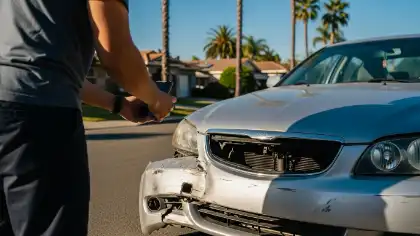
When facing a car accident fault dispute in California, here are clear, practical steps to help protect yourself and argue your side:
- Stay Calm and Ask for Details — Contact your insurance company via phone or written communication to understand why they think you share fault. Stay polite and direct. Ask them to explain their decision and the documents or evidence they considered in making it. You may also request a formal review.
- Gather and Organize Your Evidence — Collect everything that can support your claim, including:
- Medical Documentation
- Initial ER or urgent care report
- Imaging results (e.g., X-rays, MRIs, or CT scans)
- Specialist referrals
- Medical bill itemization
- Property Damage Evidence
- Impact photos
- Black box data
- Video footage
- Repair estimate
- Proof of Lost Earnings
- Wage verification (official letter from your HR department)
- Disability notes (doctor-signed “off-work” authorizations)
- Tax Records
- Official Documentation
- Police report
- Witness list (phone numbers and written statements)
- Cell records (e.g., showing you weren’t texting at the time of impact)
- Medical Documentation
- Dispute the Fault Decision in Writing — If you believe the insurer is wrong, submit a formal dispute. Clearly state why you disagree, and attach supporting documents. Keep copies of all your correspondence.
- Challenge the Police Report or Ticket (If Needed) — If the insurer’s decision is based on a police report or ticket, try to contact the officer to clarify your side. If you received a ticket, consider fighting it in court. A dismissed or reduced citation can sometimes support your position with insurers.
- Get a Car Accident Lawyer on Your Side — An experienced attorney can investigate and collect evidence for you. They can handle communications with the insurance company and help you avoid mistakes that could hurt your claim.
Taking these steps can help strengthen your position when disputing blame and pursuing a fair settlement.
Frequently Asked Questions (FAQs) About Shared Fault In Car Accidents
If an insurance company partly blames you for a crash, it’s normal to feel uncertain about your next steps for pursuing compensation. Below, you’ll find answers to common questions about shared fault in car crashes.
How Do I Prove The Car Accident Was Not My Fault?
To prove you were not at fault in a car accident, start by gathering evidence at the scene. Obtain contact information from any bystanders or other drivers who witnessed the incident. Request a copy of the police report for an official account of the accident.
Finally, talk to a lawyer who can help you collect additional evidence and build a strong case. If you’re dealing with financial constraints after your crash, you may be wondering, “Do lawyers only get paid if they win?” It depends on their fee arrangement. If they work on a contingency fee basis, then you only pay the attorney’s fees if they obtain compensation for you.
What Should I Avoid Saying After A Car Accident?
To protect your rights after a car accident, avoid making statements that could be used against you. Here are key phrases you should not say:
- “I’m Sorry.” — Even if you’re just being polite, apologizing can sound like you’re admitting fault.
- “I Didn’t See You.” — The insurer could take this as an admission that you weren’t paying attention.
- “I’m Not Hurt.” — You might feel fine at first, but some injuries take time to show. If you say you’re not hurt, insurers may use this statement to justify a lower payout.
- “Let’s Settle This Between Ourselves.” — Saying this can suggest you’re trying to avoid creating an official record of the accident, which may raise red flags with insurers later.
Stick to the facts when speaking with others at the scene, the police, or insurance adjusters. When in doubt, say as little as possible and talk to a legal professional for free accident lawyer advice.
What’s The Most Money I Can Get From A Car Accident?

Generally, there is no set limit to how much you can get from a car accident claim. The amount depends on several factors, such as:
- The severity of your injuries.
- Any lost income or property damage.
- The impact of the accident on your life.
Serious injuries like paralysis or brain trauma can lead to substantial settlements. However, every case is different, so compensation varies significantly. Consider consulting a personal injury lawyer to help you estimate what your claim is potentially worth.
What Should I Do If The Other Driver Does Not Admit Fault?
If the other driver denies fault, ask for the evidence they have against you. Your insurance company may cover your damages and then try to get reimbursed from the other driver’s insurer. If you have significant losses and the other driver still refuses to accept blame, talk to an attorney about your options, including taking the case to court.
What Happens If Both Insurance Companies Disagree On Fault?
If your insurance company and the other driver’s insurer disagree on fault, there are options they can take:
- Inter-Company Arbitration — Insurers may use a neutral third party to review the evidence and decide who is responsible for paying the claim. This private process aims to avoid a trial, and you usually won’t need to participate.
- Subrogation — If your own insurer pays for your repairs first, they will likely use “subrogation” to seek reimbursement from the other driver’s insurance. If your insurer proves the other driver was at fault, they usually refund your deductible.
In California, if this process stalls, you can request information through the California Department of Insurance. A lawyer can also advise you on whether further legal action may be necessary.
How Long Do I Have To Dispute A Fault Decision In California?
In California, there is no exact law that sets a deadline for disputing a fault decision by an insurance company. Still, you should act quickly. Insurance policies often require disputes to be raised promptly, though specific deadlines vary by policy.
If you want to file a personal injury lawsuit, you generally have to do so within two years from the date of the accident. For claims against a government agency, you only have six months to file an administrative claim. Specific situations may extend these deadlines. To learn whether any exceptions apply to your case, it’s advisable to consult a personal injury attorney.
Will My Insurance Rates Go Up If I Am Found Partially At Fault In California?
Your insurance rates may increase if you’re found partially at fault in an accident in California. However, it depends on your insurer’s policies, your driving history, and the state’s regulations. Each company handles rate changes differently.
If An Insurer Unfairly Shifts Blame To You, Call A Car Accident Lawyer
When an insurer says you’re at fault after a car accident, that decision can directly affect your potential compensation. However, its fault determinations are not always final, as they may rely on limited evidence initially. California’s comparative negligence laws also allow you to challenge a partial fault claim and seek a fair review.
After a crash, people often ask, “Do I need a personal injury lawyer?” If you believe your insurer has unfairly blamed you, the car accident lawyers at AK Law Firm are ready to help. We can challenge their decision, handle negotiations, and pursue fair compensation on your behalf. Call (888) 488-1391 today for a free case review.