TL;DR: After a motorcycle accident in Oakland, move to safety and call 911, get medical care, and document evidence to protect your injury claim. Injured riders have 2 years to file a personal injury lawsuit, and missing that deadline can cost you payment for medical bills and lost wages.
Highlights:
- Move to safety and call 911. Stay at the scene if anyone is injured.
- If you struck your head, wait for paramedics to remove your helmet, as premature removal can worsen a spinal injury and alter physical evidence.
- Photograph vehicle damage, visible injuries, road hazards, and nearby traffic controls before leaving the scene.
- Collect the other driver’s full name, license plate, and insurance details, plus names and numbers of witnesses.
- Preserve your damaged motorcycle and riding gear; do not repair or discard them before your claim is resolved.
- Get a same-day medical evaluation and attend every follow-up. Seeing a chiropractor or specialist creates records that link your injuries to the crash.
- Submit DMV Form SR-1 within 10 days if the crash caused injury, death, or more than $1,000 in property damage.
- If a government vehicle, AC Transit bus, or public road defect was involved, file a government tort claim within 6 months, a separate, shorter deadline that applies before any lawsuit.
Tip: Keep a dated folder of photos, records, and receipts. Stick to basic facts when speaking with any insurer, and avoid recorded statements until you have received legal guidance.
Table of Contents

After a motorcycle accident in Oakland, the actions you take in the first hours directly shape what you can recover for your health and your claim. Move to safety, call 911, document the scene, get medical care, and report the crash. Each step builds on the one before it.
Oakland’s position at the junction of I-880 and I-580, two of Northern California’s busiest freight and commuter corridors, means riders share roads with heavy trucks, fast-merging traffic, and lane configurations that shift under Caltrans maintenance schedules. When a crash happens here, the scene evidence, the responsible agency, and the filing deadlines can differ from those in a smaller California city. That’s why the steps below are specific to Oakland and Alameda County.
A motorcycle crash is not an ordinary fender-bender. Riders typically lack physical protection compared to vehicle occupants. That means injuries are typically more severe. The legal process may also involve several parties, including the Oakland Police Department (OPD), AC Transit, and Caltrans, each with its own claim procedures and deadlines. Knowing how to navigate that landscape from the moment the crash occurs is what protects your right to compensation.
If you have questions right now, call Arash Law at (888) 488-1391, available 24 hours a day.
What To Do In The First Minutes After The Crash
Getting out of the path of traffic is your immediate priority. Oakland’s high-volume corridors can generate secondary collisions within seconds if an injured rider or motorcycle remains in a travel lane.
- Move to Safety: Reach the nearest shoulder, sidewalk, or median if you can do so without worsening your injuries. If you are on a freeway ramp or a fast-moving surface street, getting off the travel surface matters more than anything else at this stage.
- Do Not Move the Motorcycle Unless Necessary: Leave the motorcycle where it came to rest unless it poses an immediate hazard, like a fuel leak, a fire risk, or a complete lane blockage. Its final position is physical evidence of how the collision happened.
- Protect Your Helmet: If you struck your head or you feel any pain in your neck or spine, do not remove your helmet. Premature removal can worsen a spinal injury, and the helmet itself preserves impact evidence that can help establish the forces involved. Wait for paramedics to assess you, and have them remove it if needed.
- Call 911: California law requires you to report any crash involving injury or death to law enforcement. The Oakland Police Department handles collisions on city streets. The California Highway Patrol (CHP) typically responds to incidents on I-880, I-580, and other state-managed roadways. The responding agency determines where you will later obtain your official collision report.
- Stay at the Scene: Under California law, leaving the scene of a crash that caused injury or death can result in criminal charges that follow you long after the physical injuries have healed. Stay at the scene, provide the information required by law, and render reasonable assistance to anyone who is injured.
Document The Scene And Gather Evidence
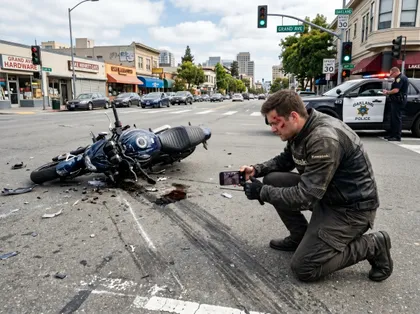
Scene evidence disappears quickly: skid marks fade, road debris is cleared, and witnesses leave. If you are physically able, start documenting before anyone moves.
Use your phone to photograph:
- Vehicle Damage: Capture your motorcycle and every vehicle involved from multiple angles. Images showing the extent of damage help establish the force of impact and support your account of what happened.
- Road Conditions: Photograph skid marks, debris, potholes, faded lane markings, or any other hazard that may have contributed to the crash. Road surface conditions on Oakland surface streets can deteriorate quickly between city maintenance cycles.
- Your Injuries: Document visible cuts, bruises, road rash, or swelling right at the scene. Injury appearance changes within hours, so early photographs matter.
- Traffic Controls and Intersection Layout: Include nearby signs, signal lights, lane markings, and a full view of the intersection or roadway. These images can help show whether a driver ran a red light, failed to yield, or violated a lane restriction.
Beyond photographs, gather the following before you leave:
- The other driver’s full name, license plate number, insurance company name, and policy number.
- Names and phone numbers of witnesses. They are difficult to locate once they leave the scene.
- The responding officer’s badge number and the incident or accident report number. That way, you can obtain the official collision report from the OPD or CHP later.
Once you are home, store your damaged motorcycle and riding gear, such as helmet, jacket, and gloves, somewhere secure. Do not authorize repairs or dispose of any item before consulting with an attorney. This physical evidence can show how the crash occurred and what forces your body absorbed.
Get Medical Care Without Delay
Adrenaline released during a crash could mask pain, which means you can feel physically fine while sustaining a concussion, internal bleeding, or a spinal injury. Symptoms of these conditions often surface hours or even days after the crash, by which point the window for early treatment may have narrowed.
Wilma Chan Highland Hospital Campus, at 1411 East 31st Street in Oakland, is Alameda Health System’s flagship hospital and the East Bay’s first designated Level I Adult Trauma Center. With 236 inpatient beds and trauma specialists available around the clock, it is the primary destination for serious crash injuries in this region. Alta Bates Summit Medical Center – Summit Campus is another Oakland acute-care option for crash victims who do not require emergency transport.
Whether you go to an emergency room, a specialist, or a chiropractor, that first appointment creates a medical record that connects your injuries to the crash. Arash Law’s Oakland motorcycle accident attorneys use these records to support damage claims. If you delay care by several days, the opposing insurer will likely argue that something else, not the crash, caused your injuries, and a gap in treatment gives them evidence to make that argument.
If you have been injured and need to understand your options, call Arash Law at (888) 488-1391 for a free initial consultation.
File The Required Crash Reports
California imposes two distinct reporting requirements after a motorcycle crash, and each serves a different purpose.
Oakland Police Department Report. If the OPD responded, follow the City of Oakland’s current vehicle-collision-report instructions. Reports may be requested online, by mail, or in person through the location identified by OPD, currently the Eastmont Substation Traffic Investigations Unit at 2651 73rd Avenue.
If the CHP responded instead because the crash occurred on a state roadway, request the report directly from the CHP.
DMV SR-1 Form. Under California law, any driver involved in a crash that caused injury, death, or more than $1,000 in property damage must file an SR-1 form with the California DMV within 10 days of the crash. This is a driver reporting obligation, separate from your lawsuit deadline and separate from any government claim deadline. Failing to file can result in license suspension.
The reporting steps, in order, are:
- Report the crash to the OPD or the CHP if you have not already done so. It is required when an injury or death occurs, under the California Vehicle Code § 20008.
- Complete DMV Form SR-1 and submit it to the DMV within 10 days if the injury, death, or $1,000 damage threshold applies.
- Request your collision report from the online Police Reports Portal, from the OPD Eastmont Substation by mail or in person, or from the CHP once it is available. The OPD states that traffic collision reports are typically available within 60–90 days of the collision. This timeline may vary if you’re requesting a copy of a CHP report.
- Keep copies of all submitted forms and received reports in one folder, alongside your photos and medical records.
Handle Insurance Communications With Care
The other driver’s insurance company may contact you within hours or days of the crash. Their adjuster’s role is to evaluate the claim and limit the payout. Anything you say, including offhand comments about how you feel, can appear later in their written assessment.
Notify your own insurer promptly. Most policies require it, and late notice can complicate your own coverage. When you call, limit what you share to basic facts: the date, the location, and who was involved.
Two things to avoid until you have legal guidance:
- Speculating about fault or saying you are “fine” or “not that hurt.”
- Giving a recorded statement to the other driver’s insurer.
California applies a legal rule called “pure comparative negligence,” established in Li v. Yellow Cab Co., 13 Cal. 3d 804 (1975). Under this rule, your compensation is reduced by whatever percentage of fault is assigned to you. If you are found 25% responsible, you recover 25% less. A recorded statement made before you understand the full picture of the crash can give the insurer facts they use to increase your share of fault.
Before providing any statement to the other side, consider seeking free advice from a personal injury lawyer. Legal counsel can advise you on what to say, or handle all insurer communications directly so you can focus on recovery.
Your Right To Compensation And The Deadlines That Protect It
If another driver, a government entity, or a third party caused your Oakland motorcycle crash, California law gives you the right to seek compensation for your losses. That right exists only within specific time windows. Miss them, and you may lose the ability to file at all.
What you may be able to recover:
- Medical Expenses: Emergency transport, hospital care at facilities like Wilma Chan Highland Hospital Campus, surgeries, physical therapy, chiropractic treatment, and projected future care costs.
- Lost Income: Wages, salary, or self-employment earnings you could not earn while injured.
- Property Damage: Repair or replacement costs for your motorcycle and riding gear.
- Pain and Suffering: Compensation for the physical pain and disruption the crash caused to your daily life.
- Emotional Distress: Anxiety, post-traumatic stress, or depression resulting from the crash and its aftermath.
Filing deadlines you must track:
California Code of Civil Procedure § 335.1 generally gives you two years from the date of injury to file a personal injury lawsuit at the Alameda County Superior Court’s Oakland location, the René C. Davidson Courthouse, subject to applicable venue, filing, electronic-filing, and courthouse-assignment rules. Missing that general two-year deadline typically bars recovery for all damages, including medical bills, lost wages, and everything else.
If a government entity contributed to your crash, as an AC Transit bus, a city vehicle, or a dangerously maintained public road, a separate, shorter deadline applies. Under California Government Code § 911.2, you must file a formal government tort claim within six months of the crash date before you can pursue a lawsuit. The Alameda-Contra Costa Transit District’s Risk Management Department specifically handles claims against AC Transit. Missing the six-month window generally prevents you from suing the government entity, regardless of how strong your underlying case is.
These two deadlines run simultaneously and independently. The two-year statute of limitations under CCP § 335.1 governs private-party lawsuits. The six-month filing deadline under Government Code § 911.2 governs public-entity claims. Both can apply to the same crash if multiple parties were at fault.
Your medical records are the foundation of any damages calculation. Every treatment record, imaging result, or chiropractic visit note ties a specific injury to the specific crash. Without those records, establishing the dollar value of your losses becomes substantially harder.
Frequently Asked Questions About Oakland Motorcycle Accidents
Oakland motorcycle crashes raise practical and legal questions that do not always fit into a standard post-crash timeline. The answers below address the situations riders most commonly face after a crash in this city.
After a crash, you are likely managing pain, paperwork, and financial pressure at the same time. These answers are meant to give you a clear starting point, not a substitute for advice specific to your situation.
Each answer stands on its own, so you can read only what applies to you.
What If My Motorcycle Was Towed After The Crash And I Cannot Locate It?
The City of Oakland’s official website instructs residents to:
- Go to the official Auto Plus Towing website. You can enter a license plate or vehicle identification number on the site’s lookup form to find your motorcycle.
- Call Auto Plus Towing at (510) 261-8199 to locate the motorcycle. Current posted telephone hours are Monday through Friday from 8:00 a.m. to 5:00 p.m. and weekends and holidays from 8:00 a.m. to 3:30 p.m.
If the motorcycle was stolen and later recovered and towed, call OPD Records at (510) 238-3021. You will need to obtain a release form and must have a valid driver’s license and proof of ownership. Storage and towing fees may apply, so act promptly.
Can I Still Recover Compensation If I Was Not Wearing A Helmet At The Time Of The Crash?
You may still be able to pursue a claim. California’s pure comparative negligence rule allows you to seek compensation even if you contributed to your own injuries. However, if the opposing party argues that riding without a helmet worsened your head injuries, that argument may reduce your share of recovery.
The degree of reduction depends on the specific facts, the nature of your injuries, and how the parties and the court assess your contribution. This is not a reason to assume you have no case. It is a reason to discuss your situation with an attorney before reaching a conclusion.
My Crash Happened On A State Freeway Near the Oakland City Border. Which Agency Do I Report To?
The California Highway Patrol typically has jurisdiction over crashes on state freeways, regardless of which side of a city boundary the crash occurred on. The OPD handles crashes on Oakland surface streets. Request your collision report from whichever agency responded. If you are unsure, call the OPD Records Division at (510) 238-3021, and they can direct you to the correct report source.
Does the Motorcycle Accident Affect My Car Insurance Policy?
Motorcycles generally require motorcycle-specific insurance because standard personal auto policies often exclude them. California law requires motorcycle operators to carry minimum liability coverage of:
- $30,000 per person for bodily injury.
- $60,000 per accident for bodily injury.
- $15,000 for property damage.
Riding without a qualifying policy puts you at financial risk if you cause a crash, and it may also limit your ability to access certain uninsured or underinsured motorist protections after a crash caused by someone else.
What Does It Mean To See A Chiropractor After A Crash, And Does It Help My Claim?
Chiropractic care is a recognized form of post-crash treatment for soft-tissue injuries: back strain, neck injuries, and joint injuries that do not always appear in ER imaging but cause lasting pain. Seeing a chiropractor promptly creates a dated medical record that connects your symptoms to the crash. That record becomes part of your damages documentation.
Gaps in chiropractic treatment, such as weeks where you stopped going without a documented reason, can be used by insurers to argue your injuries were not as serious as claimed, so consistency in follow-up appointments matters.
What If The Government Claims Deadline Has Already Passed?
The six-month government tort claim deadline under California Government Code § 911.2 is strict. Still, the law permits late-claim applications in limited circumstances, including qualifying minority or incapacity and certain cases involving mistake, inadvertence, surprise, or excusable neglect. These exceptions are narrow and require a formal written application to the public entity under California Government Code § 911.4.
Only if that application is denied, or deemed denied, may you then petition a court for relief under Government Code § 946.6. If you believe you missed the deadline, speak with an attorney immediately rather than assuming the claim is gone.
Arash Law Represents Oakland Motorcycle Crash Victims
Managing medical appointments, insurance disputes, and missed paychecks after a crash is already overwhelming. Tracking legal deadlines and evidence preservation timelines simultaneously is where injured riders lose ground. Arash Law’s Oakland motorcycle accident attorneys handle the investigation, reporting, insurer communications, and court filings so you can focus on recovery.
You may be asking: “Do lawyers only get paid if they win?” At Arash Law, yes. Our attorneys work on a contingency fee basis, meaning you pay no attorney’s fees unless we obtain a recovery on your behalf.
California Business and Professions Code § 6147 requires that the specific terms of any contingency arrangement be set out in a written agreement, which we provide at the start of representation. You retain the right to cancel that agreement. The specific fee percentage and all terms will be set out in that written agreement. There are no upfront costs and no hourly fees.
Our firm serves Oakland riders and their families across Alameda County, and our staff includes team members who speak multiple languages, so language is never a barrier to getting answers. To schedule your free consultation, call Arash Law at (888) 488-1391. This hotline is available 24 hours a day.
MAKE THEM PAY, CALL AK. Arash Law is ready to take your call.
Arash Law Case Results: Motorcycle Accidents
Past results do not guarantee future outcomes. Every case is different, and results depend on the specific facts and evidence involved.
$1,450,000 — Motorcycle Accident: Uneven Pavement at a Construction Zone. A motorcycle rider hit uneven pavement during road construction, fracturing her ribs and suffering head trauma. The contractors and the city denied liability until the first day of trial, when the case settled after sufficient compensation was offered.
About This Page
This page was prepared by Arash Law attorneys and reviewed by Arash Khorsandi, Esq. (California State Bar #249405). The procedural information, deadlines, and agency details reflect California law and local agency records as of July 2026.
Sources used in preparing this page:
- Alameda County Superior Court’s civil filing information at alameda.courts.ca.gov.
- Alameda Health System’s published facility profile for Wilma Chan Highland Hospital Campus, including its Level I Adult Trauma Center designation.
- Oakland Police Department Records Division’s published address, hours, and phone number at oaklandca.gov.
- AC Transit government tort claims page at actransit.org, confirming the Alameda-Contra Costa Transit District’s claims process.
- California Code of Civil Procedure § 335.1 (two-year personal injury statute of limitations), confirmed via the California Legislative Information portal at leginfo.legislature.ca.gov.
Additional sources:
- California Government Code § 911.2 (six-month government tort claim deadline).
- California DMV accident reporting page at dmv.ca.gov, confirming the SR-1 ten-day filing requirement.
- California Office of Traffic Safety crash rankings tool at ots.ca.gov, confirming that city-level Oakland injury and fatality rate data is available for the years 2017–2023.
This page is for general informational purposes only and does not constitute legal advice. Reading this page does not create an attorney-client relationship. Deadlines and procedures summarized here are based on California law current as of the publication date; consult a licensed California attorney for advice specific to your situation.
Reviewer Byline
Reviewed by: Arash Khorsandi, Esq.
California State Bar #249405 | Admitted 2007 | Last reviewed July 2026
Arash Law — Serving Oakland and Alameda County
Sources
- Alameda County Superior Court — Civil Filing Information. alameda.courts.ca.gov. Accessed May 2025.
- Alameda Health System — Wilma Chan Highland Hospital Campus. alamedahealthsystem.org/locations/highland-hospital. Accessed May 2025.
- Alameda Health System — Highland Hospital Named East Bay’s First Adult Level I Trauma Center. alamedahealthsystem.org. Published 2017.
- AC Transit — Government Tort Claims. actransit.org/government-tort-claims. Accessed May 2025.
- Oakland Police Department — Records Division. oaklandca.gov/Public-Safety-Streets/Police/Records-Division. Accessed May 2025.
- Sutter Health — Alta Bates Summit Medical Center, Summit Campus. sutterhealth.org. Accessed May 2025.
- California Legislative Information — Code of Civil Procedure § 335.1. leginfo.legislature.ca.gov. Accessed July 2026.
- California DMV — Accident Reporting (SR-1 Form). dmv.ca.gov/portal/dmv-virtual-office/accident-reporting/. Accessed July 2026.
- California Office of Traffic Safety — OTS Crash Rankings (Oakland city-level injury and fatality data, 2017–2023). ots.ca.gov/media-and-research/crash-rankings. Accessed May 2025.
- Li v. Yellow Cab Co., 13 Cal. 3d 804 (1975) — California Supreme Court, pure comparative negligence rule.
Disclaimer: This page is for general informational purposes only and does not constitute legal advice. No attorney-client relationship is formed by reading this content. Results in any individual case depend on the specific facts and applicable law. Past results obtained by Arash Law do not guarantee future outcomes. Arash Law is a California personal injury law firm. This page discusses California law only.