TL;DR: A person hit by a vehicle on the street is involved in a pedestrian accident. In California, fault depends on right-of-way laws, driver negligence, and comparative fault rules, and injured pedestrians may seek compensation for medical bills, lost income, and other losses, subject to a 2-year filing deadline or a 6-month limit on public entity claims.
Highlights:
- Seek immediate medical care, even if injuries seem minor.
- Call the police and request an official collision report.
- Photograph crosswalks, signals, vehicles, and visible injuries.
- Collect driver details and witness contact information.
- Preserve damaged clothing and personal belongings as evidence.
- File within 2 years – 6 months for public entity claims.
- Track medical bills, missed workdays, and income losses.
Tip: Stick to facts when speaking with insurers and keep copies of all records, reports, and written communications.
Table of Contents
When someone is hit by a vehicle while walking or crossing the road, it is called a pedestrian accident. These crashes typically occur in crosswalks, at intersections, or along busy streets where cars and foot traffic share the roadway.
Under California law, drivers must use reasonable care to avoid harming pedestrians. They must remain attentive, follow traffic signals, and yield when required. If a driver fails to meet that duty, such as by speeding or driving distracted, they may be legally responsible for the injuries that result.
When negligence causes the crash, the injured person may have the right to file a personal injury claim. Recoverable damages can include medical expenses, lost wages, and other losses tied to the accident.
When a vehicle hits someone walking or crossing the road, it is a pedestrian accident. In California, fault depends on right-of-way laws and driver negligence, and an injured pedestrian may seek compensation through an injury claim.
Understanding Pedestrian Accidents
A pedestrian accident happens when a vehicle, such as a car, truck, or motorcycle, strikes someone who is not inside a vehicle. Because pedestrians have no physical protection, even a low-speed crash can result in serious injuries.
Under California law, a pedestrian is not limited to someone walking. The term also includes:
- A person traveling on foot.
- A person using non-motorized devices, such as roller skates, scooters, or skateboards.
- A person with a mobility impairment using a wheelchair, tricycle, quadricycle, or another assistive device to get around.
These individuals share the roadway without the protection drivers have. For that reason, traffic laws set clear rules for both drivers and pedestrians to reduce crashes and help determine responsibility when one occurs.
California Laws That Protect Pedestrians
California traffic laws set clear rules for both drivers and pedestrians. These rules define right-of-way and roadway conduct. When a person violates one of these rules and a crash follows, that violation may support a negligence claim.
Drivers must follow several safety rules when sharing the road with people on foot:
- Exercise Due Care: Drivers must stay alert and take action to avoid hitting pedestrians, even if they’re outside crosswalks.
- Yield at Crosswalks: Drivers must yield to pedestrians at both marked and unmarked crosswalks.
- Avoid Passing Stopped Vehicles at Crosswalks: A driver must not pass another vehicle that has stopped to allow a pedestrian to cross.
- Obey Speed Limits & Traffic Signals: Drivers should obey speed limits and traffic signals. Following this rule helps lower the risk of collisions.
A driver who violates these rules may face civil liability if the violation results in injury.
Pedestrians also carry responsibilities under California traffic laws:
- Use Crosswalks When Available: Pedestrians must use marked crosswalks. These are found between nearby intersections with traffic signals.
- Obey Traffic Signals: Pedestrians must follow “Walk” and “Don’t Walk” signals at controlled intersections.
- Avoid Sudden Entry Into Traffic: A pedestrian must not step into the path of a vehicle so close that the driver cannot reasonably stop.
Common Types Of Pedestrian Accidents
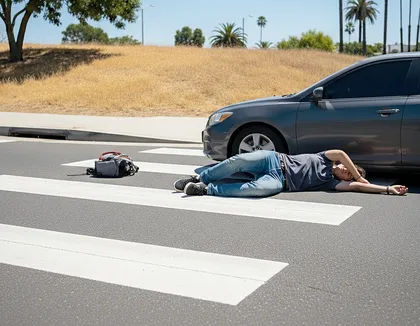
Pedestrian accidents follow predictable roadway patterns. Most incidents happen where vehicle movement and foot traffic intersect. Intersections, lane crossings, and transit stops are high-risk zones.
The following crash patterns explain how these incidents typically unfold:
- Crosswalk Incidents: Drivers strike pedestrians within marked or unmarked crosswalks. Some motorists ignore signals, misjudge distances, or fail to slow down in time, leading to direct impacts.
- Turning Vehicle Collisions: A driver turning left or right might focus on other cars. This action can lead them to miss a pedestrian crossing the street. The vehicle enters the crosswalk while the pedestrian remains in its path.
- “Multiple Threat” Crashes: One vehicle stops to allow a pedestrian to cross, but a second vehicle in the next lane continues forward. The moving driver cannot see the pedestrian because the stopped vehicle blocks the line of sight.
- Transit-Related Accidents: Pedestrians crossing in front of or behind a stopped bus face added risk. Other drivers may attempt to pass the bus without noticing a person stepping into the roadway.
Typical Causes Of Pedestrian Accidents
Driver behavior causes most pedestrian accidents. Unsafe decisions behind the wheel place people at serious risk near roadways. NHTSA’s Traffic Safety Facts report for 2023 states that 7,314 pedestrians lost their lives and an estimated 68,244 suffered an injury. These figures show the real consequences of careless driving.
Some of the top causes of pedestrian accidents include:
- Distracted Driving: When drivers look at their phones or focus on something inside the vehicle, they take their eyes off the road and may not see a pedestrian in time.
- Failure to Yield: Some drivers fail to stop for pedestrians who have the right-of-way in a crosswalk, increasing the risk of a crash.
- Speeding: Driving too fast reduces reaction time and makes it harder to stop before hitting someone.
- Impaired Driving: Alcohol or drugs affect judgment and coordination, making it harder for drivers to notice and respond to pedestrians.
- Low Lighting or Poor Road Conditions: Darkness, rain, or glare can limit visibility. Drivers who fail to slow down in these conditions increase the chance of a collision.
Injuries Commonly Seen In Pedestrian Accidents
Pedestrian accidents can cause serious injury. They may cause head injuries, spinal damage, broken bones, amputations, and severe skin injuries. The human body cannot absorb the force of a moving car. Many injuries require emergency care and long recovery periods. Some result in permanent disability or lasting pain.
Below are injuries frequently seen after a pedestrian collision:
- Traumatic Brain Injuries: A strong blow to the head can disrupt brain function. A person may experience headaches, memory loss, confusion, or changes in mood and behavior.
- Spinal Cord Injuries: Severe trauma can damage the spine and disrupt nerve signals. Some victims lose strength, sensation, or movement in parts of the body.
- Broken Bones: The crash may fracture arms, legs, ribs, or hips. Treatment may involve surgery, physical therapy, chiropractic care, and months of recovery.
- Soft Tissue Damage: Muscles, tendons, and ligaments may stretch or tear during impact. Pain, swelling, and stiffness can limit daily activities.
- Amputations: Extreme trauma may result in the loss of a limb. Amputation creates lifelong physical challenges and requires ongoing care.
- Road Rash and Skin Injuries: A pedestrian thrown onto the pavement may slide across the roadway. Friction can tear the skin and damage underlying tissue.
Legal Rights And Recovery Options For Injured Pedestrians
An injured pedestrian has legal rights after a street collision. California law allows a person injured by another party’s negligence to seek financial recovery. A claim holds the at-fault party accountable and helps recover documented losses. Taking timely action protects both health and legal interests.
After a crash, an injured pedestrian has the right to:
- Seek Medical Treatment: Prompt medical care protects your health and creates important records. These records link your injury to the collision, which can be crucial for future claims.
- Request a Police Report: An official report documents the scene, statements, and initial findings.
- Obtain Insurance Information: Drivers must provide identification and insurance details after a collision.
- File a Personal Injury Claim: A claim may proceed against the at-fault driver’s insurance policy.
- File a Lawsuit: If settlement discussions fail, a civil lawsuit may move the case forward in court.
In some cases, more than one source of recovery may be available. A claim can involve the driver’s auto insurance, uninsured motorist coverage, or a third party responsible for unsafe roads.
California law also sets deadlines. Most pedestrian injury claims are subject to a two-year statute of limitations. If your claim involves a public entity, you must initially file a government claim within 6 months of the incident. Missing these deadlines bars the right to pursue compensation in court.
Establishing Liability In Pedestrian Accident Cases
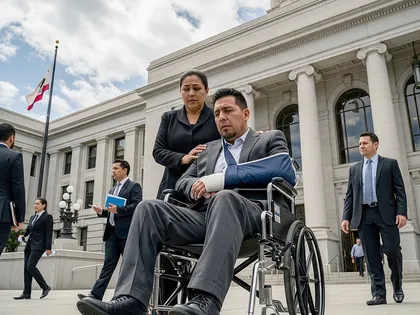
Establishing liability in a pedestrian accident case requires proving four elements. These include duty of care, breach of duty, causation, and damages. An injured pedestrian must show that another party failed to act safely and caused measurable harm. Pedestrian accident lawyers gather evidence and create the legal support needed for the claim.
To prove negligence, a claim must establish the following legal elements:
- Duty of Care: The driver had a legal obligation to operate the vehicle safely and follow traffic laws to protect people on the road.
- Breach of Duty: The driver did not meet their duty. Breaches include speeding, running a red light, or violating another traffic rule.
- Causation: The driver’s unsafe conduct directly caused the collision and resulting injuries.
- Damages: The injured pedestrian suffered measurable harm. Examples include medical expenses, lost income, and physical pain.
In many cases, the driver bears primary liability. However, other parties may share responsibility depending on the circumstances. For instance:
- An employer may share liability if the driver caused the crash while performing job-related duties at the time of the incident.
- The registered owner of the vehicle may be legally responsible if they permit an unsafe, unlicensed, or impaired person to operate it.
- A city or county can be liable if poor road design, broken traffic signals, or absent warning signs led to the crash.
Types Of Evidence That Can Strengthen Your Pedestrian Accident Claim
Strong evidence helps prove who was at fault, how the crash happened, and the harm it caused. Clear records show both the details of the collision and its impact on daily life. The following types of evidence can help support a pedestrian accident claim:
- Dashcam and Surveillance Footage: Video recordings from nearby businesses, homes, transit vehicles, or dashboard cameras can capture the moment of impact and driver behavior before the collision.
- Witness Statements: Testimony from bystanders provides independent accounts of how the accident occurred and who had the right of way.
- Scene Photographs and Videos: Images of vehicle positions, crosswalk markings, traffic signals, skid marks, lighting conditions, and roadway layout help reconstruct the event.
- Physical Evidence: Damaged clothing, shoes, and personal belongings, along with vehicle damage patterns, support the impact analysis.
- Accident Scene Measurements: Distances from the curb, crosswalk, vehicle position, and point of impact help experts evaluate speed and reaction time.
- Preservation Letters and Retained Records: Written notices requiring the preservation of video footage, vehicle data, or maintenance logs protect critical evidence from deletion.
- Employment and Wage Records: Pay stubs, employer letters, and time-off documentation establish lost income and reduced earning capacity.
- Medical Records and Treatment Notes: Emergency reports, diagnostic imaging, prescriptions, and therapy records link injuries directly to the collision.
Damages Recoverable In A Pedestrian Accident Claim
An injured pedestrian may recover economic and non-economic damages after a crash. The law permits compensation for measurable financial losses and the personal impact of the injury. The categories below outline the main types of damages available in a pedestrian accident claim.
- Economic Damages: These damages cover financial losses. You can calculate them using medical records, pay stubs, invoices, and expert evaluations. They may include:
- Medical Expenses: Hospital stays, surgery, medication, physical therapy, rehabilitation, and future medical care related to the injury.
- Lost Income: Wages lost while recovering and unable to work.
- Loss of Future Earning Capacity: Reduced ability to earn income due to long-term or permanent injury.
- Property Damage: Costs to repair or replace personal items damaged during the collision, such as clothing, phones, or other belongings.
- Non-Economic Damages: These compensate for the personal impact of the injury. These losses do not come with receipts but affect daily life in significant ways. Among them are:
- Pain and Suffering: Ongoing discomfort and physical limitations caused by the injury.
- Emotional Distress: Anxiety, depression, trauma, or sleep disturbances resulting from the crash.
- Loss of Enjoyment of Life: Reduced ability to participate in activities or routines once enjoyed.
In rare cases, a court may award punitive damages if the defendant acted with oppression, fraud, or malice. Under California law, malice includes conduct done with a willful and conscious disregard for the safety of others. Punitive damages do not compensate the injured person for losses. Courts impose them to punish wrongful conduct and discourage similar behavior.
What Is Comparative Negligence And How Does It Affect Your Claim?
California follows a pure comparative negligence rule. Courts divide fault between the parties involved in a pedestrian accident. An injured pedestrian may recover compensation even when partially responsible for the crash. The court reduces the total damages by the assigned fault percentage.
Under this system, the court assigns each party a percentage of responsibility based on the evidence. The final award reflects that allocation. Example:
Total Damages = $100,000
Pedestrian’s Fault = 30%
Amount Deducted for Fault:
$100,000 × 0.30 = $30,000
Final Recovery:
$100,000 − $30,000 = $70,000
Insurance companies may argue that a pedestrian crossed outside a crosswalk or failed to observe traffic. A pedestrian accident lawyer can present evidence to challenge inflated fault claims and advocate for an accurate percentage allocation.
Frequently Asked Questions About Pedestrian Accidents
The answers below address common concerns about legal rights, fault, compensation, and next steps after a pedestrian accident.
What Should I Do After Being Hit On The Street?
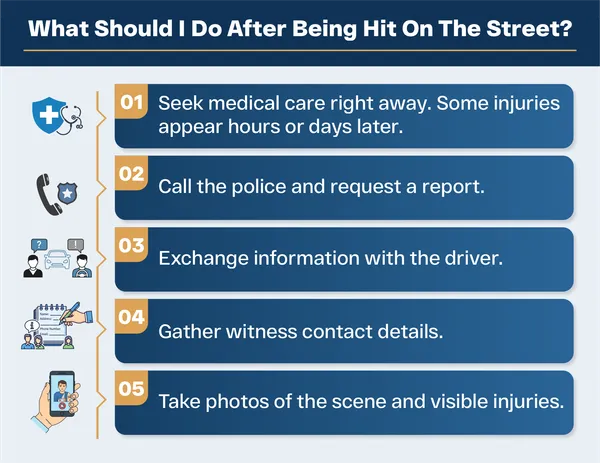
Take immediate steps to protect health and legal rights:
- Seek medical care right away. Some injuries appear hours or days later.
- Call the police and request a report.
- Exchange information with the driver.
- Gather witness contact details.
- Take photos of the scene and visible injuries.
Prompt action creates a clear record of the event and helps preserve key evidence.
What If The Driver Fled The Scene?
Leaving the scene of a crash is a hit-and-run offense. The driver may face criminal charges, fines, and civil liability. Law enforcement investigates these incidents and may use surveillance footage, vehicle debris, or witness statements to identify the driver. Even if the driver remains unknown, other insurance options, such as uninsured motorist coverage, may provide a path to financial recovery.
Can A Non-U.S. Citizen File A Pedestrian Accident Claim?
Yes. Immigration status does not prevent a person from filing a personal injury claim. Courts evaluate negligence, causation, and damages without regard to citizenship. An injured pedestrian has the same right to seek compensation for medical expenses and lost income as any other claimant.
What If My Injuries Seem Minor?
Seek medical evaluation even if symptoms seem mild. Some injuries, such as concussions or internal trauma, may not show immediate signs. Early treatment protects your health and provides documentation linking the injury to the crash. Delayed care may give insurance companies grounds to question the seriousness of your claim.
Is It Worth Working With A Pedestrian Accident Lawyer?
Yes, it is worth getting an attorney for a pedestrian accident. They review evidence, identify liable parties, calculate damages, and handle communication with insurance companies.
Many injured pedestrians reach a point where they ask, “Do I need a personal injury lawyer?” This question usually arises after high medical bills, lost wages, or disputes over fault. Legal representation helps organize the claim, present clear proof of damages, and pursue the maximum compensation under California law.
How Much Does It Cost To Hire A Pedestrian Accident Lawyer?
Most pedestrian accident lawyers work on a contingency fee basis. That means they do not charge upfront fees for legal services. Instead, payment is a percentage of the recovery obtained through a settlement or court award. So, do lawyers only get paid if they win? Under this payment structure, the answer is yes. If there is no recovery, the client typically does not owe attorney’s fees.
Protect Your Legal Rights After A Pedestrian Accident
A pedestrian accident can lead to medical bills, lost wages, and uncertainty about the future. Taking prompt action protects your rights and preserves important evidence. Consulting a legal professional helps you understand your options before dealing with insurance adjusters.
Our pedestrian accident lawyers handle all communication with insurance companies. We evaluate liability and determine the full value of your losses. Our goal is to present a compelling, well-documented claim.
Arash Law offers a free initial consultation so you can ask questions and understand your legal options without financial pressure. You can also receive free advice from a pedestrian accident lawyer to better evaluate your situation and potential recovery.
Call AK Law today at (888) 488-1391 to schedule your free initial consultation.