TL;DR: After a rideshare crash, riders need a personal injury lawyer with ride-hailing experience who can prove app status and fault using GPS and trip logs. If the lawyer does not demand preservation, the company can delete app data within days, leaving you stuck with coverage gaps and unpaid medical bills.
Table of Contents
Dealing with the pain and stress of a crash, you may wonder: What type of attorney can help me after a Lyft accident? The answer is a personal injury lawyer with specific experience handling rideshare claims under California Transportation Network Company (TNC) laws.
Being hurt in a rideshare crash is physically and financially draining. You likely face medical bills and lost wages as you navigate the recovery process.
The uncertainty of the situation is also difficult to manage. You may feel unsure about who is responsible for your injuries or which insurance company should cover your costs.
Lyft accident claims involve layered insurance policies and aggressive corporate defense strategies. California TNC regulations add another layer of complexity to these cases. Understanding these distinctions allows a victim to identify the right legal support to pursue the full compensation they may be entitled to under the law, which defines liability as the legal responsibility for damages.
Why You Need A Personal Injury Lawyer With Rideshare Experience
If you are searching for a personal injury lawyer after a Lyft crash, the answer is yes, but the type of lawyer matters. Lyft accidents require an attorney with specific Transportation Network Company (TNC) experience because Proposition 22 fractures legal responsibility for the accident across multiple insurance policies.
Most personal injury attorneys handle car accident claims every day. But a Lyft crash introduces legal questions that fall outside that routine. TNC claims require knowledge of California rideshare statutes and the interplay between a driver’s personal policy and Lyft corporate coverage. They also involve procedural steps to preserve digital evidence before it is lost.
Proposition 22 is the core issue. In 2020, Lyft and Uber spent over $200 million to pass Proposition 22, which exempted app-based drivers from California’s AB 5 worker classification law. Because drivers are classified as independent contractors rather than employees, Lyft is not automatically liable for a driver’s negligence, meaning their failure to exercise reasonable care, the way an employer would be. Lyft often uses this classification as a legal shield to push responsibility onto the driver.
The insurance coverage that applies depends on what the driver was doing at the moment of the crash. You could be dealing with the driver’s personal insurer, Lyft’s corporate policy, your own coverage, or some combination of all three. Coverage shifts based on the driver’s app status at the moment of impact, a detail that requires an attorney who knows how to pull and read that data. This contractor classification creates a complex coverage landscape that a standard car accident attorney may not be equipped to navigate.
How A Lawyer Navigates Lyft’s Complex Tiered Insurance Periods
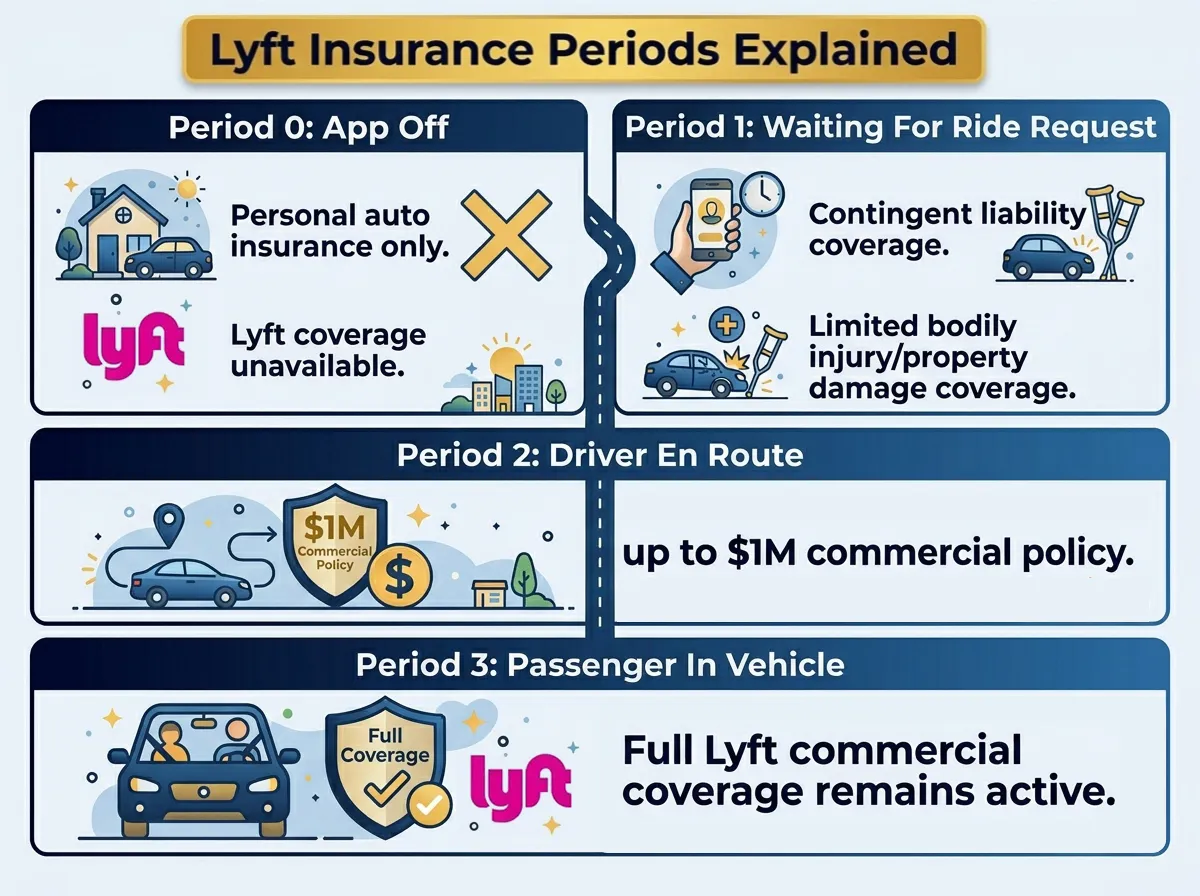
California Assembly Bill 2293 (AB 2293) created four distinct insurance periods for rideshare drivers based on their app status. Identifying the correct period is the most important legal task in your case. Available coverage ranges from a driver’s personal policy to a $1 million commercial policy based on one timestamped fact.
Each period carries different coverage rules:
- Period 0 — App Off: The Lyft app is completely closed. Lyft’s insurance does not apply at all. Only the driver’s personal auto policy covers the crash, and many personal policies contain rideshare exclusions that may reduce or deny the claim entirely.
- Period 1 — App On, No Ride Accepted: The driver is logged in and waiting for a request. Under AB 2293, Lyft must provide contingent liability coverage of $50,000 per person for bodily injury, $100,000 per accident for all bodily injuries combined, and $30,000 for property damage. This coverage activates if the driver’s personal insurer denies or limits the claim.
- Period 2 — En Route to Pick Up a Rider: The driver has accepted a ride request and is driving to the pickup location. Lyft’s full $1 million commercial liability policy applies as the primary coverage from this moment forward.
- Period 3 — Passenger On Board: The rider is in the vehicle until the trip ends at drop-off. The same $1 million commercial policy applies throughout this period.
Senate Bill 371 (SB 371), effective January 1, 2026, changed the requirements for uninsured and underinsured motorist (UM/UIM) coverage. While the $1 million primary liability requirement remains for Periods 2 and 3, SB 371 lowered the required UM/UIM protection to $60,000 per person and $300,000 per accident. In serious injury cases, this $60,000 cap may be exhausted quickly, making your own UM/UIM policy vital.
Knowing which period applied matters only if you can prove it. App logs, GPS records, and timestamped trip data are the evidence that establishes the period with certainty, and that digital evidence is not preserved indefinitely.
The Crucial Role Of Your Attorney In Preserving Lyft App Data
A police report captures the immediate aftermath of a crash, but it fails to document the driver’s status on the rideshare app at the time of the collision. This data determines which insurance policy applies to your claim. An attorney secures this critical evidence to protect your rights before corporate systems delete it.
Within 24 to 48 hours of being retained, a Lyft accident attorney will send a spoliation letter to the company. This formal demand requires Lyft to preserve specific records and halt any routine data destruction. Without this intervention, Lyft may purge trip records, GPS logs, and driver activity data on a rolling schedule, sometimes within days of the accident.
The digital evidence secured through this process includes:
- GPS Logs: Precise location and movement data that show where the driver was and how the vehicle was being operated at the time of the crash.
- Timestamped App Status: The exact on/off state of the Lyft app at the moment of impact, which establishes which insurance coverage period was active.
- Driver History: Records of prior trips, ratings, and account activity that may be relevant to establishing the driver’s conduct.
- Route Data: The full trip path and timing, which can confirm or contradict statements made by the driver or insurer about what was happening during the ride.
Corporate data purge windows are not hypothetical. Lyft manages enormous volumes of data, and routine deletion is part of standard operations. An injured victim acting alone has no legal mechanism to stop that process. An attorney does.
This preserved evidence does more than answer a technical question about insurance coverage. It establishes who is liable for your injuries, which serves as the foundation for proving fault and ultimately calculating the compensation you may be entitled to recover.
Why Your Lawyer’s Experience Matters For Proving Liability And Calculating Damages
Imagine a rideshare crash where you were riding in a Lyft and a third driver ran a red light, but the Lyft driver was also speeding. An experienced lawyer understands how to navigate California’s comparative fault rules, identify every category of loss you can claim, and build documentation to maximize your recovery.
California’s pure comparative negligence system, rooted in Civil Code § 1714, determines liability when multiple parties share fault. Under this rule, your ability to seek compensation is not eliminated by your own share of fault. For example, if a jury finds you 20% at fault, your total awarded compensation is reduced by that same 20%. Insurers and defense teams often try to inflate your fault percentage to reduce their payout. California accident lawyers know how to counter that strategy using the digital evidence and witness testimony already secured.
Economic damages cover losses documented with bills and records. They include:

- Medical Expenses: Emergency care, hospitalization, surgery, and follow-up treatment you have already received.
- Future Medical Costs: Ongoing treatment, physical therapy, and any procedures a physician projects you will need.
- Lost Wages: Income you lost while recovering, and any reduction in your future earning capacity if your injuries affect your ability to work.
Non-economic damages cover losses that cannot be shown on a receipt. They include physical pain, emotional suffering, anxiety, and long-term psychological trauma from the crash and its aftermath. These losses are recoverable under California law and can represent a significant portion of your total claim.
Properly calculating damages requires coordination with the right medical professionals. If you retain an attorney, they can work with your treating doctors and may engage a chiropractor or surgeon to document the current scope of your injuries and project future treatment needs. That medical record serves as the foundation for your damages demand. Without it, insurers have room to argue your injuries were minor or pre-existing.
Insurers routinely challenge non-economic claims, making it vital to distinguish between a general practitioner and an attorney who understands the nuances of rideshare-related liability and damages.
What Questions Should You Ask Before Hiring A Lyft Accident Attorney?
Choosing the right attorney for a Lyft accident claim means asking technical questions during your initial interview. These answers will clarify whether a firm can navigate the four coverage periods under California AB 2293, subpoena app data, and fight for fair value on your behalf.
Before you hire anyone, ask these questions directly:
- Rideshare Case History: Have you handled Lyft and Uber accident cases specifically, not just car accident claims in general? How many rideshare cases have you taken to settlement or trial in California?
- TNC Insurance Knowledge: Can you explain the four coverage periods under California AB 2293 and how each period affects the available insurance?
- Digital Evidence Capability: Do you know how to subpoena Transportation Network Company (TNC) app logs, GPS records, and driver activity data to establish which coverage period was active at the moment of impact?
- Financial Resources: Does your firm advance all case costs, including fees for medical experts, accident reconstruction specialists, and economic loss analysts, without requiring payment up front?
- Fee Structure: Do you work on a contingency fee basis, meaning you only get paid if my case is resolved in my favor?
If you want to understand your options before committing, seeking free advice from a Lyft accident lawyer costs you nothing and gives you a clearer picture of your situation.
You Need An Attorney Who Knows The Deadlines For California Lyft Accident Claims
California law sets firm deadlines for filing a Lyft accident claim, and missing them permanently ends your right to recover any compensation. Under California Code of Civil Procedure § 335.1, you generally have 2 years from the date of the crash to file a personal injury lawsuit. Acting quickly protects that right.
The standard 2-year deadline applies when all parties involved are private individuals or companies, including Lyft and its drivers. If you were injured in a Lyft collision that also involved a government vehicle, such as a city bus or public transit vehicle, a separate and much shorter deadline applies. You must file a government tort claim within 6 months of the crash. Lyft vehicles collide with city transit in major California metros, including Los Angeles, San Francisco, and San Diego, making this exception relevant in many real cases.
If the injured person is a minor, the statute of limitations (the legal deadline for filing a lawsuit) may be tolled or paused until they turn 18. Once they reach adulthood, the standard 2-year period begins to run. Other tolling exceptions exist, but they depend heavily on the specific facts of your case. Speak with an attorney to understand exactly how these deadlines apply to your situation.
Waiting to consult a lawyer does not pause any deadline. If your deadline passes before you file, you lose your right to recover compensation permanently, regardless of how serious your injuries are.
Frequently Asked Questions About Hiring A Lyft Accident Lawyer
After a Lyft accident, it is common to have pressing questions about whether the driver was insured, who will pay your bills, and how long the process will take. Dealing with multiple insurance carriers and understanding your rights can be an incredibly stressful experience for you and your family. Gaining clarity on these practical legal and insurance concerns is a necessary step toward focusing on your recovery.
How Much Does A Lyft Accident Lawyer Cost In California?

Lyft accident lawyers in California typically work on a contingency fee basis. This means you pay no attorney fees up front, and the lawyer only collects a fee if your case results in a recovery. You should always ask to review the fee agreement to understand the specific terms.
Do I Have To Accept The First Settlement Offer From Lyft’s Insurance?
No. You are never required to accept an initial offer. Insurers send early offers before medical treatment ends, when the true extent of your injuries is still unknown, so they rarely reflect the full value of a claim. Once you accept a settlement and sign a release, the claim is generally closed, even if your condition later worsens.
Will My Lyft Accident Case Go To Court?
Most Lyft accident claims resolve through settlement without a trial. Insurers tend to increase their offers once litigation, the formal court process, begins, and a trial becomes a concrete possibility.
What Happens If The Lyft Driver’s App Was Off During The Accident?
If the Lyft driver’s app was completely off at the time of the crash, Lyft’s insurance does not apply. Your claim would be limited to the driver’s personal auto insurance policy. An attorney can subpoena, meaning formally request through a court order, the driver’s trip records and digital activity data to verify the actual app status, since Lyft may dispute which coverage period was active.
How Long Does It Take To Settle A Lyft Accident Claim?
A claim can take a year or longer when serious injuries, multiple insurers, or contested fault are involved. Timelines vary significantly based on these specific factors.
Do Lawyers Only Get Paid If They Win?
Yes. A brief consultation can clarify which specific factors apply to your unique case and help you understand your legal options.
Schedule A Free Consultation With A California Lyft Accident Lawyer
Call (888) 488-1391 to discuss your legal options after a California Lyft crash and learn how to protect your rights. You may be entitled to recover compensation for your medical expenses and other losses.
Arash Law is focused on rideshare accident claims in California. Our attorneys establish which insurance coverage period was active at the moment of your crash and preserve critical app data.
We also hold all responsible parties accountable for your damages. This includes the Lyft driver, a third-party driver, or the company’s own insurance providers.
Contact us to have your case reviewed, and if we represent you, our team will pursue the fair compensation you may be entitled to under California law. There are no upfront costs, and you pay no attorney fees unless we recover compensation for you.
Call (888) 488-1391 to schedule your free consultation today.