TL;DR: In a right-turn accident, turning drivers are usually at fault because they must yield to vehicles, cyclists, or pedestrians with the right of way. Fault can shift if another driver was speeding or broke traffic laws, and injured victims in California have 2 years to sue.
Highlights:
- Right-turning drivers are usually at fault if they fail to yield.
- California law follows comparative negligence, allowing shared fault for accidents.
- Evidence such as photos, police reports, and witness statements is crucial.
- Drivers must exercise due care even when they have the right of way.
- Pedestrians, cyclists, and vehicles with the right of way must be yielded to.
- Consult a personal injury lawyer to clarify liability and navigate complex cases.
Tip: Collect and preserve evidence immediately after the accident to strengthen your case.
Table of Contents
Turning drivers who fail to yield to a pedestrian, cyclist, or vehicle with the right-of-way are often at fault in right-turn accidents. According to the California Vehicle Code, the person with the right of way may move forward, while others must yield. However, multiple parties can share liability under the state’s comparative fault system.
California law requires everyone to take reasonable care to avoid harming others. Even if a driver has the right of way, they still have an obligation to avoid accidents. That means they must stay alert, scan intersections, and yield when necessary to avoid a crash.
When Is The Right-Turning Driver Not At Fault?
Here are some example scenarios where the turning driver isn’t at fault for an accident:
- The oncoming driver was speeding.
- The other driver didn’t use headlights at night.
- A pedestrian darted into the crosswalk.
- Another motorist improperly changed lanes.
- A driver ran a red light.
- A cyclist rode unlawfully, such as by traveling in prohibited lanes.
What Is Right-Of-Way In California?
In California, “right-of-way” refers to the legal right to proceed safely in traffic. It establishes the order of traffic flow at intersections, crosswalks, and roadways. Any party that fails to yield to others with the right-of-way can face liability for right-turn collisions.
Below are common right-of-way rules in California:
- The first vehicle to arrive has the right of way at a four-way stop sign. If multiple vehicles entered the intersection at the same time, the furthest one to the right may proceed.
- Drivers must obey any yield signs they encounter by slowing down and proceeding only when the road is clear. They must also give the right of way to other vehicles or pedestrians when they’re near these signs.
- Emergency vehicles with activated sirens and lights have the right-of-way. Other vehicles must yield to them by pulling over to the side of the road.
California Laws That Influence Right-Turn Accidents
Specific provisions of the California Vehicle Code influence right-turn accidents. These laws govern lane positioning, yielding, signaling, and whether turning on a red light is legal. They can determine whether the turning driver or another road user is liable for an accident.
In California, someone is “negligent per se” if they caused harm by breaking a law. For example, suppose a speeding car driver hits a biker turning right. Their violation of the state’s basic speed law will serve as proof of their negligence.
Car accident lawyers review cases to clarify what laws apply and may prove negligence per se. Here are some of the key California Vehicle Codes (CVC) that can influence right-turn accidents:
- CVC 22100: Drivers turning right must be as close as possible to the right-hand curb. Certain exceptions apply to:
- Highways with three marked lanes for traffic moving in one direction. Drivers in the middle lane may turn right into any lawfully available lane.
- Right-hand turns from one-way highways at an intersection. Drivers may approach and turn into any lawful lane.
- Protected right-turn lanes with signs and markings. Drivers may turn right at designated lanes.
- CVC 22108: Drivers must use their turn signals. They should switch on their signals at least 100 feet before making a turn. Notably, drivers who signal a turn do not have the absolute right of way. They must still exercise due care to avoid a crash.
- CVC 21453: Drivers may turn right on a red, circular signal under specific circumstances. They may complete the turn after stopping, and there is no sign prohibiting it. Drivers must also yield to pedestrians or other vehicles close enough to constitute a hazard. They cannot make a right turn on red (ROTR) in the following situations:
- There’s a sign that explicitly prohibits turning on a red light.
- They’re in front of a solid red arrow signal. They have to stop here and may only proceed once it turns green.
- CVC 21950: This law outlines pedestrian right-of-way rules. Pedestrians generally have the right of way at unmarked or marked crosswalks. However, they must still use due care to avoid accidents.
- CVC 21717: Drivers must yield to cyclists in bike lanes. The only times they can enter these lanes are when they’re parking or preparing for a turn within 200 feet.
Common Right-Turn Accident Scenarios
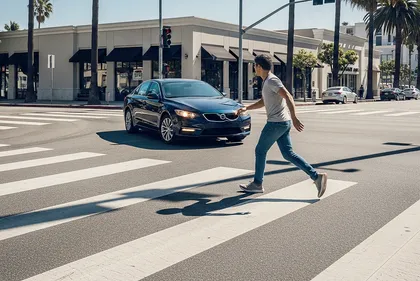
Right-turn accidents commonly occur when turning drivers fail to yield to another road user with the right of way. As a result, these crashes can happen in different ways. For example, they can involve two vehicles or a driver and a pedestrian. Commercial vehicles, such as trucks, can also cause unique right-turn accidents due to their size and weight.
Below are common scenarios in right-turn accidents:
- ROTR (Vehicle Versus Vehicle): Auto collisions can occur when one driver turns right on a red light.
- ROTR (Pedestrian in Crosswalk): These accidents occur when drivers fail to check for pedestrians before making a right on red.
- Right Turn On Green (Pedestrian In Crosswalk): The turning driver with a solid green signal may proceed. However, they must stop and yield to pedestrians and oncoming traffic.
- Right Hook Bicycle Collision: A “right hook” occurs when drivers encroach on bike lanes and cause a crash. These happen when drivers turn right across a bike lane, misjudge their speed, or neglect to check their blind spots.
- Wide Right Turn & Sideswipe: Wide-turning vehicles often occupy the second lane when making this turn. California law grants limited exceptions for necessary swingouts made by commercial vehicles such as trucks. Despite that, truck drivers must still exercise caution by:
- Checking “no zones” or blind spots.
- Managing trailer off-tracking.
- Maintaining proper lane control.
Proving Fault In A Right Turn Accident
To prove fault in a right-turn accident, victims must establish the other party’s negligence. California law obligates everyone to exercise due care to avoid harming others. The other party may be legally responsible for the crash if they broke traffic laws, failed to yield, or acted negligently.
Victims must demonstrate the following essential elements of negligence to have a valid right-turn accident injury claim:
- Duty: The at-fault party owed the victim a duty to act reasonably and prevent harm.
- Breach: They failed to fulfill that duty.
- Causation: The breach caused the accident.
- Damages: The victim suffered actual harm.
To illustrate, suppose a driver turned right on red. However, they did not check for pedestrians before turning. As a result of this breach, they hit a pedestrian crossing the street they entered. The victim broke their leg and needed surgery. They incurred significant medical bills and lost wages because they had to take time off work.
What Evidence Is Needed To Prove Fault In A Right-Turn Accident?
Proving fault in a right-turn accident requires evidence that the at-fault party acted negligently. The necessary proof can come from photos, police reports, traffic camera footage, and medical records. Some of these can be time-sensitive and must be obtained immediately. Otherwise, it can be more challenging for victims to prove their cases to insurers.
- Police Reports: Official records of the accident. These may detail vehicle positions and the officer’s preliminary assessment of fault. Insurers often use these reports to determine liability, especially in contentious right-turn accidents.
- Witness Statements: Firsthand accounts from eyewitnesses. Witness testimonies offer an unbiased outside perspective of the accident.
- Photos: Visual evidence of the crash that helps illustrate how the crash occurred. They can also document property damage and visible injuries.
- Traffic/Security Camera Footage: Video of how the accident unfolded. Traffic cameras and commercial and residential security systems may have recorded footage. However, these systems often overwrite their data quickly. Early preservation through preservation of evidence letters may be necessary.
- Traffic Signal Data: Help establish whether a driver broke traffic laws. Data may also indicate whether a signal malfunction caused the crash.
- Vehicle Damage: Provides clues about how the crash occurred. Accident reconstruction experts often analyze the vehicles involved in the crash to determine the cause.
- Event Data Recorders: Carried by commercial vehicles like trucks. These “black boxes” can provide insights into speed, braking, and steering input before the impact.
Who May Be Liable In A Right-Turn Crash?
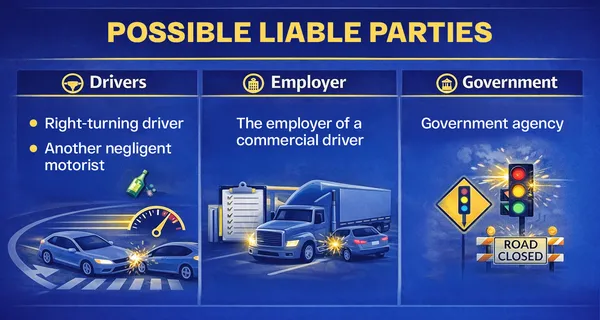
In a right-turn accident, fault usually falls on the right-turning driver who fails to yield to oncoming traffic. However, liability may also extend to other motorists if they broke traffic laws or acted negligently. Employers and government entities may also share responsibility in certain cases.
Below are some of the potentially liable parties in a right-turn crash:
- Drivers: Some scenarios when a driver could be liable for a right-turn crash are:
- A right-turning driver who fails to yield the right of way.
- An oncoming driver who causes the accident by acting negligently, such as by speeding or driving under the influence.
- Employer: Under the legal concept of “vicarious liability,” an employer can be responsible if an on-duty employee causes an accident. They may also face liability for negligent hiring, training, and supervision. For example, suppose a truck driver fails to check their blind spots before turning right. Their employer may be vicariously liable for the resulting injuries.
- Government: To illustrate, suppose a malfunctioning traffic signal causes a right-turn crash. The government agency responsible for maintaining traffic infrastructure in the area may face liability.
How Comparative Negligence Applies To California Right Turn Accidents
Under California’s comparative negligence system, multiple parties can share fault for a right-turn accident. Courts assign each of them a percentage of liability, which determines how much they owe in compensation. Injured victims can also contribute to a crash. Though they can still pursue compensation, their share of fault will limit their potential payout.
Let’s say the value of a right-turn accident case is $100,000. If you are:
- 10% Liable: You can only recover $90,000.
- 25% Liable: You can only recover $75,000.
- 50% Liable: You can only recover $50,000.
Available Compensation In Right Turn Accident Claims
If you have a valid right-turn accident claim, state law allows you to pursue different kinds of compensation for your injuries and losses. These “recoverable damages” can be either monetary or personal in nature. What you can seek depends on how the crash impacted your life and how it will continue to affect you in the future.
Generally, you may be able to include the following in your claim:
- Economic Damages: Covers financial losses. Evidence can include bills, receipts, and payslips. These damages include:
- Current and anticipated medical bills. These include costs of surgeries, chiropractor visits, and assistive devices.
- Lost income and earning potential. These include missed paychecks and job opportunities.
- Property damage. For example, victims can pursue compensation for the costs of vehicle repair or replacement.
- Non-Economic Damages: Accounts for intangible losses. Proving them can be challenging and may require extensive documentation. These damages include:
- Pain and suffering
- Emotional distress
- Loss of enjoyment of life
- Loss of consortium
- Punitive Damages: In rare cases, California courts may award these to punish the at-fault party for extreme negligence or recklessness. To seek punitive damages, victims must provide clear and convincing evidence of oppression, fraud, or malice.
- Wrongful Death Damages: After a fatal right-turn crash, eligible surviving family members can file wrongful death claims. These pursue compensation for losses such as loss of financial support, as well as funeral and burial costs.
What To Do After A Right Turn Accident In California
If you get injured in a right-turn accident, you may be eligible to pursue compensation from the at-fault party. Consider taking certain actions, such as attending follow-up doctor’s appointments and notifying your insurer. These steps can help you build the foundation of your case.
Here’s a quick list of what you can do:
- Continue Receiving Medical Care: If you were injured, make sure you see your treatment plan through to completion. Insurers may use gaps in medical care to argue that your injuries aren’t as serious as you claim.
- Notify Your Insurer: Most auto policy contracts require you to report the accidents you’re involved in, even if you didn’t cause them. However, it can also be helpful to tell your carrier about the crash because your own coverage could pay for urgent expenses while you pursue an injury claim. Deadlines for reporting vary per company, so ask your agent about your policy’s time limits if you’re unsure.
- Keep a Recovery Journal: Write about your experiences as you heal. A journal can help lawyers, insurers, and courts more accurately assess the value of your intangible losses, such as the pain and suffering caused by your injuries.
- Create an Evidence Folder: Keep all important documents in one place. Include hospital bills, auto shop receipts, and copies of police reports.
- Consult a Lawyer: A failure-to-yield accident attorney can use the evidence from the above steps to review your accident and tell you if you have a case. If you do, they can help you file a claim and pursue the compensation available to you.
Frequently Asked Questions About Who Is At Fault In A Right Turn Accident
Following a crash in California, victims typically have more questions than just “Who is at fault in a car accident turning right?” For instance, they may ask how insurers might handle their case or whether they should get legal advice about a car accident. This section aims to answer these and other common concerns.
How Do Insurers Determine Who Was At Fault In Right-Turn Accidents?
Insurers determine fault in right-turn accidents by conducting an investigation. They analyze evidence, such as police reports, traffic signal data, and witness statements. In many cases, claims adjusters assign fault to the right-turning driver who fails to yield or breaks traffic laws. However, disputes may arise over liability under California’s comparative fault system.
Should I Admit Fault In A Right-Turn Accident?
No. Saying sorry or taking the blame will give claims adjusters and courts a valid reason to assign you a larger percentage of liability. What’s more, a crash investigation might reveal that you didn’t actually cause or contribute to the crash. That said, it’s ideal to avoid apologizing, especially at the accident scene or when talking to insurers.
Who Is At Fault In A Right Turn Accident In A Parking Lot?
It depends. California’s right-of-way laws govern fault on streets and highways. However, different rules may apply in parking lots. In these crashes, a driver can be responsible if they fail to yield to those already in the parking lot when approaching. Signage and marked lanes can further influence liability assessments.
How Long Do I Have To File A Lawsuit For A Right-Hand Turn Accident?
You generally have two years to file a civil case for your right-hand turn accident in California. Section 335.1 of the state’s Code of Civil Procedure sets this deadline. Courts can dismiss your case if you miss it. That could bar you from pursuing compensation altogether.
However, some exceptions can alter the time limit:
- For cases involving minors, the deadline starts when the victim turns 18.
- The deadline may be paused for injuries that were discovered later.
- If a government agency contributed to the accident, victims must submit an administrative claim to it within 6 months. They can only sue if:
- The agency fails to respond within 45 days. The general statute of limitations applies.
- The agency denies the claim. Victims have another 6 months to file a lawsuit.
Do I Need A Personal Injury Lawyer For A Right-Turn Accident?
California law does not require you to hire a lawyer for a right-turn accident case. However, these accidents are often contentious. A personal injury lawyer can help by reviewing the available evidence to identify potentially liable parties. They can then address comparative negligence disputes and advocate for a fair assessment of fault.
Do Lawyers Only Get Paid If They Win My Right-Turn Accident Case?
Yes, this is the case for California personal injury attorneys who offer contingency fees. These lawyers will only charge you for their services if they win or settle your case. They’ll then take a percentage of the final settlement or court award. That means you don’t need to pay up front to get legal representation for your right-turn accident case.
Seek Guidance On Your Right-Turn Accident
Liability after a right-turn accident isn’t always clear-cut. While the turning driver is typically presumed liable, fault may also extend to other road users. California law also allows multiple parties, including injured parties, to share fault for a crash. Due to these complexities, many victims seek clarity by searching for free advice from car accident lawyers.
Arash Law can help. Our right-turn accident attorneys offer free initial consultations to review your case. Contact AK Law at (888) 488-1391 to schedule a meeting.