TL;DR: A car accident is a valid reason to miss work. If another driver caused the crash, California law may allow recovery of lost wages and other income losses in a personal injury claim. Eligible employees may have job-protection rights under the Family and Medical Leave Act (FMLA) or California Family Rights Act (CFRA) while recovering.
Yes. A car accident can be a valid reason to miss work, especially if you are injured, receiving medical care, or unable to perform your job safely. Taking time off to heal is not just a reasonable choice. For many crash victims, it is the most medically necessary and legally protective step they can take.
However, missing work after a crash puts real financial pressure on you at the worst possible time. Lost pay, rising medical bills, and income uncertainty pile on top of the physical pain. California law exists precisely to shift those losses back onto the party responsible for causing them.
Under California law, injured crash victims may often seek compensation for lost wages and reduced earning capacity. Paid time off or sick pay used to cover missed work does not eliminate that lost-wages claim; you may still seek to recover those losses from the at-fault driver. These are recognized categories of economic damages in a personal injury claim, though recovery depends on the facts and evidence in each case.
Keep in mind that the accident alone does not automatically make every absence legally protected.
Key Facts About Missing Work After A Car Accident
- California’s workers’ compensation system applies when the accident occurs during work. (Labor Code § 3600).
- Self-employed workers and independent contractors can also seek compensation for lost income (Civil Code § 3333).
- Under the collateral source rule, compensation you receive from independent sources generally does not reduce the economic damages an at-fault driver may be required to pay (Helfend v. Southern Cal. Rapid Transit Dist., 2 Cal. 3d 1 (1970)).
- Eligible employees may have job-protection rights under the Family and Medical Leave Act (FMLA) and California Family Rights Act (CFRA) while recovering.
- You have 2 years from the date of the accident to file a lawsuit against a private at-fault driver (CCP § 335.1).
Table of Contents

How Missing Work After A Car Accident May Lead To A Lost-Wage Claim
Missing work after a car accident isn’t just a valid reason to be absent; it can also become the basis of a lost-wage claim if someone else caused the crash. Most employers distinguish between planned absences and emergencies, and accidents clearly fall into the latter category. If you’re injured, it becomes a health-related absence.
If someone else caused your crash, you may be able to recover your financial losses. As such, lost wages can be reimbursed under California law, but the outcome depends on the specific facts of your case.
CACI 3903C allows claimants to pursue past and future lost wages resulting from the injury, as long as it’s backed by clear evidence. These generally include income missed from the accident date through the end of your case:
- Full Days Missed: Every workday you could not attend because of your injuries.
- Partial Days: Time lost for medical appointments or pain that cut your shift short.
- Overtime and Bonuses: Scheduled overtime, tips, commissions, and bonuses you did not earn because you were out.
- Sick Leave and Vacation Time: Paid time off you were forced to use because of the injury. Labor Code § 245 et seq., or California’s paid sick leave law, entitles most employees to use accrued paid sick leave for their own injury or health condition, including injuries from a car accident, regardless of fault. However, you can still seek to recover from the at-fault driver.
Lost earning capacity is a separate claim under CACI 3903D. It covers the long-term reduction in your ability to earn income as a result of your injuries. This goes beyond recent missed paychecks. It may include what you may not be able to earn for years or even decades to come, and it typically requires a vocational or economic expert to quantify.
California follows a pure comparative negligence rule, meaning your lost-wage recovery is reduced by your own percentage of fault for the crash (Civil Code § 1714; Li v. Yellow Cab Co., 13 Cal. 3d 804 (1975)). For example, if you are found 20% at fault, your recoverable lost wages would be reduced by 20%, but even partial fault does not bar you from recovering the remaining percentage of your losses.
What Evidence Do You Need To Prove Lost Wages?
Proving lost wages requires building a clear, well-documented record that links your injuries to your lost income. Insurers look for specific evidence before accepting a lost-wage claim.
The strongest evidence package typically includes:
- Pay stubs or W-2s showing your pre-accident earnings.
- An employer wage-verification letter confirming your hourly rate, salary, or typical hours.
- A physician’s note that specifically states you could not work and for how long.
- Medical records documenting the nature and severity of your injuries.
Employers’ payroll record retention policies vary, so requesting documentation promptly after the accident is advisable.
The California Employment Development Department (EDD) also maintains wage records that may be obtainable through a formal legal process if employer records are unavailable; a car accident lawyer can assist you with the process.
Arash Law has recovered over $1 billion for injured clients across California. Call (888) 488-1391 for a free case evaluation about your California car accident claim.
How Independent Contractors And Gig Workers Prove Lost Income
California law allows self-employed workers and independent contractors to seek compensation for lost income after a crash, even without traditional pay stubs (Civil Code § 3333; CACI 3903C). The right records can be just as compelling to a jury or insurer.
- Rideshare and delivery drivers for platforms like Uber, Lyft, or DoorDash may use earnings reports and 1099 forms from their app dashboards to document past income. Acting quickly to download these records is advisable because some platforms archive or restrict access to older earnings data.
- Freelancers can use client contracts, send invoices, and email clients about canceled or postponed projects to establish what they lost. A clear paper trail of promised work that did not happen because of the crash carries real evidentiary weight.
- Small business owners can show losses through profit-and-loss statements or the cost of hiring a replacement worker during their recovery. If the business finances are complex, a forensic accountant can help quantify losses and organize complex financial records in a form that may support an economic-damages claim in court.
The sooner records are gathered after the accident, the stronger the evidence base. Waiting can mean losing access to data that no longer exists.
Can You Be Fired For Missing Work After A California Car Crash?

California is generally an at-will employment state, but that does not mean your employer can freely terminate your employment for missing work after a crash. The Family and Medical Leave Act and the California Family Rights Act may shield your job while you recover. These laws provide unpaid, job-protected leave for serious health conditions.
However, these protections do not apply automatically to every employee or injury.
- Family and Medical Leave Act (FMLA): It generally covers employees who have worked for an employer with at least 50 employees within 75 miles for more than 12 months and have completed at least 1,250 hours during the preceding 12 months.
- California Family Rights Act (CFRA): It generally requires 12 months of employment, 1,250 hours of service, and an employer with at least 5 employees.
Under either law, the crash injuries must amount to a qualifying serious health condition that prevents the employee from performing essential job duties or otherwise meets the law’s medical requirements.
However, even if you do not qualify for FMLA or CFRA, crash-related physical or mental limitations may qualify as a disability under California employment law. Employers with five or more employees generally must engage in a timely, good-faith interactive process and provide reasonable accommodation unless it would cause undue hardship. Depending on the circumstances, accommodation may include medical leave, modified duties, or a changed work schedule.
Terminating an eligible employee for taking this leave may be unlawful under 29 U.S.C. § 2615(a)(1). If you were dismissed because of your crash injuries, you do not have to absorb that loss alone. Those lost earnings, including wages lost after an allegedly unlawful termination, can potentially be part of your personal injury claim against the at-fault driver. These protections apply to crashes that happen off the clock. Different rules apply if the accident occurred while you were working.
What If The Car Accident Happened While You Were Working?
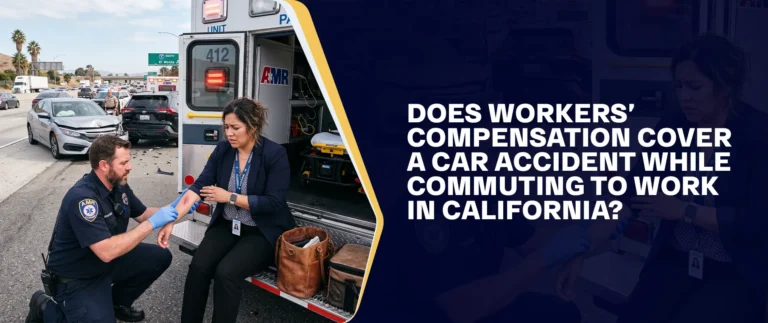
When a crash happens while you’re doing your job duties, California’s workers’ compensation system applies. Workers’ comp covers your medical bills and a portion of your wages, and critically, you do not need to prove another party’s fault to receive these benefits. The California Division of Workers’ Compensation (DWC), a division of the Department of Industrial Relations, administers these claims.
The threshold question is whether the crash happened in the course of employment. Your regular daily commute is not covered under California’s “going and coming” rule; the law treats that drive as personal time, not work time. Your travel may fall within the course of employment if any of these apply:
- Special Mission: Your employer asked you to run an errand or perform a task outside your normal duties.
- Mobile Employee: Your job regularly requires travel between job sites as part of your core work.
- Employer-Provided Transportation: The commute may be covered when transportation is part of the employment agreement or the travel provides a benefit to the employer beyond the employee’s ordinary commute. Merely driving an employer-provided vehicle with permission does not automatically make the trip work-related.
If someone other than your employer caused the crash, you may also have a third-party personal injury claim in addition to your workers’ comp claim. A workplace accident lawyer can review your case and help you pursue both simultaneously. A third-party claim may allow you to seek categories of damages (like pain and suffering or full lost wages) that workers’ comp alone does not cover.
Workers’ compensation claims run on a separate, shorter clock than a personal injury lawsuit:
California law generally requires notifying your employer of a work injury within 30 days (Labor Code § 5400) and filing a workers’ compensation claim within one year of the date of injury (Labor Code § 5405).
These deadlines are independent of, and typically much shorter than, the two-year statute of limitations for a personal injury claim against an at-fault third party (California Code of Civil Procedure, CCP § 335.1).
It’s also different from the government claim deadline. If the at-fault driver was operating a government vehicle (such as a city bus, municipal truck, or state fleet vehicle) or the crash was caused by a dangerous roadway condition, California Government Code § 911.2 requires you to file a formal administrative claim with the public entity within six months of the accident date before you can file a lawsuit. Failing to present a timely government claim can completely bar you from recovering lost wages from the at-fault agency.
Whether the crash was work-related or not, acting quickly and building a clear record is essential to protecting both your job and your income.
Immediate Steps To Protect Your Job After A Car Accident
To protect your job and income after a California crash, notify your employer in writing immediately, and begin preserving payroll and medical records. Missing work after an accident without communicating clearly with your employer may give them grounds to classify the absence as unexcused. Acting quickly and creating a paper trail can prevent that outcome and strengthen your eventual claim.
Follow these steps:
- Notify Your Employer in Writing: Send an email or certified letter as soon as possible. A dated written notice creates a record that your employer was informed, and when they were notified. This step alone can prevent an unexcused absence dispute later.
- Get Detailed Medical Documentation: A doctor’s note should specifically state what you cannot do, what your physical restrictions are, and how long you are expected to be unable to work. A vague note gives your employer and their insurer room to argue that they were not properly informed of the extent of your injuries.
-
Request FMLA or CFRA Paperwork Promptly: Eligible employees can submit a formal leave request under FMLA or CFRA. Start with your HR department to confirm eligibility and get the paperwork moving; clock delays in the leave request process can create gaps in your protection.
If the crash was not work-related, you may also qualify for California State Disability Insurance. Disability Insurance provides short-term, partial wage replacement to eligible workers who cannot perform their regular work because of a certified injury. These payments do not independently protect your job, so you may need to coordinate them with FMLA, CFRA, or a reasonable-accommodation request.
- Preserve Your Evidence: Download earnings data from any app platforms. Send a written preservation demand to your employer for all payroll and HR records related to your employment. Request your medical records under California Health & Safety Code § 123110. If the California Highway Patrol (CHP) investigated the crash, an involved or otherwise interested party can request the collision report through CHP’s report-release process, generally by submitting Form CHP 190 with identification and the applicable fee. Request it promptly because processing may take time.
Recovering from a crash while managing HR paperwork, insurance calls, and medical appointments is genuinely hard. Speaking with work injury lawyers can help you understand whether a third-party personal injury claim is available in addition to any workers’ compensation benefits, and how to pursue both without jeopardizing either.
What Arash Law Has Recovered For Car Accident Victims
Arash Law has recovered over $1 billion for injured clients across California. Below are some case results that reflect the range of economic and non-economic losses at stake when a serious crash accident takes you off the road and out of work.
Results in car accident cases have included:
$2,200,000 Auto vs. Auto Settlement: A newly married couple expecting their first child got trapped inside an overturned truck after another driver caused a serious collision. One spouse was airlifted to a distant hospital, while the other received treatment for a concussion. Although their child was born healthy, one client continued experiencing post-concussion syndrome. Arash Law secured a $2.2 million recovery to address the crash’s lasting impact on the family.
$1,735,036.26 Auto vs. Auto Jury Verdict: Our 68-year-old client suffered a spinal injury in a car accident. After an eight-day trial involving heavily disputed issues, the jury found in our client’s favor.
Past results do not guarantee future outcomes. Every case is different, and results depend on the specific facts and evidence involved.
Frequently Asked Questions About Missing Work After A Crash In California
The following questions arise repeatedly when injured workers and crash victims try to understand what their absence means for their paychecks, their jobs, and their legal claims.
Can I File A Lost Wages Claim Even If I Used Sick Pay Or PTO?
Yes. Using sick days or vacation time does not cancel your right to seek lost wages from the at-fault driver. Under California’s collateral source rule, compensation you receive from an independent source, such as sick pay or PTO, generally does not reduce the economic damages an at-fault driver may be required to pay. This rule was confirmed by the California Supreme Court in Helfend v. Southern Cal. Rapid Transit Dist., 2 Cal. 3d 1 (1970). You may still seek the full amount of wages lost as part of your damages claim.
Does Returning To Work Too Soon Affect My Settlement?
Yes, and it can significantly hurt your case. If you return before your doctor clears you, the insurance company may argue that your injuries are not as serious as claimed, which can reduce your settlement offer even if you went back early solely because you needed the income. Returning within your doctor’s stated restrictions and keeping documentation of any restrictions you are working under helps protect the claim.
How Long Should You Be Off Work After A Car Accident?
There’s no fixed timeline. The right duration depends entirely on your injuries and your treating physician’s guidance. Minor soft-tissue injuries may resolve in days. Fractures, concussions, or spinal injuries can require weeks or months of recovery. Waiting until a licensed medical professional, most commonly a physician, provides written clearance to return is the safest approach, both for your health and for the evidentiary record in your claim. Getting that clearance in writing protects you if the insurer later questions your timeline.
Can You Keep Working If You Have An Open Car Accident Lawsuit?
Yes. You can continue working while your lawsuit is open. Staying within your doctor’s stated restrictions and avoiding any activity that risks re-injury or overexertion helps protect both your physical recovery and the credibility of your claim. If your condition allows you to work with restrictions, document those restrictions and keep your medical team informed of your activities.
What If My Doctor Clears Me For Light Duty But My Job Requires Heavy Labor?

If your doctor allows you to return with physical restrictions (such as no heavy lifting, limited standing, or reduced hours), provide that written work-status report to your employer immediately. Under California’s Fair Employment and Housing Act (FEHA), employers with five or more employees must engage in a timely, good-faith interactive process to see if they can reasonably accommodate your restrictions.
If your employer cannot accommodate your restrictions and has no modified work available, your continued absence may support a lost-wage claim if your crash-related injuries and medical restrictions are what prevent you from working. You still must document the income you actually lost because of the injury. However, simply refusing to return without presenting your doctor’s restrictions can jeopardize both your employment protections and your insurance settlement.
How Can Returning Early To Work Affect My Health?
Returning before you are fully healed raises the risk of re-injury, especially in physically demanding jobs. Re-injuring the same area can extend your recovery timeline substantially and cause lasting complications. If you are taking strong pain medication, the safety risk extends beyond your own recovery; working while medicated can pose serious hazards depending on your job duties.
What If I Caused The Car Accident? Can I Still Take Time Off?
Yes. Missing work is still a valid, medically necessary reason to take leave even if you caused the accident, and FMLA/CFRA job protections don’t depend on fault. However, you generally cannot recover lost wages from another driver’s insurance if you were solely responsible for the crash. Instead, you may be able to offset missed income through employer-provided sick leave or PTO, California State Disability Insurance, or an applicable private disability policy.
Do Lawyers Only Get Paid If They Win?
Yes, if they work on a contingency fee basis, which most personal injury lawyers do. You pay no attorney fees unless we recover compensation for you. Qualified legal help is available to you, regardless of your current financial situation.
California Business & Professions Code § 6147 requires a written fee agreement that includes specific disclosures: the agreed contingency rate, how disbursements and costs affect your recovery, and your right to negotiate the fee. The written agreement will detail what you owe only if there is a recovery and how any case costs are handled.
Justice Starts Here. Call Arash Law After A Car Accident
A car accident that keeps you out of work creates financial pressure that compounds every week you are not earning. Arash Law’s attorneys are ready to fight for the wages you lost, the earning capacity you may have lost, and every other category of damage California law allows you to pursue.
If you are ready to have an attorney evaluate your potential damages and the evidence you have, reach out for a free case evaluation: a real conversation about your situation and how we may help.
Arash Law handles every personal injury case on a contingency fee basis. You pay no attorney fees unless we recover compensation for you.
Call (888) 488-1391, 24 hours a day, 7 days a week. Arash Law. Make Them Pay, Call AK.
Sources
Helfend v. Southern Cal. Rapid Transit Dist., 2 Cal. 3d 1 (Cal. Supreme Court, Feb. 18, 1970). The unanimous California Supreme Court decision establishing the collateral source rule: compensation from independent sources such as PTO, sick pay, or disability insurance does not reduce an at-fault defendant’s liability for lost wages. law.justia.com/cases/california/supreme-court/3d/2/1.html
29 U.S.C. § 2615: Family and Medical Leave Act, Prohibited Acts. Section 2615(a)(1) prohibits employer interference with, restraint of, or denial of the exercise of FMLA rights. Adverse employment action taken against an employee for exercising protected leave may be challengeable under FMLA interference or retaliation theories, depending on the facts. Section 2615(a)(2) covers discrimination against employees who oppose unlawful FMLA practices. law.cornell.edu/uscode/text/29/2615
29 U.S.C. § 2612: Family and Medical Leave Act, Leave Entitlement. Establishes the right of eligible employees to up to 12 workweeks of unpaid, job-protected leave for a serious health condition. 29 U.S.C. § 2612(a)(1). uscode.house.gov
California Government Code § 12945.2: California Family Rights Act (CFRA). State law mirrors and expands FMLA protections; it prohibits California employers from interfering with or retaliating against employees who take medical leave for a serious injury. leginfo.legislature.ca.gov
California Code of Civil Procedure § 335.1: Two-Year Statute of Limitations for Personal Injury. Establishes the 2-year filing deadline for personal injury lawsuits in California, generally running from the date of injury. leginfo.legislature.ca.gov
Disclaimer
The information on this page is for general educational purposes and does not constitute legal advice. Reading or relying on this content does not create an attorney-client relationship. If you were injured, consult a licensed California personal injury attorney about your specific situation. Arash Law, (888) 488-1391.