TL;DR: Orange County will hold an e-bike and e-motorcycle buyback on September 13, 2026, at Angel Stadium, offering gift cards up to $1,000. Riders should know that modified or high-powered bikes may fall under different motor-vehicle rules, and parents may face liability in some cases. Injury victims generally have two years to file a lawsuit, though shorter deadlines may apply.
Orange County has announced an e-bike buyback program that highlights legal issues riders and parents should understand under California law. Some high-powered electric two-wheelers do not qualify as electric bicycles under California law and may instead be treated as motorcycles or other motor vehicles. Parents who knowingly allow children to operate these vehicles illegally can face criminal charges or potential civil liability for any resulting harm, depending on the circumstances.
According to the Orange County District Attorney’s Office, injuries involving e-bikes and e-motorcycles increased 430% over four years across Southern California. Serious crashes can also raise questions about medical expenses, insurance, and the application of California law when a vehicle does not qualify as a legal e-bike. When someone you love is hurt in one of these crashes, the vehicle’s legal category can affect the rules for the rider and the injury claim.
That classification is not a technicality. Under California law, it can affect licensing, age, equipment, and operating requirements, as well as how responsibility for a crash is evaluated.
If you or your child was hurt in an Orange County e-bike or e-motorcycle crash, call Arash Law at (888) 488-1391 for a free consultation. No attorney fee unless we recover compensation for you.
Five Things About Orange County’s E-Bike Buyback And Injury Claims
- The Orange County District Attorney’s Office (OCDA) will hold an e-bike and e-motorcycle buyback on September 13, 2026, from 10 a.m. to 1 p.m. at Angel Stadium of Anaheim. Entry is off Orangewood Avenue. Law enforcement will classify vehicles onsite to determine gift card amounts, which are limited and available on a first-come, first-served basis.
- The buyback offers gift cards, not cash: Gift card amounts are $200 for pocket bikes and homemade miniature bikes; $300 for Class 1 e-bikes; $400 for Class 2; $600 for Class 3; and $1,000 for e-motorcycles.
- An electric bicycle must have fully operable pedals and an electric motor that does not exceed 750 watts of power under California Vehicle Code § 312.5.
- Manufacturers and distributors must put a permanent label on each e-bike stating its class, top assisted speed, and motor wattage under California Vehicle Code § 312.5(c).
- A parent or guardian with custody and control of a minor can be held jointly and severally liable for the minor’s willful misconduct under California Civil Code § 1714.1. The current adjusted limit is $56,400 per tort, effective July 1, 2025. For personal injury claims, this liability is limited to medical, dental, and hospital expenses.
Table of Contents

Why Orange County Launched The E-bike Buyback Program
Orange County DA Todd Spitzer scheduled a first-ever e-bike and e-motorcycle buyback event for September 13, 2026, at Angel Stadium of Anaheim (2000 E. Gene Autry Way, Anaheim, CA 92806) after a documented surge in injuries among young riders across Southern California. E-bikes, e-motorcycles, e-scooters, pocket bikes, and qualifying miniature bikes can be surrendered anonymously, no-questions-asked, in exchange for gift cards while supplies last.
The payout amounts are:
| Vehicle Type | Gift Card Amount |
|---|---|
| Pocket Bikes / Homemade Miniature Bikes | $200 |
| Class 1 E-Bikes | $300 |
| Class 2 E-Bikes | $400 |
| Class 3 E-Bikes | $600 |
| E-Motorcycles | $1,000 |
The $1,000 top payout applies to e-motorcycles, reflecting the program’s focus on higher-powered vehicles. California law separately determines whether an electric two-wheeler qualifies as an e-bike or falls under another motor-vehicle classification. Across Southern California, e-bike and e-motorcycle injuries rose 430% over four years, according to the Orange County District Attorney’s Office (OCDA). Separately, more than 100 deaths across the United States have been attributed to e-bikes and e-motorcycles. This increase reflects broader concerns about California accident trends involving vulnerable road users and changing transportation patterns.
In May 2026, DA Spitzer launched the RIDE SAFELY unit. RIDE SAFELY is described by the OCDA as Smart Accountability for E-Bikes and E-Motos and Law Enforcement for Youth, and it reviews potential criminal charges involving juveniles and adults, including parents who knowingly allow their children to ride e-motorcycles and e-bikes illegally.
Spitzer emphasized the safety concerns behind the effort, saying, “These vehicles are not child’s play, and the consequences are incredibly dangerous and increasingly deadly.”
The buyback event and the RIDE SAFELY unit are both part of Orange County’s broader approach to reducing e-bike and e-motorcycle injuries through vehicle surrender, education, enforcement, and case review.
How California Law Classifies E-Bikes Vs. E-Motorcycles
California Vehicle Code § 312.5 defines an electric bicycle as a bicycle with fully operable pedals and an electric motor not exceeding 750 watts, subject to the statute’s three class definitions and current restrictions on certain modified or manufacturer-modifiable vehicles.
A vehicle that fails either requirement is not an e-bike under California law. It may be classified as a moped, motor-driven cycle, or motorcycle depending on its design and speed capabilities, each carrying its own licensing and registration requirements.
California divides legal e-bikes into three classes:
| Class | How the Motor Works | Maximum Assisted Speed | Minimum Age (State Law) | Helmet Required |
|---|---|---|---|---|
| Class 1 | Pedal assist; limited start/walk mode permitted | 20 mph | No general minimum | Under 18 only |
| Class 2 | The motor can propel without pedaling | 20 mph | No general minimum | Under 18 only |
| Class 3 | Pedal assist; limited start/walk mode permitted | 28 mph | 16 years old | All riders |
State law sets no general minimum riding age for Class 1 or Class 2 e-bikes, though local ordinances in some Orange County cities may impose additional restrictions.
What Happens When A Vehicle Exceeds These Limits
A vehicle that exceeds 750 watts, lacks operable pedals, or has been modified to go faster than the class limit may no longer qualify as an e-bike. Depending on its specifications and intended use, California law may classify it as a motorcycle, motor-driven cycle, off-highway electric motorcycle, or another type of motor vehicle. The licensing, registration, equipment, and financial-responsibility requirements depend on that classification.
Under CVC § 312.5(c), manufacturers and distributors must affix a permanent label to each e-bike stating its class, top assisted speed, and motor wattage. CVC § 24016 addresses modifications that affect classification and labeling after sale. A bike modified beyond its original class limits may lose its e-bike status, and operating it on a public road can trigger licensing, registration, equipment, and financial-responsibility requirements the rider may not realize apply.
If you were injured by a rider on one of these vehicles, knowing the type of lawyer you need after an e-bike accident is essential. Consulting with an electric bike accident attorney early helps ensure key classification evidence is preserved.
When Can Parents Be Held Liable For A Child’s E-Bike Accident?
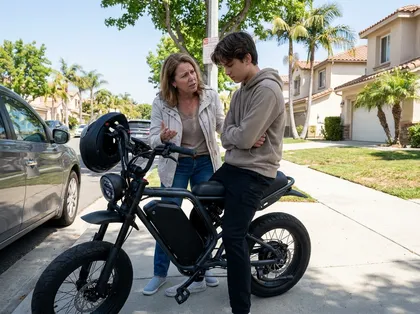
If you were hurt by a minor riding an illegal e-motorcycle or a modified e-bike in Orange County, California, the law may allow you to seek compensation from that child’s parents or guardian. Whether they can be held financially responsible depends on how the crash happened and what they knew, or reasonably should have known, before it occurred.
Responsibility may arise under one or more of the following theories, depending on the facts:
- Willful Misconduct by the Child: A parent or guardian who has custody and control of a minor may be jointly and severally liable for the minor’s willful misconduct under California Civil Code § 1714.1. The current adjusted limit is $56,400 per tort, effective July 1, 2025. For personal injuries, the parent’s imputed liability under this section is further limited to the injured person’s medical, dental, and hospital expenses.
- Negligent Entrustment: A parent may face direct liability if they allowed a child to use a vehicle while knowing, or having reason to know, that the child was not competent or safe to operate it, and that decision contributed to the injury. This is a separate negligence theory and is not subject to the parental liability cap under Civil Code § 1714.1.
- Other Negligence: Depending on the facts, other conduct by a parent, such as purchasing a vehicle the parent knew was illegally modified or encouraging a child to ride it in unsafe conditions, may also support a negligence claim.
Frequently Asked Questions About Orange County’s E-Bike Buyback
The buyback raises practical questions for riders and parents about which vehicles qualify, how the gift cards work, when an e-bike may fall outside California’s legal definition, and when parental liability may apply.
What Vehicles Qualify For The Buyback?
The OCDA says the event accepts e-bikes, e-motorcycles, e-scooters, pocket bikes, and homemade miniature bikes. Both working and non-working vehicles may be surrendered.
How Much Are The Gift Cards?
The buyback offers gift cards, not cash. Amounts range from $200 for pocket bikes and homemade miniature bikes to $1,000 for e-motorcycles. Class 1 e-bikes receive $300, Class 2 receive $400, and Class 3 receive $600.
Is The Buyback Anonymous And No-Questions-Asked?
Yes. The OCDA says vehicles may be surrendered anonymously with no questions asked. Gift cards are limited and available on a first-come, first-served basis.
What Makes An E-Bike Illegal Or Reclassified Under California Law?
A legal e-bike must have fully operable pedals, a motor that does not exceed 750 watts, and meet California’s Class 1, 2, or 3 requirements. A bike that exceeds those limits or is modified beyond them may no longer qualify as an e-bike and may fall under another motor-vehicle classification.
Can Parents Be Liable If A Minor Rides An Illegal Or Modified E-Bike?
Potentially. Parents may face liability if their own conduct contributed to the crash, such as knowingly allowing an unsafe or unqualified child to operate the vehicle. California law may also impose limited liability on parents for a minor’s willful misconduct.
What Should Someone Do If They Are Injured In A Crash Involving One?
Get medical care, photograph the e-bike or e-motorcycle and any visible modifications, preserve available footage and records, identify who owned or controlled the vehicle, and determine which law-enforcement agency responded. Because evidence may disappear or the vehicle may be surrendered, acting promptly can help protect an injury claim.
What To Do If You Are Injured In An Orange County E-bike Accident
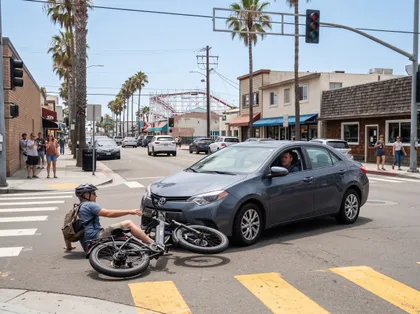
Your health and your evidence are important priorities after an Orange County e-bike or e-motorcycle crash. Surveillance footage, the vehicle itself, and electronic communications may be lost or altered over time, so promptly preserving evidence can help protect your claim.
- Get medical care promptly. Even minor injuries may require treatment, and early medical records can help document your condition.
- Photograph the e-bike or e-motorcycle when it is safe to do so. Capture the e-bike or e-motorcycle, motor, throttle, display, labels, and visible modifications before the vehicle is repaired, altered, or surrendered.
- Identify who owns and controls it. If a minor was riding the e-bike or e-motorcycle, information about who purchased, modified, or permitted its use may be relevant to parental liability.
- Identify the responding law enforcement agency. Depending on the crash location, this may be a city police department, the Orange County Sheriff’s Department, or the California Highway Patrol.
- Contact an attorney before the applicable deadlines expire. California generally allows two years to file a personal injury lawsuit under CCP § 335.1. If a public entity is involved, a qualifying government claim generally must be presented within six months after the claim accrues under Government Code § 911.2. An attorney can determine which deadlines apply to your specific case.
Evidence That Can Disappear After An Orange County E-Bike Crash
The e-bike cases that are hardest to prove are often those where the vehicle or other evidence disappears before it can be documented. With the September 13, 2026, OCDA buyback event approaching and enforcement campaigns signaling that owners can surrender vehicles, some owners may choose to quickly turn in or dispose of an e-bike. That makes early evidence preservation especially important.
| Evidence | Why It Matters | What To Do |
|---|---|---|
| E-bike or e-motorcycle | It shows wattage, modifications, labels, and other classification details. | Photograph and preserve the vehicle; consider having an expert inspect it. |
| Surveillance or dashcam footage | It may show how the crash happened and the vehicle’s movement. | Request preservation promptly before the footage is overwritten |
| Police or CHP report | It records the parties, location, and initial observations. | Request the report from the responding agency. |
| Texts and purchase records | They may show who bought, modified, or permitted the vehicle’s use. | Preserve messages, receipts, and seller records. |
| Medical records | They document injuries and treatment after the crash. | Seek care and keep copies of relevant records. |
| DMV or registration records | They may help establish how the vehicle was registered or classified. | Obtain applicable records through the proper legal process. |
Filing Deadlines That Apply To Orange County E-Bike Injury Claims
The deadline depends on who may be responsible and when the claim accrued.
- Private Parties: You generally have 2 years from the date of injury to file a personal injury lawsuit under CCP § 335.1.
- Public Entities: A personal injury claim generally must be presented within 6 months after accrual under Government Code § 911.2.
- Minors and Public Entity Claims: California’s usual rule that pauses deadlines for minors doesn’t apply to claims against public entities or employees, since those require a separate government claim first. Filing that claim is only the first step.
- If the public entity properly rejects the claim in writing, a lawsuit generally must be filed within six months of the date the notice is delivered or mailed.
- If no proper written notice is given, Government Code § 945.6 generally allows two years from when the claim arose.
In Orange County, government claims may arise if a dangerous condition on a city- or county-owned bike path, trail, or roadway contributed to the crash. Identifying the responsible entity early can help protect your claim. The bicycle accident lawyers at Arash Law can help determine which deadlines apply.
Can A Criminal Case Affect A Civil Injury Claim?
Yes. If the OCDA investigates or files charges involving a rider, parent, or other adult, evidence from that case may also be relevant to a civil injury claim. This can include ownership records, vehicle classification evidence, and statements indicating what someone knew before the crash.
A criminal charge does not automatically establish civil liability, but related evidence may help determine who was responsible. An Orange County bike accident lawyer can review how that evidence may affect a claim.
Was someone in your family injured in an Orange County e-bike crash? Arash Law has recovered over $1 billion for injured clients across California. Call us at (888) 488-1391 for a free, no-obligation consultation with our team.
Talk To Arash Law About Your Orange County E-Bike Injury Claim
California generally gives injury victims two years from the date of injury to file a personal injury lawsuit. If a public entity may be responsible for a dangerous condition of a government-owned bike path or trail, a qualifying government claim generally must be presented within six months after the claim accrues. If you or a family member was hurt in an Orange County e-bike or e-motorcycle crash, acting early can help preserve your rights and give an attorney time to secure evidence before it is lost or changed.
Arash Law has recovered over $1 billion for injured clients across California. Our attorneys handle personal injury cases on a contingency fee basis, which means you pay legal fees only if we recover compensation for you. Ask during your consultation how case costs and expenses are handled.
Call Arash Law at (888) 488-1391 to schedule your free consultation. MAKE ‘EM PAY, CALL AK.
About This Guide
Arash Law prepared this guide using primary government sources, verified California statutes, and official data from the Orange County District Attorney’s Office. The e-bike classification framework is based on California Vehicle Code § 312.5 and current California Highway Patrol guidance. The 430% injury figure is attributed to the Orange County District Attorney’s Office and was not independently calculated from an underlying dataset. The parental liability cap of $56,400 per tort is outlined in the California Judicial Council’s Appendix B, effective July 1, 2025. The legal deadlines discussed in this guide were checked against current California statutory sources.
The buyback event details, including the September 13, 2026 date, Angel Stadium location, and per-class gift card amounts, were confirmed from the OCDA’s August 20, 2026 press release and were also reported by the Orange County Department of Education Newsroom on August 25, 2026. The 430% increase in injuries and the statement that e-bikes and e-motorcycles are the number one reason Orange County children are admitted to the emergency room are attributed to the OCDA’s public representation; no underlying hospital dataset was provided in the press release, and those figures should be treated accordingly. Statistical claims are not presented as independently verified epidemiological data.
Sources
- Orange County District Attorney’s Office — First E-Bike and E-Moto Buyback Event Press Release (August 20, 2026): https://ocdistrictattorney.gov/press/orange-county-district-attorneys-office-to-hold-first-e-bike-and-e-moto-buy-back-event-sunday-september-13-in-countywide-effort-to-reduce-injuries-save-lives-surrender-unwanted-e-bikes-poc/
- California Civil Code § 1714.1 — Parental Liability for Minor’s Willful Misconduct: https://leginfo.legislature.ca.gov/faces/codes_displaySection.xhtml?sectionNum=1714.1&lawCode=CIV
- California Judicial Council Appendix B — Parental Liability Cap Formula (courts.ca.gov): https://courts.ca.gov/system/files?file=rules-court/appendix_b.pdf
- California Code of Civil Procedure § 335.1 — Two-Year Statute of Limitations for Personal Injury: https://leginfo.legislature.ca.gov/faces/codes_displaySection.xhtml?sectionNum=335.1&lawCode=CCP
- California Government Code § 911.2 — Six-Month Government Tort Claim Deadline: https://leginfo.legislature.ca.gov/faces/codes_displaySection.xhtml?sectionNum=911.2.&lawCode=GOV
- Orange County Superior Court — Central Justice Center (address and civil division): https://occourts.org/location/central-justice-center
- Samuelson, Chidike. California Accident News & Traffic Safety Trends Report: 2023–2026. Arash Law, 2026, https://www.arashlaw.com/california-accident-trends-report/.
This page is for general informational purposes only and does not constitute legal advice. Reading this page does not create an attorney-client relationship between you and Arash Law or any of its attorneys. If you have questions about your legal rights, consult a licensed California personal injury attorney.