TL;DR: In California, you generally have 2 years from a motorcycle accident to file a personal injury lawsuit. Property damage claims have a 3-year deadline. If a government entity may be responsible, you generally must file a government claim within 6 months before you can sue. Limited exceptions can extend or shorten these deadlines, but acting promptly is essential.
The deadline to file a motorcycle accident claim can vary depending on the type of claim, when the cause of the claim began, and whether special rules apply.
Under California law, you generally have two years from the date of the motorcycle crash to file a personal injury lawsuit. Claims for damage to personal property are generally subject to a three-year statute of limitations. However, some claims have much shorter deadlines. For example, an accident involving a government agency may require filing an administrative claim within six months. Missing this short deadline may bar you from suing that public entity.
Insurance claims, on the other hand, are separate and should be reported promptly in accordance with the applicable policy terms.
After a serious motorcycle crash, victims often face costly medical bills. Insurance adjusters may also start calling and asking about the incident. On top of that, victims worry about missing deadlines and jeopardizing their potential claim. A motorcycle accident attorney can help you gather relevant evidence and file your claim on time.
Key Facts About Motorcycle Accidents In California
- UC Berkeley SafeTREC reports that in 2023, motorcyclists comprised 14% of all traffic deaths in California, and Los Angeles County ranked first for motorcycle fatalities with 125 deaths.
- The California Department of Insurance states that insurers generally must acknowledge a claim within 15 calendar days, accept or deny it within 40 calendar days after receiving proof of claim, send written updates every 30 days if more time is needed, and pay within 30 calendar days after acceptance and receipt of any required release.
- The California Department of Motor Vehicles (DMV) requires an SR-1 report within 10 days for certain crashes involving injury or property damage exceeding the applicable statutory threshold, and failing to submit it can result in a driver’s license suspension.
- Caltrans accepts qualifying death, personal injury, and personal-property claims of $12,500 or less through its district claims offices, and claims over $12,500 generally must be filed with the State Government Claims Program.
- Government Code § 911.4 allows a late-claim application within a reasonable time, no later than 1 year after the cause of the claim; if denied, Government Code § 946.6 allows a petition for relief in superior court, typically within 6 months of the denial.
- Insurance Code § 11580.2 allows a named insured to reject or reduce UM/UIM coverage in writing, and the article states that since January 1, 2025, California’s standard minimum liability limits have been $30,000 per person, $60,000 per accident, and $15,000 for property damage.
Table of Contents

Insurance Claim Deadlines After A Motorcycle Accident
After a motorcycle accident, check your insurance policy for any specific notice requirements. California doesn’t set a fixed deadline to file an insurance claim after a motorcycle accident. However, the California Department of Insurance advises notifying your insurance agent or company immediately after an accident. A claim against the at-fault driver’s insurer should also go in promptly.
Filing a claim, or continuing to negotiate one, does not pause the two-year statute of limitations for a personal injury lawsuit — that clock keeps running during the insurer’s investigation.
Once a claim is filed, California regulates the insurer’s response time:
- Acknowledgment and Investigation: within 15 calendar days.
- Acceptance or Denial: within 40 calendar days of proof of claim.
- Written Status Updates: every 30 days if more time is needed.
- Payment: within 30 calendar days of acceptance and any required release.
Uninsured motorist and hit-and-run claims carry their own shorter notice and preservation deadlines. To be eligible, you generally must:
- Report the hit-and-run to law enforcement within 24 hours.
- Submit a sworn claim statement to your insurer within 30 days (Insurance Code § 11580.2).
- File a UM claim within 2 years of the accident, via lawsuit, settlement agreement, or arbitration.
Note: Unknown-vehicle hit-and-run claims generally require physical contact with your motorcycle.
Lawsuit Deadlines For California Motorcycle Accidents
California Code of Civil Procedure (CCP) § 335.1 sets a two-year deadline for personal injury and wrongful death claims arising from someone else’s wrongful act or negligence. That two-year window applies to injured victims of motorcycle accidents as well, with the deadline usually starting on the date of the crash.
CCP § 377.60 identifies who may bring a wrongful death action. Eligible parties can include the surviving spouse or domestic partner, children, and other heirs. An attorney can confirm whether a specific family member has standing. For wrongful death claims, the two-year period under CCP § 335.1 runs from the date of the decedent’s death, not the crash date, which matters when a loved one survived the crash for days, weeks, or longer before passing.
Property damage runs on a separate clock. CCP § 338(c) gives you three years to pursue claims for motorcycle repairs, replacement gear, and other damaged property. These timelines are independent. Missing one does not automatically affect the other, though missing either can permanently bar that category of recovery.
Once a deadline expires, the opposing party can raise it as a defense and ask the court to dismiss your case. Courts will typically grant that motion unless a valid tolling or exception argument applies. The defendant must raise the defense, and the court rules on it. The deadline functions as a strict cutoff in most cases, not a procedural technicality, but limited exceptions exist.
The Six-Month Government Claim Deadline
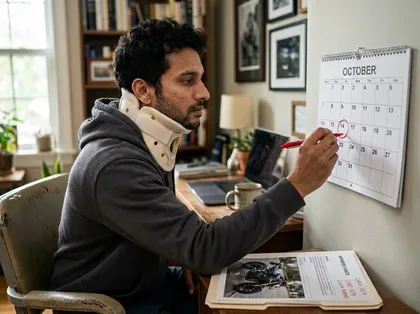
If a government entity shares responsibility for your crash, you must file a written administrative claim within six months under Government Code § 911.2 for personal injury, wrongful death, or damage to your motorcycle and gear. This time limit usually starts at the crash date.
If an agency fails to respond within 45 days, it generally considers the claim rejected. When the agency provides a rejection notice that complies with Government Code § 913, you generally have six months from the date the notice is personally delivered or deposited in the mail to file suit. Without a compliant rejection notice, Government Code § 945.6 allows up to two years from when the claim arises to file the lawsuit.
California has a limited late-claim procedure under Government Code § 911.4, allowing applications for late claims within a reasonable timeframe, no later than one year after the cause of action. Approval is not guaranteed and depends on statutory grounds. If denied, a petition for relief may be filed in superior court under Government Code § 946.6, typically within 6 months of the denial.
This shorter deadline applies across a wide range of situations. Some examples include:
- A crash involving a city bus or county vehicle.
- A collision caused by a government employee on duty.
- A fall caused by a dangerous road condition on a public street.
For motorcycle riders, road-condition hazards are especially significant. A pothole that barely registers to a car driver can send a motorcycle out of control. An unmarked construction zone or a missing sign can eliminate the fraction-of-a-second reaction time a rider has.
Claims must go to the correct office. Local entities require the method authorized by § 915: delivery or mail to the entity’s clerk, secretary, auditor, or governing body, or another method the entity specifically authorizes. Some agencies also route claims through a dedicated risk-management office or online portal, so confirm the correct destination beforehand. For state highway defects, Caltrans district offices handle qualifying claims of $12,500 or less; claims above that go to the State Government Claims Program.
If it’s unclear whether a government entity was involved, photograph the road conditions and obtain witness contact information right away. That evidence may be what identifies the responsible agency before the six-month window closes. A motorcycle accident lawyer can help confirm the right entity and filing deadline.
Exceptions That Can Pause The Statute Of Limitations
California law allows the filing deadline to be tolled (paused) in limited circumstances. Three situations most commonly arise in motorcycle accident cases.
- Minors: For many private personal injury claims, the filing deadline may be tolled while the injured person is a minor. Government-entity claims, medical malpractice claims, and other specialized claims can have different timing rules, so the applicable deadline should be reviewed with an attorney.
- Delayed Discovery: Some injuries are not apparent immediately after a crash. A traumatic brain injury (TBI), for example, may not present symptoms until weeks or months later. Where an injury was not discovered and could not reasonably have been discovered at the time of the crash, the deadline may not begin to run until discovery.
- Severe Incapacity: If the injured person was in a coma or too incapacitated to manage their own affairs at the time of the crash, California law may toll the deadline until that incapacity ends.
Tolling extends the window for filing. It does not preserve evidence, refresh a witness’s memory, or guarantee that the physical record of the crash remains intact. Even when tolling applies, waiting creates real risks to the strength of the case.
Not every exception gives an injured rider more time. If the person you could sue dies before the ordinary statute of limitations expires, California Code of Civil Procedure § 366.2 generally requires the action to be commenced within one year after that person’s death. Claims involving a deceased defendant or their estate can also involve probate procedures, so do not assume the normal two-year motorcycle accident deadline still applies.
An attorney can evaluate which tolling provisions apply to your specific situation and whether a shorter deadline must be followed. They can advise on whether waiting is wiser.
Why Waiting Too Long May Negatively Affect Your Motorcycle Accident Claim
Waiting to act can weaken a motorcycle accident claim, even when the filing deadline is months or years away, because evidence and required reports have their own much shorter windows.
Under California Vehicle Code § 16000, you or your representative must file an SR-1 report with the DMV within 10 days if anyone was injured (no matter how minor) or if the property damage to any vehicle or property exceeds $1,000. Do not rely on the responding police officer to submit this for you; the SR-1 is a separate legal obligation, and failure to file it can result in suspension of your California driver’s license.
Other types of evidence also disappear quickly, such as:
- Skid Marks: Road maintenance crews clear debris and resurface road surfaces within days. Skid marks that could establish speed and point of impact are often gone before a case investigator can reach the scene.
- Dashcam and Helmet Camera Video: This footage exists only if someone preserves the device before it is overwritten or damaged. Without prompt action, it is lost permanently.
- Surveillance Video: Businesses and parking facilities typically delete footage on rolling schedules ranging from a few days to a few weeks. An early preservation demand can hold it; one sent after deletion cannot.
Medical records carry their own urgency for a different reason. A prompt visit to an emergency room, urgent care center, or physician creates a record linking your injuries to the crash. Without it, an insurer may later argue that your injuries have a different cause or preexisted the accident. The collision report prepared by the investigating law enforcement agency, whether the CHP or a local police department, can serve as an important official record of the crash. California law enforcement agencies also submit qualifying collision data to SWITRS.
With multiple deadlines running at once, it may be challenging to remember what you need to do and when you need to do it. Here’s a quick side-by-side reference for the timelines covered above.
| Claim or Requirement | Deadline | Key Detail |
|---|---|---|
| Insurance Claim | As soon as reasonably possible | California does not set one universal reporting deadline for every motorcycle insurance claim. Your policy may contain specific notice requirements. |
| Personal Injury Lawsuit | 2 years | Generally runs from the date of the motorcycle crash under CCP § 335.1. |
| Wrongful Death Lawsuit | 2 years | Generally runs from the date of the decedent’s death, not necessarily the crash date. |
| Property Damage Lawsuit | 3 years | Applies to motorcycle repairs, damaged gear, and other personal property under CCP § 338(c). |
| Government Entity Claim | 6 months | A written administrative claim generally must be presented before suing a public entity under Government Code § 911.2. |
| Lawsuit After Government Claim Rejection | 6 months after the written rejection notice | If no compliant rejection notice is provided, Government Code § 945.6 may allow up to 2 years from when the claim arises to file suit. |
| DMV SR-1 Report | 10 days | Required for certain crashes involving injury or property damage above the applicable statutory threshold. |
| Hit-and-Run UM Claim | 24 hours / 30 days | Report the accident to law enforcement within 24 hours and submit a sworn claim statement to the insurer within 30 days. |
These deadlines run independently. Missing one doesn’t extend another, and none of them pause just because a claim is still under review.
Call Arash Law at (888) 488-1391 today for a free case evaluation. Our legal team will review your claim, identify your deadlines, and discuss your options.
What Arash Law Has Recovered For Injured Clients
Arash Law’s motorcycle accident case results demonstrate how careful investigation and case development can affect claims involving disputed fault, construction hazards, commercial vehicles, and policy-limit recoveries.
$1,450,000 — Motorcycle v Construction Contractor: Our client suffered fractured ribs and head trauma after hitting uneven pavement in a construction zone. The contractors and city denied liability, but the case concluded after the first day of trial, with the other side providing adequate compensation to settle the claim.
These results are specific to the circumstances of each case and should not be treated as an average settlement for a motorcycle accident in California.
Published case results provide useful context for how liability disputes, insurance limitations, and the severity of injuries may influence the outcome of a motorcycle accident claim. Still, they do not predict the value of any individual case. Each result depends on the specific facts, available evidence, applicable law, and circumstances involved.
Frequently Asked Questions About Motorcycle Accident Deadlines In California
California motorcycle accident claims involve more than a single filing deadline. Questions about comparative fault, uninsured drivers, lane splitting, government entities, insurance requirements, and missed deadlines can all affect how and when a claim must be pursued. The answers below address common timing and procedural questions injured riders may face and explain how California law can affect their ability to seek compensation.
Can I File A Claim Even If I Was Partially At Fault?
Yes, California law allows injured riders to pursue compensation even when they share some responsibility for the crash. The state follows a pure comparative negligence rule under Civil Code § 1714. Your percentage of fault reduces your recoverable damages, but you are not barred from recovering entirely.
If you are found 20% at fault for the crash, you may be able to recover up to 80% of your total compensable losses, including medical expenses, lost income, and pain and suffering.
What If The Other Driver Was Uninsured?
You can generally still recover compensation through your own UM/UIM coverage if the at-fault driver is uninsured or underinsured. California generally requires qualifying auto liability policies to include or offer UM/UIM coverage. Still, the named insured may reject or reduce that coverage in writing as permitted by Insurance Code § 11580.2. Since January 1, 2025, California’s standard minimum liability limits have been $30,000 per person, $60,000 per accident, and $15,000 for property damage.
UM claims in California are subject to statutory preservation deadlines. For hit-and-run incidents, California Insurance Code § 11580.2 mandates that the accident be reported to law enforcement within 24 hours and that a sworn claim statement be submitted to the insurer within 30 days. Additionally, a physical-contact requirement exists for unknown-vehicle claims. Generally, a UM claim must be initiated within 2 years of the accident by filing suit against the uninsured motorist, agreeing with the insurer on the amount due, or initiating arbitration.
How Long Does It Take To Resolve A Motorcycle Accident Case In California?
The time required to resolve a California motorcycle accident case varies significantly. Cases where liability is clear and medical evidence is well-documented may be resolved sooner. In contrast, cases involving serious injuries, disputed comparative fault, multiple parties, government entities, or litigation may take considerably longer.
One factor that affects both timeline and outcome: settling before you reach maximum medical improvement (the point at which your treating physicians expect no further recovery) risks locking in a number lower than your injuries ultimately warrant.
What Happens If I Miss The Two-Year Deadline?
Missing the two-year deadline under CCP § 335.1 can permanently bar your right to recover compensation. See the General Deadlines and Tolling sections above for when exceptions apply, and consult an attorney before assuming one applies to you.
Can I Still File A Claim If I Was Lane Splitting?
Yes. California expressly permits motorcycle lane splitting. Vehicle Code § 21658.1 defines lane splitting and authorizes CHP to develop safety guidelines concerning the practice. Riding in a lawful lane-splitting manner does not make you at fault by default.
If another driver caused the crash while you were splitting lanes safely, you may still be able to recover compensation. If you were riding at an unsafe speed or in an unsafe manner, some portion of fault may be assigned to you under California’s comparative fault rules — reducing, but not eliminating, what you can recover.
Can Social Media Posts Affect My Motorcycle Injury Claim?
Yes. Insurance adjusters and defense investigators routinely search claimants’ social media accounts for posts that contradict reported injuries. Making an account private does not reliably shield its contents. California courts have recognized that social media content can be discoverable, meaning opposing counsel may be able to demand access to posts, including those set to private or subsequently deleted. A photograph showing physical activity, travel, or a social gathering can be used to argue that injuries are less serious than claimed. Attorneys advise clients to avoid posting about the crash, their physical condition, or their activities while a claim is open.
Do Lawyers Only Get Paid If They Win?
Yes. Most personal injury lawyers handle motorcycle accident cases on a contingency-fee basis. The attorney’s fee is a percentage of what is recovered, and if nothing is recovered, you owe no attorney fees. Depending on the specific agreement, clients may still be responsible for certain advanced case costs and litigation expenses. However, many firms advance these costs and recoup them only upon successful recovery.
Can I File An Insurance Claim One Month After A Motorcycle Accident?
Yes, you may still be able to file an insurance claim one month after a motorcycle accident. California’s Department of Insurance advises drivers to notify their insurance company immediately after an accident, and your policy may contain specific notice requirements or other time limits that affect your claim. A delay in reporting does not necessarily mean the claim is automatically barred, but waiting can create coverage issues or make it harder for the insurer to investigate the accident.
You should report the crash as soon as possible and review your policy for any applicable deadlines. Keep in mind that an insurance claim is separate from a lawsuit; in California, most personal injury lawsuits generally must be filed within two years of the injury.
Protect Your Rights After A California Motorcycle Crash
California’s motorcycle accident deadlines do not pause while you recover, while an adjuster reviews your file, or while you decide what to do next. Evidence fades within hours. If a public entity may be liable, you have a shorter deadline. Even the two-year window for lawsuits against private entities may run fast when you try to build a strong claim.
You don’t have to handle all of it alone. Arash Law has recovered over $1 billion for injured clients across California, including major recoveries against government entities and private defendants. Our attorneys can handle your motorcycle accident claim — no matter how challenging.
Call Arash Law at (888) 488-1391 today for a free case evaluation. Our team will review your claim, identify every applicable deadline, and tell you exactly what your next step should be.
Arash Law: Make ‘Em Pay, Call AK.
Sources
California Office of Traffic Safety (OTS). California Traffic Safety Quick Stats — 2023 Scorecard. California traffic fatalities decreased nearly 11% from 4,539 in 2022 to 4,061 in 2023; the 2023 Mileage Death Rate was 1.26 per 100 million miles traveled. ots.ca.gov
UC Berkeley SafeTREC. 2025 SafeTREC Traffic Safety Facts: Motorcycle Safety. Motorcyclists comprised 14% of all traffic deaths in California, with Los Angeles County recording the highest total. safetrec.berkeley.edu
California Legislature. California Code of Civil Procedure § 335.1 — Two-Year Statute of Limitations for Personal Injury and Wrongful Death. leginfo.legislature.ca.gov
California Legislature. California Code of Civil Procedure § 338(c) — Three-Year Deadline for Property Damage Claims. leginfo.legislature.ca.gov
California Legislature. California Code of Civil Procedure § 377.60 — Who May Bring a Wrongful Death Action. leginfo.legislature.ca.gov
California Legislature. Government Code § 911.2 — Six-Month Government Claim Deadline. leginfo.legislature.ca.gov
California Department of General Services / Office of Risk and Insurance Management (DGS/ORIM). File a Government Claim. Claims against state entities filed here; highway pothole claims routed to Caltrans at dot.ca.gov. dgs.ca.gov
California Courts — Judicial Branch Self-Help Center. Deadlines to Sue Someone (Statutes of Limitations). Confirms that filing an insurance claim does not toll the civil lawsuit deadline; minor tolling guidance. selfhelp.courts.ca.gov
Disclaimer
The information on this page is for general educational purposes and does not constitute legal advice. No attorney-client relationship is formed by reading or relying on this content. If you were injured, consult a licensed California personal injury attorney about your specific situation.