TL;DR: If a car causes your semi-truck to roll over, the at-fault driver may be responsible for your damaged truck and cargo, towing costs, and injuries. The driver’s insurance usually pays for these losses up to the applicable policy limits. Your commercial insurance may cover additional losses. If you were working when the crash occurred, workers’ comp may also cover medical treatment and disability benefits.
The at-fault driver (and their liability insurer) is usually responsible for losses caused by the rollover, including damage to your semi-truck and cargo, towing and recovery costs, and bodily injuries. California’s minimum auto liability limits are $30,000 for injury or death to one person, $60,000 for injury or death to multiple people, and $15,000 for property damage per accident. Those minimum limits may be far below the cost of a serious semi-truck rollover.
Depending on the available policies, your commercial truck, motor truck cargo, collision, or other insurance may cover additional losses, subject to policy terms, limits, deductibles, and exclusions.
For your injuries, the at-fault driver’s bodily injury coverage may compensate you for medical expenses, lost income, pain and suffering, and other covered damages. If you were working when the crash occurred, workers’ compensation may also provide medical and disability benefits regardless of who caused the collision.
Identifying every potentially responsible party and all available insurance policies can be important when losses exceed a single driver’s coverage limits. Preserving evidence of the truck damage, cargo loss, towing expenses, and injuries can also support the value of each claim.
Key Facts About Semi-Truck Rollover Claims in California
- California has an updated minimum limit for auto liability insurance. Effective January 1, 2025, California’s minimum auto liability limits are $30,000 per person and $60,000 per accident for bodily injury or death and $15,000 for property damage.
- Filing deadlines vary depending on the type of claim. You have two years to file claims for personal injury and wrongful death (Code of Civil Procedure §335.1). Property damage claims have a three-year limit.
- Truck drivers injured on the job may have two simultaneous recovery tracks. Injured truck drivers during work hours may claim both the at-fault driver’s bodily injury liability insurance and workers’ compensation benefits.
- Engine Control Module (ECM) and dashcam data can be lost or overwritten after a crash. Evidence-preservation steps should begin as soon as possible because evidence can be lost quickly after a crash.
- Claims against Caltrans generally require a government claim within six months. If the rollover was caused by a road defect on a Caltrans-maintained highway, you generally must file a separate government claim within six months (Gov. Code §911.2).
- National large-truck crash data in 2023 show a high death risk. According to the National Highway Traffic Safety Administration (NHTSA) Traffic Safety Facts (DOT HS 813717), 70% of people killed in large-truck crashes in 2023 were occupants of other vehicles.
Table of Contents

How Liability Works When a Car Forces Your Truck Off the Road
Semi-truck rollovers can occur on major California freight routes such as I-5, I-10, I-15, I-80, and SR-99, where heavy commercial traffic, merging vehicles, grades, and sudden lane changes can create serious rollover risks. A driver can be held responsible if their careless move causes a semi-truck to roll over. Your claim may include damage to the truck and cargo, towing costs, and any injuries.
Such liabilities can apply even if their vehicle never made physical contact with yours. These are sometimes called no-contact or phantom vehicle accidents.
A no-contact crash can support a negligence claim. You just need to show that the other driver’s actions caused you to swerve and roll over. A sudden lane change on the highway, a quick brake check, or drifting over the lane line can cause a chain reaction. This might end with a loaded semi-truck tipping over.
Keep in mind that California follows a pure comparative fault rule. If the insurer determines or contends that you share some responsibility, for example, by claiming you were speeding due to conditions or overcorrected when the car cut you off, your recovery can be reduced by your percentage of fault. You can still recover even if you are found partly at fault.
Aside from the at-fault driver, the following parties may also be liable for semi-truck accidents:
-
Vehicle Owners: California Vehicle Code §17150 states that vehicle owners may be held liable for death or injuries caused by another person they permitted to use their vehicle. This provision applies if the driver didn’t own the car that hit your truck but has permission from the owner.
However, an owner’s liability based solely on permissive use under § 17150 is generally capped by Vehicle Code § 17151 at $15,000 for injury or death to one person, $30,000 for injury or death to multiple people, and $5,000 for property damage. These statutory caps differ from California’s current minimum auto insurance limits. The caps may not apply when the owner has an independent basis for liability, such as negligent entrustment.
- Caltrans: If a road defect forced a car to swerve or change lanes and contributed to a semi-truck rollover on a Caltrans-maintained highway, you may have a claim against the state. Claims of $12,500 or less for death, personal injury, or personal-property damage may be filed directly with Caltrans using their damage claim form. Claims over $12,500 generally must be filed through California’s Government Claims Program.
- Other Government Entities: If an on-duty public employee was driving the car that forced your semi-truck to roll over, a claim against the responsible public entity may be possible. Claims involving California state agencies or state employees generally go through the state’s Government Claims Program. In contrast, claims involving a city, county, or other local public entity must generally be presented to that local entity.
Who Pays for Your Truck, Cargo, Towing, and Downtime?
If another driver causes your semi-truck to roll over, you may seek payment from the at-fault driver, your own commercial insurance, or both, depending on the type of loss and the available coverage. California’s minimum property damage liability limit for a standard auto policy is $15,000 per accident. That amount may be far below the cost of a serious commercial truck rollover.
Potential recoverable losses include:
- Truck Repair or Replacement: The at-fault driver’s property damage liability coverage may pay for damage to your truck. Your commercial physical-damage coverage may also pay for repairs or a total loss, subject to the policy’s valuation terms, limits, deductibles, and exclusions.
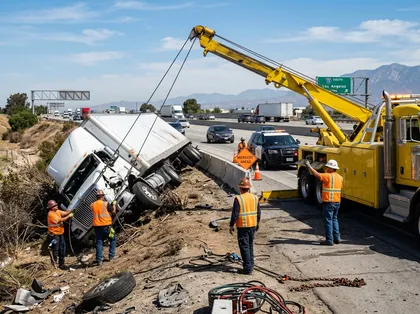
- Heavy-Duty Towing and Storage: The property damage claim may include reasonable towing, recovery, and storage costs incurred as a result of the crash. Applicable commercial coverage may also pay these expenses.
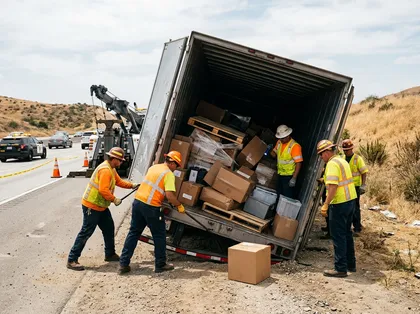
- Damaged or Lost Cargo: The responsible party may be liable for cargo damage caused by the crash. Motor truck cargo or other applicable insurance may also cover the loss, depending on the shipment and policy terms. Bills of lading, invoices, manifests, and similar records can help establish the cargo and its value.
- Commercial Downtime: The truck owner may recover loss-of-use damages or proven lost profits when the truck cannot operate as a result of the crash. These losses generally require documentation that shows the duration and financial impact of the downtime.
What If the Cargo Belongs to Someone Else?
For qualifying interstate shipments, the federal Carmack Amendment generally makes the motor carrier liable to the person entitled to recover for cargo loss or damage occurring during covered transportation, even when a third party caused the crash.
A carrier or cargo insurer that pays the loss may have separate recovery rights against the responsible third party. Carriers generally must allow at least nine months to submit a written cargo claim. Different rules may apply to intrastate shipments governed by California law.
What If Your Commercial Insurer Pays First?
When your insurer pays a covered loss, it may obtain subrogation rights, allowing it to seek reimbursement from the responsible party or insurer. Under California’s made-whole doctrine, an insurer generally cannot enforce subrogation rights against its insured until the insured has been fully compensated. However, sufficiently clear policy language can alter that default rule, so the actual policy terms matter.
Semi-truck accident lawyers can review the available policies and determine which coverage and reimbursement rules may apply.
Who Pays for Your Injuries and Lost Income?
If another driver causes a rollover while you are working, you may have two separate recovery paths: a third-party bodily injury claim against the at-fault driver and a workers’ compensation claim through your employer.
The At-Fault Driver’s Bodily Injury Liability Insurance
The at-fault driver’s bodily injury liability coverage may compensate you for losses such as:
- Medical expenses
- Lost income and reduced earning capacity
- Pain and suffering
- Other recoverable injury-related damages
California’s minimum bodily injury liability limits for standard auto policies are $30,000 per injured person and $60,000 when multiple people are injured in one accident. These limits indicate how much coverage a minimum-limit policy provides, but they do not guarantee payment of the full amount in each incident.
California Workers’ Compensation
If the rollover occurred in the course of your employment, workers’ compensation may provide benefits without requiring you to prove that your employer caused the crash.
An approved workers’ compensation claim may provide:
- Reasonable and necessary medical treatment
- Temporary disability benefits that replace part of your lost wages
- Other benefits available under the California workers’ compensation law
You should report the injury to your employer as soon as possible. California generally requires written notice within 30 days under Labor Code § 5400.
A separate statute of limitations also applies to workers’ compensation claims. Labor Code § 5405 generally requires that proceedings be commenced within one year, subject to statutory exceptions.
How the Two Claims Work Together
A third-party injury claim and a workers’ compensation claim can proceed simultaneously, but they provide different forms of compensation. Workers’ compensation generally does not pay damages for pain and suffering. A third-party negligence claim may include those damages, along with other recoverable losses.
If the workers’ compensation insurer pays benefits and you later recover from the at-fault driver, the employer or insurer may have statutory reimbursement or credit rights against the third-party recovery.
The amount ultimately available to the injured driver can therefore depend on the third-party recovery, workers’ compensation benefits already paid, and any enforceable reimbursement rights.
What Evidence Proves the Car Driver Caused Your Rollover?
ECM data, dashcam footage, and Electronic Logging Device (ELD) records are time-sensitive evidence in a semi-truck rollover claim and must be preserved promptly. To establish the car driver’s liability, you must show they acted negligently, meaning they failed to use reasonable care, and that their failure caused your rollover and your losses. Both elements depend on time-sensitive evidence.
The Critical Records and Who Holds Them
- ECM/Black Box Data: Depending on the truck and its electronic systems, stored data may include information about speed, braking, throttle use, or other vehicle activity around the time of the rollover. What is recorded and how long it remains available varies by vehicle and system, so the data should be preserved promptly.
- Dashcam Footage: Cameras on the truck cab, both forward- and rear-facing, record what the car did right before the crash. Most dashcam systems loop and overwrite footage rapidly. This footage is among the first pieces of evidence to disappear if no hold is placed on it.
- Electronic Logging Device (ELD) Records: Motor carriers generally must retain ELD records of duty status and supporting documents for six months under 49 CFR § 395.8(k)(1). These records can document your hours of service before the crash and may become relevant if fatigue or compliance is disputed. Other motor-carrier records can have different retention periods.
- California Highway Patrol (CHP) Traffic Collision Report: If CHP investigated the crash, its report may include the officer’s narrative, vehicle and driver details, diagrams, and witness info. A proper party of interest, including an involved driver, passenger, property or vehicle owner, legal representative, or qualifying insurer, may request a copy through CHP’s crash-report process.
- Witness Statements and 911 Recordings: Statements from bystanders who witnessed the car’s movement and the 911 call audio constitute strong evidence. They capture what witnesses reported in real time. Retention periods for 911 recordings vary by agency, so relevant recordings should be requested and preserved as soon as possible.
- Bill of Lading, Cargo Manifest, and Freight Invoices: These documents establish the value of the cargo you were hauling. They are required to be retained by the motor carrier under 49 CFR Part 379, the federal motor carrier records-retention regulation. The bills of lading and freight bills must generally be retained for at least one year under Part 379 Appendix A, though other record categories have different retention periods.
Why a Spoliation Letter Must Go Out Immediately
A spoliation letter is a formal letter demanding the preservation of evidence. This preservation letter can put the motor carrier, insurer, or other evidence holder on notice that they must preserve relevant evidence. Whether a legal duty to preserve exists depends on the circumstances, including whether litigation is pending or reasonably foreseeable and whether the recipient possesses or controls the evidence.
If relevant evidence is destroyed or altered after a duty to preserve it arises, the responsible party may face discovery sanctions or other evidentiary consequences. In some cases, a court may allow the jury to infer that intentionally destroyed or concealed evidence would have been unfavorable to that party.
Knowing what to do after a truck accident in the first 24 to 48 hours, including contacting an attorney who can issue a spoliation hold immediately, is often the difference between a fully supported claim and one built on incomplete records.
Until When Can You File A Claim?
In California, you generally have three years to sue for property damage to your truck, cargo, and other personal property, and two years to sue for personal injuries under Code of Civil Procedure §§ 338(c)(1) and 335.1. Crash-related towing and storage costs are typically pursued as part of the property damage claim.
Different deadlines may apply depending on who is responsible and the type of claim. If a dangerous condition on a government-maintained road contributed to the rollover, a claim for personal injury or property damage generally must be presented to the responsible public entity within six months after the claim accrues (usually from the injury date) under Government Code § 911.2.
Insurance policies, cargo claims, contractual claims, and workers’ compensation claims can have separate notice requirements or deadlines. Moreover, gathering evidence early on may also be essential to your claim. A cargo truck accident lawyer can identify the applicable deadlines to your case and work to meet them.
What Arash Law Has Recovered in Commercial Vehicle and Injury Cases
Arash Law has recovered over $1 billion for clients across California. We’ve handled cases involving truck crashes, rollover injuries, work-related vehicle accidents, and overlapping personal injury and workers’ compensation claims, all of which a semi-truck rollover may involve.
$5,500,000 — Rollover Trucking Accident: The client suffered a spinal cord injury and mild traumatic brain injury in a rollover trucking accident while working within the scope of employment. Arash Law secured a $5.5 million settlement.
$8,800,000 — Commercial Vehicle At Fault: A speeding company van driver caused the client’s severe injuries. Multiple key depositions shifted the trajectory of the case.
Past results do not guarantee future outcomes. Every case is different, and results depend on the specific facts and evidence involved.
Frequently Asked Questions About Semi-Truck Rollover Claims in California
Does My Status as an Owner-Operator Affect My Workers’ Compensation?
Yes. Your status as an employee or independent contractor can determine whether you qualify for workers’ compensation benefits. California generally uses the ABC test for this classification, although certain exceptions may require the Borello multifactor test instead.
Simply calling yourself an “owner-operator,” signing an independent-contractor agreement, or receiving a Form 1099 does not determine your status. California looks at the actual working relationship. If you are legally classified as an employee, you may qualify for workers’ compensation benefits for a work-related injury.
Does Uninsured Motorist Coverage Apply If the Car Never Touched My Truck?
If the driver is unknown, coverage usually does not apply. California’s statutory hit-and-run uninsured motorist coverage generally requires physical contact between the unknown vehicle and the insured or the vehicle the insured occupies.
If the driver is identified but uninsured, the lack of physical contact does not necessarily bar a UM claim. If the identified driver has insufficient insurance, underinsured motorist coverage may apply, subject to California law and your policy. An attorney can review your specific policy and situation.
How Are Legal Fees Handled in a Truck Accident Case?
Many personal injury lawyers handle truck accident claims on a contingency-fee basis. This generally means the attorney’s fee is paid from a recovery rather than being charged up front. California Business and Professions Code §6147 requires contingency-fee agreements to be in writing and to explain how fees and costs will be handled.
Can I Recover Lost Income While My Semi-Truck Is Being Repaired?
Yes. You may be able to recover lost income or loss-of-use damages for the period your truck is reasonably out of service. Load histories, invoices, contracts, tax records, and other business records can help document the amount of the loss.
Talk to Arash Law About Your California Truck Rollover Claim
If another driver forced your semi-truck to roll over, the claim may involve much more than damage to the truck. You may need to address cargo losses, towing and storage charges, lost income, injuries, and workers’ compensation.
Arash Law represents people injured in motor vehicle crashes throughout California. Our team can review what happened, identify potential insurance options, and explain the options available.
Call (888) 488-1391 for a free case evaluation. There is no upfront cost to speak with our team. If you would prefer to discuss your case in a language other than English, let us know when you contact us.
Arash Law. Make ‘Em Pay, Call AK.
Sources
- California Department of Motor Vehicles, Insurance Requirements, SB 1107 minimum limits effective January 1, 2025: https://www.dmv.ca.gov/portal/vehicle-registration/insurance-requirements/
- California Legislative Information: Senate Bill 1107 (SB 1107), minimum liability insurance limits effective January 1, 2025: https://leginfo.legislature.ca.gov/faces/billNavClient.xhtml?bill_id=202120220SB1107
- NHTSA Traffic Safety Facts 2023 Data: Large Trucks (DOT HS 813717, April 2025): https://crashstats.nhtsa.dot.gov/Api/Public/ViewPublication/813717
- California Office of Traffic Safety, Data and Statistics, SWITRS / TIMS access portal: https://www.ots.ca.gov/media-and-research/data-and-statistics/
- UC Berkeley Transportation Injury Mapping System (TIMS): SWITRS Summary Tool: https://tims.berkeley.edu/
- California Department of General Services, Office of Risk and Insurance Management: File a Government Claim (DGS/ORIM Government Claims Program): https://www.dgs.ca.gov/ORIM/File-a-Claim
- California Legislative Information: California Code of Civil Procedure §335.1: https://leginfo.legislature.ca.gov/faces/codes_displaySection.xhtml?sectionNum=335.1&lawCode=CCP
- Government Code §911.2: https://leginfo.legislature.ca.gov/faces/codes_displaySection.xhtml?sectionNum=911.2.&lawCode=GOV
- Labor Code §3600: https://leginfo.legislature.ca.gov/faces/codes_displayText.xhtml?lawCode=LAB&division=4.&title&part=1.&chapter=3.&article
- Federal Motor Carrier Safety Administration (FMCSA): Hours-of-Service regulations and ELD requirements, 49 CFR Parts 385, 390, 395: https://www.fmcsa.dot.gov/regulations/hours-of-service
Disclaimer
The information on this page is for general educational purposes only and does not represent legal advice. Reading or relying on this content does not create an attorney-client relationship. If you were injured, consult a licensed California personal injury attorney about your specific situation.